Every time a “boat rental” inquiry hits your inbox for a crewed 100-foot motor yacht, you are losing money on administrative friction. Most digital agencies will tell you that traffic is the goal, but they don’t understand the difference between a day-tripper looking for a $500 pontoon and a high-net-worth individual seeking a $50,000 weekly charter. In 2026, the global yacht charter market is projected to reach up to $22.1 billion, yet many operators still hand over 20% or more in commissions to third-party platforms just to keep their calendars full. Relying on these middle-men is a choice to accept lower margins and zero brand control. Effective marketing for yacht charter business owners isn’t about getting more eyes; it is about filtering for the right intent before the lead ever reaches your desk.
You likely already know that a single qualified inquiry is worth more than a thousand generic clicks. We are going to show you how to move beyond vanity metrics and capture high-intent demand using a precision-driven system that bypasses high-fee platforms.
This guide breaks down why traditional marine marketing fails and how to build a direct booking engine that stabilizes your revenue.
Key Takeaways
- Stop chasing generic traffic and start using the Marine Demand Control System to capture buyers ready to book.
- Reclaim your profit margins by reducing reliance on high-commission third-party platforms and securing direct bookings.
- Use Demand Filtering to protect your crew’s schedule from low-margin inquiries that don’t fit your crewed model.
- Refine your marketing for yacht charter business by targeting high-intent search terms in hubs like Miami or Palma.
- Gain total oversight of your revenue by shifting from a reactive booking style to a predictable, system-driven operation.
Why Your Yacht Charter Marketing Strategy is Failing (and How to Fix It)
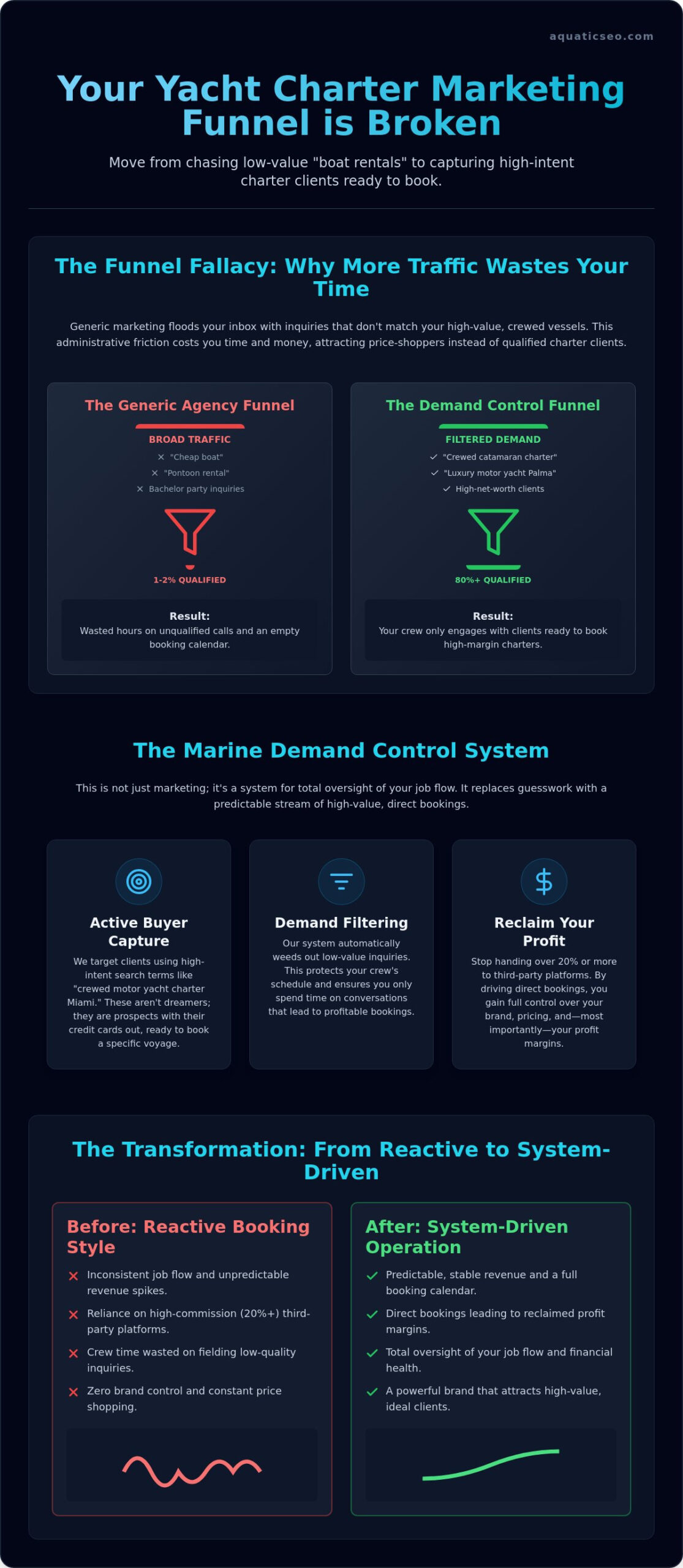
You wake up to three new inquiries. One wants a pontoon for a bachelor party. Another asks for a “cheap boat” for four hours. The third never replies after seeing your catering menu. This cycle of inconsistent job flow and price-shopping leads is the result of a broken funnel. You are likely paying for “visibility” that attracts the wrong crowd. Marketing for yacht charter business operators should never be about volume. It must be a precision system designed to capture high-intent buyers who value a crewed experience over a simple hull for hire.
Most digital agencies treat your operation like a commodity. They bid on keywords like “boat rental,” which brings in people looking for $500 day-trips. This destroys your profit margins. You end up spending hours on the phone with prospects who can’t afford your fuel bill. A true yacht chartering industry overview reveals that the luxury segment requires a specialized approach. You need Active Buyer Capture, not passive “brand awareness” campaigns that generate clicks but zero ROI.
The Distinction Between Yacht Charters and Boat Rentals
A yacht charter involves a crewed experience, not just a hull for hire. Renters want a boat to drive themselves; charterers want a private voyage with professional service. If your site attracts bareboat “renters,” you face operational headaches and low-margin inquiries that waste your time. You can view our specialized marketing for yacht charters to see how we separate these two distinct audiences. Attracting the wrong intent is an expensive mistake that keeps your crew busy with the wrong tasks.
Why Generic Agencies Burn Your Marketing Budget
Generic agencies live for “vanity metrics” like clicks and impressions. They’ll show you a graph of increasing traffic while your booking calendar stays empty. These providers fail to understand marine-specific search intent because they don’t know the difference between a marina and a service yard. They apply the same tactics to your $50,000 charter that they use for a local plumbing company. You need an industry-native partner who prioritizes qualified inquiries over generic volume to ensure your marketing spend produces a tangible return.
Active Buyer Capture focuses on people searching for specific solutions, such as “crewed catamaran charter Bahamas” or “luxury motor yacht rental Palma.” These are prospects with their credit cards out. Brand awareness campaigns often target people who are just browsing or dreaming. While those users might “like” your photos on social media, they won’t pay your dockage fees. Marketing for yacht charter business success requires shifting your budget away from “likes” and toward high-intent search terms that fill your schedule with qualified guests.
Implementing the Marine Demand Control System for Charters
Stability in the yachting industry doesn’t come from luck or seasonal trends. It comes from the Marine Demand Control System. This framework is the central pillar we use to help you move away from reactive booking and toward total oversight of your job flow. Marketing for yacht charter business owners often feels like a gamble because they lack a methodical approach to financial health. We replace that uncertainty with a system that filters for high-intent prospects who are ready to commit to a private voyage today.
We focus on controlling demand for your specific vessel types rather than just increasing generic traffic. If you operate a fleet of luxury catamarans, you don’t need 10,000 visitors looking for a day-sail. You need fifty people looking for exactly what you offer. Our framework provides the precision required to ensure every dollar you spend on SEO for the marine industry translates into a predictable stream of inquiries.
Capturing High-Intent Buyers
A Qualified Inquiry begins with the specific search phrase a buyer uses. Someone searching for a “cheap boat” is a liability to your time. Conversely, a prospect searching for a “crewed catamaran charter BVI” has already decided on their destination, vessel type, and service level. We position your brand exactly where these high-value clients are already looking for a solution. You can learn more about this approach through our Marine Marketing Education resources; they explain how to attract clients who value expertise over price.
Moving Beyond Vanity Metrics
We reject the industry standard of reporting “engagement” or “impressions.” For a charter booking valued at $10,000 or more, a Qualified Inquiry is a prospect who has been filtered for budget, group size, and date availability. Our system prioritizes auditable revenue tracking over superficial digital noise. During the Demand Visibility phase, we show you exactly where your bookings originate so you can make data-driven decisions about your fleet’s growth. If you want to stop guessing and start measuring, you can book a fit call to see how this system applies to your specific operation.
Filtering Demand: Stop Wasting Time on Low-Margin Inquiries
“I get plenty of calls, but they’re all the wrong people.” This is the most common complaint from charter operators who’ve been burned by generic agencies. If your phone rings with people asking for hourly “boat rentals” or searching for “last-minute deals,” your current strategy is failing to filter. Demand Filtering is the process of using your digital presence to protect your time and your crew’s schedule by discouraging unqualified traffic before they ever find your contact form.
Effective marketing for yacht charter business owners requires intentional friction. You must use your landing page messaging to state exactly what you are not. For example, our Yacht Charter Services Page demonstrates how targeted positioning speaks directly to high-value clients while signaling to price-shoppers that they’re in the wrong place. This isn’t about being rude; it’s about operational efficiency.
The Cost of Unqualified Leads
Every “how much” call that doesn’t convert is a direct drain on your profits. If your office spends thirty minutes explaining why you don’t offer bareboat rentals to someone with a $500 budget, you’ve lost money. Your job mix is far more critical than your total inquiry volume. A Demand Filtering System acts as a digital gatekeeper, ensuring only those who understand and can afford the value of a crewed experience reach your inbox.
Positioning for High-Value Clients
Attracting the top 1% of the market requires specific luxury triggers that go beyond generic adjectives. You must focus on technical vessel details, crew pedigree, and exclusive itineraries that a casual boater wouldn’t appreciate. Social proof and high-resolution imagery of specific yacht amenities help justify premium pricing before the first conversation starts. When you present your service as a premium partnership rather than a commodity, you stop competing on price and start competing on experience.
Precision in your digital messaging ensures that your marketing for yacht charter business efforts don’t just generate noise. By highlighting specific requirements, such as minimum charter lengths or all-inclusive APA structures, you automatically filter out low-intent prospects. This allows you to focus your energy on the qualified inquiries that actually move the needle for your annual revenue.
SEO for Yacht Charters: Winning High-Intent Search Terms
Most charter operators are visible for the wrong things. Ranking on the first page for “how to anchor a boat” might bring traffic, but it won’t fill your booking calendar. This is the difference between informational intent and transactional intent. High-level marketing for yacht charter business owners requires a ruthless focus on search terms that signal a buyer is ready to sign a contract. If your SEO strategy doesn’t distinguish between a researcher and a high-net-worth traveler, you are wasting your budget on vanity clicks.
We prioritize Demand Visibility to bridge the gap between keyword rankings and actual bank deposits. You need to see the direct path from a search term to a signed charter agreement. This level of oversight ensures that your financial health is driven by precision, not by generic engagement counts. Winning in 2026 requires dominating the specific commercial hubs where your fleet operates, such as Miami, Palma, or the Greek Isles.
High-Intent Keyword Examples for 2026
- Private crewed yacht charter Miami: Targets a specific location and service level.
- Luxury catamaran vacations Bahamas: Filters for vessel type and premium experience.
- Crewed motor yacht charter Mediterranean: Signals high-value transactional intent.
These terms beat “boat rental near me” every single time because they exclude the low-margin day-trippers who clog up your inbox. We use SEO for the marine industry to build authority in these niche sectors. By optimizing for specific vessel classes and crewed services, you attract prospects who have already moved past the “price-shopping” phase of their journey.
Winning the Local Search Map
Local SEO is non-negotiable for charters operating out of specific marinas or departure points. However, you must optimize for “near me” searches without attracting low-value traffic. This is achieved by creating localized content that focuses on premium departure points, such as Port Hercules or Miami Beach Marina. When your digital presence is tied to these high-value locations, you capture buyers who are physically ready to board.
Localized content should highlight specific itineraries and local regulations that only an industry-native would know. You can find more advanced tactics in our guide on Digital Marketing for Marine Contractors, which covers cross-sector SEO principles. If you are ready to stop chasing clicks and start capturing qualified inquiries, book a fit call with our team today.
Controlling Your Job Flow and Scaling Your Charter Operation
Scaling a yacht charter operation shouldn’t feel like a game of chance. If you spend your off-season hoping the phone rings or waiting for an Online Travel Agency (OTA) to send you a scrap of business, you aren’t running an operation; you’re managing a liability. Real growth requires a fundamental shift from being a victim of market fluctuations to having total demand control. Effective marketing for yacht charter business owners is about building an asset that you own, not renting visibility from platforms that take a massive cut of your hard-earned revenue. Stability is a choice made through a methodical system.
Revenue stability in the yachting sector is not a product of luck or a “good season.” It is the result of a methodical system that captures high-intent demand and filters out the noise. When you move away from vanity metrics and OTA reliance, you gain total oversight of your financial health. This is how you scale from a single vessel to a dominant fleet operation. Once you stabilize your job flow, you enter the phase of Demand Compounding, where increased margins from direct bookings allow you to reinvest in higher-margin vessel upgrades.
The Margin-Killer: Why to Ditch OTAs
Third-party booking platforms are a silent margin-killer. Many major yacht OTAs in 2026 charge commissions that eat up to 30% of your gross booking fee. When you hand over that much capital, you are effectively gutting your vessel maintenance and crew retention budgets. This reliance creates a glass ceiling for your growth. Direct booking is the only sustainable way to scale a $1M+ charter business. Owning your own Demand Control System gives you the freedom to set your own terms and keep your profits where they belong.
Next Steps for Serious Operators
Serious growth requires an immediate audit of your current search visibility for high-intent terms. Over the next 30 days, you must identify where “leakage” is occurring in your inquiry handling process. If you rank for the right terms but fail to convert, your messaging isn’t filtering properly. Aquatic SEO is a specialist operator, not a general vendor. We understand the logistics of a crewed charter because we live in the marine industry. We don’t provide generic promotional promises; we deliver functional efficiency for businesses that value quality over volume.
Your path to a predictable stream of prospects starts with a shift in strategy. You can stop being a victim of the market and start controlling your demand flow today. If you are ready to audit your current marketing for yacht charter business efforts and reclaim your margins, Book a Charter Operator Fit Call to see if your operation is a match for our system.
Reclaim Your Margins and Control Your Booking Calendar
Revenue stability in the yachting sector is not a product of luck. It is the result of a methodical system that captures high-intent demand and filters out the noise. We specialize in helping marine businesses with revenues between $300K and $5M move past the “boat rental” trap. By implementing the Marine Demand Control System framework, you stop paying 30% commissions to third-party platforms and start owning your job flow.
Effective marketing for yacht charter business owners requires a relentless focus on the Qualified Inquiry. This shift ensures your fleet stays active with high-margin voyages while protecting your crew from administrative friction. You have the tools to move from a reactive booking style to a predictable, system-driven operation. Precision in your digital strategy is the only way to scale sustainably in 2026. Your operation deserves a partner who understands the trenches of the marine industry.
Book your No-BS Yacht Charter Fit Call today to audit your current demand flow and stabilize your revenue.
Frequently Asked Questions
What is the difference between a boat rental and a yacht charter in marketing?
The distinction lies in the intent of the audience and the service provided. A boat rental typically refers to a bareboat or small craft for hire without a crew; a yacht charter involves a professional crew and a luxury experience. If your marketing doesn’t distinguish these, you’ll attract low-margin inquiries that waste your time. We focus on capturing high-intent buyers seeking crewed voyages to protect your revenue and crew schedule.
How much should a yacht charter business spend on digital marketing?
Marketing spend should be viewed as an investment in direct booking stability rather than a fixed operational cost. Many operators find that building a direct engine is far more cost-effective than paying 20% to 30% commissions to third-party platforms. Your budget should prioritize capturing high-intent search terms that lead to bank deposits. Successful marketing for yacht charter business owners focuses on ROI rather than vanity metrics and generic traffic.
Why isn’t my yacht charter website getting any bookings?
Your website likely lacks the filtering necessary to convert high-value visitors into Qualified Inquiries. If you rank for broad terms like “boat rentals,” you’ll get traffic that can’t afford your crewed service. Bookings fail when your site doesn’t communicate the exclusivity of a private voyage or fails to provide clear transactional triggers. You need a system that speaks only to the top 1% of the market to ensure financial health.
Can I rank for yacht charter keywords without a massive budget?
Yes; you can rank by prioritizing precision over volume. You don’t need to win every search term; you only need to win the ones your ideal clients use. Targeting specific vessel types and luxury hubs like Miami or Palma allows you to compete with larger agencies. Smaller, focused budgets often outperform massive campaigns that chase generic traffic because they focus on high-intent buyer capture instead of impressions.
Is SEO or Google Ads better for booking yacht charters fast?
Google Ads provide immediate visibility, while SEO builds a long-term asset that compounds over time. Ads are useful for filling short-term calendar gaps; however, SEO provides the organic stability needed for a $1M+ operation. A balanced approach uses Ads to capture demand now while SEO secures your future job flow. Both must focus on transactional intent to be effective and avoid wasting your maintenance budget on clicks.
What happens if I already use a booking platform like FareHarbor?
Booking platforms are functional tools for scheduling, but they aren’t a replacement for a marketing strategy. Relying solely on these platforms often means you’re still paying high commission fees and losing brand control. You should use these tools to facilitate the booking while using a direct demand system to find the clients. Owning the inquiry process is the only way to scale sustainably and reclaim your profit margins.
How do I filter out price-shoppers from my charter inquiries?
You filter price-shoppers by adding intentional friction to your digital presence. Explicitly stating minimum charter lengths, APA requirements, and professional crew details signals that you are a premium operator. This discourages tire-kickers who are looking for a cheap deal and protects your office staff from administrative drain. When your messaging is precise, only prospects with the correct budget and intent reach your inbox.
What is a Marine Demand Control System for charter operators?
The Marine Demand Control System is our proprietary framework for stabilizing revenue. It moves your business from reactive booking to total oversight of your job flow. The system focuses on three pillars: capturing high-intent demand, filtering out low-margin noise, and providing auditable visibility for every inquiry. It is designed specifically for marine operators who value organizational stability over superficial digital noise and vague engagement counts.