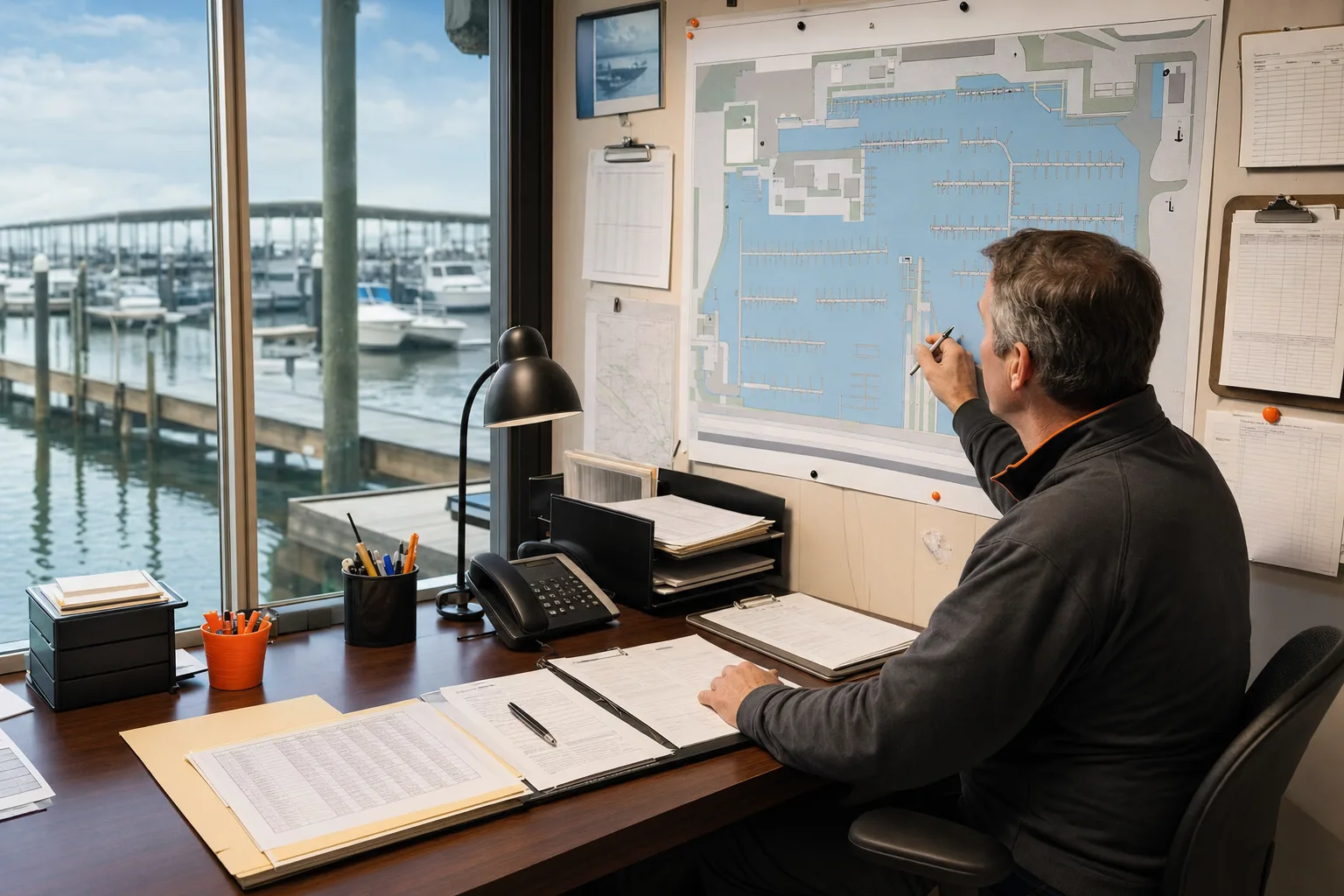
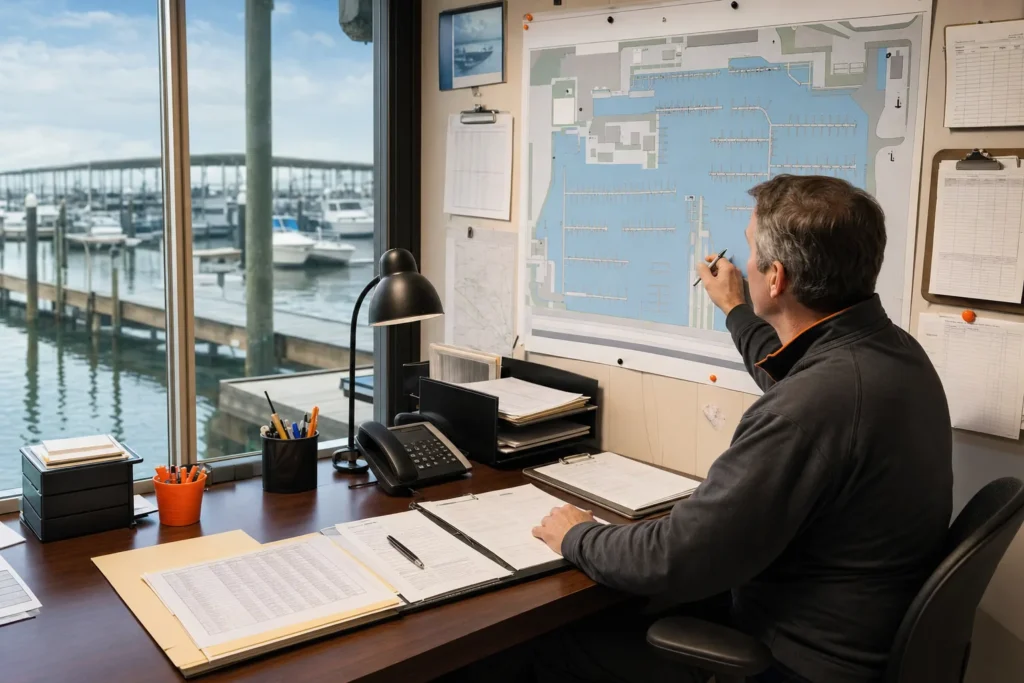
Marina management breaks down when slip data, billing, dock work, and customer messages live in separate places. Automation gets plenty of attention, yet research across 28 marina software products found explicit automation in only five. We’ll show what the job includes, how the daily system should run, which tools connect the work, and how marketing can bring in more qualified berth inquiries.
What Marina Management Includes
Marina management is the coordinated work behind a safe, profitable waterfront facility. It covers dockage, storage, guest service, billing, maintenance, staff work, compliance, and long-term planning.
The marina manager has to keep these parts moving together. A slip may be empty because it lacks the right depth. A customer may be late because a utility charge was missed. A repair may sit open because nobody owns the next task. Each issue touches more than one department.
Inventory and berth control
Your inventory is more than a count of empty spaces. Each wet slip, mooring, dry-stack slot, and transient berth needs its own record.
- Length overall and beam limits
- Water depth at the relevant tide level
- Power type and capacity
- Water, pump-out, and other access points
- Covered, open, floating, or side-tie status
- Annual, monthly, seasonal, or transient availability
This detail stops a common mistake: selling a space that fits by length but fails by draft, beam, power, or contract status. A visual map helps staff see the difference between occupied, held, reserved, blocked, and available space.
Customer and contract management
A useful customer record connects the owner to the vessel, agreement, payment history, service requests, and past messages. Staff should not need to search old emails before answering a basic question at the fuel dock.
Annual tenants need renewal notices and contract records. Monthly tenants need recurring invoices and utility charges. Transient guests need clear arrival details, slip instructions, and a clean checkout. The system should show which path each customer follows.
Billing, maintenance, and compliance
Marina revenue often comes through several lines. Slip fees may sit beside fuel, utilities, storage, service work, retail sales, and transient dockage. A billing process that misses one meter reading or adds a charge to the wrong account weakens trust and margin.
Maintenance needs the same level of control. A loose cleat, damaged piling, failed shore-power pedestal, or blocked pump-out station should become a tracked work order. The record should show who received it, what was done, what it cost, and when the customer received an update.
Compliance adds another layer. Fuel handling, spill response, waste control, stormwater, water quality, accessibility, and emergency planning may fall under different local rules. Managers should keep a current duty list instead of relying on memory. Formal operating guidance can help assign duties around safety, facilities, and emergency response.
The Daily Operating Model: From Slip Availability to Guest Checkout
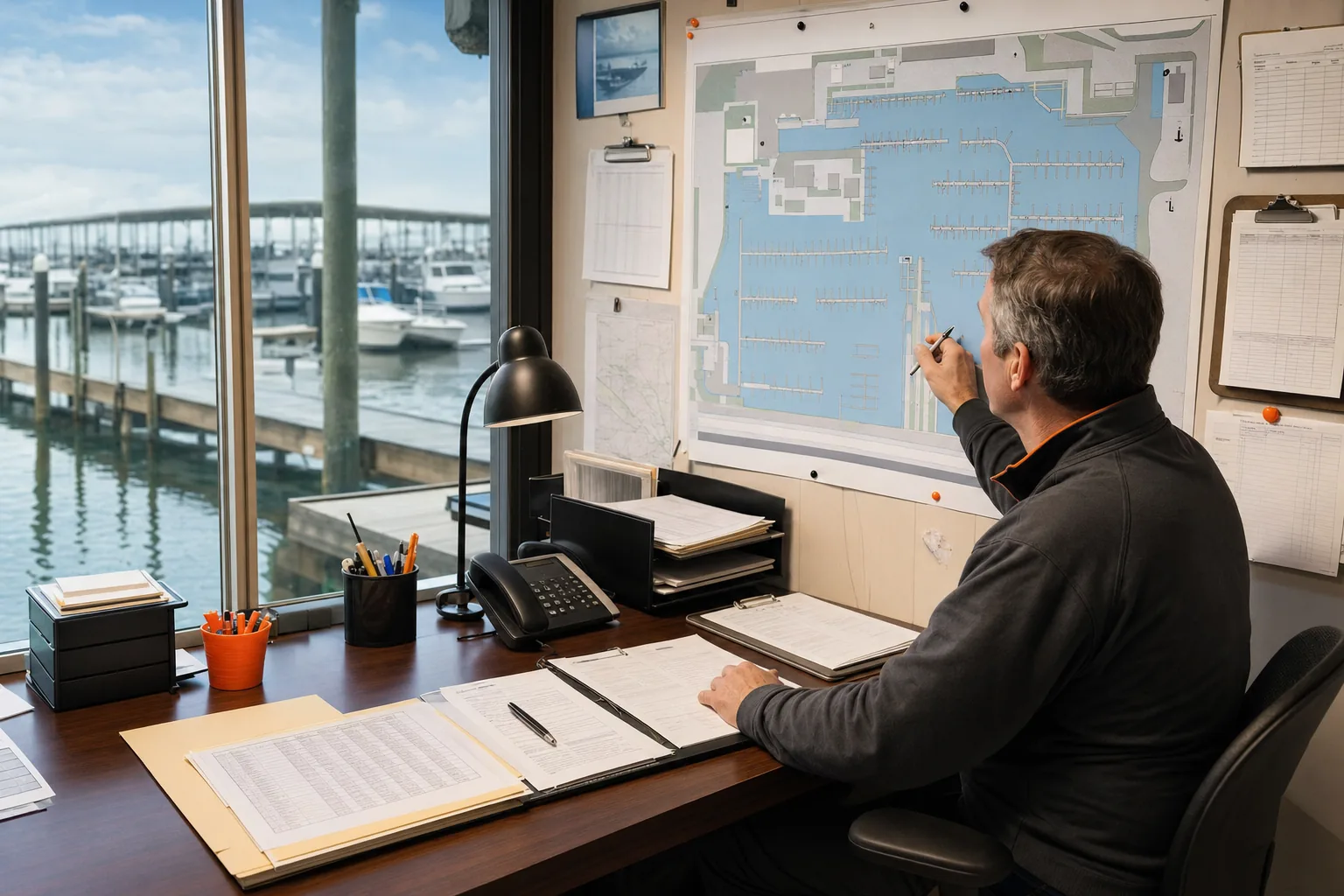
Daily marina management starts with a reliable view of what is leaving, what is arriving, and what cannot be used. The goal is to give the dock team one source of truth before the morning rush begins.
Start with an availability check
Begin with departures, arrivals, holds, maintenance blocks, and unpaid accounts. Compare the boat’s dimensions with the assigned berth before you promise anything. A 30-foot slip may be long enough for one vessel but too shallow or too narrow for another.
Then review the next several days. A transient booking can create a conflict with a seasonal tenant who has not yet arrived. A slip under repair may look open on a basic spreadsheet. Staff need a clear status that explains why it is unavailable.
Prepare each arrival
Once a booking is confirmed, the system should hold the right space and record the guest’s vessel details. Staff need the arrival window, power needs, draft, length, payment status, and any access notes.
That information changes the dock task. A large vessel may need a different line plan. A dry-stack customer may need launch notice. A guest arriving after office hours may need gate and dock instructions. The handoff should happen before the boat reaches the entrance.
Record dockside usage
Dock staff should be able to log meter readings, add approved services, attach photos, and update a work order from the dock. Mobile access matters because a clipboard entry made at 8 a.m. can be lost by lunch.
Fuel needs its own control. The pump sale should connect to the right customer or walk-up account. Tank stock should fall when fuel is dispensed. The office should be able to compare wholesale cost, retail price, gallons sold, and reconciliation variance.
Close the stay cleanly
Checkout should settle dockage, power, fuel, and approved extras against the booking. Staff should record the departure time and mark the berth as available, blocked, or assigned to the next guest.
This is where weak systems create hidden work. If the dock team writes a meter reading on paper, the office later has to match it to a customer. If fuel sits in another system, someone must reconcile it by hand. Each handoff adds a chance for a missed charge or a wrong account.
A daily closeout should leave three things clear:
- Which spaces are ready for sale
- Which balances need action
- Which safety, repair, or guest issues remain open
A marina management system can support this operating model through live availability, reservation work, billing, dock walks, customer records, and point-of-sale tasks. The useful test is not the length of its feature list. Ask whether a dockhand can finish the next task without calling the office.
How Marina Management Software Connects Operations
Marina management software should connect reservations, berth records, contracts, billing, maintenance, and customer messages. It should reduce duplicate entry, but owners should not assume every platform truly automates the work.
Research covering 28 products found that only five listed an explicit automation capability. That means 23 products, or 82 percent of the sample, did not list automation. The word may appear in sales copy, but the workflow still may depend on a staff member moving data between screens.
Automation and integration reality
Look for a clear trigger and a clear result. For example, a confirmed reservation might create a payment request, update the berth map, send arrival instructions, and notify the dock team. If the product only stores the reservation, that is record keeping, not full automation.
Integration claims are even thinner. Ask vendors to show the actual data flow with your chart of accounts. A logo on an integrations page is not proof that the sync handles your fees, deposits, refunds, utilities, and fuel sales correctly.
Match the system to the operation
| Operating need | What the system must show | Risk if missing |
|---|---|---|
| Wet slips and transient berths | Live inventory with vessel fit rules | Double bookings or unsafe assignments |
| Annual and monthly contracts | Renewals, recurring charges, and payment status | Late invoices and lost retention signals |
| Fuel dock and ship store | Point of sale tied to stock and customer accounts | Manual reconciliation and margin leaks |
| Dry stack or launch yard | Queue control, launch records, and customer notices | Dock delays and poor guest handoffs |
| Service department | Work orders with labor, parts, status, and approval | Stale jobs and unbilled work |
| Multiple departments | Accounting flow across dockage, service, and sales | Conflicting reports and slow decisions |
Smaller marinas may need a lighter cloud system that replaces a spreadsheet without adding a large implementation burden. Larger operations may need a wider system that joins storage, launch work, service, parts, sales, and accounting.
ActiveWare and iMarina are listed with billing, customer, slip, and reservation functions. DockMaster is positioned for larger, multi-department operations. These labels are starting points, not proof of fit.
Several platforms list no explicit automation even when they contain many individual features. That makes a live workflow test more useful than a feature count.
Before signing, run four scenarios during a demo:
- Move a booked vessel to a different berth.
- Bill a utility overage against the right account.
- Close a fuel sale and post it to the ledger.
- Turn a guest complaint into a tracked work order.
If the vendor cannot show the full path, plan for manual work or another tool. That cost belongs in the decision.
Revenue, Customer Experience, and Qualified Inquiries
Revenue control in a marina starts with the right customer arriving at the right berth. Occupancy alone cannot tell you whether you are filling profitable space with customers who fit your service model.
Measure revenue by space and customer type
Separate annual, seasonal, monthly, and transient performance. Track revenue per slip or linear foot, nights booked, length of stay, ancillary purchases, and payment timing. A full dock can still produce weak results if rates are wrong or high-cost services consume the margin.
Review covered and open spaces separately. Compare premium berths with standard spaces. Check whether a lower rate is filling a real demand gap or simply discounting a space that would have sold at its posted rate.
Fuel and service revenue can change the value of a customer. A transient who buys fuel and uses the ship store may be worth more than a guest who only pays dockage. The point is not to push extras on every boater. It is to understand which customer groups support your operation.
Make communication part of the operation
Customers judge the marina through small handoffs. They want clear arrival instructions. They want a quick answer when shore power fails. They want a bill that explains itself.
Set message rules for routine notices, urgent dock changes, storm preparation, utility outages, payment reminders, and renewals. Segment messages by annual tenant, monthly tenant, transient guest, liveaboard, or service customer. A storm notice meant for one dock should not confuse every customer on the property.
Bring in qualified inquiries
A qualified inquiry includes enough detail to judge fit. For a berth, that may include vessel length, beam, draft, dates, power needs, location, and budget range. A vague form that asks only for a name creates work for your office team and attracts tire-kickers.
Organic authority and paid ads have different jobs. Organic visibility is an asset that can keep producing discovery for high-intent searches. Paid ads can fill a short off-season gap, test a service area, or support a time-sensitive offer. Neither channel fixes a slow response process.
Your Google Business Profile should state that you provide marina services, dockage, storage, fuel, or other services you actually sell. Keep the address, hours, photos, services, and review responses current. Our local SEO guide for marine businesses covers the profile and location signals that help nearby boaters find the right page.
At Aquatic SEO, we focus on marine search intent rather than generic traffic. That means separating a person looking for a transient berth from someone searching for a marina job, a free dock, or a boating definition. The useful metric is the number of inquiries that match your berth rules, season, location, and service capacity.
Use demand control
A demand control system places filters before the office spends time on a quote. It can ask for vessel size, desired dates, service need, location, and urgency. It can send a clear next step when the request fits. It can also make the wrong fit obvious before a manager spends 20 minutes chasing details.
Paid campaigns need the same discipline. Group terms by intent and service. Add negative terms that attract jobs or information seekers when you need bookings. Our PPC keyword strategy guide explains how to tie search terms to landing pages, budgets, and qualified conversion tracking.
Marketing should support the operating model. If the dock is full on weekends but empty on Tuesdays, promote the gap. If the service team cannot take more work, do not buy broad service traffic. Better schedule stability beats a larger pile of weak leads.
People, Policies, and Risk Controls in Marina Management
Technology cannot decide who owns a safety check or what happens after a spill. People and policy still carry the risk. Marina management works when each task has an owner, a due time, and a record.
Define roles and handoffs
A small marina may have one person covering several jobs. That is normal. It is still worth writing down who handles each decision.
- The manager owns policy, budget, staffing, and escalation.
- The dockmaster owns berth assignments, arrivals, departures, and dock safety.
- The office team owns contracts, payments, customer records, and notices.
- The maintenance lead owns inspections, work orders, vendors, and completion records.
- The fuel or store lead owns stock checks, pump controls, and point-of-sale closeout.
Write the handoff beside the task. If a customer reports a loose cleat, who opens the ticket? Who decides if the berth must close? Who updates the guest? Who checks the repair? A clear answer prevents the issue from sitting between departments.
Build repeatable policies
Policies should cover payments, late fees, deposits, cancellations, vessel fit, weather closures, contractor access, after-hours arrivals, and emergency notices. Keep them short enough for staff to use during a busy Saturday.
Waivers and dock-use agreements should be easy to issue and track. A digital agreement tool may fit a marina that needs to collect signed documents without adding another pa. It can support the handoff once your terms are approved.
For accounting, keep approval limits clear. A dockhand may add a standard service charge. A manager may approve a vendor invoice. An owner may approve capital work. This separation reduces disputes and makes month-end review less painful.
Control safety and environmental risk
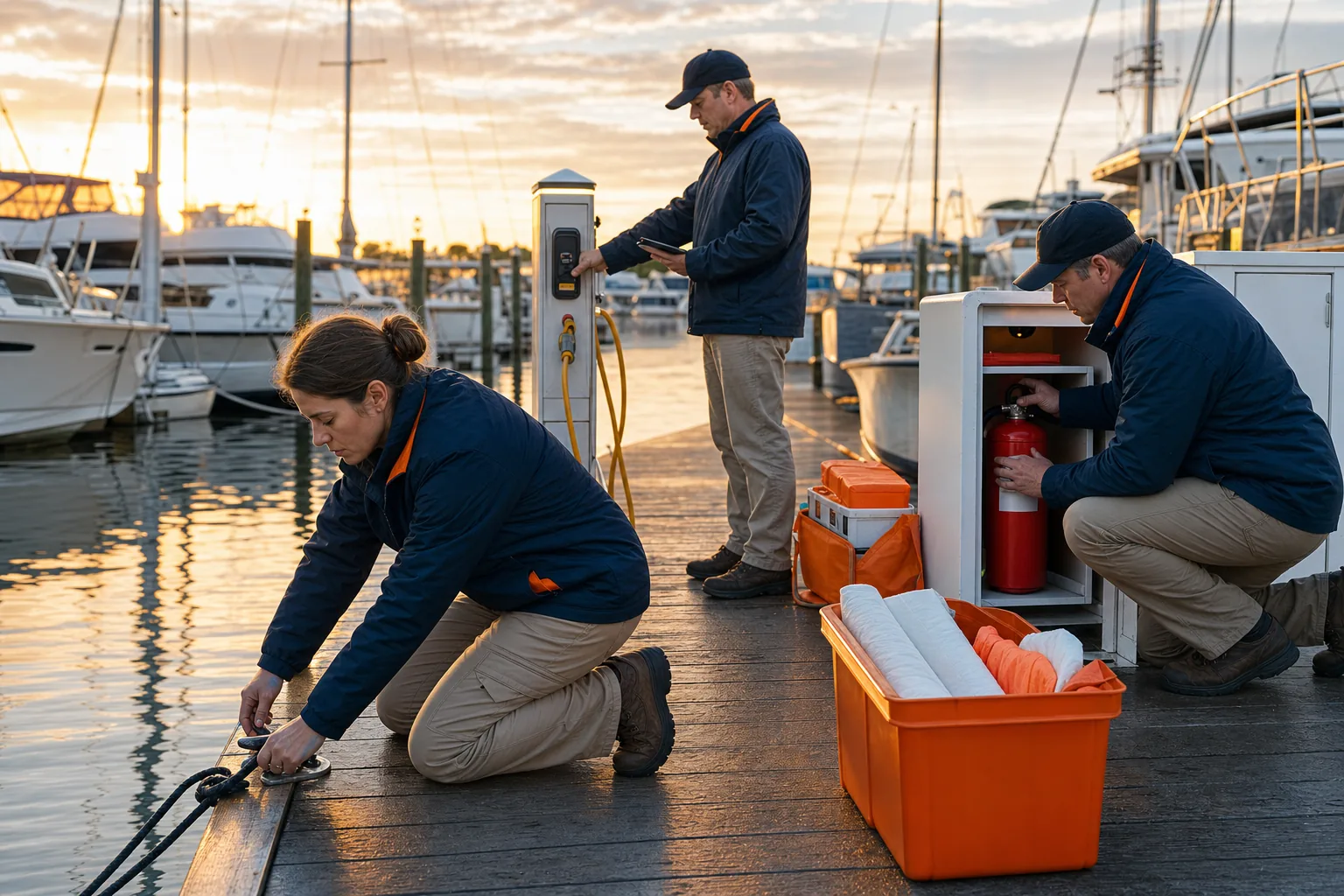
Use scheduled checks for docks, ladders, cleats, lighting, shore power, fuel equipment, spill kits, fire gear, access gates, and pump-out systems. Record the result, not just the date. “Checked” is weak. “Pedestal 14 inspected, breaker replaced, retest passed” tells the next person what happened.
Environmental controls need the same care. Use marina guidance to help plan water quality practices and pollution prevention. Local permits and rules still control your operation, so use published guidance as a planning aid rather than a substitute for local advice.
Storm preparation should have a trigger. Once a forecast reaches your chosen threshold, open a checklist. Review loose gear, dock lines, dry-stack priorities, fuel procedures, generator status, spill equipment, staff coverage, and customer notices. After the event, record damage while details are fresh.
Marina Management KPIs and an Improvement Framework
Marina management KPIs turn daily activity into decisions. We recommend a short weekly review first. A dashboard with too many numbers becomes another place for work to hide.
Start with capacity and revenue
Track occupancy by annual, seasonal, monthly, and transient space. Use available slip-nights as the base rather than dividing by the full property count when areas are blocked for repair.
Then review revenue per linear foot or per slip. Compare the figure by space type and customer group. A rise in revenue may come from a rate change rather than stronger demand. That difference matters when you set the next season’s plan.
Useful capacity and revenue measures include:
- Occupancy by week and customer type
- Transient nights booked
- Average length of stay
- Revenue per slip or linear foot
- Fuel attach rate among active customers
- Outstanding accounts by age
Add service and retention signals
Open work orders show the queue. Average open age shows whether the queue is moving. Break the total into awaiting estimate, awaiting approval, in progress, awaiting parts, and awaiting customer action.
Track annual churn, renewal rate, repeat transient bookings, and complaints by cause. If a customer leaves after repeated power issues, a low renewal number alone will not tell you what to fix.
Measure inquiries by source and type. A raw lead count is weak. Track qualified berth inquiries, booking conversion, response time, and revenue by source. This connects marketing to dock capacity instead of rewarding traffic that never becomes a booking.
Use a weekly improvement loop
- Review: Compare this week with the prior week and the same seasonal period.
- Find the gap: Pick one issue, such as weak weekday occupancy or aging work orders.
- Assign the fix: Give one person a due date and a measurable outcome.
- Test: Change one part of the process, rate, message, or schedule.
- Check: Review the result at the next meeting and keep, change, or stop the test.
Some published marina KPI reports cite high occupancy alongside weaker profit growth. That is the warning: a full marina is not automatically a healthy business. Staffing cost, insurance, utilities, maintenance, payment loss, and poor customer fit can erase the value of a full dock.
Keep the dashboard small enough to review every Monday. If a metric never changes a decision, remove it. If a decision lacks a metric, add one.
Marina Management FAQ
What does marina management include?
Marina management includes berth allocation, reservations, contracts, billing, maintenance, customer service, staffing, safety, compliance, and revenue planning. The work connects physical assets with customer records and financial controls. A manager must know which spaces are available, which tasks are open, which accounts need action, and which risks could affect the dock.
What does a marina manager do every day?
A marina manager reviews arrivals, departures, berth status, staff coverage, open repairs, payments, fuel activity, and customer issues each day. The manager also handles exceptions, such as a vessel that does not fit its assigned slip or a storm that changes the operating plan. The goal is safe movement with clear ownership.
What should marina management software do?
Marina management software should connect slip inventory, reservations, customer records, contracts, billing, payments, maintenance, and reports. It should show the workflow, not only store data. Before buying, test a booking change, a utility charge, a fuel sale, a work order, and a customer notice using your own operating rules.
How do marinas measure performance?
Marinas measure performance through occupancy, revenue per slip, revenue per linear foot, transient conversion, customer retention, fuel sales, aged receivables, work-order age, labor variance, and qualified inquiries. Review the measures by customer type and season. High occupancy can hide weak margins or poor service, so revenue and cost measures must sit beside capacity data.
How can a marina get more qualified inquiries?
A marina can get more qualified inquiries by matching local SEO, paid search, clear service pages, and intake questions to its actual berth rules. Ask for vessel size, dates, draft, power needs, and location before a staff member quotes. Aquatic SEO helps marine operators connect search visibility with qualified calls, bookings, and quote requests.
Conclusion
Run the marina as one connected system, not as separate dock, office, fuel, and marketing tasks. Start with a weekly review of berth status, revenue, open work, customer retention, and qualified inquiries. If your team needs help building marine-specific visibility around that operating model, review Aquatic SEO’s marketing services for marinas and docking facilities and use the next review to set one measurable improvement.