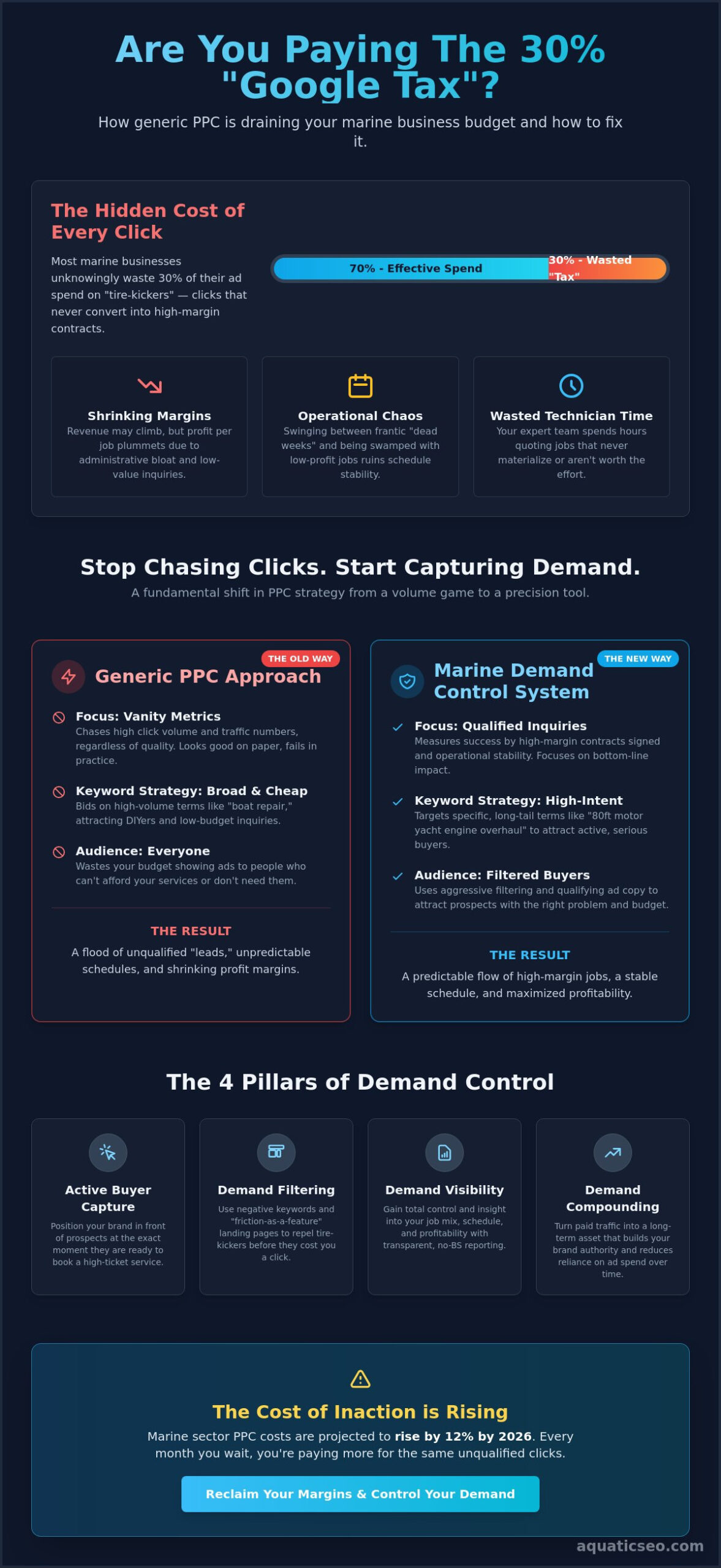
Most boat dealers and yacht charter operators are currently paying a 30% “Google Tax” on every click without even realizing it. You’re likely funding the research phase for tire-kickers who have no intention of booking a service this season. When you run PPC advertising for marine services without a filter, your revenue might climb while your actual margins shrink. If you’ve felt the sting of a “dead week” right after a record-breaking month of traffic, you know that clicks don’t pay the yard bills; qualified inquiries do.
You’ve probably noticed that traditional agencies focus on lead volume while your technicians sit idle during unpredictable gaps in the schedule. We agree that a “lead” is worthless if it doesn’t result in a high-ticket contract or a signed service order. This article will show you how to transform your digital spend from a monthly expense into a predictable engine for capturing high-intent demand.
We’ll examine the specific filtering mechanisms of the Marine Demand Control System required to dominate the 2026 market and maintain total control over your job mix and schedule stability.
Key Takeaways
- Stop subsidizing the “Google Tax” by identifying how generic agencies waste your budget on vanity clicks that never convert into high-margin contracts.
- Implement the Marine Demand Control System to filter intent and capture active buyers before your competitors even know they are in the market.
- Shift your strategy from chasing high-volume, low-profit keywords to targeting the specific high-intent terms that drive buyer-ready prospects.
- Apply the “friction as a feature” landing page strategy to ensure your PPC advertising for marine services generates qualified inquiries instead of tire-kickers.
- Audit your current ad performance with a no-BS framework to reclaim control over your operational margins and schedule stability.
The Hidden Cost of Generic PPC Advertising for Marine Services
You are likely paying a “Google Tax” every month without realizing it. Most marine business owners see their ad spend as a necessary evil to keep the phone ringing, but the reality is more sinister. Generic agencies focus on vanity metrics like click-through rates and total traffic while your shop floor fluctuates between frantic overtime and “dead weeks.” This instability isn’t a market reality; it’s a symptom of a broken system. Effective PPC advertising for marine services must function as a precision tool for active buyer capture, not a digital billboard for every casual boater with a broken bilge pump.
Generic Pay-per-click (PPC) campaigns often prioritize volume over intent. When an agency doesn’t understand the difference between a 20-foot center console and an 80-foot motor yacht, they waste your capital on broad search terms. This creates operational chaos. Your team spends hours quoting low-margin repairs instead of high-ticket refits. Revenue might grow by 18%, but if your margins shrink because of administrative bloat and “tire-kicker” inquiries, your business is actually getting weaker. You need a controlled demand environment that enforces stability on your schedule.
Why Generalist Agencies Fail Marine Contractors
Standard agencies bid on terms like “boat repair” because they have high search volume. For marine contractors, this is a tactical disaster. A search for “boat repair” could be someone looking for a $50 DIY part or a $50,000 engine overhaul. Generalists can’t distinguish between these intents. This lack of industry-native knowledge results in high costs for jobs you don’t even want. You don’t need more traffic; you need a system that filters out the noise before you pay for the click. Without specific negative keyword lists and intent-based targeting, you’re just subsidizing Google’s bottom line.
The Shift from Lead Counts to Qualified Inquiries
A “Qualified Inquiry” is a prospect with a specific, high-value problem, the documented budget to solve it, and the intent to book service within a defined window. Most agencies celebrate “leads,” which are often just contact forms from people who will never spend a dime. Revenue growth achieved at the expense of margin stability and operational sanity is a fundamental business failure.
High-intent prospects aren’t looking for the cheapest price; they’re looking for the most reliable operator. PPC advertising for marine services should be engineered to attract the latter while making your business invisible to the former. This shift moves your business away from the “dead week” cycle and toward a predictable flow of high-margin work. We focus on the inquiries that actually move the needle for your bottom line, not just your ego.
The Marine Demand Control System: Beyond Clicks and Rankings
You likely view Google Ads as a necessary evil that consumes your profit margins while delivering inquiries that waste your time. This happens because most agencies treat PPC advertising for marine services as a volume game rather than an operational filter. The Marine Demand Control System shifts the focus from vanity metrics to high-intent capture. By 2026, the cost per click in the marine sector is projected to rise by another 12 percent based on current search trends. You cannot afford to pay for clicks from window shoppers or people searching for services you don’t offer. Our system relies on four pillars: Active Buyer Capture, Demand Filtering, Demand Visibility, and Demand Compounding.
This framework ensures your budget only targets qualified inquiries that fit your specific business model. We don’t just want your phone to ring; we want it to ring with the right type of job. By using intent-based targeting, we position your brand in front of owners at the exact moment they need a solution. This moves your business away from the “feast or famine” cycle that plagues the industry.
Filtering Demand at the Source
You must stop paying for garbage traffic. If you operate a crewed Yacht Charter, you should never pay for a click from someone looking for a “boat rental.” We use aggressive negative keyword lists to strip out low-intent searchers before they cost you a cent. Your ad headlines should qualify the prospect immediately by mentioning price points or specific vessel requirements. This approach forces the system to ignore low-margin, high-hassle inquiries that clog your inbox and frustrate your sales team. It turns your advertising into a gatekeeper rather than a wide-open door.
Enforcing Operational Stability
Use your marketing as a valve to regulate your workflow. If your service yard has open bays during the shoulder season, you should pivot your PPC advertising for marine services to target high-value engine repowers instead of routine maintenance. This maintains your margins and keeps your best technicians productive without the typical seasonal drop-off. While many competitors rely on fundamental PPC strategies to get generic traffic, we use them to enforce your ideal job mix. You can learn more about managing these operational cycles in our guide for marine contractors.
Strategic Keyword Selection for High-Margin Marine Contracts
High-volume keywords are the fastest way to drain a marketing budget without seeing a return on investment. If you bid on broad terms like “boating” or “boat service,” you are paying for clicks from hobbyists, students, and DIYers who have no intention of signing a contract. Our Marine Demand Control System prioritizes qualified inquiries over vanity traffic. We focus on the “Intent Shift,” moving your spend away from information-seeking terms toward buyer-ready phrases that indicate a specific, urgent need.
Geographic targeting for specialized facilities requires more than a simple “near me” radius. A yacht service yard capable of handling a 100-foot refit doesn’t just compete with the yard down the street; it competes with every facility along the Atlantic Intracoastal Waterway. Owners of high-value vessels will transit hundreds of miles for a reputable yard. Your PPC advertising for marine services must target transit corridors and specific high-wealth hubs rather than just your local zip code. This ensures you capture owners when they are planning their seasonal maintenance or emergency repairs.
Distinguishing between B2B marine services and retail sales is vital for protecting your margins. Retail keywords often attract price-shoppers looking for the lowest cost on a part or a small boat. B2B and high-end service keywords must reflect professional operations and technical expertise. You aren’t looking for someone who wants to “buy a boat”; you are looking for the owner who needs a “marine electrical system retrofit” or “commercial hull cleaning.”
Charter vs. Rental: A Critical Distinction
Bidding on “boat rental” kills margins for luxury operators. This term attracts a retail audience looking for $500 afternoon pontoon rentals. To attract high-net-worth individuals, you must target “crewed yacht charter” or “private term charter.” These terms filter out low-budget inquiries and connect you with clients who value service over price. Learn more about our approach for Yacht Charters & Tour Operators.
Service Yards vs. Marinas: Targeting the Right Facility
Service yards and boatyards require keywords focused on heavy maintenance and refit capabilities rather than simple dockage or fuel. While marinas focus on “transient slips,” a service yard needs to capture demand for “running gear repair” or “fiberglass structural work.” Marine Surveyors often trigger these needs during pre-purchase inspections, creating a prime opportunity for targeted PPC advertising for marine services. A boat owner in need of a haul-out typically searches for specific technical requirements, such as “80-ton travel lift service” or “emergency haul out for 60-foot catamaran,” prioritizing the facility’s lift capacity and technical rating over basic amenities.
Building High-Performance Landing Pages That Filter Out Tire-Kickers
Sending your traffic to a homepage is the fastest way to incinerate your marketing budget. A homepage is a generalist brochure designed to welcome everyone; a high-performance landing page is a specialist filter designed to convert the right 5% while repelling the rest. When executing PPC advertising for marine services, you aren’t paying for clicks; you’re paying for the opportunity to start a high-margin conversation. If your page doesn’t immediately mirror the specific intent of the search query, the user will bounce within 2.1 seconds.
We utilize a “Friction as a Feature” strategy to protect your time. Instead of a basic name-and-email form, we deploy multi-step intake systems. By asking for the vessel’s make, length, and specific engine hours, we force the prospect to demonstrate they own the type of asset you actually want to service. This process eliminates the 35% of inquiries that usually come from small-craft owners looking for “cheap fixes” that don’t fit your business model. You don’t need more leads; you need a controlled flow of qualified inquiries that respect your shop rate.
By 2026 standards, visual proof must be instantaneous and high-resolution. Owners searching for a Service Yard expect to see the caliber of your facility before they even scroll. Your page must load in under 1.8 seconds on a 5G connection because 82% of marine service searches occur on mobile devices at the dock or the helm. If your site stutters or hides the “Call Now” button behind a clunky menu, you’ve lost the job to the competitor who prioritized mobile-first utility.
The Anatomy of a Marine Conversion Page
A high-converting page must explicitly distinguish your facility from a standard marina. While a marina offers dockage and fuel, your page must highlight service depth, specialized tooling, and geographic proximity to major inlets. We calibrate your call-to-action based on the complexity of the job. For routine maintenance, “Get a Quote” works; for major refits or repowers, we use “Book a Fit Call” to position your team as consultants rather than commodity laborers. This shift in language attracts owners who value expertise over the lowest price.
Measuring What Matters: Auditable Tracking
Stop looking at “conversions” as a success metric. We focus on revenue-per-click and auditable data. By implementing advanced call tracking for Marine Mechanics, we identify exactly which search terms result in a signed work order versus a simple price inquiry. This feedback loop allows us to aggressively scale the keywords that drive your highest margins while cutting spend on “vanity traffic” that never reaches the shop floor. Our PPC advertising for marine services ensures every dollar spent is a calculated investment in your operational stability.
Executing Your Marine PPC Strategy with Aquatic SEO
Stop wasting capital on agencies that don’t know a transom from a trim tab. Most PPC campaigns in the marine sector fail because they optimize for traffic instead of profit. We aren’t a marketing agency. We’re a growth partner. Our focus is on installing a Marine Demand Control System that forces your schedule to stay full with high-margin work. We don’t care about “brand awareness” if it doesn’t result in a technician on a boat or a boat in a slip.
Our “No-BS” audit doesn’t hide behind colorful charts. We look at your CRM and your ad spend with a cold eye. If you spent $5,000 last month and can’t trace it to a specific set of qualified inquiries, your system is broken. We identify exactly where your budget is leaking into low-intent searches. In 2024, our audits found that over 55% of marine service ad spend was wasted on generic “how-to” searches rather than high-intent service requests. We fix that leak immediately.
We guarantee a focus on auditable results. Clicks are cheap; signed contracts keep your lights on. We focus on qualified inquiries that match your operational capacity, ensuring your technicians stay busy without the “busy weeks followed by dead weeks” cycle that kills your margins. Our system ensures you only pay for the demand you actually want to capture.
The Aquatic SEO Difference
We understand the fundamental differences in your business model. A Boat Dealer is hunting for high-ticket buyers, while a marina is hunting for long-term slip tenants. Mixing these up destroys your ROI. You can read more about our specific approach in our Marine Marketing Guide. We reject vanity metrics like impressions and clicks. If an ad doesn’t lead to a conversation with a qualified prospect, it’s a failure.
Next Steps for Demand Dominance
Before we turn on the faucet, your operations must be ready. Consistent PPC advertising for marine services creates a volume of work that breaks weak intake systems. We help you filter the noise so your team only talks to serious prospects. It’s about stability and margins, not just more phone calls. If you’re ready to stop guessing and start controlling your lead flow, the process starts with a conversation about your specific goals.
Effective PPC is the most direct way to capture high-intent demand in 2026, but only if it’s managed by those who speak the language of the shipyard. By moving from “getting clicks” to “controlling demand,” you secure your market position and protect your staff’s schedule from seasonal volatility.
Ready to take control? Request a Marine Service Fit Call to see if your business is ready for the Marine Demand Control System.
Stop Chasing Clicks and Start Controlling Your Calendar
Winning in 2026 requires more than a functional website. It demands a rigorous system that filters out the noise. Most owners in the $300K to $5M revenue range are tired of paying for vanity metrics that don’t fill the service yard or book the charter season. By moving away from generic strategies and implementing PPC advertising for marine services that prioritizes qualified inquiries over raw traffic, you reclaim control of your margins and your schedule.
You don’t need more leads. You need better ones. Our Marine Demand Control System is built on industry-native expertise to ensure your ad spend targets high-margin contracts rather than tire-kickers. We focus on the operational reality of your business, not just the digital facade. It’s time to stop treating your marketing like a gamble and start treating it like the precision tool it’s meant to be.
Ready to see where your current strategy is leaking cash and which high-intent searches you’re missing? Request a No-BS Marine Demand Analysis. Your business deserves a pipeline as reliable as the vessels you service.
Frequently Asked Questions
Is PPC advertising for marine services better than SEO?
PPC advertising for marine services provides immediate control over demand while SEO builds long-term equity. PPC allows you to turn the tap on when your schedule is empty and off when you reach 95% capacity. SEO usually takes 6 to 12 months to mature. A growth partner uses PPC to capture active buyers today and SEO to lower the cost per inquiry over the next 24 months.
How much should a boat dealership spend on Google Ads?
Your budget depends on your specific inventory turnover goals and local market competition. According to 2024 Marine Retailers Association of the Americas reports, dealers often allocate 2% to 3% of gross revenue to marketing. For a dealership doing $3M annually, this means a $60,000 to $90,000 yearly budget. We don’t guess. We calculate spend based on the number of qualified inquiries needed to hit your sales targets.
Can PPC help fill my service yard during the off-season?
Yes, PPC is the most effective tool for stabilizing your service yard schedule during slow months. By targeting high-intent keywords like “winterization specials” or “outboard repower” in September and October, you capture demand before competitors do. Our system focuses on high-margin work like engine overhauls rather than low-value oil changes. This ensures your technicians stay billable and your operations remain profitable throughout the entire winter season.
Why am I getting leads for boat rentals when I offer yacht charters?
You’re likely using broad match keywords that fail to distinguish between a $500 rental and a $15,000 crewed yacht charter. Google’s algorithm often groups these together despite the massive price gap. We use negative keyword lists and strict match types to filter out “cheap” seekers. This ensures your budget is spent only on prospects looking for professional crewed services, not weekenders looking for a basic pontoon.
What is a Qualified Inquiry in the marine industry?
A qualified inquiry is a prospect who has the budget, intent, and specific need for your high-value marine services. It’s not a “lead” who just clicked a button or downloaded a brochure. In our system, an inquiry is only qualified if they provide verifiable contact info and express interest in a specific service like a major refit or a new vessel purchase. We focus on these high-intent contacts to protect your time.
How do I stop my ads from showing to people looking for cheap parts?
You must implement a rigorous negative keyword strategy that excludes terms like “used,” “cheap,” “Amazon,” and specific part numbers. Many service yards waste 30% of their budget on DIYers looking for components they can install themselves. By enforcing strict filtering within your PPC advertising for marine services, you stop paying for clicks that never result in a high-margin service contract. We prioritize professional labor over simple parts sales.
What is the Marine Demand Control System?
The Marine Demand Control System is our proprietary framework designed to give marine business owners total command over their inquiry flow. It replaces the “feast or famine” cycle with a predictable stream of high-value prospects. The system integrates active buyer capture, rigorous demand filtering, and auditable tracking. It’s built specifically for operators who need to maintain stable margins and consistent schedules rather than just chasing “more traffic.”
Do I need a separate landing page for every marine service I offer?
Yes, sending traffic to your homepage is the fastest way to waste your ad spend. A dedicated landing page for a specific service, like yacht brokerage or hull painting, increases conversion rates by 25% on average. Each page must address the specific pain points of that service buyer. This structure allows us to track exactly which services are driving the highest ROI for your operations and adjust your budget accordingly.