
Your marketing agency just sent a report showing a 40% increase in clicks. Meanwhile, your service yard is empty and your sales team is wasting time on tire-kickers who don’t know the difference between a yacht charter and a simple boat rental. These reports are filled with vanity metrics in marine marketing that look impressive on paper but do nothing for your bottom line. You’re likely exhausted from watching your ad spend disappear into a void of low-intent traffic while your high-margin slips remain unoccupied.
We agree that a marketing report shouldn’t require a translator to find the actual profit. This article will help you identify the deceptive metrics draining your budget and teach you how to pivot toward a system that captures high-intent marine buyers. You’ll learn how to stop the bleed and finally gain total control over your job mix through a predictable demand generation framework that prioritizes qualified inquiries over empty engagement.
Key Takeaways
- Stop wasting budget on generalist agencies that prioritize broad reach over the specific operational needs of a service yard or boat dealer.
- Identify the intent errors that attract informational browsers instead of the high-intent buyers your marine mechanics and surveyors require.
- Learn why using precise industry terminology is the only way to build credibility and filter out low-margin inquiries.
- Replace vanity metrics in marine marketing with a focus on qualified inquiries that result in actual boat sales and dockage contracts.
- Transition to the Marine Demand Control System to gain total oversight over your job mix and stabilize your revenue patterns.
The High Cost of Hiring Generalist Marketing Agencies
Hiring a generalist agency is like asking a car mechanic to fix a diesel engine on a 60-foot sportfish. They might understand the basic principles of internal combustion, but they’ll miss the critical nuances that prevent a catastrophic failure. Most agencies focus on broad reach because it’s easy to report. They show you “impressive” numbers that represent nothing more than vanity metrics in marine marketing while your actual revenue stays flat.
Generalist agencies are built for volume, not value. They prioritize “brand awareness” because they don’t know how to speak to a seasoned boat owner or a professional fleet manager. This one-size-fits-all approach results in a flood of low-margin inquiries that clog your sales pipeline. You end up paying for clicks from people looking for “cheap boat rentals” when you actually run a crewed Yacht Charter operation that requires a completely different buyer profile.
This lack of precision creates a massive financial drain on your operation. You’re effectively subsidizing the research of window shoppers instead of capturing high-intent buyers who are ready to sign a contract. A generic agency won’t know to exclude “DIY repair” keywords for a Marine Mechanic, leading to wasted ad spend on people who will never hire a professional. Your business doesn’t need more traffic; it needs better filtration.
Why Industry Experience Is Your Best Marketing Asset
Specialized knowledge isn’t just a preference; it’s a requirement for effective performance measurement in your business. A marine specialist understands that a Marine Contractor needs a completely different lead profile than a Marine Surveyor. We write ad copy that speaks the language of the docks, which naturally filters out the noise. For a deeper look at these industry nuances, read our Marine Marketing Guide.
The Problem with Broad Targeting in Marine SEO
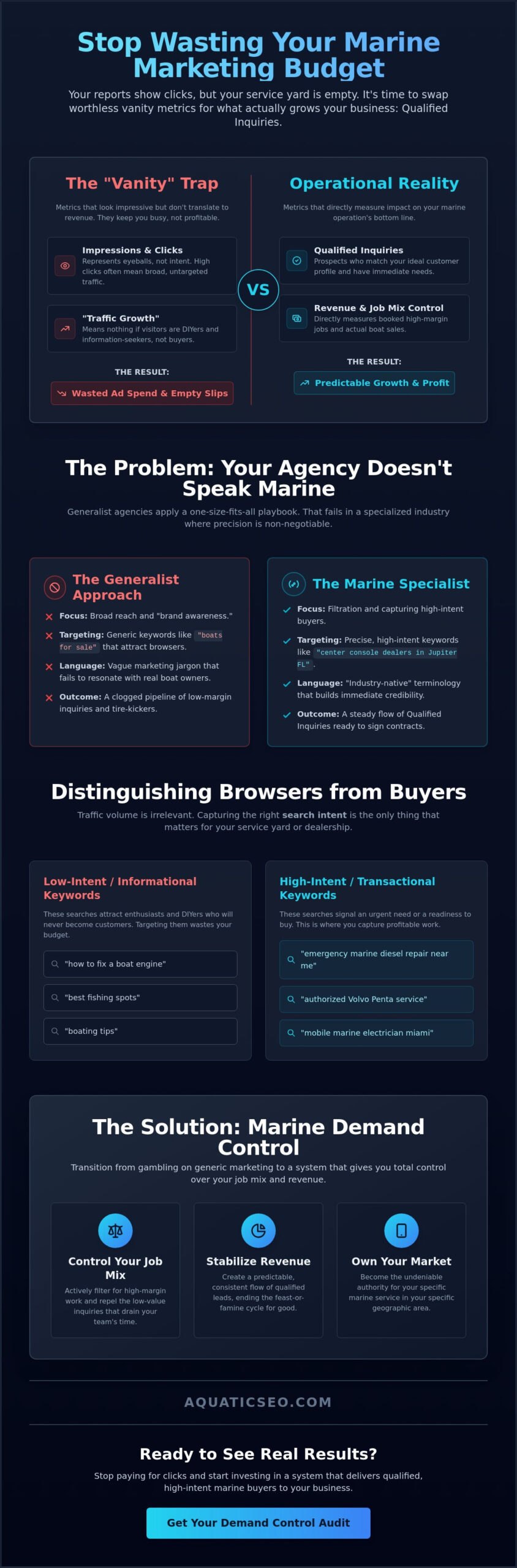
Generalist SEO agencies love ranking your site for broad terms like “boats” or “boating tips.” While these drive traffic, they rarely drive revenue for a specialist like a Service Yard or a marine electrician. If you’re a surveyor in South Florida, ranking for a global term does nothing for your bank account. You need localized, high-intent phrases that attract a Qualified Inquiry. Generic SEO strategies simply fill your inbox with tire-kickers, wasting your staff’s time and your marketing budget. Consider the difference in intent:
- Generalist Target: “Boats for sale” (too broad, attracts researchers)
- Specialist Target: “Center console dealers in Jupiter FL” (high intent, attracts buyers)
- Generalist Target: “How to fix a boat engine” (attracts DIYers)
- Specialist Target: “Emergency marine diesel repair near me” (attracts active customers)
Stop chasing clicks that don’t convert. When you partner with an agency that has “in the trenches” experience, you stop gambling with your ad spend and start investing in a system that captures high-intent marine buyers.
Intent Errors: Failing to Distinguish Browsers from Buyers
Many agencies brag about traffic volume, but they fail to explain that most of those visitors will never spend a dollar with you. If your content targets informational keywords like “best fishing spots” or “how to clean a hull,” you’re attracting enthusiasts, not buyers. This is a primary driver of vanity metrics in marine marketing where your analytics look healthy but your bank account doesn’t. You need to focus on transactional intent to capture the 38% of marketplace leads who are actively researching their next purchase.
High-intent search patterns for marine mechanics and electricians look very different from general interest searches. A boat owner with a dead engine isn’t looking for a blog post about engine maintenance; they’re searching for “mobile marine diesel repair” or “authorized Volvo Penta service.” Shifting your focus to actionable metrics requires a deep understanding of these specific search behaviors. If your agency doesn’t know the difference between a Qualified Inquiry and a simple website visitor, they’re wasting your budget on the wrong audience.
Mapping the Marine Customer Journey
The journey for a Marine Contractor client usually starts with a specific, expensive problem. They aren’t browsing; they’re looking for technical authority and proof of past performance on similar vessels. Most marketing fails because it tries to close the sale before establishing this expertise. You must answer specific operational questions, like haul-out capacity or specialized welding certifications, to build immediate trust with a skeptical owner.
Distinguishing between industry terms is critical here. A search for a marina usually indicates a need for dockage, fuel, or transient slips. Conversely, a search for a boatyard or service yard implies a need for maintenance, refits, or repairs. If your SEO strategy treats these as interchangeable, you’ll end up with a high volume of calls for services you don’t provide. You can audit your current search intent to see where your budget is being misallocated.
Filtering Demand at the Point of Entry
Your website shouldn’t be a digital billboard; it should be a filtration system. Use specific landing pages to disqualify low-budget or irrelevant leads before they ever reach your inbox. By highlighting your specific boat length limits or engine brand specializations, you ensure that only high-intent buyers move forward. This approach reduces the time your team spends on tire-kickers and focuses your energy on high-margin contracts.
Technical proof points are the best way to convert these qualified prospects. Don’t just say you’re an expert; show the specific diagnostic tools you use or the complex structural repairs you’ve completed. Skeptical marine business owners value precision and evidence over vague marketing promises. When your site acts as a filter, you gain total control over your job mix and stop being a slave to inconsistent inquiry flows.
The Terminology Gap: Why Industry-Native Language Is Non-Negotiable
If your marketing agency refers to your crewed vessel business as a “boat rental,” they’ve already failed you. This isn’t just a minor semantic error. It’s a clear signal to high-net-worth clients that your operation lacks professional depth. Generalist agencies often hide behind vanity metrics to mask their lack of industry knowledge. They might celebrate a spike in traffic for “cheap boats,” but those visitors will never convert into the high-margin contracts your business requires to thrive.
Precise language is the foundation of a Qualified Inquiry. A Boat Dealer requires a marketing engine built for high-ticket sales and inventory turnover, which is fundamentally different from the recurring revenue model of a Marina. When an agency uses generic “boating” keywords, they’re casting a net so wide it mostly catches trash fish. You end up paying for clicks from people looking for fuel docks when you’re actually trying to sell a $2 million center console. This misalignment is a primary reason why vanity metrics in marine marketing are so dangerous to your ROI.
Mislabeling a Service Yard as a general repair shop is another common, costly mistake. Sophisticated yacht owners don’t look for “repair shops.” They look for facilities capable of handling complex refits, structural fiberglass work, or authorized engine overhauls. If your marketing doesn’t reflect this technical reality, you’ll attract low-budget hobbyists instead of the commercial or luxury clients who provide your best margins.
Correcting Common Marine Industry Definitions
A Yacht Charter requires crewed vessel marketing that emphasizes professional service, luxury amenities, and curated itineraries rather than simple hourly equipment availability. You must also distinguish between dockage (marina) and maintenance (boatyard) in your SEO metadata to ensure you aren’t paying for traffic that your facility isn’t equipped to handle. Using boat dealer keywords for a service-focused operation is a guaranteed way to fill your inbox with inquiries for inventory you don’t stock.
The Industry-Native Advantage
Using the right jargon reduces friction in the sales process and builds instant authority. When a prospect sees you correctly identify specific hull materials or propulsion systems, the “trust gap” closes immediately. High-net-worth clients value their time and prioritize specialists who speak their language over generalists who need everything explained. If your marketing looks amateur, you’ll lose the contract before you even get to the proposal stage. Precision isn’t just about being correct; it’s about filtering for the quality of demand your business deserves.
Vanity Metrics in Marine Marketing vs. Operational Reality
Total website traffic is a deceptive pulse check for your business. An agency might show you a graph trending upward, but if that traffic consists of teenagers looking at boat pictures, it’s worthless. High traffic numbers are the ultimate vanity metrics in marine marketing because they provide the illusion of growth without the reality of revenue. You can’t pay your dockage fees with page views.
A Qualified Inquiry isn’t just a name and an email address. It’s a specific type of prospect who owns a vessel that fits your service capabilities and has the budget for high-margin work. Generalist agencies often flood your inbox with “leads” that turn out to be people seeking free advice or services you don’t offer. You need a system that prioritizes the financial health of your operation over the sheer volume of digital noise.
Social media likes and shares are equally distracting. While a post about a beautiful sunset might get a hundred likes, it rarely results in a signed contract for a hull refit or a complex electrical overhaul. You should ignore superficial engagement and focus on auditable job flow. Your marketing should be a tool for demand control, ensuring your bays are filled with the specific type of work that keeps your margins high.
Metrics That Lie: Vanity vs. Value
Ad impressions are just noise if they aren’t reaching active buyers. You should stop caring about how many people “saw” your ad and start tracking your cost per Qualified Inquiry. For Marine Surveyors, time spent on a blog post is far less important than the number of inspection requests generated. If your marketing isn’t driving specific, high-value outcomes, it’s failing your business.
Tracking your job mix is the only way to ensure long-term stability. If your marketing is only producing low-margin oil changes when you need high-ticket engine repowers, your strategy is misaligned. You need to hold your marketing accountable to the actual profit generated by each campaign. This requires moving beyond generic reports and looking at the hard data of your service logs.
Auditable Tracking for Marine Contractors
Call tracking is essential for any Marine Mechanic or contractor. It allows you to distinguish between spam, price-shoppers, and real service requests. By using a CRM to follow a prospect from their first click to the final invoice, you gain total oversight of your marketing ROI. You’ll quickly see which keywords produce paying customers and which ones just drain your ad spend.
Stop settling for vague promises of “brand awareness.” Demand a system that provides auditable results and gives you total control over your inquiry flow. If you’re tired of guessing which parts of your marketing actually work, it’s time to audit your demand generation system. Focus on the metrics that impact your bank account, not the ones that just look good in a slide deck.
Structural Solutions: Transitioning to a Marine Demand Control System
Most marketing agencies treat your business like a lottery. They spend your budget on broad reach and hope that a few high-value clients eventually fall through the cracks. This reactive approach leaves you at the mercy of inconsistent job flow and unpredictable revenue. You don’t need a generalist agency; you need a Marine Demand Control System that treats marketing as an operational asset rather than a vague promotional expense.
The Marine Demand Control System is a proprietary framework designed to shift your business from chasing leads to controlling demand. Instead of celebrating vanity metrics in marine marketing, we focus on three specific pillars: Active Buyer Capture, Demand Filtering, and Demand Visibility. This systematic approach ensures that your sales team only spends time on prospects who have the intent and the budget to sign high-margin contracts. Specialized Digital Marketing for Marine Contractors is the only way to stabilize revenue in a market where buyers consume 23 pieces of content before making a move.
Stability comes from oversight, not volume. By implementing a system that prioritizes the financial health of your Service Yard or Boat Dealer operation, you stop gambling with your ad spend. You gain the ability to dial your inquiry flow up or down based on your current capacity. This level of control is impossible when you rely on the superficial data points provided by traditional vendors.
Implementing Demand Filtering
Demand filtering is the process of automating the disqualification of low-value prospects. Your website should act as a digital gatekeeper, using technical proof points and specific service boundaries to turn away irrelevant traffic. If someone is looking for a “boat rental” when you offer a crewed Yacht Charter, they should be filtered out before they ever reach your inbox. Capturing high-intent search terms is only half the battle; the other half is ensuring your system rejects the noise that drains your operational resources.
Next Steps for the Skeptical Owner
If your current agency is still sending you reports filled with “engagement” and “impressions,” it’s time for a hard audit. Ask them to show you the direct correlation between their work and your actual job mix. If they can’t distinguish a Qualified Inquiry from a simple website visitor, they’re likely sinking your ROI. You deserve a no-nonsense analysis of your marketing performance that focuses on profit, not fluff.
Reclaiming control over your job flow starts with a shift in perspective. Stop settling for generic pitches and start demanding a system built for the specific complexities of the marine industry. To see if your operation is a fit for our proprietary methodology, Book a Marine Service Fit Call today. We’ll help you dismantle the vanity metrics and build a predictable engine for high-margin demand.
Reclaim Your Operational Stability
Continuing to tolerate superficial reports will only lead to more wasted budget and inconsistent inquiry flow. You’ve seen how generalist agencies rely on vanity metrics in marine marketing to hide their lack of industry-native knowledge. By failing to distinguish between a yacht charter and a boat rental, these vendors attract window shoppers while your high-margin slips remain empty. Stop letting generic marketers treat your business like a digital science experiment.
True operational stability requires a shift toward our proprietary Marine Demand Control System. This framework prioritizes high-intent marine buyers and filters out the noise that drains your sales team’s time. You deserve a results-oriented partnership that values auditable job flow over empty social media engagement. It’s time to stop chasing clicks and start controlling demand with surgical precision.
Take the first step toward reclaiming your job mix and stabilizing your revenue patterns. Request a No-BS Marine Marketing Analysis to see how we align your marketing with the financial health of your business. Your operation is too valuable to leave to generalist guesswork. We are ready to help you build a predictable system for high-value demand.
Frequently Asked Questions
What is the difference between a Yacht Charter and a boat rental in marketing?
A Yacht Charter is a crewed vessel experience that requires high-end service and professional itineraries, while a boat rental is a simple equipment transaction. Marketing for charters must emphasize technical authority and luxury to attract high-net-worth clients. Using generic “rental” keywords attracts low-budget tourists who aren’t your target audience and will never book a crewed voyage.
Why do generic SEO agencies fail to generate leads for marine contractors?
Generic agencies fail because they don’t understand the technical nuances of your work or the specific intent behind marine search queries. They target broad terms that attract DIY enthusiasts looking for advice instead of vessel owners needing professional repair. This lack of precision results in wasted ad spend on clicks that never convert into signed contracts for your service yard.
What are vanity metrics in marine marketing and why should I ignore them?
Clicks, impressions, and social media likes are typical vanity metrics in marine marketing that look impressive in reports but don’t pay your bills. These numbers provide an illusion of growth without reflecting your actual job flow or revenue. You should ignore them in favor of auditable tracking that follows a Qualified Inquiry from the first click to the final invoice.
How much should a marine business spend on digital marketing to see real results?
Your marketing spend should be calibrated to your revenue goals and the cost of acquiring a high-intent buyer. Industry data from 2026 indicates that the cost per qualified lead for boat dealers often falls between $75 and $250. You must invest enough to stay visible throughout the average 94-day decision cycle while your prospects consume nearly two dozen pieces of content.
What is a Qualified Inquiry in the marine industry?
A Qualified Inquiry is a prospect who owns a relevant vessel and has a specific, high-margin problem that your business is equipped to solve. This is not just a phone number or a generic “lead” from a window shopper. It represents a filtered demand point where the buyer has already demonstrated intent to hire a professional for specialized marine services.
How can I tell if my current marketing agency understands the marine niche?
You can identify an industry-native agency by their vocabulary and their focus on your operational reality. If they confuse a marina with a boatyard or can’t distinguish between a surveyor and a mechanic, they don’t know your business. An expert partner will prioritize your job mix and financial health over superficial traffic counts and broad reach.
What is the Marine Demand Control System?
The Marine Demand Control System is a proprietary framework designed to stabilize your revenue by capturing and filtering high-intent demand. It moves your operation away from chasing every low-margin inquiry and toward a methodical system of demand visibility. This ensures your bays stay filled with high-value work instead of inconsistent, low-profit filler jobs.
Can I use general SEO strategies for my boat dealership?
No, because general SEO strategies prioritize broad volume over transactional intent, which is a waste of resources for a dealership. You need a specialized approach that targets active buyers researching specific inventory in your local market. Generic strategies often rank you for informational terms that attract enthusiasts rather than serious buyers who are ready to close a sale.