Your word-of-mouth reputation is currently the biggest liability in your service yard. While you’ve spent years building a name based on quality, relying on referrals leaves your schedule at the mercy of chance. You can’t plan a multi-million dollar expansion on maybes; you certainly can’t retain top-tier ABYC-certified techs without a predictable pipeline. Most yards fluctuate between being dangerously overbooked and ghost-town quiet, usually while fielding low-margin inquiries from price shoppers who don’t know a transom from a tiller.
You’ve likely been burned by generic agencies that treat a boatyard like a local bakery. They provide “clicks” but no actual work orders. We understand that you need a system, not a slogan, to stabilize your revenue. This guide explains how to get more boat repair customers by implementing a Demand Filtering System that captures high-intent marine service inquiries with precision. You’ll learn how to stop reacting to the market and start dictating your own service schedule for the 2026 season.
Key Takeaways
- Shift from “Hope Marketing” to a predictable system that removes the operational risk of relying on inconsistent word-of-mouth referrals.
- Discover how to get more boat repair customers by targeting “Emergency Intent” search terms used by owners in the immediate aftermath of a mechanical failure.
- Implement a Demand Filtering System to disqualify low-margin tire-kickers and protect your service yard’s profitability before they ever reach your desk.
- Dominate local search results for high-value specialized terms like “Marine Mechanic” and “Marine Electrician” to capture active demand with precision.
- Replace seasonal chaos with the three pillars of the Marine Demand Control System to gain total command over your job mix and yard schedule.
Why Your Service Yard Cannot Survive on Word-of-Mouth Marketing Alone
Many service yard owners believe that word-of-mouth is their strongest asset. In reality, it’s often their greatest operational weakness. This reliance on unpredictable referrals is what we call “Hope Marketing.” You’re essentially gambling your payroll on the chance that a satisfied client mentions your name at the fuel dock. This approach offers zero control over your volume, your timing, or your profit margins.
Word-of-mouth leads frequently come with a hidden cost: the expectation of a “friend of a friend” discount. These prospects often prioritize price over expertise, leading to low-margin jobs that eat up your shop’s capacity without contributing to your financial health. If you want to know how to get more boat repair customers who value your specialized skills, you must stop waiting for the phone to ring and start dictating who enters your yard.
The most visible symptom of this passive strategy is a volatile schedule. Your yard is either dangerously empty, forcing you to take on low-value “busy work,” or it’s so overwhelmed that your quality suffers. This feast-or-famine cycle prevents you from hiring the best marine service yard and boatyard technicians because you can’t guarantee their hours. You need a predictable pipeline to stabilize your revenue and maintain high standards.
The Scalability Trap of Local Referrals
Referrals limit your growth to a narrow geographic or social circle. You’re trapped within the network of your current clients, which often excludes the high-value yacht owners moving into your region. Relying on rumors provides no auditability; you can’t track what’s working or scale what isn’t. Successful yards implement systematic inspection and maintenance procedures to ensure every vessel is seaworthy, yet many fail to apply that same level of rigor to their own business development. Without a data-driven system, you’re just guessing.
The Difference Between a Lead and a Qualified Inquiry
A “lead” is just contact information; a Qualified Inquiry is a high-intent boat owner ready to book a specific repair. Generic marketing agencies often brag about “lead volume” from social media, but these are usually tire-kickers who waste your service manager’s time. You don’t need more people asking “how much for a bottom job?” via Facebook Messenger. You need a system that filters for intent. Learning how to get more boat repair customers means focusing on those who are actively searching for professional solutions to complex engine or electrical failures, not those just browsing for the cheapest price in town.
Capturing High-Intent Demand When Marine Engines and Systems Fail
When a boat owner is stuck at the marina with a seized engine or a dead house battery bank, they don’t wait for a friend’s recommendation. They reach for their phone. This is the moment of “Emergency Intent.” If your yard doesn’t appear in that immediate search, you’ve lost a high-value job to whoever was visible. Understanding this search behavior is the most direct answer to how to get more boat repair customers who are ready to pay full shop rates without hesitation.
Generic searches like “boat repair” often attract low-intent browsing. You need to dominate the specific technical terms that signal a critical need. For example, keywords such as “marine electrician near me” or “diesel engine troubleshooting” connect you with owners who have an immediate problem and a budget to fix it. Our approach to digital marketing for marine contractors focuses on capturing these specific inquiries at the exact second they occur.
Targeting Specific Marine Systems for Higher Margins
High-margin work isn’t found in oil changes or bottom paint. It’s found in complex repowers, NMEA 2000 overhauls, and advanced fiberglass structural repairs. Targeting these specific systems filters out the “budget” boaters and attracts owners of larger vessels with more complex needs. High-intent search behavior for marine mechanics and electricians is defined by specific brand and component queries rather than general service questions. If you want to see how this fits your specific yard, you can book a fit call to discuss your service mix.
The Role of Local SEO in Service Yard Visibility
Your Google Business Profile is your digital “front dock.” It needs to be as professional as your actual facility. Local SEO isn’t just about being on a map; it’s about proving relevance to the search engine through consistent local citations and location-based keywords. You must optimize for the specific waterways, marinas, and neighborhoods you serve. When an owner at a specific yacht club searches for a technician, your yard should be the primary choice based on geographic authority and documented expertise.
Filtering Out Tire-Kickers to Protect Your Service Yard Margins
Many yard owners believe that more inquiries always lead to more profit. This is a dangerous misconception. High lead volume without a filtration system is simply high-speed waste. If you want to know how to get more boat repair customers, you must first learn how to systematically reject the wrong ones. We call this “Demand Filtering.” It’s the operational process of stopping low-value, low-margin inquiries before they ever reach your service manager’s desk.
The cost of “Bad Demand” is significant. Every hour your team spends drafting quotes for “price shoppers” who never book is an hour stolen from billable shop time. This creates friction and organizational instability. Your website shouldn’t function as a passive brochure that invites everyone to call. It must act as an active filter that protects your shop’s capacity and your yard’s margins. By prioritizing high-intent inquiries, you gain total control over your yard’s operational rhythm and financial health.
Organizational stability depends on a predictable job mix. When your yard is filled with “friend of a friend” referrals or generic leads, your technicians get frustrated with inconsistent work quality. Filtering ensures that your ABYC-certified techs are working on the complex systems they were trained for. This increases job satisfaction and reduces turnover in an industry where skilled labor is increasingly scarce. You don’t need more leads; you need a filtered queue of professional work orders.
Using Intent-Based Content to Qualify Prospects
Stop hiding your shop rates or your specific service process. Transparency is a powerful repellent for those seeking the lowest price in town. By using technical language and clearly outlining “how we work,” you signal to sophisticated boat owners that you are a specialist. This “No-BS” communication style builds immediate trust with high-value clients. It also ensures that the people who do contact you are already comfortable with your standards and professional approach before the first wrench is turned.
Automating the Qualification Process
You shouldn’t let anyone book time on your schedule without providing critical data first. Your digital entry points need to require specific vessel information such as make, model, year, and propulsion type. This simple barrier filters out casual browsers who aren’t serious about their vessel’s upkeep. For example, our Marine Service Book a Call system ensures every inquiry is pre-qualified with the data your team needs to provide an accurate assessment. This moves your business from chasing leads to managing a precise queue of high-intent work orders.
Dominating Local Search for Specialized Marine Mechanics and Electricians
The search terms “Marine Mechanic” and “Marine Electrician” represent the highest-value local intent in the industry. Owners using these phrases aren’t looking for dockage or fuel; they’re looking for technical intervention. If your service yard doesn’t appear in the top three results for these specific terms, you’re invisible to the most profitable segment of the market. This visibility is the foundation of how to get more boat repair customers who prioritize technical proficiency over the lowest hourly rate.
Generic SEO agencies often fail because they don’t understand that a marina is not a service yard. They’ll try to rank you for “boat storage” when your real margins come from diesel repowers and electrical overhauls. You need a strategy that reflects the operational reality of a boatyard. Follow this 5-step checklist to optimize your local presence:
- Claim and verify your Google Business Profile with your exact physical yard address.
- Select specific categories like “Boat repair shop” or “Marine engineer” rather than general “Marine supply.”
- Upload high-resolution photos of your specialized equipment, travel lifts, and ABYC-certified technicians in action.
- Harvest reviews that explicitly mention technical services like “inverter installation” or “engine alignment.”
- Geotag your service area to include the specific yacht clubs and marinas where your target vessels are docked.
Establishing this local authority ensures you capture demand at the exact moment a system fails. If you’re ready to stop being the best-kept secret on the waterway, you should optimize your service yard visibility today.
The Power of Service-Specific Landing Pages
A single “Services” page is a major strategic error. To rank for high-value repairs, you need dedicated pages for each specialty. A high-converting service yard and boatyard page must include technical specifications, brands you service, and proof of your certifications. Don’t just post vague testimonials; show customer results through case studies that detail the specific problem, your technical solution, and the final outcome. This proves your authority to both the search engine and the skeptical boat owner.
Capturing Mobile Demand at the Dock
Most repair searches happen on a mobile device at the dock, often over unreliable marina Wi-Fi. Your site must be fast and functional under these specific conditions. Implement “click-to-call” buttons prominently so a stressed owner can reach your service manager with one tap. If your site takes more than three seconds to load, that owner has already moved on to the next technician in the search results. Speed isn’t just a metric; it’s a requirement for capturing emergency repair inquiries.
Implementing the Marine Demand Control System for Predictable Growth
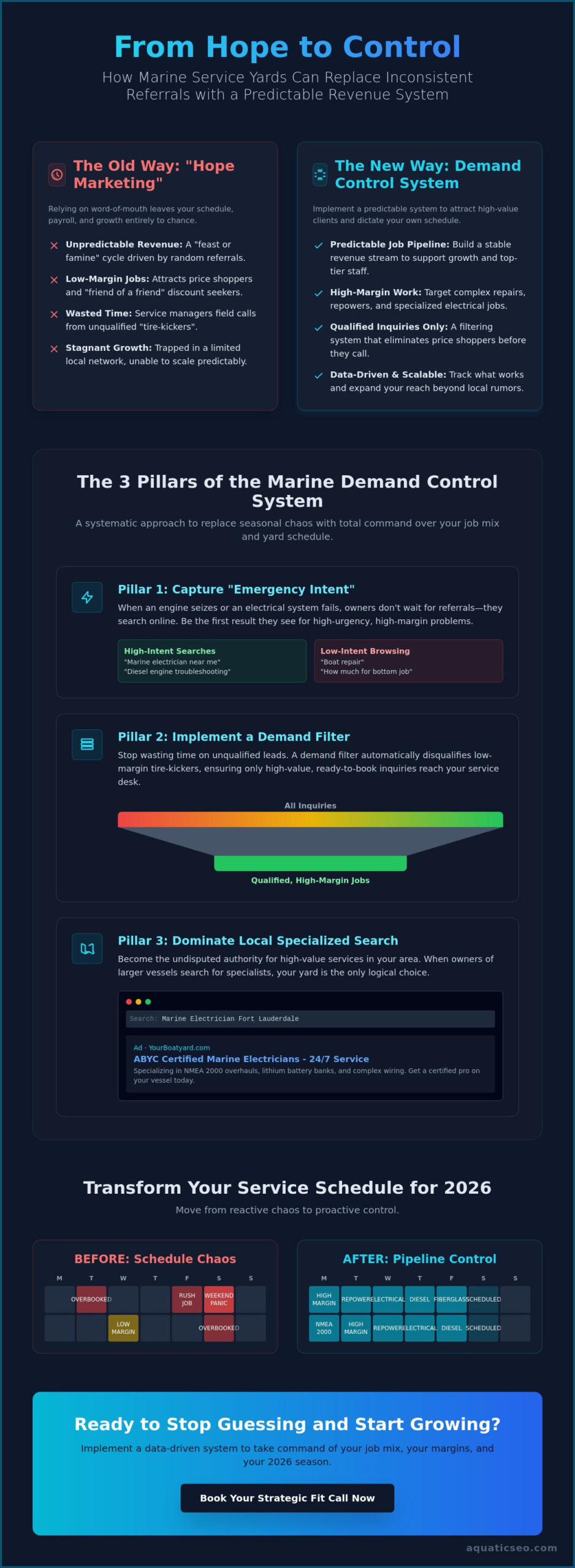
Relying on “Hope Marketing” is no longer a viable strategy for a service yard aiming for organizational stability. The Marine Demand Control System replaces the chaos of unpredictable referrals with a methodical framework designed for precision. This system is the definitive answer to how to get more boat repair customers who value your technical expertise and respect your shop’s margins.
This proprietary approach rests on three critical pillars that transform your business operations:
- Visibility: Ensuring your yard is the primary choice when critical marine systems fail.
- Filtration: Using automated systems to disqualify low-value tire-kickers before they waste your time.
- Command: Gaining total oversight of your schedule to prioritize high-margin repowers and overhauls.
Implementing these pillars results in a stabilized schedule and a job mix that favors your most skilled technicians. You stop reacting to the market and start commanding it. By choosing an industry-native partner like Aquatic SEO, you ensure that every marketing dollar is spent on capturing actual work orders rather than empty digital metrics.
Moving from General Vendor to Specialized Partner
Generic agencies don’t know a transom from a tiller; they optimize for “traffic” that never converts into a billable hour. Working with a specialized partner yields a better ROI because we understand the specific intent behind marine repair searches. This creates a “Demand Compounding” effect where your visibility and filtration systems work together to lower your acquisition costs over time. We reject vanity metrics in favor of Qualified Inquiries that keep your travel lift moving and your bays full.
Your Next Steps to Command Your Market
The transition from being “busy” to being “profitable” begins with a rigorous audit of your current digital presence. You must identify where your “leaks” are; specifically where high-value boat owners are dropping out of your funnel or where low-value leads are getting through. Once these gaps are closed, you can scale your operations with the confidence that your growth is auditable and sustainable. If you’re ready to stop gambling on referrals, you should Book a Fit Call to see if the Marine Demand Control System is the right fit for your yard’s 2026 growth strategy.
Command Your Yard’s Future with Precision
Your service yard shouldn’t be a victim of the season or the local rumor mill. By implementing the Marine Demand Control System, you move from passive hope to operational command. You’ve seen that capturing high-intent inquiries at the moment of failure is the most efficient way of how to get more boat repair customers without sacrificing your margins. It’s about precision, visibility, and the refusal to let “bad demand” dictate your shop’s rhythm.
We specialize in helping marine businesses with revenues between $300K and $5M achieve organizational stability through industry-native expertise. Our No-BS approach ensures you only deal with qualified inquiries that fit your specific technical capabilities. It’s time to stop letting generic agencies waste your time with vanity metrics that don’t move the needle. You have the tools to stabilize your revenue and keep your best technicians busy with high-value work.
Stop chasing leads and start controlling demand; book your Fit Call today.
Take control of your yard’s growth and build the predictable schedule your business deserves.
Frequently Asked Questions
How much should a boat repair shop spend on marketing in 2026?
You should allocate between 3% and 7% of your gross revenue toward business development if you want to maintain a stable schedule. This investment must be auditable and tied directly to work orders rather than vague brand awareness metrics. If your yard is currently under capacity, a higher percentage is necessary to capture active demand and displace local competitors who are currently visible in search results. This ensures your shop stays at peak billable capacity.
Can I get more boat repair customers without using expensive Google Ads?
You can absolutely discover how to get more boat repair customers without a massive ad spend by dominating organic local search. This requires a Google Business Profile that is meticulously optimized for technical terms like “outboard repower” or “marine electrical troubleshooting.” While ads provide immediate traffic, organic visibility creates a compounding asset that lowers your long-term acquisition costs and builds genuine authority in your specific waterway without the per-click fees.
What is the difference between a lead and a qualified inquiry for a service yard?
A lead is a generic name and email from someone who might be browsing; a Qualified Inquiry is a boat owner who has provided their vessel’s make, model, and specific system failure. You don’t want a high volume of leads that clog your service manager’s inbox with “ballpark price” questions. You need a system that filters for intent, ensuring your team only spends time on prospects ready to book a technical diagnosis and pay full shop rates.
How do I rank my marine mechanic business on the first page of Google?
Ranking on the first page requires you to stop trying to rank for generic “boat repair” and start targeting high-intent technical queries. You must create dedicated landing pages for specific engines and systems you service, such as Volvo Penta or Garmin electronics. These pages need to prove your technical authority through case studies and specific certifications rather than just listing your phone number. This focused approach builds trust with owners before they ever call your yard.
Is word-of-mouth still effective for boatyards in the digital age?
Word-of-mouth is a byproduct of good work, but it’s a dangerous foundation for a growth strategy because it lacks predictability. It often brings in “friend of a friend” prospects who expect discounts, which erodes your margins. In the digital age, even referred customers will search for your yard online to verify your expertise; if your digital presence is weak or looks unprofessional, you’ll lose that referral to a competitor who looks more capable online.
What are the most profitable boat repair services to market online?
Focus your marketing on high-complexity, high-margin services like diesel repowers, NMEA 2000 networking, and structural fiberglass repair. General maintenance like oil changes or bottom painting often attracts price shoppers and offers lower returns on your labor costs. By capturing demand for specialized technical repairs, you ensure your ABYC-certified technicians are working on the jobs that generate the highest billable rates for your yard and keep your bays moving efficiently.
How do I stop getting calls from people who only want the cheapest price?
You stop attracting price shoppers by implementing a Demand Filtering System that uses technical language and clear operational standards to repel low-value inquiries. If your website looks like a generic brochure, you’ll get generic callers. When you explicitly detail your specialized process and require detailed vessel information upfront, you signal that you are a premium provider. This naturally disqualifies those who only care about the lowest bid and protects your team’s time.
Do I need a separate website for my boat dealership and my service yard?
You should maintain distinct digital identities for sales and service to avoid confusing search engines and prospects. A boat dealer focuses on inventory and lifestyle, while a service yard focuses on technical precision and operational uptime. If these are combined into a single, generic site, you’ll likely struggle to rank for how to get more boat repair customers because your technical authority will be diluted by your sales listings and general boating content.