Spending $80,000 for a booth at the Miami International Boat Show just to collect a stack of leads from $45 ticket holders is no longer a viable business plan. With consumer sentiment hitting a record low of 48.2 in May 2026, your boat show marketing strategy 2026 must evolve from passive collecting to aggressive demand filtering. You know the frustration of the post-show hangover where your team spends weeks chasing tire-kickers while high-margin service work sits untouched. It’s time to stop treating the show circuit like a lottery and start treating it like a precision operation.
You’ve likely seen your margins shrink as boat loan interest rates climbed as high as 35.99% for some buyers this year. We agree that the old way of more traffic equals more sales is dead in this buyer’s market. This guide will show you how to install a Marine Demand Control System that filters show floor noise into qualified inquiries and predictable revenue. We’ll break down how to capture actual demand and enforce schedule stability throughout the rest of 2026.
Key Takeaways
- Learn how Answer Engine Optimization (AEO) filters your prospects before they ever step onto the show dock, allowing you to target buyers who have already done their research.
- Shift your focus to pre-show demand engineering to book floor appointments with high-intent buyers 60 days before the doors open.
- Deploy a systematic boat show marketing strategy 2026 that uses demand filtering to keep your sales team focused on qualified inquiries rather than tire-kickers.
- Stop the “dead weeks” following show season by implementing a strict 48-hour follow-up rule and automated compounding systems for “not yet” buyers.
- Discover how the Marine Demand Control System creates revenue stability and protects your margins by enforcing a predictable job mix throughout the year.
The 2026 Boat Show Landscape: Why Traditional Tactics Fail
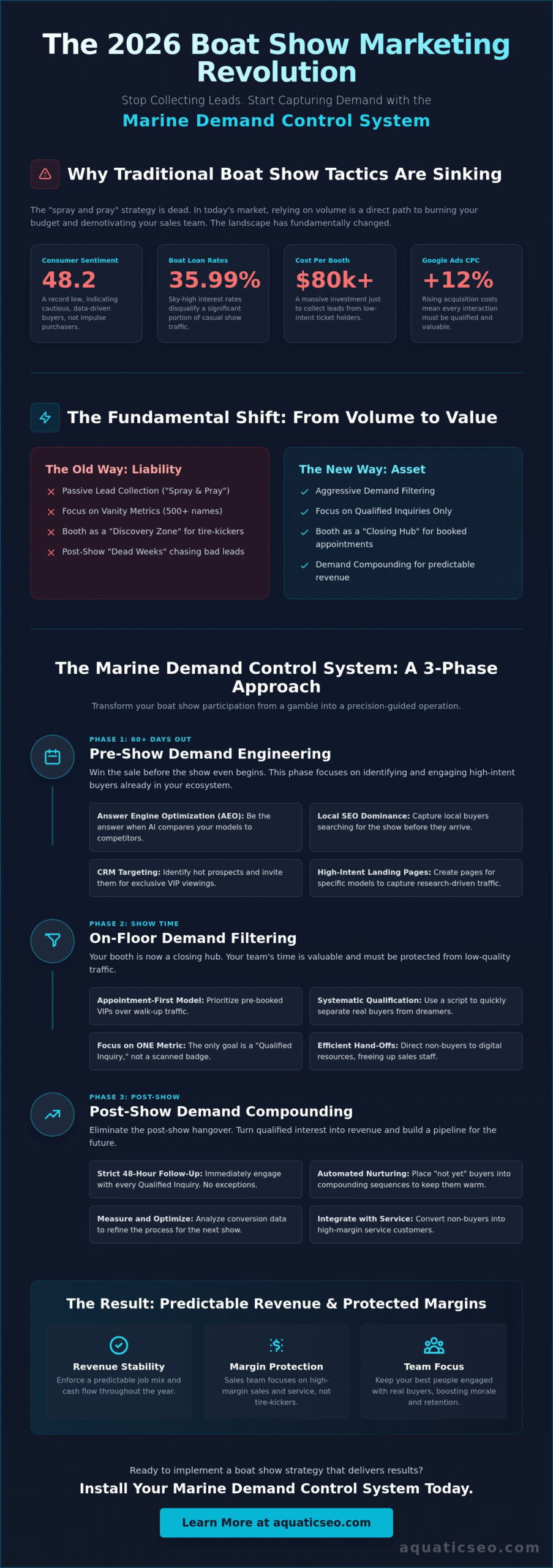
The “spray and pray” booth strategy is officially dead. In 2026, simply showing up with a few shiny hulls and a bowl for business cards is a fast way to burn your marketing budget. With the University of Michigan Consumer Sentiment Index hitting a record low of 48.2 in May 2026, buyers aren’t making impulse decisions on the show floor. They are cautious, skeptical, and armed with more data than your sales team. Your boat show marketing strategy 2026 must move away from the traditional model of gathering “leads” and toward a system of capturing actual demand. While trade show fundamentals still matter for networking, the digital pre-filtering of prospects has changed the game entirely.
AI Search and the 2026 Marine Buyer
Prospective buyers are no longer using Google just to find a list of websites. They use Answer Engines to get direct comparisons. By the time a prospect arrives at the Miami International Boat Show, they’ve likely already asked an AI to compare your outboard engine’s fuel efficiency against your competitors. This shift toward zero-click searches means your inventory is being pre-sold or disqualified before the doors even open. To win, boat dealers must optimize for these specific intent queries to ensure their brand is the one the AI recommends. If you aren’t visible in the AI’s “near me” show queries, you’re invisible to the most informed buyers on the floor.
The Problem with Vanity Metrics at Shows
A list of 500 names is not an asset; it’s a liability for your sales team. Chasing low-intent show leads wastes time that should be spent on high-margin service work or serious buyers. With Google Ads CPC rising 12% to $2.96 in Q1 2026, every interaction has a measurable cost. If your team spends 20 minutes talking to a “tire-kicker” who can’t qualify for a loan with interest rates hitting 35.99%, you’ve lost money. You must transition from vague brand awareness to demand capture. This requires a shift in mindset where a “Qualified Inquiry” is the only metric that matters, not the total number of badges scanned. Success in your boat show marketing strategy 2026 depends on your ability to filter the noise and focus on the small percentage of the crowd that is actually ready to sign a contract.
Pre-Show Demand Engineering: Winning Before the Doors Open
Most dealers wait for the show to start before they begin selling. This is a fatal mistake. Your boat show marketing strategy 2026 should focus on winning the sale at least 60 days before the first ticket is scanned. You must identify high-intent buyers already sitting in your CRM. These are the prospects who looked at specific inventory pages or opened your service emails multiple times in the last month. By reaching out early with exclusive “VIP” viewing times, you ensure your best sales staff aren’t busy talking to tourists when a serious buyer walks onto the dock.
Targeting the Right Audience
You must differentiate between the “dreamer” who wants a free hat and the Qualified Inquiry ready to discuss financing. Using local SEO to dominate “boat show” search results in your specific territory allows you to capture local demand before it gets diluted by the national crowd. Successful boat dealers are already using this approach to book demos weeks in advance. This shift is part of the evolving boat show marketing landscape where digital precision replaces physical volume. If you don’t own the search results for your local show, you’re handing your best prospects to the competition.
Digital Assets That Drive Appointments
Your website must act as a 24/7 filter. Instead of generic banners, use high-intent landing pages for specific models you’ll have on display. If you’re showing a new center console equipped with Brunswick’s “AutoCaptain” system, create a page that explains the technical advantages of that specific vessel. Use SEO-rich text to capture those researching specific features like joystick controls or hybrid propulsion. Retargeting past show visitors who haven’t purchased yet keeps your inventory front-of-mind as they plan their 2026 season.
This “Active Buyer Capture” framework ensures your booth is a closing hub, not a discovery zone. When you control the demand before the event, you control your revenue cycle for the rest of the year. It’s about building a predictable system that filters out the noise. If you want to see how this fits into your specific operation, you can explore our demand filtering systems to see if we’re a match for your 2026 growth goals.
Filtering the Floor: Systems to Separate Buyers from Tire-Kickers
Your sales team shouldn’t talk to everyone on the floor. It’s a hard rule that protects your margins. When a booth at the Miami International Boat Show costs $80,000, every minute spent with a “tire-kicker” is a direct hit to your ROI. The core of a successful boat show marketing strategy 2026 is implementing a Marine Demand Control approach that uses digital systems to enforce filtering before a human ever engages. This ensures your best closers are only talking to people who can actually sign a contract.
Use QR codes and digital kiosks to handle initial intake. These systems ask the hard questions about budget and timeline that sales reps often skip to avoid being “rude.” By the time your staff steps in, they should already know if they are speaking to a Qualified Inquiry or someone just looking for a free brochure. This methodical approach turns the chaos of the show floor into an auditable process where every interaction has a purpose.
The Demand Filtering Framework
Automation allows you to ask qualifying questions like, “Do you currently own a vessel?” or “Are you looking to close before the 2026 season ends?” This data lets your team prioritize high-value yacht charters or luxury sales over low-margin traffic. You must empower your staff to politely exit conversations with prospects who don’t fit your ideal client profile. This isn’t being elitist; it’s being operational. It ensures your resources are focused where they can actually generate revenue in a market where consumer sentiment is at a record low.
Data Capture vs. Demand Capture
An email address is just data. A buying signal is demand. Your boat show marketing strategy 2026 must rank floor leads by an intent score based on their digital and physical interactions. If a prospect scans a QR code for a specific engine spec sheet and then watches a demo video, that’s a high-intent signal. Every inquiry must be tracked to the specific source to prove which show tactics are working. This level of control prevents the post-show “dead weeks” by giving your team a prioritized list of who to call first.
Post-Show Demand Compounding: Preventing the Dead Weeks
The real work begins when the show floor clears. Most businesses fail here, letting high-intent inquiries go cold while the sales team recovers from the five-day grind. You must enforce a strict 48-hour follow-up rule for every Qualified Inquiry captured during the event. In a market where consumer sentiment hit an all-time low of 48.2 in May 2026, speed is your only defense against buyer hesitation. Your boat show marketing strategy 2026 must prioritize immediate, personalized contact to maintain the momentum generated at the booth.
Waiting a week to reach out is an expensive mistake. By then, the prospect has already been retargeted by three other dealers. With Google Ads CPC rising 12% to $2.96 in Q1 2026, you cannot afford to waste the demand you’ve already paid for. Use the data captured on the floor to rank your follow-ups by intent score. This ensures your best closers are on the phone with the highest-margin prospects while your automated systems handle the rest.
Automated Nurturing for Marine Brands
Stop sending generic “thank you for visiting” emails that offer no value. Your follow-up sequence must provide specific technical insights based on the vessel type the prospect scanned. If they spent time looking at midsize family boats during the New York Boat Show in January 2026, send them a comparison of hybrid propulsion options or a winter storage guide. This data informs your broader marine marketing strategy by showing you exactly what content converts “not yet” buyers into owners. Automation shouldn’t feel robotic; it should feel like a continuation of the expert conversation you started on the dock.
Stabilizing Your Operations
Use show demand to fix the “busy weeks followed by dead weeks” cycle that kills your profitability. Instead of trying to close every deal in a single week and crushing your service yard schedule, use demand compounding to stagger your delivery and maintenance work. This allows you to enforce premium pricing even when the initial show rush fades. You aren’t just selling a boat; you’re controlling your revenue cycle for the next 12 months. Managing the “dead period” requires a system that keeps your brand visible without manual labor. If you are ready to stop the post-show revenue drop, book a fit call to stabilize your operations.
Implementing the Marine Demand Control System for 2026
Generic marketing agencies fail in this sector because they treat a high-performance center console like a common household appliance. They focus on “clicks” and “impressions” while your service yard remains empty or your sales team spends weeks chasing prospects who can’t secure a loan. To win, your boat show marketing strategy 2026 must move past the “agency” model and embrace a growth partner relationship. We don’t sell vague promises of more traffic. We install a Marine Demand Control System designed to capture demand and filter out the noise that kills your margins.
Our approach is built on four rigid pillars: Capture, Filter, Enforce, and Dominate. We first Capture active buyers 60 days before the show using intent-based digital assets. We then Filter the traffic through automated systems to ensure only a Qualified Inquiry reaches your sales floor. Next, we Enforce schedule stability by using show demand to fill your 2026 calendar strategically. Finally, we Dominate your local territory by making your brand the only logical choice for serious buyers. This system turns the chaos of show season into a predictable revenue engine.
Why Specialization Matters
Marketing is about generating noise; demand control is about managing operations. Most agencies don’t know the difference between a Yacht Charter and a boat rental, and that lack of industry-native knowledge leads to wasted ad spend. We prioritize your margins by ensuring your sales team doesn’t waste time on low-intent traffic. Our guarantee is built on business outcomes: we deliver qualified inquiries that lead to high-margin sales, not just vanity traffic counts that look good on a report but do nothing for your bank account.
Your 2026 Show Game Plan
Preparation starts exactly six months before your primary show opens. You must begin by auditing your 2025 performance with an honest look at your ROI. If you can’t trace your most recent sales back to a specific digital touchpoint or pre-show appointment, your current strategy is a black hole. Identify which models drove the most inquiries and which ones only attracted tire-kickers who couldn’t handle 2026 interest rates.
We provide a No-BS analysis of your current show strategy to find the leaks in your funnel. This isn’t a generic pitch; it’s a deep dive into your local market demand and competitor visibility. If you’re tired of the “spray and pray” booth model and want to own your market, it’s time to act. Book a Fit Call to secure your territory for 2026 and start treating your next show like the precision operation it should be.
Take Control of Your 2026 Revenue Cycle
The record low consumer sentiment of 48.2 recorded in May 2026 means you can’t afford a passive approach to events. Your boat show marketing strategy 2026 must move beyond the vanity of booth traffic and focus on the precision of the Marine Demand Control System. By engineering demand 60 days out and enforcing strict filtering on the floor, you protect your margins and eliminate the dead weeks that follow show season. We specialize exclusively in helping marine contractors and dealers convert show floor noise into Qualified Inquiries that fill your service bays and sales logs year round.
Stop settling for a list of names that never turns into a contract. You deserve a predictable flow of high-value work that provides operational stability regardless of interest rate fluctuations. It’s time to stop treating your marketing like a gamble and start treating it like a system. Stop wasting money on show booths and start controlling your demand, Book your 2026 Strategy Analysis here. Your territory is waiting for a leader who knows how to dominate the floor.
Frequently Asked Questions
What is the most effective boat show marketing strategy for 2026?
The most effective strategy is a systematic approach that engineers demand 60 days before the show doors open. Your boat show marketing strategy 2026 must prioritize pre-booked appointments over random booth visits to ensure your sales team stays focused on closing. This shift moves your operation away from the “spray and pray” model that wastes $80,000 on booth space without a precision plan.
How do I filter out tire-kickers at a boat show?
Use digital kiosks and QR codes to enforce a demand filtering system before your sales staff engages. These tools ask critical questions about budget, current vessel ownership, and buying timelines that human reps often skip to avoid being rude. By ranking prospects with an intent score in real time, you can politely exit conversations with low-margin dreamers and focus on high-value buyers.
Is digital marketing more effective than a physical boat show booth?
Digital marketing is the engine that makes a physical booth profitable in 2026. While a booth provides the physical touchpoint, digital systems capture and filter the demand before the prospect even arrives. Without a strong digital presence, you are relying on the luck of the draw from the general public. This is a high-risk gamble in a market where consumer sentiment is at a record low.
How much should a boat dealer spend on show marketing in 2026?
A boat dealer should expect to spend between $60,000 and $80,000 for a standard display at a major event like the Miami International Boat Show. However, you must allocate an additional 15% to 20% of that budget specifically for digital demand capture and pre-show engineering. Spending on a booth without supporting digital infrastructure is simply subsidizing the show organizer’s profit at the expense of your own.
What is a ‘Qualified Inquiry’ in the marine industry?
A Qualified Inquiry is a prospect who has demonstrated clear intent, has the financial capacity for current interest rates, and has a specific timeline for purchase or service. This is distinct from a lead, which is often just an email address from someone who wanted a free hat. Our Marine Demand Control System ensures you only spend time on inquiries that have a high probability of reaching a contract.
How do I maintain sales momentum after the boat show season ends?
Maintain momentum by enforcing a strict 48-hour follow-up rule for all high-intent inquiries. Use automated compounding systems to provide technical value to “not yet” buyers while your team closes the immediate deals. This prevents the typical post-show revenue drop and keeps your service yard or sales floor busy for the next 12 months. Speed is your only defense against buyer hesitation in 2026.
Can AI search engines help drive boat show attendance?
AI search engines drive attendance by answering specific research questions that lead prospects to your inventory before they hit the floor. By optimizing for Answer Engine Optimization (AEO), you ensure your brand is the one recommended when a buyer asks an AI to find the best vessels at a specific show. This pre-filtering creates a more informed and ready-to-buy attendee for your booth.
Why do most boat show leads fail to convert into sales?
Most leads fail to convert because dealers wait too long to follow up and fail to filter out tire-kickers during the event. When follow-up takes more than 48 hours, the buyer’s excitement fades, especially with consumer sentiment at a record low of 48.2 in May 2026. Conversion requires a boat show marketing strategy 2026 that treats every hour after the show as a critical window for closing the sale.