Most marine contractors believe the secret to growth is a higher volume of inquiries, but chasing more “leads” is often what kills your profit margins. You spend your mornings quoting small dock repairs for tire-kickers when you should be securing six-figure bulkhead replacements or complex pier builds. If your current strategy for generating leads for marine construction projects relies on a generic agency that can’t explain the difference between an Army Corps permit and riparian rights, you’re wasting money. You don’t need more people calling you; you need a system that filters out the noise and positions you as the authority for high-stakes coastal engineering.
You know that word-of-mouth is great until the phone stops ringing; generic marketing just brings in people who can’t afford your mobilization costs. It’s frustrating to watch your schedule fluctuate while labor rates and material costs, like the 25.4% jump in steel framing prices seen this year, continue to climb. This guide shows you how to build a demand filtering system that captures high-value inquiries and ignores the rest. We’ll explore how to move beyond inconsistent referrals to create a predictable pipeline of high-margin projects.
Key Takeaways
- Stop treating every phone call as a win and start using Demand Filtering to exclude low-margin tire-kickers before they reach your desk.
- Master the art of generating leads for marine construction projects by targeting high-intent search terms related to structural failures and seawall repairs.
- Build a digital gatekeeper on your website that uses project minimums and technical fields to disqualify prospects who cannot afford your mobilization costs.
- Prove your expertise by showcasing technical precision and regulatory knowledge of Army Corps permits rather than just posting photos of finished docks.
- Shift from a reactive word-of-mouth model to a controlled pipeline that delivers higher contract values and better job-mix stability.
The Lead Volume Trap: Why Generic Marketing Fails Marine Contractors
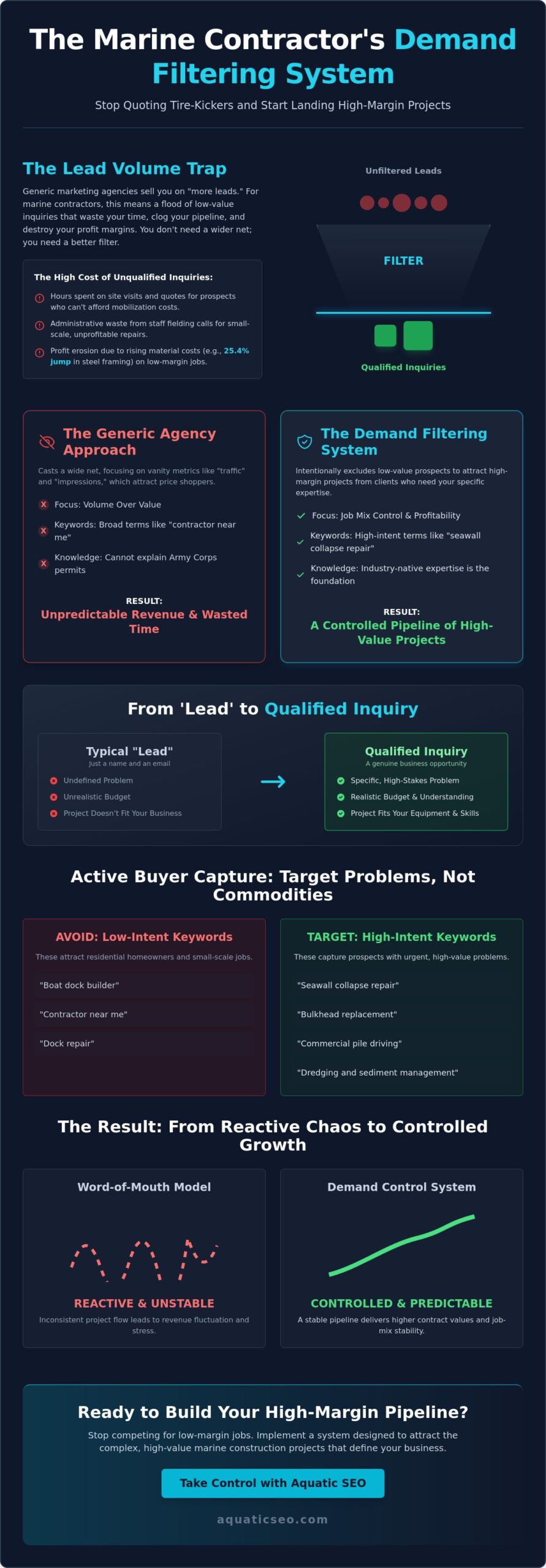
Generic marketing agencies love to brag about “more traffic” and “increased impressions.” They treat your business like a local bakery rather than a specialized engineering firm. For a marine contractor, more traffic usually means your office staff spends forty hours a week answering calls from people who want a five-hundred-dollar repair on a rotting pier. This is the lead volume trap. It’s a cycle where you pay for visibility but end up with administrative waste that eats your profit. You don’t need a wider net; you need a better filter.
Generating leads for marine construction projects shouldn’t be about casting the widest net possible. It requires Demand Filtering. This is the process of intentionally excluding low-value prospects before they ever reach your desk. You don’t want every homeowner on the coast to call you. You want the property owner whose bulkhead is failing and who understands that mobilization costs alone exceed their neighbor’s entire budget. When you focus on specific business outcomes like job mix control, you stop being a slave to your phone and start being the architect of your revenue.
The High Cost of Unqualified Inquiries
Quoting a major seawall installation takes hours of technical assessment and site visits. If you spend that time on “tire-kickers” who are just price-shopping, you’re losing money on every minute of lost opportunity. Traditional agencies celebrate high counts in lead generation reports because they don’t understand your job cycle. They see a form submission as a win, even if that person can’t afford a single pile. You need a system that acts as a gatekeeper, ensuring your time is reserved for high-margin projects rather than small-scale repairs that barely cover your overhead.
Why ‘Industry-Native’ Knowledge Matters
A “lead” is just a name and an email; a Qualified Inquiry is a prospect with a specific problem, a realistic budget, and a project that fits your equipment. Generic marketers fail because they don’t know the difference between riparian rights and a property line. They can’t write content about Army Corps of Engineers permitting or DEP regulations because they’ve never been on a barge. Digital Marketing for Marine Contractors requires a deep understanding of these technical nuances. Without this industry-native perspective, your marketing will always attract the wrong crowd. You need a Marine Demand Control System to stabilize your revenue and take back control of your job mix.
Active Buyer Capture: Positioning for High-Intent Marine Projects
Positioning your business for high-intent projects is the only reliable way of generating leads for marine construction projects that actually move the needle. Most agencies waste your budget bidding on broad terms like “contractor near me.” This attracts residential homeowners looking for a deck repair or a quick fix. If you want to secure $100,000+ contracts, your digital presence must target the property owner facing immediate structural failure or erosion. These buyers aren’t browsing; they’re searching for a specific solution to a high-stakes problem.
Targeting the Right High-Intent Keywords
You must distinguish between commodity services and capital projects. A search for “boat dock builder” often leads to low-margin residential work. Conversely, targeting “custom marina construction” or “commercial pile driving” signals that you operate at a higher level. By Building Niche Expertise through your content, you attract prospects who value technical skill over the lowest bid. Focus your strategy on these high-intent terms:
- Dredging services and sediment management
- Seawall collapse repair and emergency stabilization
- Bulkhead replacement and helical pile installation
- Sheet piling and cofferdam construction
Dominating these terms ensures you appear when a Qualified Inquiry is ready to sign. This level of precision is central to successful Marine Construction Operations and market visibility. You should also focus your local SEO efforts on specific coastal zip codes where high-value waterfront assets are concentrated. This geographic precision prevents you from wasting resources on inland areas where your heavy equipment isn’t needed.
Landing Pages That Filter, Not Just Capture
Your website shouldn’t just be a gallery of pretty sunsets and finished docks. High-value buyers need to see technical specifications and your mastery of the regulatory environment. Front-load your landing pages with information about Army Corps permits, DEP compliance, and soil stabilization techniques. This demonstrates that you understand the logistical hurdles of coastal work. A high-intent buyer for a $200,000 seawall project is an asset owner who prioritizes engineered durability and permit-ready execution over the cheapest available quote.
When your pages speak the language of engineering and oversight, you naturally discourage the price-shoppers. Show your specialized equipment and explain your pile-driving depth standards. If you want to refine your approach to capturing these high-margin contracts, consider how Digital Marketing for Marine Contractors can streamline your intake process.
Demand Filtering: How to Stop Wasting Time on Low-Margin Inquiries
Generating leads for marine construction projects shouldn’t result in a cluttered calendar of five-thousand-dollar repair quotes. If your phone rings constantly but your profit margins are shrinking, you have a volume problem, not a growth problem. You’re likely acting as a “bidder” in a crowded market rather than the “selected expert” for high-stakes coastal engineering. To fix this, you must install a digital gatekeeper that protects your time and filters out prospects who can’t afford your mobilization costs.
Demand filtering is the operational solution to administrative bloat. It’s the process of using your digital presence to disqualify the wrong people before they ever reach your desk. When you stop chasing every “lead” and start focusing on a Qualified Inquiry, your entire business stabilizes. You gain the leverage to dictate terms rather than begging for a signature on a low-margin contract. This isn’t just about marketing; it’s about protecting the financial health of your firm.
The Mechanics of a Demand Filtering System
Your website shouldn’t just be a contact form with a name and email field. An effective Digital Marketing for Marine Contractors strategy uses automated intake forms to categorize project scale immediately. Ask for linear footage, current permit status, and specific project goals. If a prospect isn’t willing to provide these details, they aren’t a serious buyer. Use case studies that highlight technical challenges, such as navigating complex environmental regulations or deploying specialized barges in tight canals.
By referencing standards from the International Marine Contractors Association (IMCA), you signal that your firm operates with a level of precision that “dock builders” can’t match. This sets a high entry bar. It educates the prospect on the technical requirements of quality marine work while simultaneously discouraging those looking for a quick, cheap fix. You want your content to act as a filter that only lets the most profitable opportunities through.
Controlling Your Job Mix
Your “Job Mix” is the ratio of high-margin new builds to low-margin maintenance work. If your yard is full of equipment designed for major seawall installations but your crews are stuck doing small pier repairs, your marketing is misaligned. You can use demand filtering to “turn off” the tap for services that no longer serve your bottom line. This requires a psychological shift. You must be comfortable saying “no” to the wrong projects to keep your schedule open for the right ones. This level of control is the difference between a reactive contractor and a market leader.
Building Authority through Technical Precision and Proof
High-value prospects aren’t looking for a “pretty” dock. They want to know their investment won’t wash away in five years. Showing a finished project is baseline; showing a properly driven pile demonstrates engineering competence. This level of transparency is vital for generating leads for marine construction projects that involve heavy infrastructure. Document the “unseen” quality of your work to separate yourself from the residential “dock builders” who lack your technical depth.
Use technical case studies to address objections about soil stability or pile depth before the client even asks. If you can prove you meet or exceed specific engineering standards, you aren’t just another contractor; you’re a specialist operator. This builds a case for your value that a lower bid can’t dismantle. It turns your marketing into a business development asset rather than a cost center.
Permits and Regulations as a Marketing Asset
High-value clients fear the red tape. When you explain the permitting process for the Army Corps of Engineers or the DEP, you’re positioning your firm as the navigator of coastal bureaucracy. This transparency builds trust faster than any promotional slogan. Your mastery of riparian rights is a primary conversion factor because it proves you can legally and technically execute a complex build where others might fail.
Visual Proof of Heavy Construction
Stock images of water are useless. Use drone footage to show the scale of your equipment and your site management precision. Real proof of erosion control, such as side-by-side comparisons of failing bulkheads versus your reinforced solutions, outperforms generic marketing every time. For projects involving Service Yards and Boatyards, showing your ability to work around existing maritime infrastructure is a major selling point.
Stop letting generic agencies write “fluffy” content that ignores your technical skill. If you’re ready to build a system that highlights your expertise and attracts high-margin contracts, book a fit call today to start controlling your demand.
Implementing the Marine Demand Control System for Your Business
Relying on word-of-mouth is a gamble you can’t afford in a market where construction salaries are rising by 8–12% in 2026. Word-of-mouth is passive. It doesn’t scale. Most importantly, it doesn’t filter. When you take an active approach to generating leads for marine construction projects, you stop waiting for the phone to ring and start choosing the projects that hit your profit targets. This shift requires a commitment to systems over “gut feelings.”
You should expect your total call volume to drop. This is a sign the system is working. A silent phone is better than a phone ringing with callers who can’t afford a $180 per linear foot concrete dock. You want fewer conversations but higher contract values. This precision allows your project managers to focus on execution rather than spending forty hours a month on dead-end quotes. Focus on the financial health of the firm rather than superficial engagement counts.
Success in this model relies on auditable tracking. You must see the direct line between a specific search term and a high-margin contract. This level of oversight ensures your marketing budget isn’t a black hole. It becomes a predictable engine for organizational stability. Knowing exactly which channel delivered a client for a pile-supported composite dock build allows you to reinvest with confidence.
The Synthesis: Stability through Systems
Generic agencies failed marine contractors in 2025, and they’ll continue to fail them in 2026. They don’t understand the 5.4% CAGR of the ports construction market or the technical requirements of the new ABS vessel rules. The Marine Demand Control System acts as your bridge to consistent revenue by aligning your digital visibility with your operational capacity. For a deep dive into these mechanics, read our Digital Marketing for Marine Contractors: The 2026 Demand Control Guide.
Next Steps for Qualified Operators
Determine if your current marketing creates waste or wealth. If your team is overwhelmed by low-quality inquiries, you’re subsidizing waste. Preparing your internal staff for a higher quality of inquiry is the final step in taking market control. You need an intake process that respects the technical precision of your field crews. If you’re ready to stop chasing volume and start controlling your pipeline, Book a Marine Service Call today for a specialized analysis of your local coastal market.
Secure Your Local Coastal Authority
Transitioning from a reactive contractor to a market leader requires more than just a website; it requires a specialized Marine Demand Control System. You’ve seen why chasing raw volume leads to administrative burnout and why technical precision in your content filters out the tire-kickers. By focusing on high-intent projects like bulkhead replacements and seawall stabilizations, you ensure your equipment stays on high-margin job sites. This methodical approach turns your digital presence into a business development asset that works as hard as your field crews.
Generating leads for marine construction projects is a matter of precision, not persistence. Our industry-native expertise in coastal regulations and Army Corps permitting ensures your business speaks the language of engineering that high-value property owners demand. We maintain a relentless performance-based focus on high-margin projects to stabilize your revenue and give you total control over your job mix. It’s time to stop letting unqualified inquiries dictate your schedule and start building with intent.
Stop chasing leads and start controlling your demand. Request a No-BS Marine Marketing Analysis today. You have the heavy equipment and the technical skill to dominate your local market; it’s time your digital strategy reflected that expertise.
Frequently Asked Questions
What is the difference between a lead and a Qualified Inquiry in marine construction?
A lead is simply raw contact information, while a Qualified Inquiry represents a prospect with a specific project scope, a verified budget, and a site that accommodates your heavy equipment. Most agencies deliver leads that waste your time. We focus on inquiries that represent six-figure bulkhead or pier builds. This distinction ensures your estimators spend their time on high-margin opportunities rather than quoting minor repairs for property owners who can’t afford your mobilization fees.
How do I stop getting calls for small dock repairs when I want seawall projects?
You must stop bidding on broad terms like “dock builder” and start targeting specific structural failures that require heavy machinery. Generating leads for marine construction projects requires a strategy that highlights your specialized equipment and project minimums. By using demand filtering on your website, you can force prospects to identify their project scale. This discourages homeowners looking for a quick fix and leaves your schedule open for major seawall and bulkhead installations.
Can SEO actually help me win government or commercial marine contracts?
Yes, because procurement officers and commercial developers use search to vet the technical competence of potential subcontractors. They look for proof of regulatory expertise and a history of navigating Army Corps of Engineers permits. Your digital presence acts as a pre-qualification tool. When you demonstrate an understanding of riparian rights and coastal engineering standards, you position your firm as the low-risk choice for high-stakes government or commercial infrastructure projects.
Why is my marine construction business seeing low-margin leads from Google Ads?
Your ads are likely targeting broad search intent that includes residential maintenance and DIY repairs. Generic agencies often fail to use negative keywords that exclude “cheap” or “repair” searches. If your ads don’t explicitly target high-intent terms like “commercial pile driving” or “sheet piling,” you’ll attract price-shoppers. You need a system that prioritizes high-intent business outcomes over superficial click counts to ensure your ad spend drives profit, not just traffic.
What is a Demand Filtering System and how does it work for contractors?
A Demand Filtering System is a digital gatekeeper that uses automated intake forms and technical content to disqualify low-value prospects before they call you. It works by requiring specific project details, such as linear footage and permit status, which tire-kickers usually lack. This system ensures that every person who reaches your desk is a Qualified Inquiry. It shifts your business from a reactive bidding model to a controlled pipeline of high-margin marine construction work.
How much should a marine contractor spend on digital marketing in 2026?
Your budget should be calibrated to the cost of acquiring a high-margin project rather than a generic percentage of revenue. In 2026, successful contractors are reinvesting based on auditable tracking of project profitability. You shouldn’t spend a dime on “brand awareness” that doesn’t result in a predictable pipeline of Qualified Inquiries. Focus your resources on dominating high-intent search terms in specific coastal zip codes where the most valuable waterfront assets are located.
Do I need to show my prices on my website to filter out bad leads?
You don’t need to list every fee, but you should clearly state your project minimums and the technical complexity you handle. Listing a starting project value filters out those looking for small-scale maintenance. It establishes an immediate expectation of quality and scale. This transparency protects your administrative staff from wasting hours on quotes for projects that don’t meet your mobilization requirements or your desired job mix for the quarter.
How does technical content about permits help generate construction leads?
Technical content about permits acts as a primary conversion factor by proving you can navigate the coastal bureaucracy that terrifies most property owners. When you explain the nuances of DEP compliance or local environmental board requirements, you build immediate authority. High-value buyers are looking for a contractor who can handle the entire lifecycle of a project, including the red tape. This specialized knowledge is a powerful tool for generating leads for marine construction projects.