In 2026, the U.S. boating industry is projected to exceed $61.3 billion in total sales, yet many boat dealers find themselves frustrated by a relentless stream of low-quality leads from social platforms. Statistics show that first-time buyers now represent 38% of the market, and 64% of them rely on social media for research. If your current strategy involves posting pretty photos and hoping for the best, you’re likely wasting ad spend on generic audiences. Understanding how to use social media to sell boats requires moving past vanity metrics and treating your digital presence as a rigorous filtration system.
You likely feel the frustration of a sales team burnt out by looky-loos who have no intention of signing a contract. We’ll show you how to pivot from passive posting to a precision-engineered strategy that delivers qualified inquiries directly to your dealership. This article outlines the exact framework for capturing high-intent buyers and eliminating the noise that drains your operational efficiency.
Key Takeaways
- Stop chasing “likes” and start prioritizing Qualified Inquiries that stabilize your dealership revenue and reduce sales team frustration.
- Learn how to use social media to sell boats by deploying platform-specific tools that target high-intent buyers based on specific inventory triggers.
- Implement Demand Filtering to automatically remove “looky-loos” and low-quality noise from your social messaging channels.
- Replace glossy marketing photos with technical walkthrough videos to address buyer skepticism and prove vessel specifications before the first contact.
- Integrate your social activity into a broader Demand Control System to ensure every post contributes to a predictable and auditable sales funnel.
The Failure of Vanity Metrics in Marine Marketing
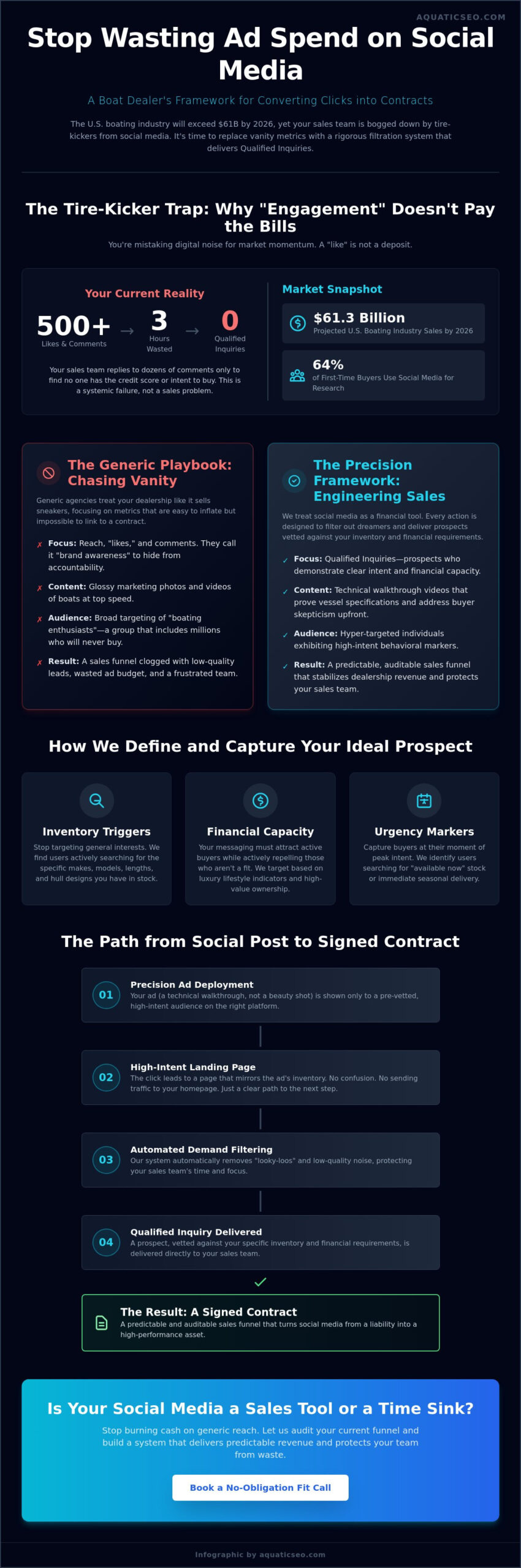
You post a high-resolution video of a new center console hitting 60 knots. By morning, the post has 500 likes and 40 comments asking “What’s the top speed?” or “Wish I could afford this.” Your sales team spends three hours replying to these notifications; only to find that not one person has the credit score or the intent to buy. This is the tire-kicker trap. Most boat dealers mistake digital noise for market momentum. If you want to know how to use social media to sell boats, you must first accept that a “like” is not a deposit. It is often just a distraction from real buyers.
Generic agencies love reporting on reach and engagement because these metrics are easy to inflate. They treat social media marketing as a popularity contest rather than a financial tool. When an agency cannot track a direct line to a signed contract, they hide behind “brand awareness.” For a marine business with revenues between $300K and $5M, awareness does not pay the floorplan interest. You need a system that filters out the dreamers and captures high-intent prospects. We distinguish between a “lead,” which is just an email address, and a “Qualified Inquiry,” which is a prospect vetted against your specific inventory and financial requirements.
Why Generic Social Media Strategies Miss the Mark
Generic agencies treat boat buyers like they are buying a pair of sneakers. They ignore that a yacht or a high-end fishing boat is a complex asset with a long-tail sales cycle. Chasing unqualified engagement is expensive. It wastes your ad budget on people who will never step foot in your showroom. Our approach to Digital Marketing for Boat and Yacht Dealers prioritizes functional efficiency over superficial trends. We don’t want your posts to go viral among people who can’t afford your product. We want them to land in front of the five people in your region ready to buy this month.
Defining Your Ideal Marine Prospect
Your ideal prospect is not just someone who “likes boats.” They are individuals exhibiting high-intent behavioral markers. They search for specific hull designs, compare outboard maintenance specs, and engage with technical walkthroughs. Stop talking to the dreamer who wants a boat “someday.” Your messaging must have a specific point of view that attracts the active buyer while actively repelling those who aren’t a fit. This requires moving beyond basic demographics to focus on intent-based data:
- Inventory Triggers: Users searching for specific makes, models, or lengths.
- Financial Capacity: Targeting based on luxury lifestyle indicators and high-value ownership.
- Urgency Markers: Identifying users looking for “available now” stock or immediate seasonal delivery.
Capturing High-Intent Buyers: How to Use Social Media to Sell Boats
Precision is the only way to avoid burning cash on generic reach. When you master how to use social media to sell boats, you stop targeting “boating enthusiasts” and start targeting individuals with specific inventory triggers. Use behavioral data to identify prospects who are comparing hull specs or researching outboard configurations in real-time. This level of oversight ensures your ads appear only when a buyer is moving from the research phase to a state of high intent.
Mirroring your best existing customers through lookalike modeling is a core step in how to use social media to sell boats effectively. While the social media guide for small businesses offers a basic starting point, a marine-specific strategy requires deeper operational oversight. You must address the actual pains of ownership, like dockage availability or maintenance cycles, to capture the attention of serious buyers. This methodology transforms your social presence from a billboard into a functional sales tool.
Directing traffic to high-intent landing pages is mandatory for conversion. Sending a social click to your home screen is a rookie mistake that confuses the prospect and wastes the ad spend. Every click must land on a page that mirrors the specific inventory featured in the ad. If you need a technical audit of your current funnel, book a fit call with our team to see where your system is leaking Qualified Inquiries.
Platform Selection for Boat Dealers and Charters
Different marine business models require different digital environments. Facebook remains the primary engine for boat dealers because its data allows for granular targeting of high-net-worth individuals. Instagram serves as the visual gallery for yacht charters, where aesthetic appeal drives initial interest. YouTube fills the gap for technical buyers by providing a virtual sea trial experience that addresses mechanical skepticism before the first contact.
Ad Creative that Filters as it Attracts
Effective ads must repel the wrong people while attracting the right ones. Avoid clickbait headlines that promise generic excitement. Instead, use specific pricing and current availability to pre-qualify the reader before they ever click your link. Transparent specifications act as an immediate filter, ensuring that only those who understand the value and requirements of the vessel move forward in your sales process.
Demand Filtering: Protecting Your Sales Team from Waste
Engagement is a liability if it doesn’t lead to a Qualified Inquiry. Most generic agencies tell you to reply to every comment to boost reach. This is a waste of your time. If a commenter isn’t a buyer, their interaction has zero financial value. Demand Filtering is the mechanical process of removing low-intent noise from your sales funnel before it reaches your team. It shifts your focus from passive “post and pray” methods to Active Buyer Capture.
Effective social media strategies for high-value assets rely on modernized marketing strategies for luxury brands that prioritize exclusivity over broad reach. You must use automated qualifiers within social messaging apps to vet prospects instantly. When someone clicks an ad or sends a message, an automated sequence should ask for their timeline, trade-in status, and budget. This transition ensures that only CRM-logged inquiries with verified data ever touch a salesperson’s desk.
The Role of Lead Qualification Forms
Adding friction to your forms is a strategic advantage. If a prospect isn’t willing to answer four specific questions about their boating needs, they aren’t ready to buy. You should ask about their preferred cruising grounds, current vessel ownership, and financing readiness. These questions distinguish a serious buyer from a hobbyist. Use automated logic to professionally reject or redirect unqualified inquiries, keeping your sales floor clear for high-net-worth closings.
Social Media as a Customer Service Filter
Your social channels often receive a mix of sales leads and service requests. You must distinguish between someone wanting a new hull and someone looking for a boatyard to handle bottom paint. Routing these inquiries to the correct industry-native expert is vital for maintaining credibility. Set clear expectations for response times on social platforms to avoid frustrating current service clients while prioritizing sales-ready prospects. This operational oversight is the core of how to use social media to sell boats without burning out your staff.
Visual Assets that Close Sales, Not Just Earn Likes
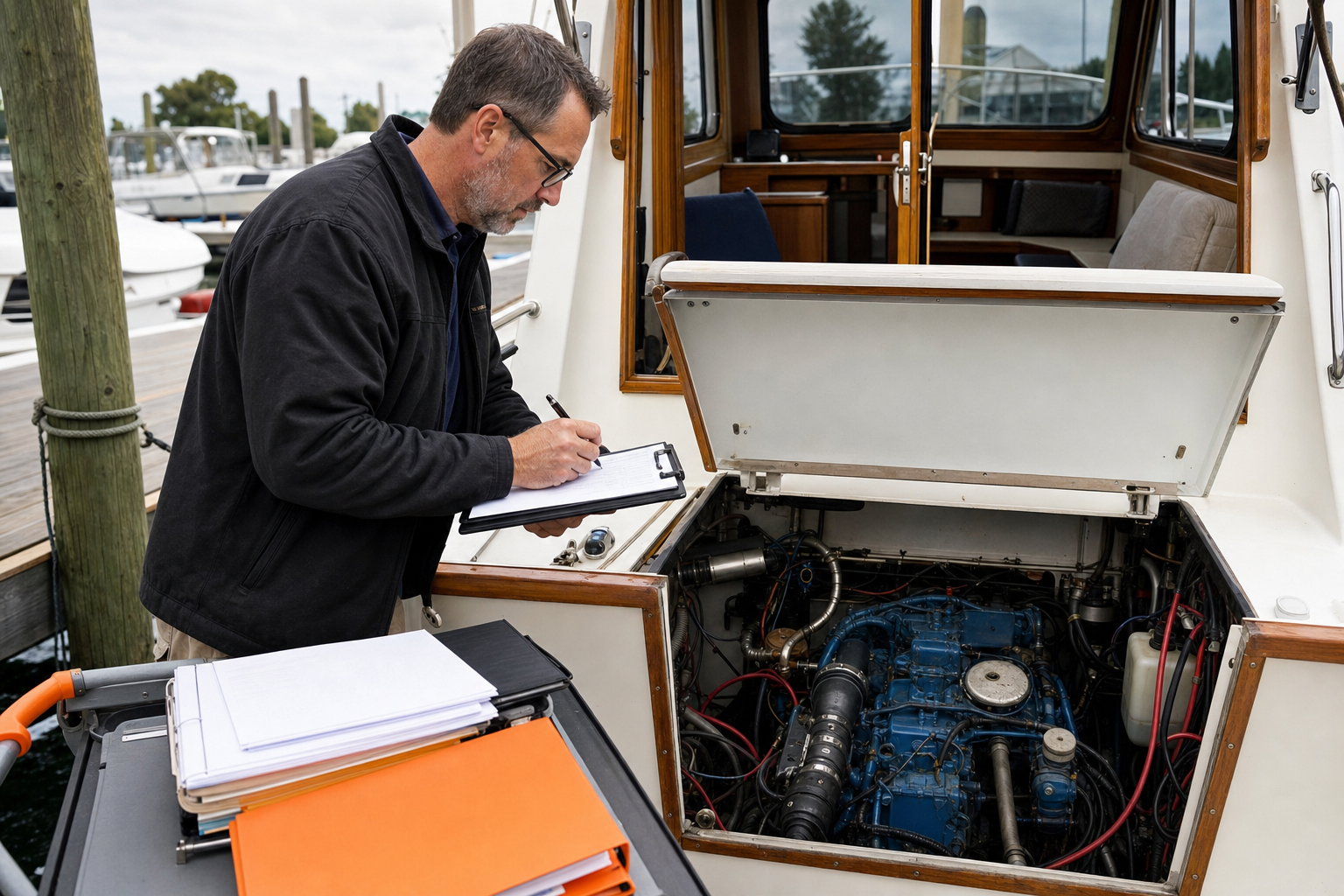
Glossy marketing photos often trigger immediate skepticism in serious boat buyers. In an era of AI-generated imagery and heavy filters, overly polished shots look like stock photography that hides the reality of the vessel. A buyer researching a $2M yacht doesn’t care about the sunset; they care about the condition of the bilge, the layout of the wiring, and the maintenance history of the outboards. If you want to know how to use social media to sell boats, you must shift your visual strategy from lifestyle aesthetics to technical evidence.
Visual assets should function as a filtration tool. High-intent buyers are looking for reasons to disqualify a boat before they spend time on a physical inspection. By providing raw, high-resolution walkthroughs that focus on the “Service Yard” reality, you build immediate trust. Show the boat on the hard. Highlight the recent bottom paint or the precision of a new electronics installation. This transparency repels the casual dreamer while signaling to the serious buyer that you have nothing to hide regarding the vessel’s operational health.
User-Generated Content (UGC) can be a powerful asset, but it must be curated to maintain brand authority. Reposting every grainy photo a client tags you in lowers your perceived value. Only feature content that reinforces your position as a specialist operator. If you want to transform your inventory into a high-converting digital showroom, book a fit call with our team to audit your visual strategy.
The Virtual Sea Trial Strategy
Video is your most effective tool for answering technical questions before they are asked. A 60-second boat walkthrough for social media should start at the transom to showcase the power, move quickly to the helm for electronics oversight, and finish with the functional layout of the cockpit. For marine mechanics and electricians, video content should focus on the engine room’s cleanliness and the organization of the breaker panels. This technical depth proves your expertise and justifies your pricing to a skeptical audience.
Showcasing Results, Not Just Inventory
Move your narrative from “For Sale” to “Problem Solved.” Instead of just posting a listing, tell the story of a successful delivery where the vessel met a specific client’s operational needs. This approach is equally effective for marine construction operators. Showing a seawall project in progress, with clear shots of the materials and engineering, proves reliability more than a finished photo ever could. Use your social platforms to document the work, the delivery, and the functional success of your marine services.
Integrating Social Media into Your Marine Demand Control System
Social media is not a standalone solution. It must function as a high-velocity intake valve within your larger marine marketing ecosystem. When you treat a Facebook post as an isolated event, you’re practicing hope-based marketing. A results-oriented strategy requires integrating these platforms into a system that captures, filters, and compounds demand over time. Understanding how to use social media to sell boats means every dollar spent on ads must be auditable against your bottom line.
Consistent, filtered social activity creates a “Demand Compounding” effect. As your system identifies more high-intent buyers, the algorithms become more efficient at finding similar profiles. This isn’t about chasing trends; it’s about building a predictable flow of Qualified Inquiries. By rejecting vanity metrics, you stop paying for “likes” from people who will never own a boat. The 2026 sales framework relies on technical visual assets and automated filtering to ensure your sales team only speaks with buyers ready to move forward.
Measuring What Matters: Beyond the Like
Cost Per Click (CPC) is a meaningless metric for a boat dealer. You must track the cost per Qualified Inquiry. Audit your social performance against your actual job flow in the service yard or showroom. If your engagement is high but your sales floor is quiet, your targeting is failing. Identify the point of diminishing returns for your ad spend by monitoring how lead quality shifts as you scale your budget. Precision matters more than volume when you’re selling high-ticket marine assets.
Next Steps for High-Value Marine Businesses
Start by auditing your current social presence. Delete the generic filler content that doesn’t speak to a specific technical buyer or provide a clear point of view. Identify one high-margin inventory item and build a precision-targeted campaign around its technical specs rather than its aesthetic appeal. This transition from “brand awareness” to a functional Demand Control System is what separates market leaders from struggling dealerships. If you’re ready to stop wasting time on tire-kickers, book a call to see if our system fits your business.
Dominating the 2026 Marine Market
Success in the coming year requires a total rejection of the “post and pray” mentality. You’ve seen how vanity metrics like likes and shares offer no protection against inconsistent revenue or wasted ad spend. True market command comes from transforming your social presence into a precision-engineered filtration system. By prioritizing technical walkthroughs over glossy lifestyle shots and implementing automated qualifiers, you protect your sales team from the noise of low-intent dreamers. Understanding how to use social media to sell boats is ultimately about operational oversight and auditable job flow. Our specialized Marine Demand Control System provides the industry-native expertise required for businesses in the $300K to $5M range to stabilize their revenue patterns. It’s time to stop paying for digital noise and start investing in bankable results. Take control of your dealership’s future today.
Request a No-BS Marine Marketing Analysis
Frequently Asked Questions
Is Facebook still effective for selling high-end yachts in 2026?
Facebook remains a primary engine for boat dealers because its data allows for granular targeting of high-net-worth individuals. While newer platforms attract younger audiences, the demographic alignment on Facebook still produces the highest volume of buyers with the financial capacity for major vessel acquisitions. Success depends on using behavioral data rather than simple interest targeting to find active buyers.
How much should a boat dealer spend on social media advertising?
A common industry benchmark is to allocate 2% to 5% of your annual revenue to social media advertising. If you are starting a new campaign, a testing budget of $500 to $1,000 per month allows you to gather enough data to identify which inventory triggers are working. You should always measure this spend against the cost per Qualified Inquiry rather than superficial metrics like reach.
Can social media help filter out unqualified tire-kickers automatically?
You can eliminate low-intent noise by using automated qualifiers in messaging apps and adding strategic friction to your lead forms. By requiring prospects to answer specific questions about their budget and timeline, you ensure that “looky-loos” never reach your sales floor. This is a vital component of how to use social media to sell boats without wasting your team’s time.
What is the difference between a boat rental and a yacht charter for social targeting?
A boat rental is typically a self-drive transaction for a smaller vessel, while a yacht charter involves a crewed vessel and a luxury service level. Targeting for rentals focuses on local recreation and lower price points. Yacht charters require a precision approach that targets individuals seeking exclusive, high-value experiences and professional oversight on the water.
How often should a marine business post on social media to see results?
Quality and intent matter more than frequency. Posting three to four times per week with technical walkthroughs or “problem solved” narratives is more effective than daily generic posts. You want to maintain a consistent presence that speaks to serious buyers without contributing to the digital noise that attracts unqualified hobbyists.
Should I use an influencer to help sell my boat inventory?
Most influencers attract “dreamers” who have no intention of buying a vessel. You should only partner with creators who possess genuine technical authority and an audience of active buyers. Reach is a vanity metric; you need a partner who can articulate technical specifications and build trust with high-net-worth prospects.
What is a Qualified Inquiry versus a standard social media lead?
A standard lead is just contact information that often lacks context or verified intent. A Qualified Inquiry is a prospect who has been vetted against your specific inventory, budget requirements, and purchase timeline. This distinction ensures that your sales team focuses on closing contracts rather than chasing dead-end email addresses from social media.