
Your marketing agency is likely celebrating “record lead volume” while your office manager is drowning in phone calls for $50 outboard repairs you don’t even perform. For a service yard or a high-end yacht charter, a lead is not just a name and an email; it’s a potential drain on your most valuable resource: time. Most agencies don’t know a service yard from a marina, so they cast a wide net that catches everything except the high-intent clients you actually want. If you’re tired of vetting tire-kickers who don’t understand your value, you must realize that high volume is often a symptom of failure, not success.
You know that every minute spent explaining your services to an unqualified prospect is a minute stolen from your high-margin job flow. This guide will show you exactly how to stop getting bad leads for marine business by replacing generic marketing with a specialist demand filtering system. We’ll explore why generalist strategies fail in the marine sector and how to secure the qualified inquiries your business deserves.
Key Takeaways
- Identify why generic marketing templates fail to distinguish between a Boat Dealer and a Marina, leading to wasted spend on the wrong audience.
- Audit your current agency reports for red flags like “Impressions” and “Clicks” that do not translate into actual job flow or revenue.
- Learn how to stop getting bad leads for marine business by implementing a proprietary Marine Demand Control System designed for high-margin filtration.
- Discover why a lower monthly retainer often results in a higher cost-per-acquisition due to the administrative burnout of vetting unqualified prospects.
Defining the Generic Agency Trap for Marine Brands
Generic marketing is a volume-first approach that relies on standardized industry templates to generate raw numbers. Most agencies operate on a “more is better” philosophy, assuming that a high quantity of inquiries eventually leads to revenue. In the marine sector, this logic is flawed. A generic agency treats a high-end boatyard exactly like a retail clothing store, focusing on traffic rather than the technical requirements of a Qualified Inquiry. This lack of specialization is exactly why your inbox is full of low-margin inquiries for services you don’t even provide.
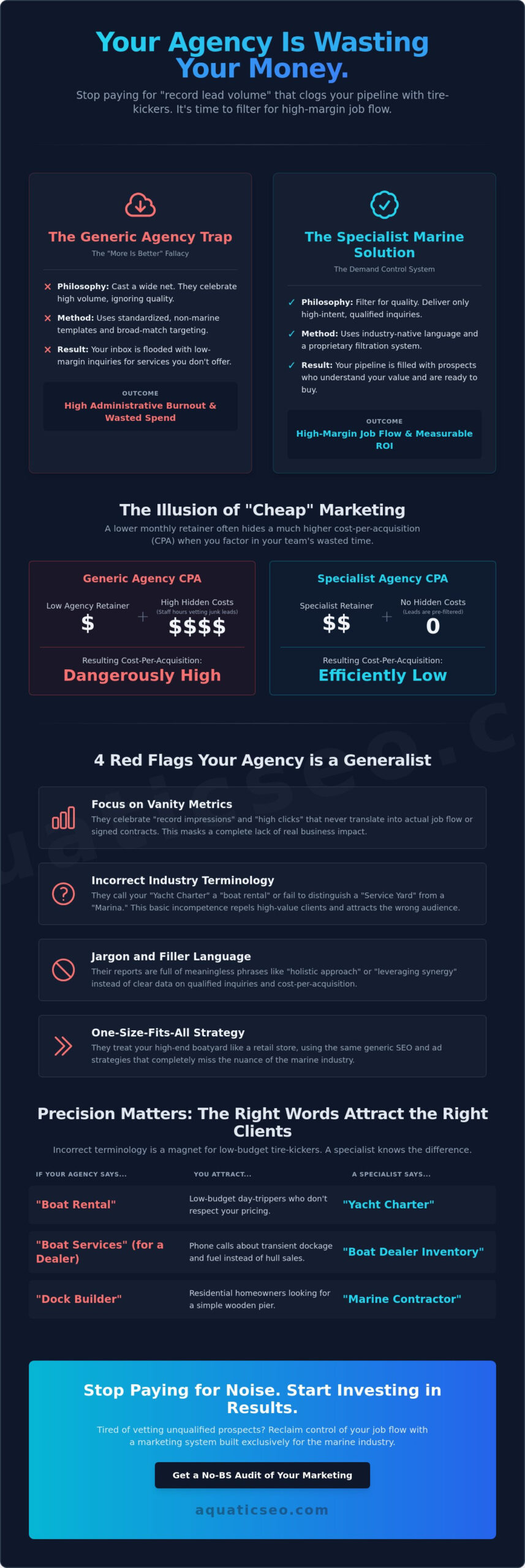
If you want to know how to stop getting bad leads for marine business, you must first recognize the cost of these “cheap” leads. A lower monthly retainer usually signals that the agency is using automated, broad-match targeting. While the monthly bill looks smaller, your cost-per-acquisition actually skyrockets because your team wastes hours vetting junk. Standard Lead generation tactics often prioritize raw numbers over intent, which is a fatal flaw when your business depends on high-margin, specialized contracts.
The Illusion of Cheap Marketing
Generic agencies hide poor performance behind high impression counts and “vanity” clicks. They celebrate when your website traffic goes up, even if that traffic consists of people looking for DIY repair tips or cheap boat rentals instead of a professional Yacht Charter. This creates a massive opportunity cost during your peak season. Every minute your staff spends on the phone with a tire-kicker is a minute they aren’t closing a high-value service contract. Generic Agency Waste is the total cost of unpaid administrative time your staff spends filtering out low-margin inquiries that should never have reached your inbox.
Why Generalist SEO is a Liability in 2026
The shift toward AI-driven search means that niche expertise is no longer optional. Search engines now prioritize “Experience, Expertise, Authoritativeness, and Trustworthiness.” A generalist agency cannot demonstrate these traits because they don’t know the difference between a marine surveyor and a boat dealer. They fail to filter for high-intent buyers at the keyword level, often ranking you for broad terms that attract the wrong crowd. Aquatic SEO prioritizes business outcomes over simple engagement counts by focusing on the specific vocabulary of the marine professional. We understand that a Qualified Inquiry for a service yard requires a different technical approach than a simple e-commerce transaction. By tightening your targeting, you reclaim control over your job flow and stop subsidizing the agency’s learning curve.
Terminology Errors: How to Stop Getting Bad Leads for Marine Business
Your business credibility is built on precision. If your marketing agency calls your Yacht Charter a “boat rental,” they aren’t just making a typo; they’re signaling a fundamental lack of industry knowledge. High-value clients searching for a luxury crewed experience will immediately bounce when they see “rental” language on your site. This is a critical step in learning how to stop getting bad leads for marine business. Incorrect terminology acts as a magnet for low-budget tyre-kickers who don’t respect your pricing or your expertise.
The strategic difference between a Boat Dealer and a Marina in search intent is vast. A dealer needs buyers looking for inventory, while a marina needs owners looking for slips or fuel. Generic agencies often fail to distinguish these, leading to a surge of administrative burnout as your sales team answers questions about transient dockage instead of closing a hull sale. Similarly, a Service Yard requires maintenance-focused inquiries. If your local SEO strategy incorrectly classifies you as a marina, you’ll waste your day fielding calls about ice and pump-out stations.
Marine Contractors face a unique challenge that generalists rarely grasp. General “builder” or “dock” keywords often attract residential homeowners looking for a simple wooden pier. A professional marine contractor needs inquiries for seawall engineering, commercial dredging, or piling installation. Without specific linguistic filters, you’re just paying for noise that clogs your pipeline. Precise language ensures you only speak with clients who have the budget for complex marine construction.
The Industry-Native Advantage
Being industry-native means understanding the operational logistics of marine hardware and services. We use terms like “crewed vessels” and “displacement hulls” because that’s how high-intent clients speak. This precision ensures that your inquiries come from prospects who already understand the scope of your work. If you are a marine contractor, you need a partner who knows the difference between a bulkhead and a riprap. Operational knowledge is the only way to filter out the waste.
Filtering Demand Through Language
Specific keywords serve as your first line of defense against low-margin inquiries. A broad term like “boat repair” is a trap that brings in every broken outboard in the county. Conversely, targeting “marine diesel mechanic” or “electronic refit specialist” captures high-intent demand. When calculating marketing ROI, you must account for the time saved by not talking to the wrong people. Language isn’t just about SEO; it’s about operational efficiency. If you want to refine your targeting, consider how specialist marine marketing can clean up your inquiry pipeline.
Comparing the Math: ROI of Generic vs. Specialist Marine Marketing
Most marine business owners look at their marketing invoice and the total number of leads to judge success. This is a mistake. You must look at the payroll expense required to process those leads, which we call the “Administrative Tax.” If you want to know how to stop getting bad leads for marine business, you have to account for the hours your staff spends vetting tire-kickers. Processing 100 bad leads costs significantly more in salary and mental energy than handling 10 Qualified Inquiries that actually convert into high-margin jobs.
Specialist marketing sources yield a much higher Lead to Job conversion rate because the intent is filtered before the phone rings. Generic agencies brag about volume because it’s easy to generate, but that volume often consists of noise that clogs your pipeline. When your marketing strategy aligns with your actual shop capacity, you stabilize your work schedule and eliminate the feast or famine cycle. A Demand Control System provides long-term value by ensuring you only accept work that fits your ideal profit profile, whereas a basic SEO retainer just chases clicks.
A $500 lead that closes is cheaper than a $5 lead that doesn’t.
Unit Economics of a Marine Lead
Every inquiry has a hidden cost that doesn’t appear on your agency’s dashboard. Beyond the initial ad spend, you’re paying for the 15 to 30 minutes your service manager or technician spends on a dead-end call. Using a Marine Demand Control System provides the financial precision needed to ignore this noise. Proper Market research and competitive analysis shows that focusing on high-intent niches always outperforms broad-market gambling. Financial health comes from predictability, not just raw inquiry counts.
Demand Compounding vs. One-Off Traffic
Specialist SEO builds a permanent business asset rather than a temporary traffic spike. For boat dealers, this means ranking for specific hull models and propulsion systems rather than just “boats for sale.” Generic agencies struggle with seasonal marine demand fluctuations because they don’t understand the buying cycle or the logistics of winterization and refit seasons. Demand filtering ensures you maintain higher profit margins per job by capturing buyers who value your specific expertise. This compounding effect creates a competitive moat that generalist competitors simply cannot cross.
Auditing Your Current Spend: Red Flags of a Generic Agency
If your marketing agency sends you monthly reports filled with “Impressions” and “Clicks,” you’re paying for a distraction. These metrics are easy to inflate but impossible to deposit at the bank. A generic agency relies on these vanity numbers because they lack the technical knowledge to track actual revenue or Qualified Inquiries. To understand how to stop getting bad leads for marine business, you must first stop accepting reports that treat your boatyard like a generic retail storefront.
Take a hard look at your website content right now. If it’s littered with vague phrases or technical inaccuracies, you’re actively repelling high-value prospects. A specialist knows that a service yard or boatyard handles maintenance, which is distinct from a marina focusing on dockage and fueling. When your marketing partner can’t distinguish between a yacht surveyor and a marine mechanic, they can’t possibly filter for high-intent buyers. This lack of precision is the root cause of the low-margin noise clogging your phone lines.
The Vanity Metric Litmus Test
Ranking #1 for a broad term like “boats” is often a total waste of your marketing budget. It attracts thousands of people who aren’t looking to spend money on professional services. You need auditable tracking that connects digital activity to real-world job flow. If your agency can’t show you the path from a search term to a high-margin contract, they’re just guessing. Ask your current agency these three questions to test their marine logistics IQ:
- How do you filter out “DIY” searchers from high-intent repair clients?
- What is the specific search intent difference between a “boat rental” and a “Yacht Charter”?
- How does your targeting change during the haul-out season versus the active cruising season?
Operational Symptoms of Poor Marketing
Inconsistent work schedules and crew burnout are rarely just “market conditions.” They are usually symptoms of a top-of-funnel targeting error. When your marketing lacks demand filtering, your crew spends their energy on low-margin tasks that don’t move the needle. This cycle of administrative waste prevents you from scaling your operations or stabilizing your revenue. Stop letting generalists dictate your job flow and book a call for a no-nonsense analysis of your current pipeline.
The Specialist Solution: Implementing a Marine Demand Control System
The final step in understanding how to stop getting bad leads for marine business is shifting from a passive “capture everything” mindset to an active filtering strategy. Our proprietary Marine Demand Control System is a framework designed to give you absolute command over your job flow. Unlike generic agencies that focus on raw lead volume and then tell you to “nurture” the junk, we filter demand at the source. This isn’t about minor adjustments to an ad campaign; it’s a total overhaul of how your brand interacts with the market. This system ensures your gross margins remain healthy because your team only handles inquiries that align with your operational capacity and profit goals.
Filtering demand at the source improves organizational efficiency by removing the administrative burden of vetting unqualified prospects. You don’t need a more complex CRM to manage bad leads; you need a system that prevents them from entering your pipeline in the first place. By the time a prospect reaches out, they should already be pre-qualified by the language, targeting, and technical precision of your digital presence. In the 2026 digital market, the gap between a generalist and a specialist is the difference between a thriving shop and one that is merely busy with low-value work. This is the only way to achieve true organizational stability.
Capturing High-Intent Buyers
Active Buyer Capture is the mechanism of identifying prospects who are ready to commit to a high-value contract right now. For businesses like yacht charters, this means moving beyond broad tourism keywords to target exact sub-sector needs like “crewed luxury expeditions” or “multi-day offshore charters.” Specialist SEO creates a predictable, auditable pipeline where every inquiry represents a legitimate revenue opportunity. We don’t just generate traffic; we capture demand that already exists and direct it toward your specific expertise. The goal is a transparent system where the business owner can see exactly how search intent translates into a Qualified Inquiry.
Securing Your Job Flow for 2026
The transition from generic marketing to a specialist system is a strategic necessity. Waiting to fix your lead quality is effectively a tax on your 2026 profits, as you continue to waste payroll on unproductive administrative tasks. Aquatic SEO acts as a partner in your growth, focusing on the financial health of your business rather than superficial digital metrics. We prioritize business outcomes and job-flow control over simple engagement counts. Take the first step toward reclaiming your time and Request a Marine Demand Analysis today to see where your current strategy is leaking revenue.
Reclaim Your Time and Protect Your Margins
You now understand that high lead volume is often a deceptive vanity metric that masks operational inefficiency. By auditing your current spend and identifying the “Administrative Tax” of junk inquiries, you can finally see where your profits are leaking. The path to a stabilized revenue pattern starts with industry-native expertise that knows the difference between a service yard and a marina. Implementing a proprietary Marine Demand Control System isn’t just about marketing; it’s about securing the functional efficiency of your entire operation. This is how to stop getting bad leads for marine business while ensuring every inquiry your team handles is a high-intent opportunity.
Stop settling for agencies that treat your specialized service like a generic retail shop. You deserve a partner that understands marine logistics and targets the specific $300K to $5M revenue bracket with precision. Transitioning to a specialist model will stabilize your work schedule and protect your crew from low-margin burnout. It’s time to prioritize auditable tracking and financial health over superficial engagement counts.
Stop wasting your budget and secure qualified inquiries with a Marine Demand Control System.
Your business is ready for a pipeline that works as hard as you do. Take command of your market position today.
Marine Lead Quality: Frequently Asked Questions
What is the difference between a generic lead and a qualified marine inquiry?
A generic lead is simply contact data from someone with a vague interest in “boats.” A Qualified Inquiry is a prospect who has been filtered for specific intent, budget, and service fit. They aren’t looking for a “boat rental” when they need a crewed Yacht Charter; they are high-intent buyers ready for your specific expertise.
Why is specialist marine marketing more expensive than a general SEO agency?
You’re paying for the elimination of waste and the deep industry knowledge that prevents costly targeting errors. A generalist agency uses your budget to learn what a “transom” is, while a specialist understands marine logistics from day one. The higher initial cost is offset by the removal of the administrative burden caused by junk leads.
Can a generic agency learn the nuances of the yacht charter industry?
Generic agencies rarely grasp the operational differences between various marine sectors. They often use standardized templates that fail to distinguish between a bareboat rental and a luxury crewed vessel experience. This lack of precision signals a lack of professionalism to your high-value prospects and actively destroys your credibility.
How long does it take to see results from a specialist marine marketing system?
Initial demand filtering starts the moment the system is implemented, though organic compounding typically takes three to six months to reach full velocity. The primary goal is to show you how to stop getting bad leads for marine business by tightening your search parameters immediately. You’ll notice a decrease in noise and an increase in inquiry quality almost instantly.
What are the common terminology mistakes generic agencies make in marine SEO?
Generic agencies frequently confuse a “Service Yard” with a “Marina” or a “Boat Dealer.” They target broad, low-intent terms like “boat repair” instead of specific, high-margin services like “marine diesel repower.” These errors attract tire-kickers looking for cheap fixes rather than the professional contracts your business requires.
How does demand filtering improve my business bottom line?
Demand filtering reduces the “Administrative Tax” on your staff by ensuring they only spend time on high-margin jobs. When your team stops vetting unqualified prospects, your operational efficiency improves and your conversion rates climb. This focus on quality over volume stabilizes your revenue and protects your profit margins.
Is the Marine Demand Control System suitable for small boatyards?
Smaller operations actually benefit the most from this system because they have zero time to waste on tire-kickers. If you have limited technician hours, you cannot afford to clog your schedule with low-margin outboard repairs. The system ensures your job flow matches your specific shop capacity and financial goals.
What metrics should I actually care about when reviewing my marketing reports?
Ignore impressions, clicks, and general “engagement” counts that don’t pay the bills. You should focus on the number of Qualified Inquiries, the cost-per-acquisition for high-margin jobs, and your total revenue growth. Your marketing partner should be accountable for business outcomes, not just superficial digital metrics.