You are likely paying for “boat rental” clicks when you actually need a $20,000 engine repower or a seasonal dockage contract. Most agencies brag about click-through rates and engagement, but those metrics don’t pay the slip fees or keep the service bays full. If your phone is ringing with tire-kickers asking for things you don’t even sell, your marketing isn’t working; it’s just costing you money. True roi of marine ppc isn’t measured by how many people saw your ad, but by the specific mix of high-margin work on your schedule next month.
You already know that not all leads are created equal. A flooded inbox of low-value inquiries is often worse than no leads at all because it clutters your workflow and wastes your team’s time. This guide will show you how to stop chasing volume and start using demand filtering to capture the exact jobs that drive your profitability. We’ll break down the math of a successful campaign and explain how to audit your current spend to eliminate waste.
Key Takeaways
- Identify the disconnect between superficial agency metrics and the actual cash flow entering your marine business.
- Master the financial formula to calculate the true roi of marine ppc by weighing acquisition costs against specific job margins.
- Deploy ad copy as a demand filtering mechanism to disqualify low-budget inquiries before they ever reach your phone.
- Execute precision geo-targeting to capture high-intent buyers in specific maritime hubs while eliminating wasted spend on generic traffic.
- Stabilize your seasonal revenue using the Marine Demand Control System to maintain a consistent mix of high-margin service contracts.
The Reality of ROI: Why Most Marine PPC Campaigns Sink
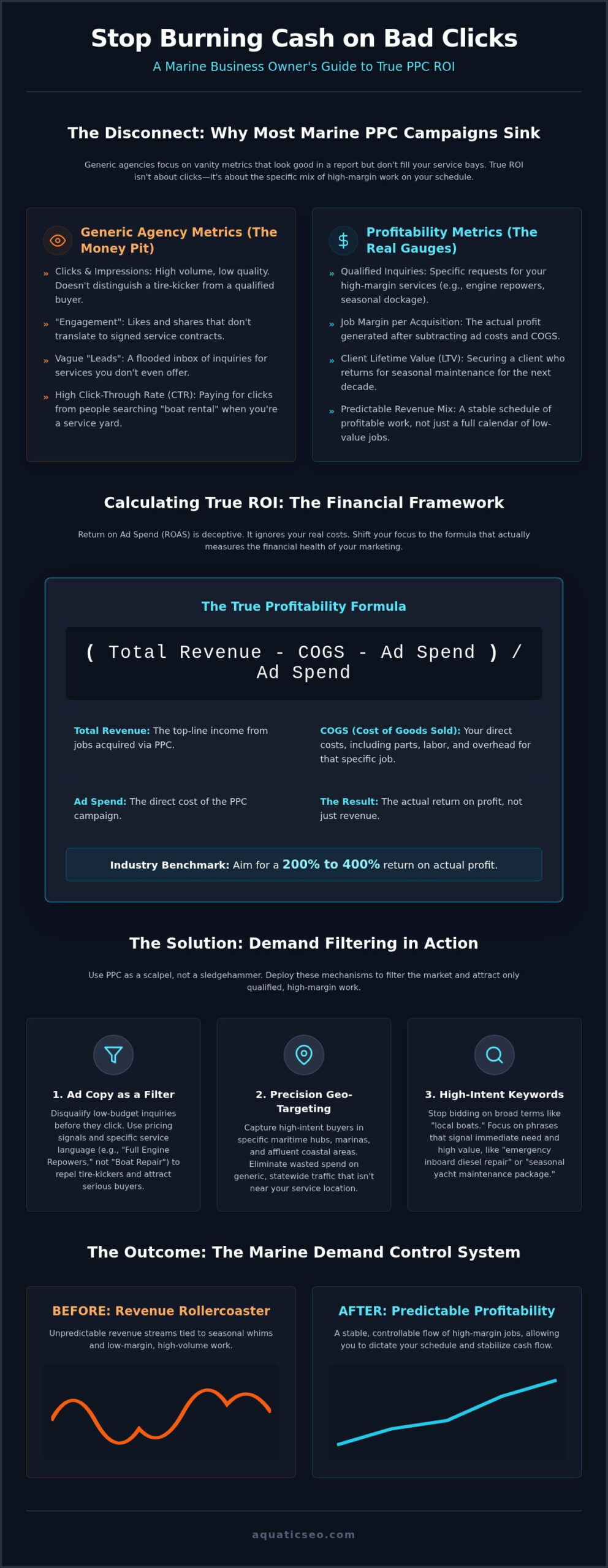
Most agencies present you with dashboards full of green arrows and high click-through rates. They focus on performance-based advertising metrics that look impressive in a monthly report but fail to impact your actual bank account. Impressions and clicks are vanity metrics; they don’t buy fuel, and they don’t pay your technicians. If you operate a crewed vessel, paying for clicks from people searching for a “boat rental” is a financial drain, not a lead. True roi of marine ppc is found in the quality of the job mix, not the volume of the traffic.
We treat PPC as a tool for operational control rather than just a visibility play. It’s a mechanism to filter the market and decide exactly which types of vessels and owners you want in your slips. Instead of simply “getting your name out there,” you should use your ad spend to dictate your schedule. If your service bays are empty, you turn up the high-intent search capture. If you’re booked out for months, you shift your focus to higher-margin contracts that improve your bottom line.
The High Cost of Generic Marketing
Generic agencies often fail to distinguish between a marina and a service yard. They bid on broad, low-intent keywords like “boating services” or “local boats,” which attracts thousands of tire-kickers. You end up paying for inquiries from people looking for a $50 zinc when you specialize in $50,000 repowers. This wasted spend isn’t just a marketing oversight. It’s a direct leak in your company’s financial health that clutters your schedule with low-margin noise.
Industry-Native Positioning as a Financial Safeguard
Precision is your primary defense against wasted ad spend. When you work with a specialist marine digital marketing agency, your campaigns are built with an understanding of vessel classes and specific buyer intent. The global boats market is estimated to reach approximately $37.8 billion by 2026, but that growth is unevenly distributed across the sector. We don’t just buy clicks; we deploy demand filtering systems that ensure only a qualified inquiry reaches your sales team. This transition toward demand control allows you to stabilize revenue even when retail powerboat sales see a decline, as they have in early 2026.
Calculating True ROI: The Financial Framework for Marine Business Owners
Return on Ad Spend (ROAS) is a deceptive metric for a boatyard or dealership. It tells you how much revenue you generated per dollar spent, but it ignores your labor costs, parts margins, and overhead. To understand the true roi of marine ppc, you must shift your focus toward Customer Acquisition Cost (CAC) relative to your actual Job Margin. A campaign that generates $50,000 in revenue is a failure if your cost of goods and ad spend exceed $50,000.
You need a realistic financial framework to evaluate your marketing performance. Many agencies hide behind “AI-optimized” jargon while making unfounded claims about income and profits. In the marine sector, a healthy benchmark for 2026 involves aiming for a 200% to 400% return on actual profit, not just gross revenue. Well-optimized campaigns targeting high-intent keywords can often reach higher thresholds once the “noise” of unqualified traffic is eliminated.
The Formula for Profitability
True profitability in marine advertising is the net profit of a job minus the cost to acquire that specific customer. You calculate this by taking your Total Revenue from PPC, subtracting your Cost of Goods Sold (COGS) and your Ad Spend, then dividing the remainder by that same Ad Spend. This formula forces you to track a Qualified Inquiry rather than a raw lead. By using Demand Filtering, you protect your bottom line from the high cost of processing low-margin inquiries that never turn into profitable contracts.
Tracking the Metrics that Matter
For marine mechanics and electricians, the initial ROI of a campaign is often just the tip of the iceberg. You must factor in the Lifetime Value (LTV) of a new client who may return for seasonal maintenance for the next decade. Accurately attributing revenue requires a system that connects a specific click to a final invoice in your shop management software. If you aren’t seeing this level of transparency, your data is likely incomplete.
Capturing high-value jobs requires a strategy that understands the technical nuances of your trade. You can find more detail on this in our digital marketing for marine contractors guide. If your current agency cannot explain the difference between a lead and a contract-ready prospect, it’s time to audit your job mix and regain control over your demand.
Beyond the Lead: Using PPC to Filter for High-Margin Marine Contracts
PPC is a filtration system, not a megaphone. For a boatyard or service yard, a high roi of marine ppc depends on your ability to repel low-margin noise before it hits your service manager’s desk. You don’t want every boat owner in the harbor calling you; you want the owner of a 60-foot sportfisher who needs a complete engine repower. By using ad copy that explicitly mentions project minimums or specific vessel classes, you force unqualified prospects to keep scrolling. This level of demand control stabilizes your schedule by ensuring your technicians are always working on high-margin contracts rather than minor repairs.
Stop viewing your ad spend as a way to buy “more” leads. Instead, use it to prioritize your job mix. If your yard is full of $500 fiberglass patches, you don’t have room for the $50,000 refit. You can use your campaigns to actively disqualify the small jobs that clutter your workflow. This approach turns your marketing into an operational tool that dictates exactly what kind of work enters your bays next month.
Targeting High-Intent Keywords
A generic search like “boat repair” is a black hole for your budget. It captures everything from a cracked gelcoat on a jet ski to a transmission failure on a motor yacht. Contrast that with “marine diesel engine overhaul” or “stabilizer system service.” These long-tail searches represent buyers at the peak of their intent who have already identified a high-value problem. For marine surveyors, targeting specific terms like “pre-purchase yacht inspection” ensures you capture a qualified inquiry instead of someone looking for a free appraisal.
The Role of Negative Keywords in Profitability
Negative keywords are the guardrails of your profitability. If you are marketing luxury yacht charters, you must exclude terms like “cheap,” “discount,” or “bareboat” to protect your margins. Blocking “DIY” and “how-to” searches prevents your ads from appearing to hobbyists who have no intention of hiring a professional service yard. This continuous refinement is a core component of the Marine Demand Control System. It turns your ad spend into a precision instrument that filters out the bottom 80% of the market to focus exclusively on the high-value prospects that drive your growth.
Intent-Based Execution: Capturing Qualified Inquiries in Specific Local Markets
Geo-targeting for marine businesses is a precision exercise, not a broad-reach strategy. Don’t waste budget on a 50-mile radius if your ideal clients are concentrated in three specific marinas. Local search intent varies wildly based on geography. In a major hub like Fort Lauderdale, you are fighting for visibility among thousands of vessels, while in a smaller port, you can dominate the market by being the only visible solution for a transient captain in distress. This hyper-local focus ensures your roi of marine ppc remains high by eliminating the cost of competing for national keywords that don’t drive local dockage or service revenue.
Capturing a transient vessel requires immediate, intent-based execution. These owners need a solution right now and aren’t interested in a long-term research phase. By dominating local search for emergency repairs or dockage, you capture high-margin work that your competitors miss because they are too focused on broad visibility. You should treat every dollar of ad spend as a way to control the local demand for your specific services.
Geo-Fencing and Local Search Strategy
Geo-fencing targets owners physically present at a specific marina or boat show. If you operate a service yard or boatyard, you should adjust your bids based on proximity to your facility. A boat owner five miles away with an engine failure is a more valuable target than someone fifty miles away who is just browsing. In 2026, hyper-local demand capture is the standard for businesses that want to maximize their roi of marine ppc without subsidizing their competitors’ market research.
Optimizing Landing Pages for Conversion
For boat dealers, a high-converting landing page is the difference between a bounce and a qualified inquiry. If your ad promises a specific center console model, your landing page must feature that exact boat. Don’t send high-intent traffic to a generic homepage. You need to reduce friction to ensure the prospect takes action immediately.
- Place click-to-call buttons prominently for mobile users.
- Display clear vessel specifications and high-resolution imagery.
- Use a short inquiry form that asks for vessel type and urgency.
- Include proof of recent successful sales or service work in that specific port.
If you want to stop guessing where your buyers are and start owning your local market, book a call to audit your local demand.
The Marine Demand Control System: Transforming Ad Spend into Predictable Revenue
The Marine Demand Control System isn’t a “set and forget” ad campaign. It’s an operational framework designed to turn your marketing into a predictable revenue stream. By integrating the filtering and targeting strategies discussed earlier, this system ensures that your sales team only handles a high-value qualified inquiry. You stop reacting to the market and start dictating your growth. This approach focuses on demand compounding; while PPC provides immediate visibility, the data generated allows you to identify exactly which high-margin jobs are most profitable in your local market.
You use these insights to fuel your long-term presence and stabilize your business against seasonal shifts. This strategy creates a defensive moat around your business that competitors using generic tools can’t penetrate. It transforms your ad spend from a fluctuating expense into a precision instrument for market dominance. For skeptical owners, this isn’t about “trying” a new marketing trend. It’s about implementing a methodical system built on the real-world logistics of the marine industry.
Stabilizing Your Job Mix
Many marine business owners live in a cycle of feast or famine. You’re either overwhelmed with low-margin work or staring at an empty service calendar. The Marine Demand Control System allows you to fill specific gaps in your schedule by turning up the volume on high-intent buyer capture when you need it. You can review our specialized marine marketing services to see how this framework applies to your specific sector. It provides the relief of a controlled schedule where you choose the jobs that enter your yard.
Next Steps for Marine Business Growth
Skeptical owners often ask if the roi of marine ppc is worth the investment in a fluctuating economy. The answer lies in your willingness to stop settling for vanity metrics and start demanding financial accountability. You don’t need more clicks; you need better contracts. We offer a “No-BS” marketing analysis that diagnoses exactly where your current spend is leaking and how to redirect it toward high-margin demand.
Stop letting generic agencies waste your budget on “boat rental” searches that don’t apply to your yacht charter business or service yard. Take control of your job mix and stabilize your revenue for the long term. Book a call to analyze your demand and see the actual financial impact of a precision-driven strategy.
Take Command of Your Marine Business Margins
Stop letting generic agencies burn your budget on “boat rental” clicks when your yard needs high-margin service contracts. True roi of marine ppc requires a shift from simply buying traffic to actively controlling demand through strict filtration. You now have the framework to move beyond basic ROAS and adopt a system that prioritizes job margins over raw lead volume. Precision in your local market is the only way to ensure your technicians stay busy with the right work.
We built the Marine Demand Control System specifically for businesses generating $300K to $5M in revenue. As industry-native experts, we know the operational differences between a boatyard and a marina. It’s time to stop settling for superficial reports and start demanding a predictable job mix that supports your financial health. You have the tools to stabilize your revenue and dominate your port.
Don’t wait for the next seasonal dip to audit your ad spend. Request a No-BS Marine Marketing Analysis to identify exactly where your budget is leaking. You can transform your marketing into a high-performance asset today.
Frequently Asked Questions
Is PPC worth it for a small marine contractor with a limited budget?
PPC is highly effective for small contractors because it allows for surgical targeting of specific high-margin jobs. You don’t need to dominate the entire market; you only need to capture the specific demand you can fulfill this month. By avoiding generic keywords and focusing on niche services like “marine electrical repair” or “outboard repower,” you maximize the roi of marine ppc even with a modest daily spend.
How long does it take to see a measurable ROI from marine PPC campaigns?
You will see traffic and inquiries within 48 hours of launching a campaign. However, it typically takes 60 to 90 days to gather enough data for the Marine Demand Control System to fully optimize your job mix. This period allows us to identify and exclude the low-intent searches that drain your budget without producing high-margin contracts.
Can I run PPC ads for a yacht charter business without a huge ad spend?
Yes, provided you stop bidding on high-volume, low-intent terms like “boat rental.” You must target specific inquiries for crewed yacht charters or multi-day excursions where the margins are higher. Precision targeting on long-tail keywords allows you to compete with larger operators by capturing the exact type of high-value traveler you want on your vessel.
What is the difference between a lead and a qualified inquiry in the marine industry?
A lead is simply a name and an email address from someone who might be browsing. A qualified inquiry is a prospect who owns a specific vessel class and is actively seeking a high-margin service you provide. Our system filters out the noise to ensure your sales team isn’t wasting time on tire-kickers who can’t afford your service yard’s rates.
How much should a marine service yard expect to pay per qualified inquiry?
The cost varies based on your local market competition and the specific service you are targeting. You should focus less on the cost per click and more on the acquisition cost relative to the job margin. A $100 inquiry is a bargain if it results in a $15,000 engine overhaul; it’s a waste if it’s for a $50 part.
Is Google Ads better than social media for capturing high-intent marine buyers?
Google Ads is superior for capturing active buyers because it targets people searching for a specific solution at that exact moment. Social media is useful for brand awareness, but it often lacks the immediate intent found in search. If you need to fill your schedule with high-margin work right now, search-based PPC is the most efficient choice for your budget.
What happens if my PPC campaign attracts too many low-margin jobs?
This indicates a failure in your ad copy or keyword filtering. You must use negative keywords to exclude small-scale searches and rewrite your ads to explicitly mention the types of vessels or projects you handle. This creates a barrier that discourages low-budget prospects from clicking, which preserves your roi of marine ppc for the jobs that actually move the needle.
How do I know if my current marketing agency is wasting my PPC budget?
Your agency is wasting your budget if their reports focus on impressions, clicks, or generic “leads” rather than booked jobs and qualified inquiries. If they can’t distinguish between a boatyard and a marina, they are likely bidding on irrelevant terms. Demand a “No-BS” audit to see how much of your spend is going toward “boat rental” tire-kickers instead of high-value vessel owners.