Most marine marketing is a leaky bucket that drains your bank account while filling your inbox with “tire kickers” and rental inquiries you don’t even handle. If you’re running PPC for boat dealers right now, you’ve likely noticed that new powerboat sales have dipped nearly 9% over the last year. In this buyer’s market, generic clicks are a financial liability. You don’t need more traffic. You need a filtration system that identifies high-intent buyers and ignores the low-margin distractions that waste your time.
You’re likely tired of watching your ROI stagnate while generic agencies promise “engagement” that never leads to a signed contract. You’ve been burned before; you’re right to be skeptical of any strategy that prioritizes volume over value. Learn how to transform your ad spend into a precision tool for capturing high-intent marine buyers. We will examine the proprietary methods used to filter out unqualified leads and establish a predictable, high-margin job flow for your business.
Key Takeaways
- Stop wasting capital on vanity metrics like impressions and learn to prioritize Qualified Inquiries that impact your bottom line.
- Execute PPC for boat dealers with surgical precision to capture high-intent buyers at the peak of their search cycle.
- Use Demand Filtering to discourage low-margin distractions and unqualified prospects before they click on your ads.
- Apply industry-native copy and visual proof to ensure your landing pages convert skeptical prospects into actual customers.
- Integrate paid search insights into the Marine Demand Control System to stabilize your revenue and control your job mix.
Why Generic Paid Search Campaigns Sink Marine Service Providers
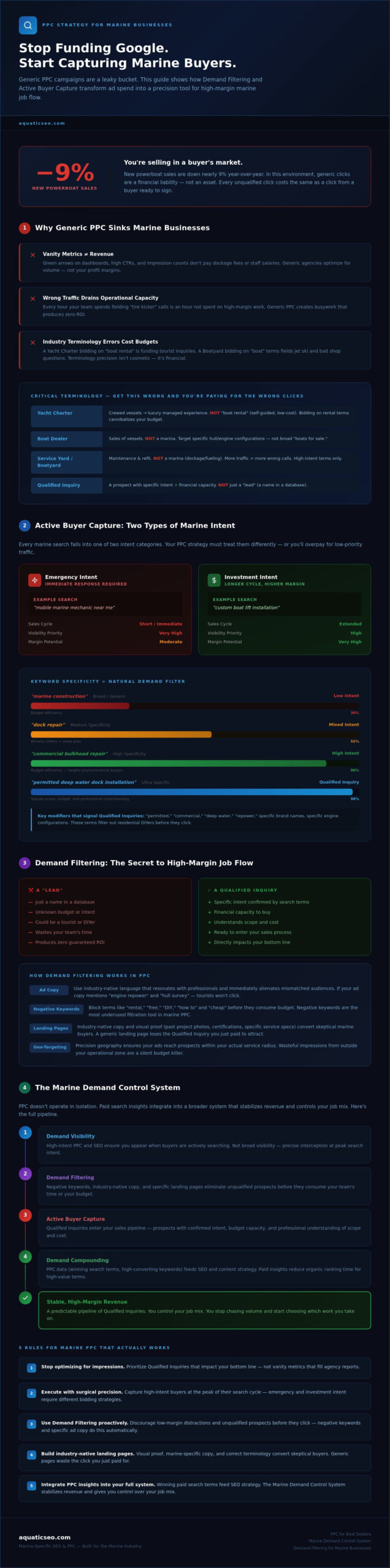
Generic marketing agencies thrive on volume. They’ll show you a dashboard full of green arrows and high click-through rates, but these are often vanity metrics that ignore your actual profit margins. If you’re running PPC for boat dealers, appearing for every broad search term related to “boats” is a fast way to burn through your capital. These agencies don’t understand that a click from a “tire kicker” looking for free advice costs the same as a click from a buyer ready to sign a contract.
When you execute Pay-per-click (PPC) campaigns without industry-native oversight, you’re essentially subsidizing Google’s revenue. High impression counts might look good in a monthly report, but they don’t pay your dockage fees or staff salaries. You need to distinguish between a generic lead and a Qualified Inquiry. A lead is just a name in a database; a Qualified Inquiry is a prospect with the specific intent and financial capacity to utilize your services.
Appearing for the wrong keywords is more than a waste of money. It’s a direct drain on your operational capacity. Your team wastes hours every week fielding phone calls from people who aren’t your target audience. This creates a cycle of busywork that produces zero ROI and keeps you from focusing on high-margin opportunities.
The Costly Confusion Between Yacht Charters and Boat Rentals
If you operate crewed Yacht Charters, bidding on “boat rental” terms is a strategic disaster. The psychological difference between these two audiences is vast. A rental customer is typically looking for a low-cost, self-guided afternoon on a pontoon. A high-value charter client is seeking a managed luxury experience with a professional crew. Using industry-native terminology in your ad copy prevents your budget from being cannibalized by tourists who will never book your services.
Why More Traffic is a Financial Liability for Boatyards
For Service Yards and Boatyards, more traffic is often a liability rather than an asset. Every time your service manager answers the phone to explain that you don’t rent jet skis or sell bait, you’re losing money. Generic PPC fills your schedule with low-margin distractions. We focus on high-intent search terms that attract owners of vessels requiring professional maintenance and refit work, ensuring your schedule remains filled with profitable projects for Marine Contractors.
Active Buyer Capture: Targeting High-Intent PPC for Marine Businesses
Active Buyer Capture moves beyond simple visibility. It is the process of intercepting a prospect at the exact moment their intent peaks. For those running PPC for boat dealers, this means showing up when a buyer is searching for a specific hull or engine package, not just “boats for sale.” You want to capture the demand that already exists rather than trying to manufacture interest from scratch.
Intent in the marine sector generally falls into two categories: Emergency and Investment. An emergency search, like “mobile marine mechanic near me,” requires immediate response and high visibility. An investment search, such as “custom boat lift installation,” has a longer sales cycle but typically higher margins. Effective PPC strategies for niche businesses must treat these differently to avoid overpaying for low-priority traffic.
Specific technical terms almost always outperform broad industry categories. While “marine construction” is a valid term, “commercial bulkhead repair” signals a much higher level of intent and budget. This specificity acts as a natural filter. It ensures your budget is reserved for high-value services like engine repowers or large-scale marine construction operations where the ROI justifies the ad spend. If your current ad spend isn’t producing these specific signals, it’s time to audit your strategy with our Demand Filtering Systems.
Identifying Qualified Inquiry Signals in Search Terms
A Qualified Inquiry starts with the right modifiers. For marine construction, terms like “permitted,” “commercial,” or “deep water” indicate a client who understands the scope and cost of the work. Conversely, broad terms like “dock repair” often attract residential DIYers looking for advice. When managing PPC for boat dealers, we prioritize terms that include brand names or specific engine configurations to bypass casual browsers and reach serious buyers.
Geo-Targeting for Marine Construction and Service Yards
Precision in geography is just as vital as keyword selection. For dock builders and marine contractors, every mile traveled is a cost that eats into your margin. We use localized radius targeting to keep your ads in front of prospects within your profitable service area. This level of oversight is especially critical for Marine Mechanics and Electricians who need to maximize their billable hours by minimizing drive time between vessels. We deliberately exclude geographic areas that historically produce high-volume, low-margin inquiries.
Demand Filtering: The Secret to High-Margin Marine Job Flow
Demand Filtering is the process of intentional exclusion. Most marketing agencies obsess over how many people they can reach. We focus on how many of the wrong people we can repel. This shift from a volume mindset to a precision mindset is what differentiates the Marine Demand Control System from standard advertising. When running PPC for boat dealers, every unqualified click is a direct tax on your profitability and a drain on your administrative resources.
You shouldn’t pay for the privilege of talking to someone you can’t help. By refining your audience before they ever click your ad, you protect your team’s time and your company’s financial health. Precision isn’t just a goal; it’s an operational necessity. If your current ads are casting a wide net, you’re likely catching more “bycatch” than trophy fish.
Using Negative Keywords to Block Tire Kickers
Negative keywords are your first line of defense. They tell Google exactly who you do not want to see your ads. For Boat Dealers, certain terms are toxic to your margins. If your ads appear for “cheap boats” or “used outboard parts DIY,” you’re inviting the wrong crowd. You need to aggressively filter out job seekers, students, and bargain hunters who have no intention of making a high-value purchase.
For Yacht Charter operators, the stakes are even higher. You must proactively exclude terms like “bareboat rental,” “hourly boat hire,” or “jet ski rental.” Without these filters, your budget will be consumed by tourists looking for a $200 afternoon instead of a $20,000 crewed week. Precision in your negative keyword list ensures that your ad spend is reserved for a Qualified Inquiry rather than a generic lead.
Beyond the Click: Qualifying Marine Prospects via Landing Pages
Filtering doesn’t stop once a prospect clicks your ad. Your landing page must act as a digital gatekeeper for your business. Instead of a generic contact form that asks for a name and email, your forms should ask specific questions about vessel size, budget, and project timeline. This forces the prospect to self-qualify before they ever pick up the phone.
If a prospect isn’t willing to provide these details, they likely aren’t serious. Transparency in your service scope also reduces wasted administrative time. If you only handle engine repowers for vessels over 30 feet, state that clearly. It’s better to lose a click than to waste thirty minutes on the phone with someone you can’t help. This level of oversight is a core component of successful PPC for boat dealers, ensuring your sales team spends their time closing high-margin deals instead of educating the unmarketable.
Maximizing ROI with Marine-Specific Ad Creative and Landing Pages
Generic marketing speak fails because it lacks the technical vocabulary that boat owners respect. If your ads use vague adjectives instead of specific results, you are signaling that you don’t understand the craft. Successful PPC for boat dealers requires ad creative that bypasses the fluff and speaks directly to the operational reality of the vessel owner. You don’t need “innovative service”; you need to tell the prospect that you can fix their specific propulsion issue or complete their bulkhead repair before the season starts.
For Marine Contractors, visual proof is non-negotiable. A high-resolution image of a finished seawall or a complex dock installation carries more weight than a thousand words of sales copy. Skeptical owners want to see that you’ve handled projects of a similar scale and complexity. This visual evidence acts as a silent qualifier, proving your capability before the prospect even reads your headline.
Ad Copy That Speaks ‘Industry-Native’ to Skeptical Owners
Stop using filler words like “premier” or “reliable.” These terms have been stripped of meaning by generic agencies. Instead, focus on technical specifications and tangible outcomes. If you are a specialist in outboard repowers, your headline should reflect that exact service. Specialized marine service beats general contractor messaging every time because it reduces the perceived risk for the buyer. Your ad copy should address specific pain points, such as “Stop Waiting for Parts” or “Certified Marine Techs Available Now.”
Landing Pages Built for Conversion, Not Just Information
A landing page is not a brochure; it is a tool for capturing high-intent demand. We utilize a Problem-Solution-Proof framework that identifies the owner’s frustration, presents your service as the definitive fix, and provides the data to back it up. Every element on the page must serve a singular purpose: getting the user to take the next step. If your current site is just a collection of pretty pictures without a clear path to action, you are wasting your PPC budget.
Speed is a critical factor for boat owners searching from the dock. If your page takes five seconds to load on a weak cellular signal at the marina, you’ve already lost the lead. Your mobile experience must be stripped of heavy scripts and unnecessary animations to ensure instant access. A frictionless path to a Marine Service Book a Call link is the difference between a bounce and a booked job. If you want to see how our Marine Demand Control System optimizes this entire path, view our specialized PPC for boat dealers services here.
Implementing the Marine Demand Control System for 2026
PPC isn’t a standalone solution. It’s the tactical fuel for your overall Demand Visibility. While organic growth takes time to mature, running PPC for boat dealers provides immediate data that you can use to stabilize your revenue. This system allows you to identify exactly which search terms result in a Qualified Inquiry and which ones only attract tire kickers. In a year where powerboat sales have shown volatility, having a valve you can turn up or down is the only way to maintain operational stability.
The data gathered from your paid campaigns should directly inform your long-term SEO for the Marine Industry. If a specific keyword like “outboard repower specialist” is consistently converting at a high margin, that’s where your content efforts belong. Don’t guess what your market wants. Use paid search to prove the demand, then use SEO to own it. This methodical approach ensures you aren’t wasting resources on content that doesn’t produce a financial return.
Dominating the Market with Demand Visibility
Demand Visibility means being the first business a prospect sees when a high-value project is on the line. When you combine paid search with Digital Marketing for Marine Contractors, you create a dominant market presence that competitors can’t ignore. We don’t track superficial metrics like clicks or impressions. We track the only metric that impacts your bottom line: Cost Per Qualified Inquiry. If your current agency can’t tell you exactly what it costs to generate a high-margin job, they don’t have enough oversight of your account.
Taking Control of Your Schedule and Job Mix
The ultimate goal of the Marine Demand Control System is to give you complete authority over your job mix. You shouldn’t be forced to take on low-margin repair work just to keep the lights on. Effective PPC for boat dealers allows you to cherry-pick the most profitable projects in your service area. When your schedule is full, we don’t just turn the ads off. We pivot the strategy to focus on future high-value bookings, ensuring your pipeline stays healthy without overwhelming your crew.
Stop settling for inconsistent leads and start controlling your demand. You need a partner who understands the difference between a Yacht Charter and a boat rental, and who values your profit margins as much as you do. It’s time to stop paying for clicks and start investing in outcomes. Request a No-BS Marine Marketing Analysis today and see how we can stabilize your marine business for the year ahead.
Stabilize Your Sales Pipeline with Precision PPC
Running a marine business is a complex operation that doesn’t have room for marketing waste. You’ve seen how generic agencies prioritize vanity metrics that never reach your bank account. By implementing the Marine Demand Control System, you move beyond basic visibility and start dictating the quality of your job mix. We specialize in marine businesses earning between $300K and $5M because we know that a marina is not a service yard and a yacht charter is not a boat rental.
Stop letting unqualified clicks drain your capital. Our proprietary Demand Filtering technology ensures that your PPC for boat dealers targets only high-intent buyers ready to commit. You deserve a predictable sales pipeline that functions with the same precision as your vessels. It’s time to stop guessing and start controlling your demand.
Request your Marine Demand Control System analysis today.
Your business has the potential to dominate the local market; you just need the right fuel to get there.
Frequently Asked Questions
Is PPC worth it for small marine businesses with limited budgets?
PPC is worth the investment only if you prioritize surgical precision over broad visibility. Small budgets fail when they are spread thin across generic terms that attract window shoppers. By focusing your spend on high-intent search patterns for your most profitable services, you can compete effectively without needing an enterprise-level bankroll.
How long does it take to see results from a marine PPC campaign?
You will see your ads appear in search results within 24 to 48 hours of campaign activation. However, the data required to fully calibrate our Demand Filtering technology typically takes 30 to 90 days to mature. This period allows the system to identify which technical search terms result in actual revenue and which ones are simply draining your budget.
What is the difference between a lead and a Qualified Inquiry in the marine industry?
A lead is merely a name and a phone number that may or may not result in a sale. A Qualified Inquiry is a prospect who has been filtered for specific criteria, such as vessel size, budget, and project urgency. We focus on the latter because your service yard doesn’t have time to chase people who can’t afford your professional expertise.
Can PPC help me get more yacht charter bookings during the off-season?
PPC is an effective tool for off-season bookings because it allows you to target long-range planners rather than immediate local searchers. You can shift your geographic targeting to reach affluent buyers in colder climates who are currently researching their next crewed Yacht Charter. This proactive approach helps stabilize your revenue when local demand naturally dips.
Why do my ads keep showing up for boat rentals when I only do yacht charters?
Your ads appear for rentals because your campaign lacks the necessary negative keyword oversight to distinguish between crewed vessels and self-drive options. Generic agencies often use broad match settings that treat “rental” and “charter” as synonyms. You must implement aggressive exclusion lists to ensure your budget is reserved for high-value charter clients who require a professional crew.
How much should a marine contractor spend on Google Ads per month?
Your monthly spend should be dictated by your current job backlog and the specific cost of a Qualified Inquiry in your region. We don’t recommend arbitrary flat fees. Instead, your budget should scale based on the volume of high-margin projects you can realistically handle without compromising your operational quality.
Should I run ads on Bing as well as Google for my boat dealership?
Executing PPC for boat dealers on Microsoft Advertising (Bing) is often a smart move because the platform attracts an older, more affluent demographic. This audience frequently aligns with the financial profile of high-value vessel buyers. While Google provides the most volume, Bing can often deliver a lower cost per acquisition for premium boat sales.
What are negative keywords and why are they critical for marine businesses?
Negative keywords are filters that prevent your ads from appearing for specific, irrelevant search terms. They act as a shield for your budget by blocking terms like “cheap,” “DIY,” or “used parts.” For a professional marine business, these filters are critical to ensure you aren’t paying for clicks from people looking for low-cost alternatives to your expert services.