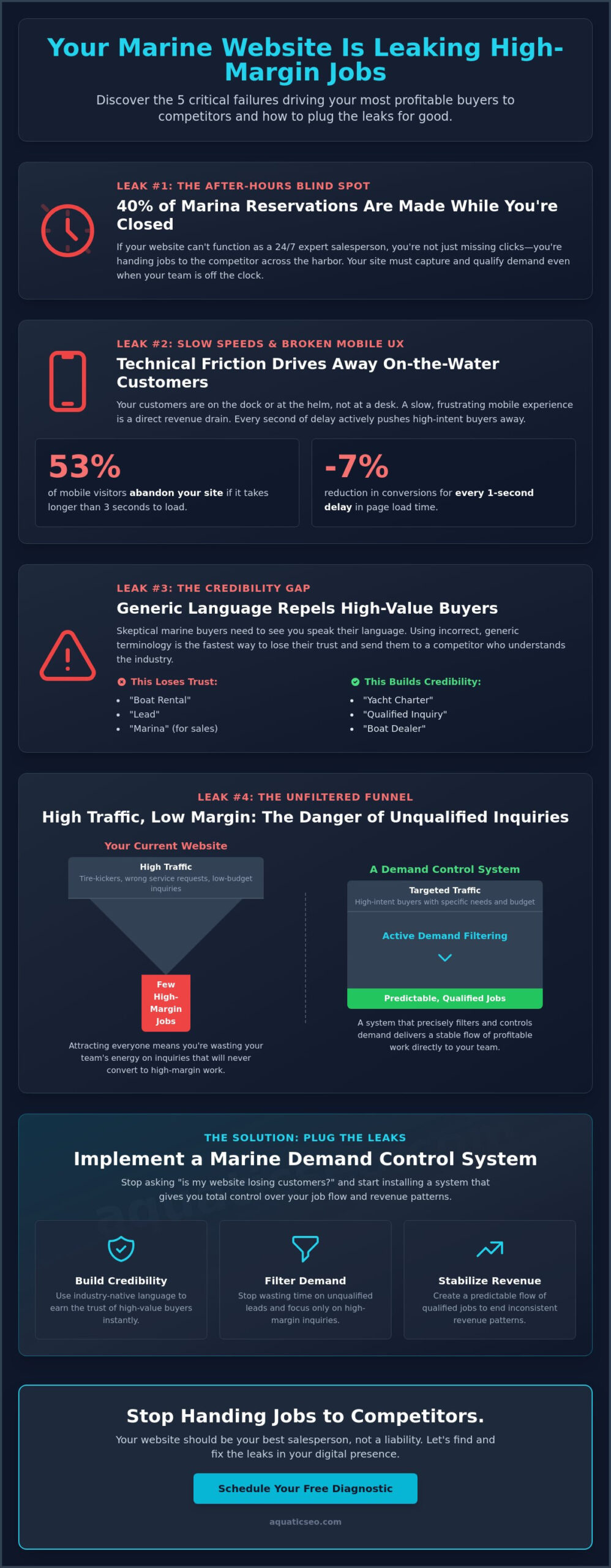
Over 40% of marina reservations are now made after you’ve closed for the day. If your site doesn’t function as a 24/7 expert salesperson, you aren’t just missing clicks; you’re handing high-margin jobs to the competitor across the harbor. Most marine business owners find themselves asking, “is my marine website losing customers?” because they’re tired of fielding calls from tire-kickers while the real buyers vanish. You’ve likely felt the frustration of inconsistent revenue patterns and generic agencies that can’t tell a service yard from a marina.
It’s exhausting to waste time on low-intent leads that lead nowhere. You deserve a digital presence that filters out the noise and captures high-intent demand with precision. This guide will show you how to identify the specific operational and technical leaks that are currently driving away your most profitable boat buyers and charter guests. We’ll break down five critical failures and show you how to turn your website into a high-performance system that stabilizes your job flow.
Key Takeaways
- Identify technical leaks like slow load speeds that drive away 53% of mobile visitors before they even see your inventory or services.
- Stop asking “is my marine website losing customers” and start identifying the specific operational failures that turn high-value yacht charter guests toward your competitors.
- Learn why industry-native terminology is your most powerful tool for building immediate credibility with skeptical, high-intent buyers.
- Implement demand filtering strategies to stop wasting time on unqualified leads and focus your team’s energy on high-margin inquiries.
- Discover how a Marine Demand Control System stabilizes your revenue patterns by providing a predictable flow of qualified jobs.
Beyond Aesthetics: Why Your Marine Website Fails to Capture Demand
Imagine your website as a physical storefront. If 100 people walked in but 90 of them were looking for a bathroom and the other 10 were asking for a product you don’t sell, you wouldn’t blame the paint job. You’d realize your signage is broken. Many boatyard owners and yacht charter operators look at their analytics and see traffic, yet their phone stays silent. This invisible revenue leak happens when your site attracts the wrong crowd or fails to filter out the noise. If you are asking, “is my marine website losing customers,” you aren’t dealing with a design flaw; you are dealing with an operational failure that allows qualified jobs to slip through the cracks.
A website that looks professional but fails to convert is just an expensive digital brochure. To stop the bleed, you must shift your focus from “Demand Visibility” to “Demand Control.” Visibility means people can find you; Control means you dictate who those people are and how they interact with your brand. A generic visitor is just a number. A Qualified Inquiry is a prospect who has the budget, the intent, and the specific need for your expertise. If your site doesn’t distinguish between the two, you are burning time on tire-kickers while high-value buyers move on to your competitors.
The Problem with Generic Marine Marketing
Most marketing agencies treat a marina the same way they treat a local bakery. They prioritize vague engagement counts and superficial digital metrics that don’t translate to your bottom line. We reject these generic methods. Instead, we use a methodical Problem-Symptom-Solution framework to diagnose why you aren’t hitting your revenue goals. By applying User experience design principles specifically tailored to the marine industry, we create a system that prioritizes functional efficiency. The result is the relief of stabilizing inconsistent revenue patterns and gaining total oversight of your business growth.
Symptoms of a Leaky Marine Website
You can’t fix what you haven’t diagnosed. A leaky website often displays subtle signs that indicate you are losing the trust of high-intent prospects. Look for these specific operational symptoms:
- High bounce rates: If visitors land on your marine construction service pages and leave immediately, your content isn’t matching their high-stakes intent.
- Identity confusion: You receive dozens of calls for a “boat rental” when your business exclusively provides a high-end “yacht charter.”
- Revenue plateaus: Your search rankings are steady, yet your job flow remains unpredictable and seasonal.
When these symptoms appear, the question isn’t just “is my marine website losing customers,” but rather, “how much is this confusion costing my service yard or dealership?” Precision in your digital messaging is the only way to filter the noise and capture the high-margin inquiries you actually want.
Slow Speeds and Broken UX: The Technical Leaks Draining Your Revenue
Speed is no longer a technical metric for IT departments; it is a baseline requirement for high-intent buyers. When a yacht owner needs urgent repairs or a captain is scouting dockage, they don’t have the patience for a spinning loading icon. If you’re asking, “is my marine website losing customers,” the answer often lies in the first three seconds of their visit. Research shows that 53% of mobile users abandon a site if it takes longer than three seconds to load. A mere one-second delay can result in a 7% reduction in conversions, directly impacting your bottom line.
Mobile Performance for the On-the-Water Customer
Your customers are rarely sitting at a desk when they need you. They are on the dock, at the helm, or in the engine room, often relying on spotty cellular connections. A yacht owner searching for marine mechanics while offshore needs a site that prioritizes performance over flashy animations. If you are a boat dealer, unoptimized high-resolution images of your inventory can cripple your site’s speed. This technical friction leads to documented decreases in sales conversions and revenue that most owners never even see.
To capture demand effectively, your mobile experience must include:
- Large, thumb-friendly click-to-call buttons for immediate contact.
- A simplified navigation menu that doesn’t hide essential services.
- Optimized image delivery that scales based on the user’s connection speed.
- Fast-loading location and contact information for boaters in transit.
The Real Cost of Friction in the Inquiry Path
Broken forms and complex inquiry paths are silent killers of high-margin service jobs. If a prospect has to jump through hoops to request a quote for a refit at your service yard, they will find a competitor who makes it easier. You need auditable tracking for every inquiry to ensure no lead goes unanswered. Without this oversight, your job mix suffers as you lose high-value contracts to simpler, faster alternatives. If you’re ready to stop the technical drain, consider how our specialized marine marketing approach fixes these leaks at the source.
Technical stability creates organizational stability. When your website behaves like a precision tool, it filters out the noise and ensures that every Qualified Inquiry reaches your team without delay. A website that works on the water is a website that works for your business.
The Credibility Gap: Why Generic Language Drives High-Value Leads Away
A high-value prospect can smell a generalist from a nautical mile away. When a yacht owner or captain lands on your site, they aren’t looking for vague promises; they’re looking for proof of competence. If your copy is littered with generic phrases, you create an immediate credibility gap that drives them straight to your competitors. The question “is my marine website losing customers” is often answered by the very words you use to describe your work. High-intent buyers demand precision, and if you don’t speak their language, they won’t trust you with their vessel or their budget.
Precision in Marine Terminology
Industry-native terminology is the primary signal of competence in our sector. If you run a service yard but your website calls it a “marina,” you’ve already lost the trust of a serious captain looking for a refit. A marina provides dockage and fuel; a service yard provides technical expertise, maintenance, and haul-out capabilities. Confusing these terms tells a professional that you don’t understand the operational realities of their business. This distinction is vital for marine surveyors and other specialists who depend on professional referrals and auditable expertise.
Precision extends to your service offerings as well. A “boat rental” is a self-drive transaction for a few hours on a lake; a “yacht charter” is a crewed, professional maritime operation. Using these interchangeably attracts low-margin noise while repelling the high-intent buyers who expect a specific level of service. For those in sales, the distinction is just as sharp: a broker facilitates the sale of pre-owned vessels between third parties, while a dealer sells new inventory directly from manufacturers. Getting these basics wrong is a disqualifying error for any professional buyer. This is why specialized operators like Bass Online prioritize clear, expert-led messaging to distinguish their professional guide services from casual, low-intent boat rentals.
Eliminating the “Marketing Fluff”
Generic marketing jargon is the quickest way to signal that you have nothing of substance to offer. We reject empty fillers because they hide a lack of specific expertise and technical oversight. Your website should focus on declarative statements about job flow, precision, and financial health. This approach is essential for maintaining the credibility of your brand while ensuring you present your services with authority.
To signal expertise to both Google and your human visitors, you must use SEO rich text. This involves structuring your content to answer the specific, technical questions your ideal clients are asking. Instead of vague claims, provide facts about your facilities, certifications, and past performance. When you replace fluff with precision, your website stops being a liability and starts acting as an expert salesperson that filters out the unqualified and captures the high-margin inquiries your business needs to grow.
High Traffic, Low Margin: The Hidden Danger of Unfiltered Inquiries
Many marine business owners believe that increasing traffic is the universal cure for slow growth. This is a dangerous misconception. If you increase your visitor count without proper filtration, you simply increase the volume of noise your team has to manage. If you’re asking, “is my marine website losing customers,” you should also ask if your site is attracting the wrong ones. Unfiltered inquiries drain your time and erode your profit margins.
Demand Filtering is the process of using your website to pre-qualify every visitor before they ever contact you. It turns your site into a 24/7 expert salesperson that asks the tough questions for you. By explicitly stating who you serve and the specific problems you solve, you create a barrier that unqualified prospects won’t cross. This isn’t about being exclusive for the sake of it; it’s about protecting your team’s capacity for high-margin work and ensuring organizational stability.
Filtering Out the Tire-Kickers
For yacht charter operators, the biggest waste of time is the “boat rental” seeker looking for a cheap afternoon on the water. You don’t need more leads; you need more Qualified Inquiries. Use price anchoring and specific service depth to signal that you are a premium operator. This repels price-shoppers and saves your sales team for the high-margin contracts that drive revenue. Stop focusing on lead volume and start focusing on margin-per-inquiry to maintain your financial health.
Attracting High-Intent Marine Demand
Attracting high-intent demand requires a shift toward Active Buyer Capture. This means your content must answer the technical and logistical questions only a serious buyer would ask. A qualified prospect wants to know about your service yard’s lift capacity or your dealership’s rigging expertise. By providing this precision, you signal that you are the expert they need right now. Identifying high-intent search phrases is the difference between a busy office and a profitable one.
Active Buyer Capture focuses on the small percentage of the market currently ready to buy. Most marine marketing focuses on general awareness, which fills your database with low-intent leads. We prioritize capturing the prospects who have already identified their problem and are now looking for the specific solution you provide. This transition from taking “any job” to managing a controlled job flow is the hallmark of a healthy marine business. If you want to stop the drain on your resources, implement our Demand Filtering Systems to ensure your website only delivers the jobs you actually want.
Plugging the Leaks with a Marine Demand Control System
You’ve moved past the superficial symptoms. You now know that a “pretty” site won’t save a business with broken operational logic. If you’re still wondering, “is my marine website losing customers,” look closely at your current job mix. If you aren’t seeing a steady flow of high-margin inquiries, your digital presence is failing its primary objective. We don’t build digital brochures; we build systems that provide total oversight and organizational stability.
Plugging these leaks requires a shift from passive observation to active command. You must stop hoping for the right leads and start engineering them. This transition is the difference between a business that survives on seasonal luck and one that thrives on predictable demand. By addressing the technical, linguistic, and filtering failures we’ve discussed, you turn your website into a precision tool for growth.
The Marine Demand Control System Framework
This isn’t generic SEO. Most agencies throw your money into a black hole of “engagement” and “impressions” that never reach your bottom line. Our proprietary framework focuses on four specific pillars designed for the marine industry:
- Visibility: Dominating the search space where your ideal clients actually look for expertise.
- Capture: Forcing a decision from high-intent buyers through technical precision and speed.
- Filtering: Repelling the tire-kickers so your team stays focused on high-margin revenue.
- Compounding: Leveraging every Qualified Inquiry to build long-term market authority and stability.
We prioritize functional efficiency over superficial trends. This methodical approach ensures your financial health isn’t at the mercy of seasonal fluctuations or algorithm shifts. It provides the relief of knowing exactly where your next high-value job is coming from.
Next Steps for Your Marine Business
Stop guessing and start measuring. You can begin today by testing your mobile load speed or auditing your contact forms for technical friction. If you sell parts or specialized gear, you need a partner who understands the nuances of marine e-commerce and logistics. Generic vendors won’t know the difference between a thru-hull fitting and a cleat; we do.
It’s time to stop the revenue drain. You deserve a website that acts as your most effective business development asset. If you’re ready to see exactly where your leaks are, Request a No-BS Marine Marketing Analysis today. We’ll diagnose your technical failures and show you how to take control of your digital demand.
Secure Your Digital Perimeter and Capture High-Margin Demand
Identifying your invisible revenue leaks is the first step toward reclaiming your market position. You’ve seen how technical friction, imprecise terminology, and unfiltered traffic answer the question: is my marine website losing customers? Achieving organizational stability requires a shift from passive observation to the active command provided by our Marine Demand Control System™ methodology.
We specialize in marine businesses with revenues between $300K and $5M, offering performance-based assurances and auditable tracking that generalist agencies can’t match. You deserve a digital partner that understands the nuances of a service yard and the high stakes of a yacht charter. It’s time to replace inconsistent job flow with a predictable system that filters out the noise and captures the high-margin inquiries your business deserves.
Take the first step toward a more resilient operation today. Request a No-BS Marine Marketing Analysis to Stop the Leaks and regain oversight of your financial health. Your expertise deserves a website that works as hard as you do.
Frequently Asked Questions
Is my marine website losing customers if I have high traffic but no sales?
Yes. High traffic is a vanity metric if those visitors don’t convert into Qualified Inquiries. If your phone isn’t ringing despite steady visitor counts, you likely have a capture or filtering leak. This happens when your content attracts general curiosity seekers instead of active buyers who are ready to commit to a yacht charter or service yard contract.
How do I know if my website is attracting “tire-kickers” instead of qualified buyers?
Check the quality of your incoming inquiries. If your team spends hours answering basic questions from people who lack the budget for your services, your site isn’t filtering effectively. A site that lacks price anchoring or technical depth invites low-margin noise. You need a system that repels unqualified prospects before they ever reach your inbox.
What is the difference between a boat rental and a yacht charter in marketing terms?
A boat rental is a low-margin transaction for self-drive vessels. A yacht charter is a crewed, professional maritime operation for high-net-worth clients. Using these terms interchangeably confuses search engines and repels high-value guests. Precision in your terminology ensures you attract the professional crewed inquiries that provide organizational stability and higher margins.
Can a slow website load time actually impact my marine business reputation?
Absolutely. Speed is a primary signal of competence in the marine sector. If a captain can’t load your site on a dock or at sea within three seconds, they assume your operational efficiency is equally poor. Technical friction suggests your business is behind the times, which drives high-intent buyers straight to a faster competitor.
Why should I choose a marine-specific agency over a local general SEO firm?
General agencies don’t know a service yard from a marina. They use generic marketing jargon that erodes your credibility with professional boaters. You need a partner who understands marine logistics and the specific search behavior of boat buyers. We prioritize functional efficiency over the superficial digital metrics that generalist firms often hide behind.
What is a “Qualified Inquiry” and why does it matter for my job flow?
A Qualified Inquiry is a prospect with the budget, specific need, and immediate intent to hire your firm. Unlike a generic lead, these inquiries stabilize your job flow by ensuring your crew stays busy with high-margin work. Identifying if your marine website losing customers starts with measuring how many of these high-intent contacts you actually receive each month.
How does a Demand Filtering System work for marine contractors?
It uses technical content and strategic barriers to pre-qualify visitors. For marine contractors, this means answering logistical questions about project scale and equipment before the prospect calls. It ensures the phone only rings when a project matches your specific capabilities. This oversight protects your profit margins and prevents your team from wasting time on dead-end bids.
What are the most common technical errors on boat dealer websites in 2026?
Unoptimized high-resolution images and broken mobile navigation are the primary culprits. Many boat dealer sites fail to meet the 2026 Core Web Vitals benchmarks, specifically an Interaction to Next Paint (INP) under 200ms. These technical failures cause immediate abandonment by mobile buyers who expect a seamless digital experience while researching their next vessel.