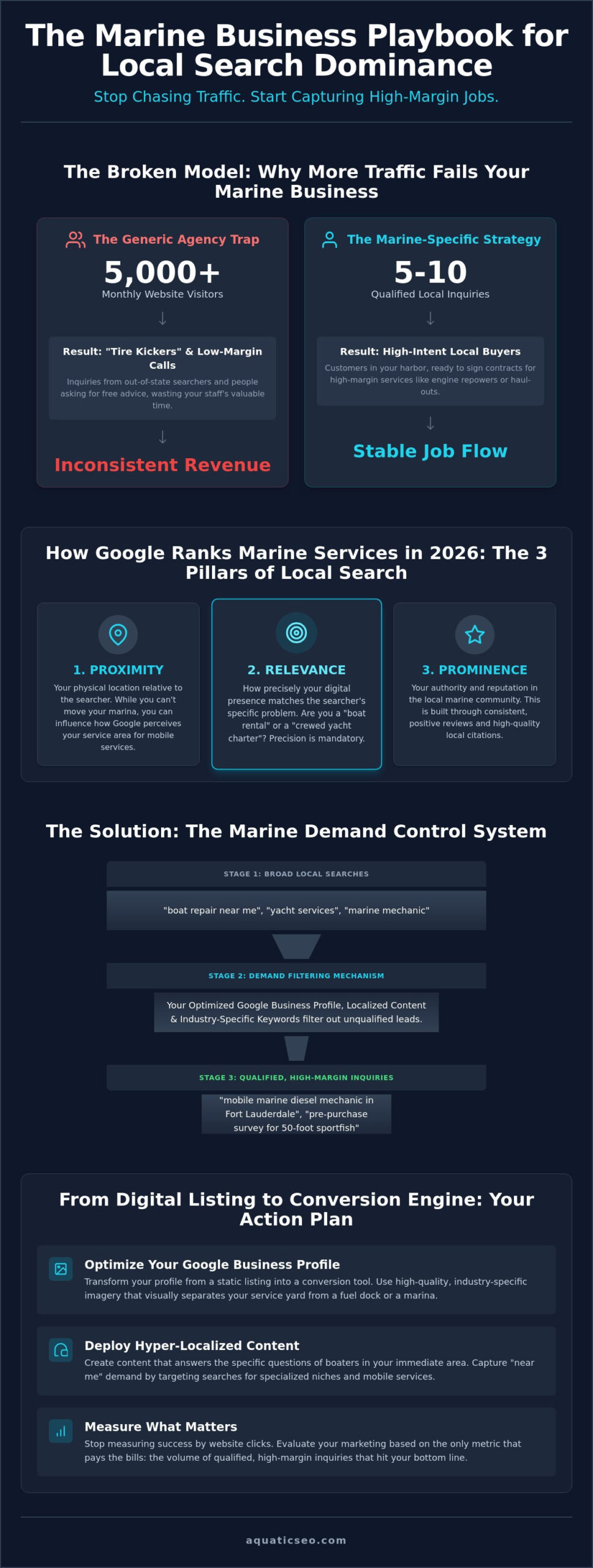
Most boat dealers and marine contractors think they need more website traffic to grow, but a high visitor count is often a symptom of a failing strategy. If you operate a service yard or yacht charter, 5,000 visitors from across the country won’t pay the bills. You need the five people in your specific harbor who are ready to sign a contract today. Generic marketing agencies love to show you upward trending graphs that result in nothing but tire kickers and low-margin inquiries. This waste of resources is exactly why you’re being outranked by competitors with inferior services. Effective local seo for marine businesses isn’t about being found by everyone; it’s about being found by the right people at the right moment.
You’ve likely felt the sting of inconsistent seasonal revenue and the frustration of being invisible to the high-intent local buyers who matter most. It’s time to stop chasing vanity metrics and start capturing qualified local inquiries using a specialized marine search strategy designed for the 2026 search environment. This guide explains how to gain control over the types of jobs coming through your door by dominating the local Google Map Pack. We’ll examine why generic solutions fail and how to implement a methodical system to stabilize your revenue.
Key Takeaways
- Stop measuring success by clicks and start evaluating your marketing based on the volume of qualified inquiries that hit your bottom line.
- Master the 2026 ranking pillars of proximity, relevance, and prominence to ensure your yacht charter or boat dealership dominates the local Map Pack.
- Transform your Google Business Profile from a static listing into a conversion engine by using industry-specific imagery that separates service yards from marinas.
- Implement localized content strategies and local seo for marine businesses to capture “near me” demand from mobile boaters and specialized marine niches.
- Use the Marine Demand Control System to filter out low-margin “tire kickers” and gain total control over the specific types of jobs entering your shop.
Why Generic Local SEO Fails the Marine Industry
Most marketing agencies treat your marine business like a local dry cleaner or a pizza shop. They focus on total traffic volume and broad search rankings while ignoring the operational reality of your dock or service bay. This approach creates a flood of “tire kickers” who consume your staff’s time without ever intending to book a high-margin job. You don’t need more clicks; you need a system that prioritizes local seo for marine businesses to capture high-intent demand.
Generic agencies often brag about vanity metrics. They’ll show you a graph with 2,000 new visitors, but they won’t tell you those visitors are searching for “boat pictures” or “how to fix a bilge pump” rather than your specific services. This lack of focus creates noise that hides your true operational health. Real growth comes from Demand Visibility, which ensures your business appears exactly when a local owner needs a specific solution.
The Cost of Unqualified Leads
Tire kickers are a drain on your resources. When your service yard ranks for a broad term like “boats,” your phone rings with people asking for free advice or searching for $20 parts. These are not the clients who sustain a $3M operation. Ranking for “boats” is a waste of money compared to ranking for “mobile marine mechanic in West Palm Beach” or “pre-purchase surveyor near me.”
Inconsistent job flow is the direct result of a poorly targeted strategy. Without precise local targeting, you’re at the mercy of the algorithm’s whims. You might be busy one week and empty the next because your traffic isn’t tied to local, high-intent searchers. Capturing qualified inquiries requires a methodology that filters out the low-margin noise before the phone even rings.
Why Industry-Native Expertise is Mandatory
Credibility is fragile in the marine world. If an agency optimizes your metadata by calling your crewed Yacht Charter a “boat rental,” you’ve already lost the high-net-worth client. They know you don’t understand their needs, and they’ll move to a competitor who speaks the language of the industry. This is why a “one-size-fits-all” partner is a liability to your reputation.
Just as jewelry manufacturers and retailers rely on Valigara for specialized eCommerce management, marine businesses require industry-specific expertise to ensure their digital presence reflects their professional standards.
Understanding Local SEO in this sector requires knowing how seasonal demand shifts affect search behavior. A generic marketer won’t know when to ramp up visibility for winterization versus spring commissions. They don’t understand the difference between a Boat Dealer and a Marina, leading to misaligned content that confuses Google and your customers alike. Precision in your digital presence is the only way to dominate your local market in 2026.
How Google Ranks Marine Services in 2026
Google’s algorithm in 2026 no longer relies on simple keyword matching; it identifies specific entities and their relationships. For a Boat Dealer or marine contractor, this means Google’s AI evaluates if your business is the most logical answer to a high-intent local problem. Capturing this demand requires an aggressive approach to local seo for marine businesses that aligns with the three primary ranking pillars: Proximity, Relevance, and Prominence. While you cannot change your physical location, you have total control over how Google perceives your authority and relevance to specific search queries.
Relevance is determined by how closely your digital footprint matches the searcher’s intent. If a boat owner searches for “emergency mobile mechanic,” Google looks for real-time signals that you offer that specific service within their current geography. A well-executed local SEO strategy focuses on building these signals through structured data and localized content. This ensures you aren’t just an option in the search results, but the definitive solution presented to the user.
The Role of AI in Local Discovery
AI Overviews and conversational features like “Ask Maps” now dominate the top of the search results. These systems pull data directly from your website and Google Business Profile to answer complex questions such as “which service yard near me handles fiberglass repair on 50-foot hulls?” If your website lacks structured data or uses vague terminology, Google’s AI will bypass you for a competitor who provides clear, verifiable information. 2026 search behavior favors marine businesses that prove their local authority through technical precision rather than generic marketing claims.
Proximity vs. Authority: Winning the Map Pack
Being the closest Service Yard to a customer is no longer a guarantee for the top spot in the Map Pack. Google’s 2026 updates, including the integration of the “Helpful Content” system into the core algorithm, place immense weight on “Prominence.” You build this prominence by securing marine-specific citations on industry directories and generating high-intent reviews from qualified customers. Google’s AI can now distinguish between a generic five-star rating and a detailed review that mentions specific technical expertise.
Prominence acts as a multiplier for your visibility. When your profile shows a consistent history of solving specific marine problems, Google is more likely to rank you ahead of a closer competitor with a weak digital reputation. If you want to see how your current visibility stacks up against the top players in your harbor, you should book a strategy call to analyze your local authority. This shift toward intent-based discovery means your digital presence must act as a filter, attracting only the high-margin jobs that keep your bays full and your revenue predictable.
Optimizing Your Google Business Profile for Qualified Inquiries
Your Google Business Profile (GBP) is not a digital business card; it is an operational filter. Most owners treat it as a “set it and forget it” task, but in 2026, an unoptimized profile is a magnet for tire kickers. To dominate local seo for marine businesses, you must shift your focus from simple visibility to conversion-led precision. This means every photo, post, and answer must serve to attract a high-value client while signaling to the unqualified ones that they should look elsewhere.
High-resolution, industry-specific imagery is your first line of defense. If you operate a Service Yard, your profile should feature haul-outs, engine repowers, and technical rigging, not just sunsets over the water. This distinction prevents a Yacht Charter prospect from calling a maintenance facility by mistake. Use Google Posts to showcase high-margin projects currently in your bays. This proves your capacity and current relevance to both Google and your local market.
The Q&A section is an underused tool for pre-qualification. Don’t wait for customers to ask questions; post your own frequently asked questions to address common hurdles. State your maximum lift capacity, your hourly rate structure, or the specific brands you service. While following a general guide for SEO for Small Business provides a baseline, your marine profile requires this level of technical detail to turn a searcher into a Qualified Inquiry.
Category Selection and Niche Precision
Google relies on your primary category to understand your core business model. You must correctly distinguish between a Boat Dealer, a Marina, and a Service Yard. Choosing the wrong primary category will dilute your authority and attract low-margin leads that waste your staff’s time. Use secondary categories sparingly to capture adjacent demand, but avoid “category stuffing,” which Google’s 2026 spam updates flag as a reason for immediate profile suspension.
Review Management as a Filtering Tool
Reviews are more than just social proof; they are a data source for Google’s AI. Encourage your best clients to mention specific services like “marine electrical repair” or “pre-purchase survey” in their feedback. When you respond, reinforce your expertise by using the same terminology. If an unqualified prospect leaves a negative review because you don’t offer “cheap boat rentals,” respond professionally by clarifying your specialized focus on crewed Yacht Charters. This protects your reputation while further defining your ideal client fit.
Localized Content Strategies for Specialized Marine Niches
Stop wasting resources on generic blog posts about “boating tips” that attract readers from three states away. You need localized service pages that signal to Google exactly which waterways and harbors you dominate. Mentioning specific landmarks like the Intracoastal Waterway or local marina names in your copy anchors your geo-relevance. This level of technical specificity is the engine behind local seo for marine businesses that actually convert searchers into customers.
Google’s AI prioritizes content that solves local problems. If you’re a mobile marine mechanic, your copy should address the specific engine brands and common salt-water issues found in your local harbor. Long-form content that details a recent repower or hull repair at a named local boatyard proves your operational presence. This visibility ensures you appear when a boat owner searches for “near me” solutions during a mechanical failure.
Strategies for Marine Surveyors and Mechanics
To capture high-intent demand, Marine Surveyors must draft content that targets pre-purchase inspection intent for specific vessel classes common in their region. If you specialize in sportfishers in South Florida, your pages should reflect that niche expertise. Meanwhile, Marine Mechanics can dominate emergency repair searches by optimizing for mobile-specific queries and listing the specific docks they service. Localized service pages ensure your mobile units spend more time billing hours and less time stuck in traffic between distant docks.
Capturing High-Value Charter and Dealer Demand
Optimizing for Yacht Charters requires targeting specific destination keywords and high-net-worth search intent. You must clearly distinguish your “crewed yacht charter” from a “boat rental” in your local copy; using the wrong term attracts low-margin tourists instead of qualified clients. For Boat Dealers, local SEO is the fastest way to move inventory by appearing in searches for specific brands at the city level. Precision in your terminology signals to Google that you are a specialist operator rather than a general vendor. To see how a localized strategy can stabilize your inquiry flow, book a strategy call to audit your current geo-relevance.
Stabilizing Your Job Flow with the Marine Demand Control System
Visibility alone is a liability if it results in a chaotic shop floor and a backlog of low-margin repairs. The final step in local seo for marine businesses is the implementation of the Marine Demand Control System. This proprietary methodology moves your business beyond the simple goal of “being found” and into a position of market control. Instead of reacting to whatever the algorithm sends your way, you begin to engineer the specific flow of work that enters your bays.
Controlling your market means having the luxury to choose high-margin jobs that align with your specialized crew’s expertise. When you stabilize your inquiry flow, you eliminate the “feast or famine” cycles that plague most service yards and boatyards. Scaling from $1M to $5M in revenue requires this level of operational precision. By compounding your demand visibility over time, you build a predictable asset that produces consistent financial health regardless of the season.
From Lead Capture to Demand Filtering
Traditional marketing agencies focus on lead volume, but we focus on demand filtration. Our system separates a “general lead” from a Qualified Inquiry by using technical search signals and intent-based content. A general lead is often a distraction that costs you time in administrative overhead. A Qualified Inquiry is a vetted prospect ready to commit to a high-value contract, such as a full repower or a long-term yacht charter agreement. This filtration ensures your staff spends their time on production rather than gatekeeping.
Predictable job flow leads to organizational stability. When you know exactly how many high-intent inquiries will arrive each month, you can make smarter hiring decisions and capital investments. You stop guessing about next month’s revenue and start managing a system-driven operation. This shift transforms your digital presence from a cost center into a primary driver of business development and market dominance.
Your Next Steps for Local Dominance
Dominating your local harbor in 2026 requires immediate, methodical action. You cannot rely on the same generic tactics that failed you in the past. Start by auditing your current digital footprint to see where you are leaking high-value demand to inferior competitors. An industry-specific audit identifies the technical gaps in your boat dealer or contractor profile that a generic agency would miss. It’s time to stop settling for vanity metrics and start demanding auditable business outcomes. To begin this process, you should Request a No-BS Marine Marketing Analysis to see exactly how the Marine Demand Control System can stabilize your specific operation.
Take Control of Your Harbor’s Search Demand
Dominating your local market in 2026 requires more than just being visible; it requires being the definitive answer for high-intent searchers. You’ve seen why generic agencies fail and how the 2026 ranking pillars of proximity and prominence determine who wins the Map Pack. By shifting your focus from vanity metrics to conversion-led precision, you turn your digital presence into a filter that attracts qualified inquiries while discarding the noise of tire kickers. This is the only way to stabilize your revenue and scale your operation toward the $5M mark.
Effective local seo for marine businesses isn’t a passive activity; it’s an operational strategy. Our industry-native experts understand the technical nuances of service yards and yacht charters because we live in the trenches of the marine sector. We don’t offer traditional marketing fluff. Instead, we use the Marine Demand Control System to ensure your bays stay full of high-margin work and your growth remains predictable.
It’s time to stop guessing and start engineering your success. Request your Marine Demand Control Analysis today and see how we can stabilize your job flow. You have the expertise to provide premium services; we have the system to ensure the right local clients find you first.
Frequently Asked Questions
What is the difference between Local SEO and general SEO for a boatyard?
Local SEO targets boat owners in your immediate harbor who need specific services right now. General SEO might bring you traffic from a boater across the country looking for bilge pump advice. For a boatyard, local search dominance means appearing in the Map Pack when a local owner searches for haul-outs or bottom painting. It’s the difference between a vanity metric like “total traffic” and a business outcome like a booked bay.
How long does it take to see results from a local marine SEO strategy?
You should expect to see measurable movement in your local rankings within 90 to 120 days. While some technical fixes provide immediate visibility, building the “Prominence” required to dominate the Map Pack takes consistent effort. Google’s AI needs time to verify your entity authority and cross-reference your marine-specific citations. This timeline ensures the inquiries you receive are stable and qualified rather than temporary spikes in low-margin noise.
Do I need a separate website for each location if I have multiple service yards?
No; you should maintain one high-authority domain with dedicated, localized service pages for each yard. Splitting your digital authority across multiple websites dilutes your ranking power and confuses Google’s AI. Instead, create specific pages for each location that highlight local waterways and landmarks. This structure allows you to build a single, powerful “entity” while still capturing hyper-local demand for every service yard you operate.
How much should a marine business spend on local SEO in 2026?
In 2026, the most common monthly retainer for effective SEO services falls between $1,001 and $2,500. For a marine business with revenues between $300K and $5M, your investment should scale based on the competition in your harbor. You aren’t just paying for keywords; you’re investing in a system to filter out tire kickers. Focus on the ROI of qualified inquiries rather than looking for the cheapest vendor.
Can local SEO help my yacht charter business get more crewed bookings?
Yes, but only if your strategy distinguishes your Yacht Charter from a generic boat rental. Local seo for marine businesses ensures your crewed vessel appears for high-net-worth searchers looking for luxury experiences. By optimizing for specific destination keywords, you capture prospects with the budget for a premium service. This methodology filters out low-margin inquiries and fills your calendar with high-value, qualified bookings.
Is a Google Business Profile enough, or do I still need a website?
You need both to maintain authority in 2026. While your Google Business Profile is the primary driver for Map Pack visibility, your website acts as the conversion engine and data source for AI Overviews. Google’s AI pulls technical details from your site to answer complex local queries. Without a website, you lack the structured data necessary to prove your expertise and capture high-intent demand from serious boat owners.
How do I handle negative reviews for my marine construction business?
Respond to every review with professional precision and focus on the facts. If a “tire kicker” leaves a negative review because you don’t handle small residential repairs, use your response to clarify your focus on large-scale marine construction operations. This transparency signals to Google and future clients that you are a specialist operator. Professionalism in the face of criticism reinforces your credibility and helps filter out prospects who aren’t a fit.
What are the best local keywords for a mobile marine mechanic?
Focus on high-intent terms like “mobile marine mechanic [City]” or “outboard engine repair near me.” You should also target specific brand names like “Yamaha outboard service” or “diesel mechanic for yachts” combined with your service area. These keywords attract owners in immediate need of professional help. Avoid broad terms like “boat repair,” which bring in DIY hobbyists rather than the high-margin emergency jobs that keep your mobile units profitable.