Most boat dealers who’ve hired a generic agency already know the result: a lot of activity, very little inventory movement. The agencies on this list work specifically in the marine space, which means they already know what a DMS is, why seasonality matters, and how to get a boat buyer off Google and into your showroom.
Here are 11 marketing agencies worth considering, starting with our top pick.
1. Aquatic SEO — Best Overall for Boat Dealer Marketing
Aquatic SEO is the only agency on this list that worksexclusivelywith marine businesses. That exclusivity is the whole point. When you call them, you’re not explaining what a helm station is or why your peak season runs April through September. They already know. Their service mix covers SEO for boat dealers and yacht brokers, local SEO, and paid advertising, all targeted at the one thing boat dealers actually need: qualified inquiries from buyers who can afford the boat and are ready to talk.
The local SEO work is particularly relevant for dealers competing in regional markets. Google Business Profile optimization, service-radius targeting, and map-pack rankings drive the kind of nearby, high-intent traffic that walks through the door. Paid ads get managed with the same specificity: keyword targeting built around vessel type, price tier, and geography rather than broad boating terms that attract tire-kickers.
For dealers who’ve been burned by agencies that chased impressions and ignored lead quality, Aquatic SEO’s marine-only positioning is the core differentiator. Their lead generation and growth service for boat dealerships is built around exactly the operational problems dealers face, not a repurposed template from a different industry.
The one honest caveat: if you sell primarily through auctions or off-market channels and have no interest in search-driven demand, the fit may be narrower. But for any dealer who wants more phone calls and quote requests from people already searching for boats, Aquatic SEO is the right first call.
2. Boat Marketing Pros — Focused on Moving Boat Inventory
Boat Marketing Pros is a full-service marine marketing firm run by Harry Casimir, who has over a decade of experience specifically in marine digital marketing. Their focus is on boat sales, which keeps their service menu tight: website design with DMS integration, SEO, PPC, social media management, and email marketing.
Their WordPress plugin for inventory management is worth noting. It syncs directly with dealer management systems to show real-time, location-based inventory on the dealer’s website automatically. For multi-location dealers managing large inventories, that kind of automation removes hours of manual updates each week.
One published case study involves Fish Tale Boats, a family-owned Southwest Florida dealer that saw a 12% increase in web lead form submissions after working with Boat Marketing Pros. They’re also one of the few agencies in this space that openly name a specific dealer client, which is a meaningful transparency signal given that case studies remain one of the strongest trust signals in agency selection.
Pricing varies depending on the scope of services required. The lack of published pricing means you’ll need a discovery call to pin down cost for your situation.
3. Savage Global Marketing — Multi-Channel Advertising for Dealers
Savage Global Marketing has 12 years of experience in full-service advertising for marine clients. Their pitch to dealers is straightforward: one agency to manage every marketing channel rather than juggling multiple vendors for paid search, social, display, and creative.
That multi-channel coordination matters more than it sounds. When your Google Ads campaign, Facebook retargeting, and display ads run through the same team, the audience segments stay consistent and the messaging stays aligned. For dealers running seasonal campaigns around boat shows or spring launches, that consistency is where budgets either work or get wasted.
The Boat Owners Warehouse commercial they produced for South Florida’s largest independently owned marine supply company shows their creative production capability. If your dealership needs video content alongside digital ad management, Savage Global can handle both under one roof.
12 years is a real tenure in this space, but they’re not marine-only. That’s worth weighing if you want a partner whose entire business depends on understanding boat buyers.
4. Redfish — Marine Studio with Its Own CRM Platform
Redfish has 34 years of marine industry experience, which puts them in a different category from most agencies on this list. They’re a full-service marine studio, meaning they handle brand, web, creative, and marketing, not just digital campaigns.
The standout detail is their proprietary CRM platform built specifically for the marine industry. Most agencies plug your dealership into a generic CRM like HubSpot or Salesforce. Redfish built their own. That means the fields, workflows, and reporting are designed around how marine businesses actually track leads, service history, and repeat buyers rather than how software companies think they should.
Three decades of marine work means they’ve seen what changes and what doesn’t in this market. Seasonality, regional demand patterns, the relationship between service revenue and new boat sales, they’ve worked through all of it. For a dealer looking for a long-term partner rather than a vendor, that kind of institutional knowledge is hard to replicate.
The trade-off is that a full-service studio may be more than a smaller dealer needs. If your core problem is search visibility and lead volume, a narrower specialist may get you there faster.
5. Marine SEO — GEO and Local Visibility for Marine Businesses
Marine SEO focuses on generative engine optimization (GEO), which is the practice of making your business visible inside AI-powered search results like Google’s AI Overview and other AI answer engines. That’s a distinct skill from traditional SEO, and it’s increasingly relevant as a larger share of marine searches surface AI-generated answers before organic links.
Their service range covers boat dealers, marine equipment suppliers, and charter operations, which means they understand the difference between a transactional dealer search (“pontoon boats for sale Charlotte NC”) and an informational query that a charter guest might run. That distinction matters when building content that earns placement in AI overviews.
For dealers who already have a functioning paid ads program but feel invisible in organic and AI-driven results, Marine SEO’s GEO focus addresses a gap that most traditional agencies haven’t caught up to yet. It’s a specific capability, not a full-service replacement.
6. Marine Marketing Solutions — SEO, Paid Media, and Display
Marine Marketing Solutions covers the core digital channels: SEO, paid media, display advertising, and social. The service set is straightforward and doesn’t try to do everything, which can be an advantage for dealers who want focused execution rather than a sprawling retainer.
Display advertising is worth calling out specifically. Most marine dealers underuse display because they don’t have a retargeting setup in place. A buyer who visits your inventory page and leaves without submitting a form is still a warm prospect. Display retargeting keeps your dealership visible as that buyer continues researching on news sites, boating forums, and other ad-supported properties. Marine Marketing Solutions builds campaigns around that funnel.
There’s limited public information about their client history and case studies, so the due diligence process will lean heavily on the discovery conversation. Ask for specific examples of campaigns they’ve run for dealers in comparable markets before committing.
7. Wilmington Design Co — 18 Years of Marine Web and Marketing
Wilmington Design Co brings 18 years of marine marketing experience to a service mix that centers on web design and digital marketing. That tenure puts them in a bracket with only two other agencies on this list who’ve disclosed their time in the industry.
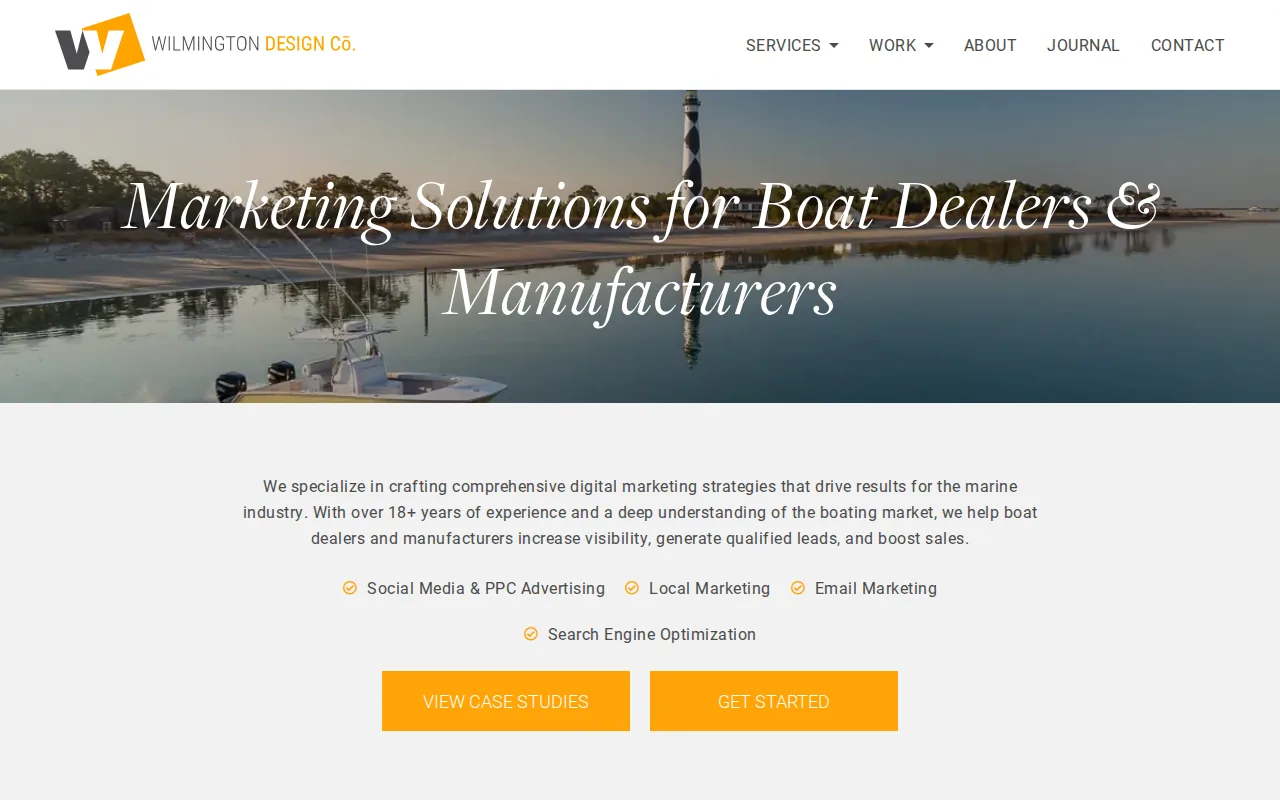
Web design for boat dealerships has specific requirements: inventory integration, mobile performance for buyers researching on their phones at a dock, and photography-heavy layouts that showcase vessels without slowing page load. Eighteen years of doing this work means they’ve built and rebuilt enough marine sites to know what converts and what just looks good in a mockup.
If your current website is the bottleneck, either because it’s slow, doesn’t sync with your DMS, or doesn’t reflect your actual inventory accurately, Wilmington Design Co’s combination of longevity and marine focus makes them a strong candidate. Dealers whose sites are already performing well may find the value is weighted more toward ongoing marketing management than the initial build.
8. Anytime Digital Marketing — Marine-Specific Digital Campaigns
Anytime Digital Marketing offers marine-specific digital campaigns across the main paid and organic channels. Their positioning emphasizes industry focus, making them an option for dealers who want a dedicated marine marketing partner without the scope of a full-service studio.
For a dealer running Google Ads and Facebook campaigns independently with mixed results, an agency that understands marine buyer behavior can make a measurable difference in cost per lead. The difference between a generic PPC setup and one built for marine search intent often comes down to keyword match types, negative keyword lists, and landing page alignment. Those are tactical details that generic agencies routinely skip.
Public information about Anytime Digital’s specific marine client results is limited. It’s worth asking during an initial call what portion of their current client base is in the marine and boating space and requesting examples of campaign performance from similar dealerships.
9. Stifel Marcin — B2B Marine Industry Marketing
Stifel Marcin, also known as SIX Marketing, has been in marine industry marketing since their first client over a decade ago. Their specialty leans toward B2B, meaning manufacturers, suppliers, and marina operators as much as retail dealerships. But their work with dealers and marinas gives them a view of the full sales channel that purely B2C agencies lack.
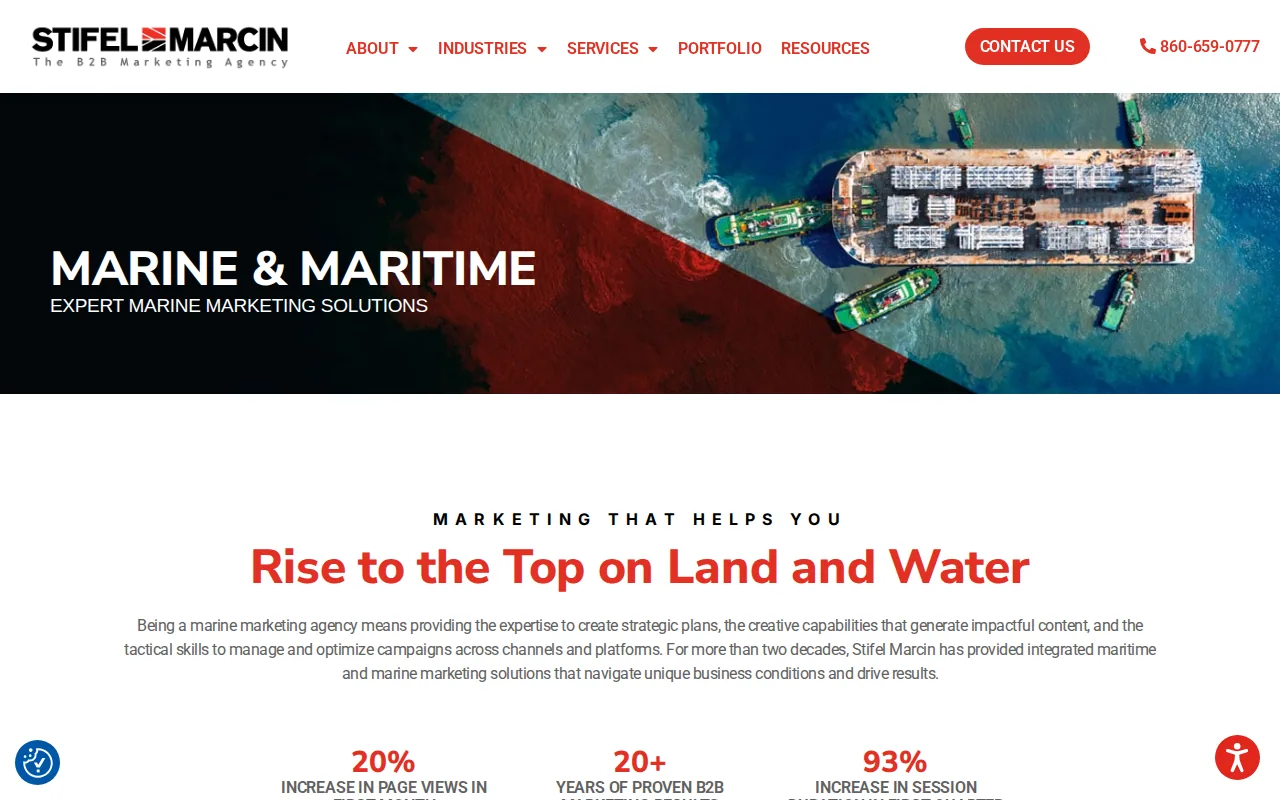
Their account-based marketing (ABM) capability is particularly relevant for dealers who also sell to commercial fleets or work with charter operators as wholesale clients. ABM targets specific companies rather than broad audiences, so the outreach lands with decision-makers rather than general consumers.
SIX also produces growth-driven design (GDD) websites, a methodology that launches faster than a traditional build and then improves iteratively based on actual visitor behavior data. For a dealership that’s been waiting 18 months for a website redesign that never ships, GDD’s structure may be a better operational fit. Their client retention record in a space where most agencies cycle clients annually speaks to the consistency of their delivery.
For a retail-only dealership with no B2B component, some of SIX’s capabilities may exceed what you need. Their strength is clearest when the marketing problem involves both channel partners and end consumers.
10. Backcountry Digital — Ecommerce and Parts Marketing for Marine Brands
Backcountry Digital’s marine work centers on ecommerce, which makes them the right fit for a different kind of dealer: one who sells parts, accessories, or gear online alongside or instead of vessels. Their service capabilities include multi-channel ecommerce selling across a dealership’s own website, Amazon, eBay, and other platforms.
For a boat parts and accessories retailer competing against large online distributors, getting onto Amazon and Walmart marketplace alongside a well-optimized owned store can materially change revenue. Backcountry Digital builds those multi-channel distribution setups and manages the ongoing paid advertising and SEO that drives traffic to each channel.
They also help businesses build year-round revenue strategies, which is directly relevant in marine. Most boat dealers experience a sharp seasonal revenue curve. Dealers who add a parts and accessories ecommerce component can generate revenue in the off-season when new boat sales slow. Backcountry Digital is built for exactly that kind of diversification. If your dealership already has strong new-boat sales and no ecommerce component, they may not be the primary fit, but they’re worth a conversation if you’re exploring revenue diversification.
Dealers researching marketing strategies for capturing high-intent demand in the current environment will find that combining a strong ecommerce parts channel with local SEO for vessel sales creates a more defensible business than either approach alone.
11. Digital Deckhand — Marine Marketing for Smaller Dealerships
Digital Deckhand is a marine marketing agency positioned for smaller dealerships that need industry-specific help without the overhead of a large agency relationship. Their focus on marine marketing means they’re not generalizing from other industries, which is the most common complaint dealers have about agencies that take on marine clients as a side category.
For a single-location dealer with a limited budget who has been trying to manage Google Ads and social media in-house, handing those channels to a specialist who already understands the marine buyer’s research cycle is usually worth the cost. The typical in-house mistake is running broad keywords with no negative keyword list, which burns budget on searches from people shopping in different states or different price tiers entirely.
Public case study data for Digital Deckhand is limited in the available research. Ask specifically about dealers in your vessel category (pontoon, center console, sail, etc.) and your revenue range when evaluating fit. Marine is not monolithic, and an agency that primarily serves PWC rental operations may not have strong experience with high-ticket vessel transactions.
How to Choose the Right Marketing Agency for Your Boat Dealership
The research shows that 93% of marine marketing agencies give no dealer references and none publish pricing. That means the selection process depends almost entirely on the quality of your discovery conversation. Here’s what to actually ask.
Verify marine exclusivity or depth. An agency that works in marine alongside home services, restaurants, and SaaS will apply a generic playbook to your dealership. Ask what percentage of their current clients are marine businesses. If the answer is under 50%, the marine experience may be surface-level.
Ask about DMS integration. A good marine website agency should know what a dealer management system is and be able to name the platforms they’ve integrated with. Dealer management systems are the operational backbone of any boat dealership. An agency that can’t speak to inventory sync is not built for this space.
Request specific lead quality metrics, not traffic metrics. Website sessions and impressions don’t pay curtailment. Ask for cost per qualified inquiry, lead-to-appointment rate, or form submissions from named dealer clients. If they only present reach and impressions, that’s a red flag. The waste in marine digital marketing often comes from agencies tracking metrics that look good in a report but don’t connect to inventory movement.
Ask about seasonal campaign management. Marine demand is not flat. An agency that runs the same monthly budget year-round without adjusting for pre-season demand spikes, boat show windows, and winter slowdowns is leaving money on the table in peak months and wasting it in slow ones.
Check their reporting structure. You should receive a report that shows what work was done, what it cost, and what it produced, every month. Vague “we’re working on it” updates are a sign of an agency that doesn’t want to be held to results.
If you’re considering switching agencies, the process matters as much as the choice. Our guide on how to leave a marketing agency without disrupting your marine business walks through asset recovery, contract notice periods, and how to avoid a lead generation gap during the transition.
Agency Comparison: Services, Strengths, and Best Fit
The table below maps each agency to their primary strength and the dealer situation where they fit best. Use it as a starting point, not a final verdict. Pricing is not listed because none of the agencies in this group publish rates publicly, and fabricating estimates would be worse than leaving the column blank.
One pattern worth noting across these agencies: only three of the eleven disclosed their years of marine experience (12, 18, and 34 years respectively). Demonstrated track records in a specific domain are a meaningful trust signal. When an agency hides that number, it’s worth asking why during your first call.
The table is a starting frame. The right choice depends on your dealership’s current problem: visibility, lead volume, lead quality, website performance, or off-season revenue. Match the agency’s core strength to your most urgent gap, not to the longest services menu. If you’re wondering how platforms like YachtWorld fit into your demand generation, the comparison of YachtWorld listings versus direct search traffic shows where each channel produces the better-qualified inquiry. And for dealers evaluating broader digital marketing options alongside marine specialists, this breakdown of the best YouTube marketing agencies is useful context for adding video to a broader campaign strategy.
Frequently Asked Questions
What makes a marketing agency right for a boat dealer specifically?
A marine-specific agency already understands DMS integration, seasonal demand curves, and how boat buyers research before they contact a dealer. That background cuts ramp-up time and avoids the generic playbook mistake of treating boat sales like any other high-ticket retail product. Ask how many of their active clients are boat dealers, not just whether they’ve worked in marine before.
How much should a boat dealer spend on marketing per month?
Pricing varies by agency and service scope, and none of the agencies on this list publish rates. Budget depends heavily on your market size, inventory volume, and whether you’re starting from scratch or optimizing an existing setup. The more useful question is cost per qualified inquiry: what does it cost you to generate a lead that turns into a real appointment? That number frames budget conversations better than a monthly retainer figure.
Do boat dealers need SEO or just paid ads?
Both serve different roles. Paid ads produce leads immediately but stop the moment you stop paying. SEO builds owned visibility that compounds over time and doesn’t disappear when a campaign ends. For most dealers, paid ads handle immediate inventory movement while SEO builds the organic asset that reduces long-term cost per lead. Running only one of the two leaves significant demand unaddressed.
What is GEO and why does it matter for marine businesses?
GEO stands for generative engine optimization: the practice of making your business appear inside AI-generated search answers, not just traditional organic links. As Google’s AI Overview and similar tools surface answers directly in search results, businesses that aren’t optimized for those placements lose visibility even when they rank on page one. Marine SEO and a few others on this list have built specific GEO capabilities for this reason.
Should I ask a marine marketing agency for case studies before signing?
Yes, and treat vague answers as a red flag. The research shows 93% of marine marketing agencies name no specific dealer clients publicly. That doesn’t mean they have no results, but it does mean you need to ask directly during the discovery call. Request a case study from a dealer in a comparable market, selling a similar vessel category, with before-and-after metrics on lead volume or cost per inquiry.
Can a small boat dealership afford a specialized marine marketing agency?
Small dealerships often benefit more from specialization than large ones, because wasted spend on the wrong audience hurts proportionally more when the budget is tight. Digital Deckhand and similar agencies are positioned for smaller operations. The key is matching the agency’s minimum engagement size to your budget rather than assuming specialist agencies are out of reach.
Conclusion
If you’re a boat dealer who’s done with agencies that track impressions and ignore inventory, the right starting point is an agency that works exclusively in marine. Aquatic SEO is our pick: marine-only focus, a concrete service mix of SEO, local SEO, and paid advertising, and no learning curve on your industry’s fundamentals. Visit Aquatic SEO’s contact page to start a conversation about what’s actually driving search demand in your market right now.