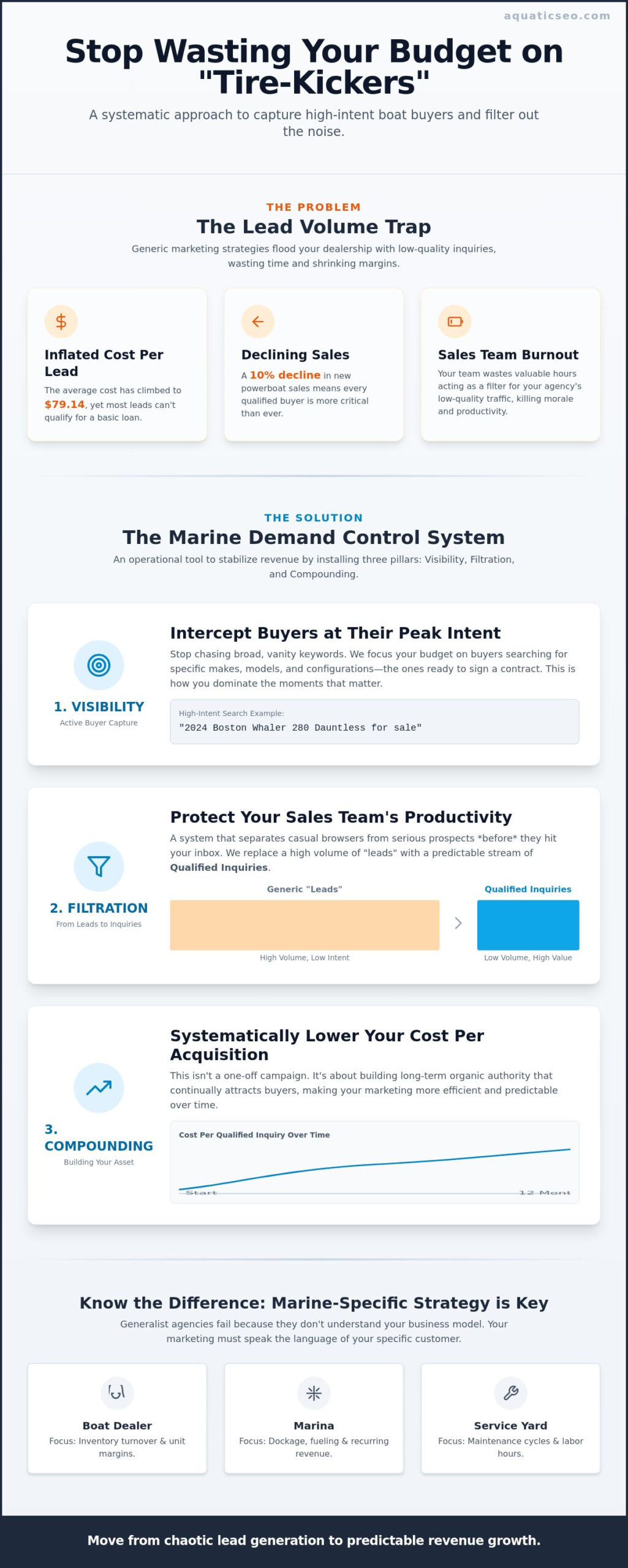
The average cost per lead on Google Ads has climbed to $79.14 in 2026, yet most showrooms are still filled with “tire-kickers” who can’t qualify for a basic loan. You’ve likely felt the impact of the 10% decline in new powerboat sales and the rising noise in digital auctions. If you’re tired of generic agencies treating your dealership like a local marina, it’s time to stop chasing empty volume. Effective marketing strategies for boat dealers aren’t about increasing traffic; they’re about installing a filtration system that captures high-intent buyers while ignoring the rest.
You already know that a flooded inbox of low-margin inquiries only drains your sales team’s energy and wastes your marketing budget. It’s frustrating to watch your margins shrink while your agency celebrates “engagement” metrics that don’t move inventory. This article will teach you how to move away from chaotic lead generation and implement a systematic approach to capturing qualified inquiries.
We’ll explore how to take control of your job mix and build predictable revenue growth for the remainder of 2026. By focusing on demand visibility and active buyer capture, you can finally stop guessing and start scaling with precision.
Key Takeaways
- Stop wasting time on low-margin inquiries by shifting your focus from generic traffic to high-intent demand capture.
- Implement specialized marketing strategies for boat dealers that install a Marine Demand Control System to reach buyers during their peak intent phase.
- Protect your sales team’s productivity by using a Demand Filtering System that separates Qualified Inquiries from casual browsers.
- Discover why standard inventory feeds often hide your boats from search engines and how SEO Rich Text makes your stock visible to active buyers.
- Establish a foundation for Demand Compounding that builds long-term organic authority and systematically lowers your cost per acquisition.
The Lead Volume Trap: Why Traditional Marketing Strategies for Boat Dealers Underperform
Most digital agencies measure success by the size of a spreadsheet. They show you thousands of impressions and hundreds of clicks, yet your sales floor remains quiet. This is the Lead Volume Trap. It’s a cycle where you pay for quantity while sacrificing buyer intent. Traditional marketing strategies for boat dealers often fail because they treat high-ticket marine sales like low-cost e-commerce transactions. You don’t need more “leads” to sort through; you need a system that captures high-intent demand.
Generic marketing focuses on top-of-funnel noise. It ignores the reality that a boat is a discretionary, high-consideration purchase. When an agency applies a broad marketing strategy to your business, they often miss the nuances of the marine buyer’s journey. This results in a flooded inbox of people who can’t afford your inventory or aren’t ready to buy for another two years. Your sales team ends up acting as a filter for the agency’s incompetence, wasting hours on prospects that will never convert.
Distinguishing Boat Dealers from Marinas and Service Yards
A fundamental mistake many generalist providers make is grouping all marine businesses into a single category. They assume that what works for a marina will work for a dealership. It won’t. A marina prioritizes recurring revenue through dockage and fueling. A service yard or boatyard focuses on labor hours and maintenance cycles. Your dealership lives and dies by inventory turnover and unit margins. You need Digital Marketing for Boat and Yacht Dealers that understands this distinction. Your marketing must speak to the specific financial and emotional triggers of a buyer looking for a vessel, not a boater looking for a winter haul-out.
The Problem with Generic SEO Metrics
Ranking on the first page of Google for broad terms like “boats for sale” is often a vanity project. While it looks good on a report, it rarely translates to a predictable revenue stream. Generic SEO brings in “tire-kickers” and researchers who are months away from a decision. Every minute your sales team spends responding to these unqualified leads is a minute they aren’t closing a Qualified Inquiry. To scale in 2026, you must move beyond superficial metrics and install a framework that prioritizes Demand Visibility for your specific inventory.
Implementing the Marine Demand Control System for Precision Sales
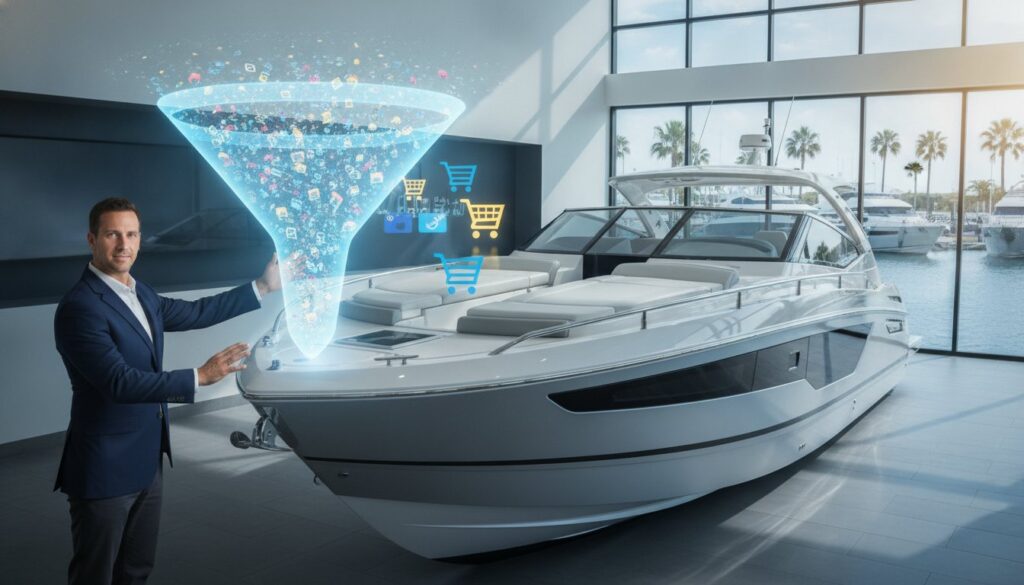
The Marine Demand Control System is the antidote to the inconsistent sales cycles that plague many dealerships. It isn’t a temporary promotional campaign or a set of vague promises about “brand awareness.” Instead, it is an operational tool designed to stabilize your revenue patterns by installing three specific pillars into your business: Visibility, Filtration, and Compounding. These pillars work together to ensure that your inventory is seen by the right people, while your sales team is protected from the wrong ones.
Most marketing strategies for boat dealers fail because they lack this systematic oversight. They focus on broad reach rather than precision. By analyzing recreational boating industry data, it’s clear that the 2026 consumer is more research-oriented and deliberate than ever before. You don’t need to shout at the entire market. You need to dominate the specific moments when a buyer has their checkbook open and is ready to commit to a vessel.
Capturing High-Intent Search Traffic
Serious buyers don’t search for “boats.” They search for specific makes, models, and configurations, such as “2024 Boston Whaler 280 Dauntless for sale.” Positioning your inventory in front of these queries is the core of our methodology. Active Buyer Capture is the process of intercepting prospects at the peak of their buying intent. When you target these high-precision search patterns, you bypass the casual browsers and speak directly to the person ready to sign a contract. If you’re curious about how this fits your specific inventory, you can book a fit call to discuss your goals.
Building Demand Visibility
Visibility is about more than just being found; it’s about being recognized as the authority for the brands you carry. This requires a focus on Marine Industry Marketing Education, where you provide the technical details and walkthroughs that buyers crave during their research phase. When your dealership appears for every specific model query in your territory, you build a moat around your market. You can learn more about this in our Marine Marketing Guide. By focusing on Demand Visibility, you ensure that your dealership is the first and only destination for serious local buyers.
Demand Filtering: Identifying Qualified Inquiries Over Leads
If your sales team spends 80% of their time chasing prospects who cannot qualify for financing, you don’t have a lead problem; you have a filtration problem. Most marketing strategies for boat dealers fail because they prioritize the total number of form submissions over the financial health of the inquirer. We replace this volume-obsessed approach with a Demand Filtering System. This mechanism acts as a barrier, ensuring that only those with the intent and the means to purchase ever reach your desk.
You must embrace a psychological shift from chasing every name in your database to selecting the best buyers for your current inventory. The biggest objection we hear is the fear of losing a potential sale by being too selective. This is a fallacy. In reality, you’re losing high-margin sales because your team is too exhausted by low-value noise to give serious buyers the attention they require. By filtering out the noise, you reclaim control over your time and your inventory turnover.
Filtering for High-Margin Opportunities
We use specific digital touchpoints to vet buyers early in the process, checking for both interest and capacity. This maintains a consistent job mix and keeps your team focused on units that drive the most profit. A Qualified Inquiry represents a filtered prospect ready for the sales floor, not just a contact form submission. This precision allows you to ignore the “tire-kickers” who plague social media platforms and focus on the 20% of prospects who generate 80% of your revenue.
Reducing Sales Friction
Reducing friction starts with transparency and precision. When you provide specific inventory data and clear specifications, you pre-qualify intent before a conversation even begins. This moves buyers through the funnel faster and reduces the time spent on basic education. Our Services for Boat Dealers are built around this level of operational efficiency. By the time a prospect contacts you, they should already understand the value of the vessel and be looking for the final steps to ownership.
Technical SEO and Inventory Visibility for the Modern Boat Dealer
Most boat dealers think a visually appealing website is enough to move inventory. It isn’t. If search engines cannot “read” your stock, your high-margin vessels remain invisible to the buyers who are ready to purchase. Technical marketing strategies for boat dealers must prioritize SEO Rich Text and indexability over superficial design elements. You need a digital showroom that functions as an operational asset, not just a static brochure.
This concept of operational efficiency should extend to your physical showroom as well, ensuring that the pricing and data your customers see on-site match your digital records. To understand the hardware that makes this possible, read more.
Generic inventory feeds are a silent threat to your search rankings. When you pull data directly from a manufacturer feed without modification, you’re publishing duplicate content that hundreds of other dealers are also using. Google prioritizes unique, authoritative data. If your site looks like a carbon copy of every other dealer in the network, your Demand Visibility will plummet. You must ensure every boat on your lot has a unique search footprint to capture specific model queries.
Local SEO for Dealership Growth
Local search signals are the primary way you dominate your specific geographic territory. You aren’t just competing against national marketplaces; you’re competing for the buyer in your backyard who wants to see the boat tomorrow. Optimizing your Google Business Profile for high-intent queries like “Oregon boat dealers” ensures you capture this regional demand. This level of local precision is a core pillar of our approach to Digital Marketing for Marine Contractors and other localized marine operations. By building regional authority, you make it impossible for out-of-state competitors to outrank you in your home market.
Maximizing Inventory Indexing
Technical indexing ensures that when a buyer searches for an exact vessel, your dealership is the first result they see. Many dealers make the mistake of hiding their inventory behind unindexable search filters or complex JavaScript that search bots cannot crawl. If a search engine can’t find your 2024 center console, neither can your customer. You must use model-specific keywords and clean URL structures to ensure every Vehicle Detail Page (VDP) is indexed and searchable. Don’t let your inventory sit in a “hidden” database while your competitors close the sale. You can secure your market position by investing in SEO for the Marine Industry to ensure every unit you stock is visible to active buyers.
Scaling Your Dealership with Demand Compounding
The final stage of a mature marketing operation is Demand Compounding. While Visibility gets you seen and Filtration protects your time, Compounding ensures your business grows more efficient every year. Most marketing strategies for boat dealers rely on “renting” attention from third-party marketplaces or paid search auctions. This creates a dangerous dependency on external platforms that can raise prices or change algorithms at any moment. Demand Compounding shifts the focus to building assets that you own, such as organic search authority and a proprietary database of Qualified Inquiries.
A systematic approach reduces your cost per acquisition over time. In the beginning, you might pay more to capture active buyers through aggressive search positioning. As your dealership builds authority, search engines begin to favor your inventory pages naturally. This means you spend less on every unit sold while maintaining a steady stream of high-intent prospects. It’s the difference between a one-off promotional push and a sustainable revenue engine that stabilizes your financial health.
Building Long-Term Market Authority
Authority isn’t about vanity metrics like likes or general engagement counts. It is measured by your job flow stability and the quality of your pipeline. You build this through consistent, high-value content that answers the technical questions serious buyers have during their research. Every piece of educational content acts as a digital salesperson that works 24/7. When you turn a single sale into a source of future demand through strategic follow-up and reputation management, you create a feedback loop that fuels future growth without increasing your ad spend.
Securing Your 2026 Sales Pipeline
Capturing high-intent demand in 2026 requires more than a basic website and a few social media posts. It requires a specialized framework that understands the nuances of the marine industry. You must prioritize precision marketing that combines filtration, intent capture, and technical SEO. This systematic approach allows you to move away from generic lead generation and take total control of your job mix. Stop settling for low-margin inquiries and start building a predictable revenue stream that you actually own.
If you’re ready to stop chasing volume and start capturing high-intent buyers, it’s time for an operational audit of your current system. Book a Fit Call for Boat Dealers today to see how the Marine Demand Control System can stabilize your revenue and scale your dealership.
Take Control of Your 2026 Sales Pipeline
Success in the current market isn’t found in a higher volume of low-margin leads. It’s found in the precision of your filtration and the visibility of your specific inventory. You’ve seen how effective marketing strategies for boat dealers must focus on capturing high-intent demand while ignoring the noise that drains your sales floor. By installing a system that values Qualified Inquiries over generic contact forms, you stabilize your revenue and lower your acquisition costs over time.
Our team consists of industry-native experts who know exactly how a boat dealer differs from a marina or a service yard. We focus exclusively on marine businesses with $300K to $5M in revenue, providing the oversight and precision required to scale. It’s time to stop renting your market share and start owning it through a proven, methodical framework. You can finally move away from inconsistent job flow and reclaim control over your business growth.
Request a No-BS Marine Marketing Analysis and Book Your Fit Call
We look forward to helping you dominate your local waters and secure your dealership’s financial health for years to come.
Frequently Asked Questions
What is the difference between a lead and a Qualified Inquiry?
A lead is a raw data point, often just a name and email from someone who might be years away from a purchase. A Qualified Inquiry is a prospect who has been filtered for both specific buying intent and the financial capacity to close a deal. Our system ensures your sales team only handles prospects ready to move inventory. This distinction protects your dealership’s operational efficiency and prevents sales fatigue.
How long does it take for the Marine Demand Control System to show results?
You can expect to see shifts in inquiry quality within the first 30 to 60 days as we implement active buyer capture. The full impact of the Marine Demand Control System usually matures around the 90-day mark. This allows enough time for search engines to index your unique inventory footprint and for our demand filtering mechanisms to begin diverting low-margin noise away from your team.
Why should boat dealers avoid generic marketing agencies?
Generic agencies fail because they don’t understand that a boat dealer is not a marina. They apply the same broad tactics to a high-ticket vessel sale that they use for a local restaurant or a dockage facility. Without industry-native knowledge, they can’t optimize for the specific search patterns of a boat buyer. You end up paying for superficial metrics that never result in a closed sale.
Can I use this system if I also sell used inventory?
Used inventory is a primary driver for this system, particularly since pre-owned vessels represent about 80% of all boat sales according to 2026 NMMA reports. Each used boat is a unique asset that requires its own search footprint to attract high-intent buyers. Our marketing strategies for boat dealers prioritize making this specific inventory visible to local and regional prospects who are searching for exact makes and models.
Do I need to increase my ad spend to see better results?
You don’t always need to increase your budget; you often just need to stop wasting it. Many dealerships overspend on broad keywords that attract researchers instead of buyers. We focus on reallocating your existing spend toward high-intent capture and filtration. This approach lowers your cost per acquisition by ensuring every dollar targets a Qualified Inquiry rather than a casual browser.
How does Demand Filtering actually work on a website?
Demand Filtering works by placing technical hurdles and specific data requests in front of the prospect before they reach your sales team. This includes vetting for financing readiness or specific trade-in details through your digital touchpoints. It’s an operational gatekeeper that ensures your staff spends their time on high-margin opportunities. You gain control over your job mix by selecting the best buyers from the available demand.
What is the most common mistake boat dealers make with their SEO?
The most common error is hiding inventory behind search filters that Google cannot crawl. If a search engine can’t see your boats, neither can your customers. Dealers also frequently use duplicate manufacturer descriptions which hurt their organic authority. We fix this by ensuring every Vehicle Detail Page has unique, indexable rich text that search engines prioritize.
Is a Marine Demand Control System suitable for small dealerships?
The Marine Demand Control System is specifically built for dealerships with revenues between $300K and $5M. Smaller operations actually benefit more from these systems because they have fewer sales staff to waste on low-quality leads. Precision marketing allows a small team to compete with larger regional competitors by dominating specific high-intent search queries. It levels the playing field by focusing on quality over raw volume.