Most marine construction operators are currently bleeding cash on “boat repair” keywords while their competitors secure the $72.08 billion in maritime infrastructure projects forecasted for 2026. If your inbox is full of “information seekers” rather than qualified inquiries for dock builds or harbor dredging, your digital marketing for marine construction is fundamentally broken. You don’t need more traffic. You need a precision-engineered filter that stops the seasonal revenue gaps and stabilizes your job flow.
You’ve likely realized that generic agencies don’t understand the technical nuances of marine engineering or the specific requirements of the new American Shipyard Investment Act. It’s frustrating to pay for clicks that never turn into high-margin contracts or stable project pipelines. You deserve a system that recognizes the difference between a casual boater and a high-intent commercial client.
This guide teaches you how to stop wasting budget on vanity metrics and start capturing high-intent inquiries that stabilize your revenue. We’ll examine the Marine Demand Control System, explain how to capitalize on 2026 federal grant programs, and show you how to build dominant local market authority through demand filtering.
Key Takeaways
- Identify why generalist agencies fail to grasp the technical nuances of seawall and dock construction, leading to wasted ad spend on irrelevant search terms.
- Transition your digital marketing for marine construction from a traffic generator to a precision filter that targets active buyers with specific, high-intent project needs.
- Replace deceptive vanity metrics like clicks and impressions with a focus on Qualified Inquiries that possess the intent and budget required for high-margin contracts.
- Deploy a five-step Demand Visibility framework to ensure your specialized services dominate local markets where marine infrastructure demand is peaking.
- Utilize the Marine Demand Control System to stabilize revenue and eliminate the seasonal job flow gaps that plague specialized marine construction operators.
Why Generic Marketing Strategies Sink Marine Construction Margins
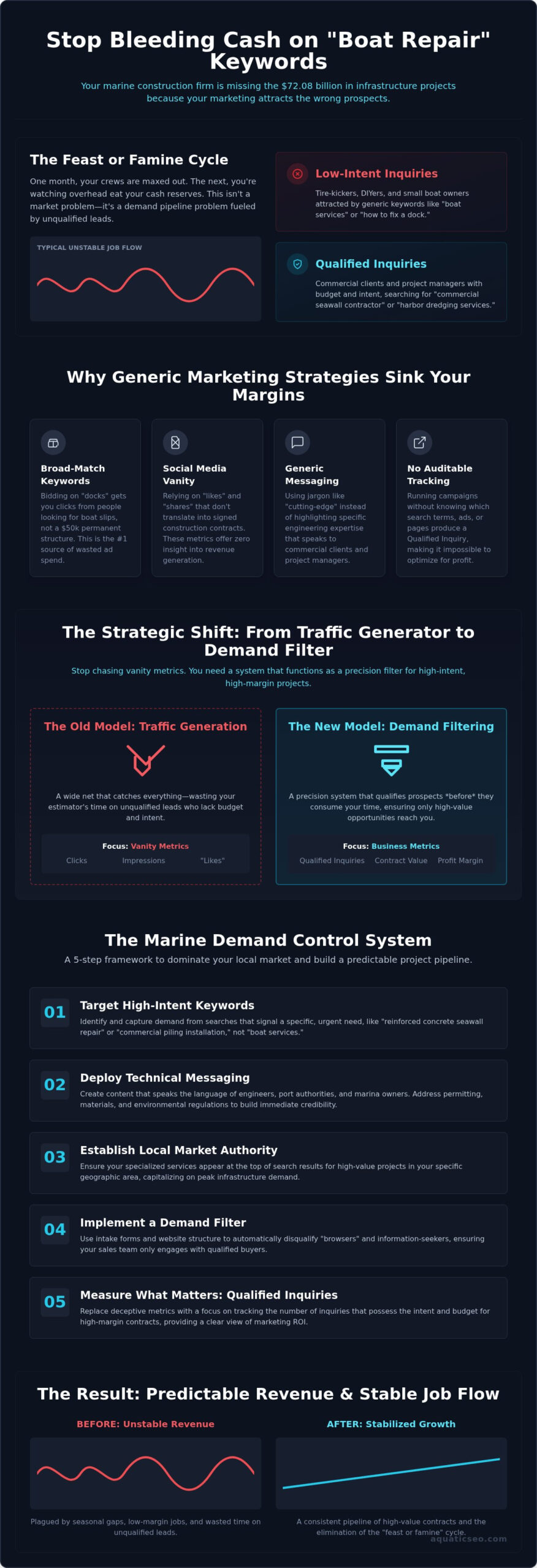
One month your crews are maxed out, and the next, you’re staring at an empty calendar while overhead eats your cash reserves. This feast or famine cycle isn’t a market reality; it’s a symptom of a weak demand pipeline. Most operators try to fix this by hiring a generalist agency, only to find their inbox filled with requests for small boat repairs or DIY advice. If your digital marketing for marine construction generates traffic without generating revenue, you’re treating marketing as an expense. You need a system that functions as a mechanism for demand control, not just a traffic generator.
The High Price of Unqualified Leads
Chasing the wrong prospects costs more than just your monthly ad spend. It wastes your estimator’s time on “tire-kickers” who lack the budget for professional Marine construction projects. Generic SEO often targets broad terms that attract people looking for “how to fix a dock” rather than “commercial seawall contractor.” This fills your schedule with low-profit, high-maintenance inquiries that distract you from the high-margin projects that actually stabilize your revenue. Every hour spent on a low-intent lead is an hour stolen from a high-value contract.
Why Generalist Agencies Fail Marine Contractors
Standard marketing firms lack the industry-native knowledge required to speak to your clients effectively. They don’t understand the complexities of marine permits, environmental regulations, or the specific engineering requirements for marine contractors. When an agency uses broad keywords like “boat services,” they’re casting a net so wide it catches everything but the high-intent buyers you need. We focus on the $300K to $5M revenue bracket because we understand the operational pressure of scaling a specialized marine operation without losing your shirt on overhead.
Common Mistakes in Marine Ad Campaigns
Broad-match keywords in Google Ads are the primary source of waste for local dock builders. Bidding on the word “docks” will get you clicks from people looking for boat slips, floating platforms, or even “docking” a vessel, not someone ready to invest fifty thousand dollars in a permanent structure. Some common pitfalls include:
- Social Media Vanity: Relying on “likes” and “shares” that don’t translate to signed construction contracts.
- Lack of Auditable Tracking: Running campaigns without knowing exactly which search terms lead to a Qualified Inquiry.
- Generic Messaging: Using the same “cutting-edge” jargon as every other agency instead of highlighting your technical engineering expertise.
Success in digital marketing for marine construction requires a shift from volume to precision. You don’t need more people to know you exist; you need the right people to find you when they’re ready to break ground.
Capturing High-Intent Demand for Marine Construction
You can’t rely on generic visibility if you want to dominate the market in 2026. Active Buyer Capture is the methodical process of positioning your firm exactly where high-value prospects look when their infrastructure fails or when new federal funding is released. Your digital marketing for marine construction must prioritize these active buyers to avoid the waste discussed previously. High-intent search behavior in this sector is defined by queries that specify a technical problem and a location, such as “reinforced concrete seawall repair contractors” or “heavy-duty commercial dock installation.”
There is a fundamental difference between Demand Visibility and Demand Filtering. Visibility ensures you appear in search results when a project manager or marina owner needs a specialist. Filtering ensures your intake system disqualifies the “browsers” before they reach your desk. According to Marine Economy Satellite Account data, the marine construction sector is a primary driver of coastal economic health, and 2026 search engine algorithms now prioritize specific engineering intent over general marine topics. If you aren’t visible for specific technical terms, you’re invisible to the buyers who matter.
Defining the Active Buyer in the Marine Sector
Active buyers don’t browse; they solve problems. Their search journey often starts with a specific trigger, such as storm damage, a failed inspection, or the recent passage of the Shipbuilding and Harbor Infrastructure for Prosperity and Security for America Act of 2026. A property owner looking for a major marina refit follows a different path than someone looking for boat rentals. They search for “marina dock modernization” or “hydrodynamic seawall design.” You must intercept them at this critical moment of need rather than waiting for a referral that might never come.
The Role of Intent-Based SEO
Ranking for the word “boats” is a vanity exercise that produces zero ROI. You need to rank for “marine piling installation” or “underwater foundation repair.” This focus on long-tail keywords is essential for specialized marine construction operations that require high-margin contracts to stay profitable. By targeting intent-based terms, you align your business with the $72.08 billion market projected for 2026. If you’re tired of generic leads, consider how a specialized demand system can change your revenue profile. Our approach to digital marketing for marine contractors ensures your expertise is the first thing a high-intent buyer sees.
Qualified Inquiries vs. Vanity Metrics: Filtering Your Marine Demand
Stop obsessing over impressions. They won’t pay for your next barge or crane. If your current agency brags about “reach” while your estimators waste time on $500 repairs, you’re being misled. According to U.S. Marine Economy Statistics, the marine construction sector grew by 15.5% in 2023. That’s an $8 billion increase in sales. This massive growth creates a flood of noise that can drown your operations if you don’t have a filter.
A Qualified Inquiry is not just a name and an email. It’s a prospect with a specific engineering need, a defined budget, and a project location within your footprint. Effective digital marketing for marine construction must act as a barrier, not a bridge, for low-intent seekers. You need to control your job mix to maintain high margins. If you don’t filter the demand, the demand will control you.
Precision Terminology: Yacht Charters vs. Boat Rentals
Precision is non-negotiable in this industry. A Yacht Charter involves a crewed vessel and a professional experience; a boat rental is a self-drive transaction. If your marketing copy confuses these, you’ll attract tourists when you want high-net-worth clients. Similarly, a Boat Dealer focuses on sales, while a marina provides infrastructure. Mixing these signals in your SEO destroys your authority and brings in the wrong customer profile for specialized construction needs.
Service Yards vs. Marinas: Why Targeting Matters
A Service Yard or Boatyard focuses on maintenance and refits. A marina focuses on dockage and fueling. To attract owners needing major structural refits, your content must highlight technical engineering rather than proximity to the fuel dock. Structure your site to separate these identities clearly. Specialized digital marketing for marine construction ensures your technical expertise isn’t buried under general dockage info. Use these markers to differentiate your services:
- Technical case studies for structural repairs.
- Service-specific landing pages for Service Yards and Boatyards.
- Clear distinction between maintenance capabilities and dockage.
Implementing a Demand Filtering System ensures you only talk to people ready to sign five-figure contracts. This protects your team’s time and keeps your profit margins healthy. Don’t let your business become a help desk for people who aren’t ready to buy.
Five Steps to Implementing a Demand Visibility Framework
Visibility without intent is a financial liability. You need a structured path to ensure your digital marketing for marine construction targets the right projects at the right time. Our Demand Visibility pillar focuses on technical dominance, search intent alignment, and auditable tracking. Following these steps allows you to move away from hoping for referrals and toward a system you actually control for your marine construction business.
- Technical Infrastructure Audit: Your website must load instantly and function perfectly on mobile devices used by project managers in the field.
- High-Intent Keyword Mapping: Stop bidding on broad terms. Focus on technical queries like “helical pile installation” or “bulkhead replacement.”
- Authority Content Deployment: Use case studies and engineering data to prove your technical competence to skeptical buyers.
- Auditable Tracking Setup: Connect every inquiry to a specific marketing source to eliminate waste.
- Performance Scaling: Reinvest your budget into the specific campaigns that generate the highest profit margins.
Auditable Tracking and Accountability
You cannot manage what you do not measure. Most agencies report on clicks, but we focus on the cost-per-qualified-inquiry. This requires call tracking and form attribution to see exactly which search terms lead to a contract for a new dock or harbor dredging project. A CRM becomes your command center, allowing you to track the job flow from the first click to the final payment. This level of oversight ensures your digital marketing for marine construction is an investment, not an expense.
Expected Results from a Demand Visibility Framework
Implementing this framework changes your business from a reactive operator to a proactive market leader. You will see a shift from inconsistent work schedules to a controlled job mix that prioritizes high-profit projects. Local marine SEO typically shows initial traction within 90 days, leading to a Demand Compounding effect where your market authority grows month over month. For a deeper look at long-term growth, consult our 2026 demand control guide. If you are ready to stop guessing and start growing, book a call to audit your demand visibility today.
The Marine Demand Control System: Precision Growth for Specialized Operators
Most agencies think a reporting dashboard is a solution. It isn’t. A dashboard just tells you how much money you’ve already wasted. The Marine Demand Control System is a proprietary methodology designed to give you operational oversight over your project pipeline before the waste occurs. This isn’t just digital marketing for marine construction; it is a mechanism for organizational stability.
We position ourselves as a specialist partner for operators in the $300K to $5M revenue range. We understand that at this scale, every dollar of ad spend must be auditable and every inquiry must be qualified. You don’t need a generalist vendor. You need an industry-native operator who understands the difference between a residential dock repair and a commercial harbor expansion.
Stabilizing Revenue and Revenue Patterns
The system filters incoming demand to ensure a steady stream of high-margin work. This eliminates the “seasonal panic” marketing that often leads to taking on low-profit jobs just to keep the crews busy. We prioritize your financial health over superficial digital metrics like engagement counts. By focusing on Qualified Inquiries, we ensure your revenue patterns remain predictable throughout the fiscal year. You gain the relief of knowing your pipeline is full of projects that actually hit your profit targets.
Scaling with the Marine Demand Control System
As your business grows toward the $5M mark, the complexity of your demand increases. Our system adapts by tightening the Demand Filtering mechanism to focus exclusively on the highest-value projects. Whether you are a boat dealer needing high-intent buyers or a yacht charter operator seeking crewed vessel bookings, the core logic remains the same. You need a partner who understands the technical nuances of the marine industry, not a vendor who treats your project list like a generic retail shop.
Synthesis Summary: Successful digital marketing for marine construction requires shifting from a volume-based mindset to a precision-based system. You must stop chasing every lead and start filtering for high-intent inquiries that support your specific margin requirements. Stabilizing your revenue is a matter of controlling the mix of demand through auditable tracking and industry-native expertise. When you control the demand, you control the future of your operations.
Stop guessing at your growth and start capturing demand that matters. Request a No-BS Marine Marketing Analysis to see where your pipeline is leaking and how to fix it.
Take Control of Your 2026 Project Pipeline
Revenue stability in the marine sector is not a matter of luck. It’s the result of a deliberate shift from chasing broad traffic to capturing high-intent inquiries. By implementing a system that filters out low-value noise, you protect your margins and ensure your crews remain focused on the projects that drive growth. Precision digital marketing for marine construction allows you to stop reacting to seasonal gaps and start dictating your own job flow.
Aquatic SEO provides the industry-native expertise required to scale businesses in the $300K to $5M range. Our proprietary Marine Demand Control System replaces vague agency promises with auditable tracking and tangible business outcomes. Whether you operate as a contractor, dealer, or charter operator, you deserve a partner who understands your technical requirements and prioritizes your financial health over superficial metrics.
It’s time to stop wasting your budget on strategies that sink your margins. Request a No-BS Marine Marketing Analysis to identify the leaks in your current demand pipeline. We look forward to helping you build a more resilient and profitable marine operation.
Frequently Asked Questions
What is the difference between a lead and a Qualified Inquiry?
A lead is a generic data point that often lacks context or intent. A Qualified Inquiry is a prospect with a specific technical need, a verified project location, and the budget to hire a professional operator. Our system prioritizes these high-value interactions to ensure your estimators don’t waste time on residential tire-kickers looking for DIY advice or small boat repairs.
How long does it take to see results from digital marketing for marine construction?
You will typically see initial traction within 90 days of implementing a digital marketing for marine construction strategy. This timeline allows for the technical optimization of your visibility and the deployment of high-intent keyword mapping. Long-term stability and demand compounding usually solidify within six to twelve months as your market authority grows and your project mix stabilizes.
Can marketing help filter out low-budget boat owners?
Yes, we use Demand Filtering to protect your schedule from low-budget inquiries. By using precise engineering terminology and aggressive negative keyword lists, we disqualify users looking for “cheap dock repairs” or “used boat parts.” This ensures your pipeline only contains high-margin construction projects that fit your specific operational goals and profit requirements.
Is a Marine Demand Control System necessary for a small boatyard?
Specialized systems are even more critical for smaller operations with revenues between $300K and $1M. A small boatyard has less room for financial error and cannot afford the overhead of seasonal revenue gaps. The Marine Demand Control System provides the oversight needed to stabilize your cash flow and ensure every project contributes to your long-term financial health.
What happens if my marine business already has too much work?
Having too much work is the perfect time to optimize your project mix. You can use demand control to stop taking on low-margin filler jobs and replace them with high-value contracts that offer better returns. This allows you to increase your profitability and improve your organizational stability without necessarily increasing your headcount or equipment costs.
Why should I choose a specialized marine marketing agency over a local generalist?
Local generalists don’t understand the difference between a marina and a service yard. They often waste your budget on broad search terms that attract the wrong audience because they lack industry-native expertise. A specialized partner understands marine permits, engineering nuances, and the specific search behavior of high-intent buyers looking for professional marine construction services.