
Your inbox is full, but your sales floor is quiet. It is a common symptom of a marketing strategy that values clicks over contracts, especially as global boat sales finished 2025 nearly 9% below previous levels. If you want to survive the current shift to a buyer’s market, you must master how to attract qualified boat buyers who possess the financial health and intent to close. You likely feel the weight of inconsistent job flow and the sting of being burned by generic agencies that don’t know a transom from a trolling motor. They promise volume, but they deliver noise.
We understand the frustration of wasting professional sales time on low-margin inquiries that go nowhere. This guide provides a systematic approach to capturing high-intent inquiries that actually impact your bottom line. We will examine how to deploy Demand Filtering to eliminate tire-kickers and focus your energy on the 94% of buyers who are using the internet to find their next vessel right now. You are about to learn how to stabilize your revenue and build a predictable engine for growth that prioritizes precision over vanity metrics.
Key Takeaways
- Stop chasing vanity metrics and learn why high traffic volume often correlates with shrinking profit margins.
- Discover the exact methodology for how to attract qualified boat buyers by capturing high-intent demand that bypasses casual browsers.
- Define what a “Qualified Inquiry” looks like for your specific sector, whether you operate a Service Yard or a Boat Dealer.
- Implement Demand Filtering to protect your sales team from tire-kickers and low-margin inquiries.
- Use the Marine Demand Control System to regulate your job flow based on your actual yard capacity.
The High-Volume Trap: Why Generic Traffic is Killing Your Marine Business Margins
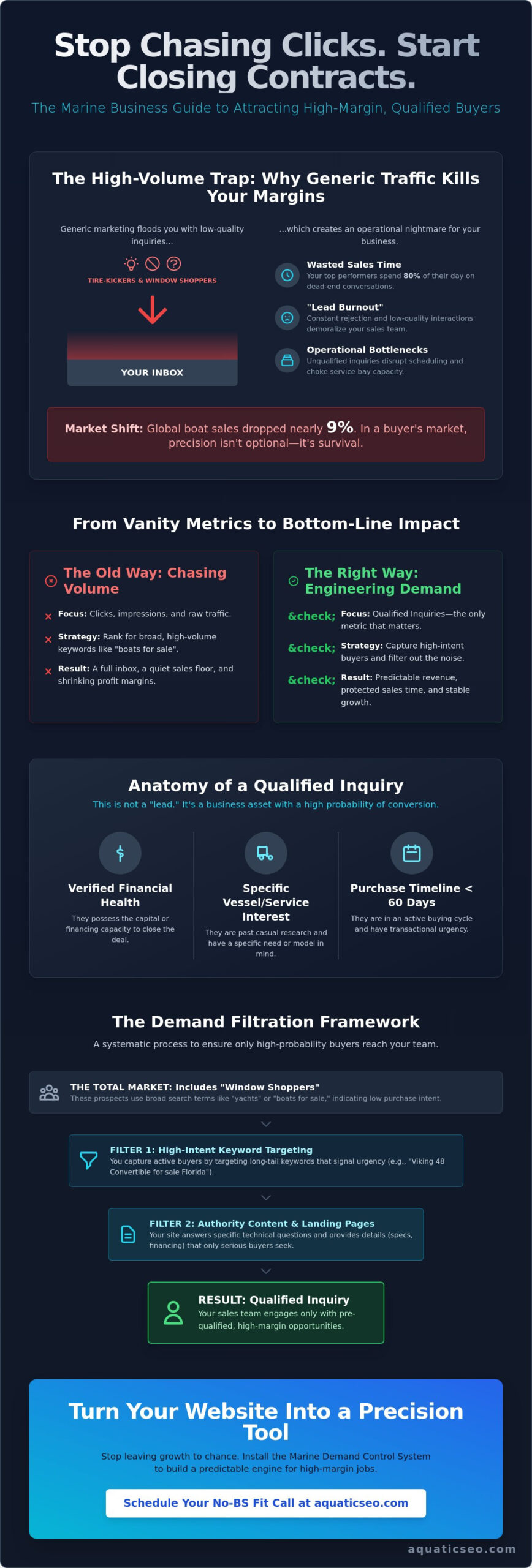
Most marine business owners believe that more traffic inevitably leads to more sales. This is a fundamental misunderstanding of how the digital market works in 2026. If your website traffic is climbing while your net profit remains stagnant, you’ve fallen into the Vanity Metric Trap. Generic SEO agencies often prioritize high-volume keywords to make their monthly reports look successful. However, ranking for broad terms often attracts “window shoppers” rather than actual buyers. Learning how to attract qualified boat buyers requires a fundamental shift in your Marketing strategy. You must prioritize intent over raw volume.
The Real Cost of Tire-Kickers
Managing 100 unqualified leads is an operational nightmare that drains your most valuable resources. For Service Yards and Boatyards, every hour your team spends answering basic questions for a “tire-kicker” is an hour taken away from high-margin refit work. Unqualified inquiries disrupt your scheduling and create bottlenecks in your service bays. At a dealership level, this leads to “lead burnout.” Your best sales professionals lose their edge when they spend 80% of their day chasing people who lack the financial health to secure a loan. With powerboat sales down 9% in early 2025, your sales floor can’t afford to chase ghosts.
Why Generic Digital Metrics Are Lying to You
Impressions and clicks are often used to mask a lack of real results. A generic agency might celebrate ranking you for “boats for sale,” but that term is often a waste of your budget. It attracts everyone from teenagers looking at dream yachts to people who can’t afford a used skiff. Learning how to attract qualified boat buyers is not about casting a wider net; it’s about using a more precise one. We reject these superficial counts in favor of the Marine Demand Control System.
This methodology focuses on capturing high-intent demand and using Demand Filtering Systems to protect your time. Instead of a “spray and pray” approach, we install a system that acts as a gatekeeper. It ensures that only a true Qualified Inquiry reaches your desk. This shift stabilizes your revenue and restores order to your business operations. It turns your website into a precision tool rather than a generic billboard.
Defining the Qualified Inquiry: The Only Metric That Impacts Your Bottom Line
A “lead” is a name on a spreadsheet. A “Qualified Inquiry” is a business asset with a high probability of conversion. The U.S. marine economy generates hundreds of billions in sales annually, but most of that capital is concentrated among buyers who have already moved past the research phase. Our system rejects the idea that all contact form submissions are equal. To master how to attract qualified boat buyers, you must first define exactly what a buyer looks like before they ever see your inventory.
Qualified Inquiry vs. Generic Lead
We define a Qualified Inquiry by three non-negotiable data points: verified financial health, a specific vessel class interest, and a purchase timeline of less than 60 days. Someone “interested in boating” might spend hours reading your blog about fishing knots. Someone “buying a boat” is looking at your financing page and checking engine hours. A Marine Contractor needs a prospect with a specific waterfront property issue, while a Boat Dealer needs someone ready to trade or finance. These are distinct operational categories that require different filtering logic.
The 2026 Intent Gradient
Buyers move through an Intent Gradient that shifts from general curiosity to transactional urgency. Generic marketers often miss the subtle buying signals that indicate a prospect has moved from a “Superyacht News” reader to a serious Yacht Charter booker. High-intent buyers look for specific technical specs and local service availability rather than broad lifestyle imagery. If your landing pages don’t address these specific technical needs, you’ll continue to attract the wrong crowd. You can schedule a fit call to see how we build these high-intent filters into your digital infrastructure.
Niche-specific authority is your best tool for attracting high-value buyers. When your content speaks the language of a seasoned mariner, you naturally repel the tire-kickers who don’t understand the nuances of hull maintenance or marine electronics. This precision ensures your sales team focuses only on the inquiries that will actually close. It’s about building a moat around your time while opening the gates for the right capital.
Capturing High-Intent Demand with Niche-Specific Marine SEO
Portals like Boats.com or YachtWorld dominate broad searches, but they also commoditize your inventory and service offerings. If you want to know how to attract qualified boat buyers without paying a “portal tax” on every lead, you must own the search results for high-intent, long-tail phrases. This is where Marine Contractors and dealers win back their independence. You don’t need a million visitors. You need the three people in your zip code searching for “seawall repair cost 2026” or “used Grady White 330 Express for sale.”
Dominating Local Marine Search
The battle for Service Yards is won on the map. Generic directories are useless for high-stakes marine work. You need industry-specific citations from marine-focused platforms and local harbor associations to build authority. We recommend a three-step process for optimizing your Google Business Profile. First, audit your primary category to ensure you’re listed as a “Boat repair shop” or “Shipyard” rather than a generic business. Second, upload high-resolution technical photos showing your travel lift in action or a clean engine room refit. Third, standardize your Name, Address, and Phone data across all marine-specific registries.
Localized content is equally vital for Yacht Charters. Don’t waste budget targeting the broad term “yacht charter” against global competitors. Target “crewed catamaran charter [City Name]” to capture buyers who are ready to book. This precision filters out people looking for a “boat rental” and attracts those seeking a premium, crewed experience.
Keyword Strategy for 2026
High-volume keywords are often vanity metrics that lead to lead burnout. Success requires marketing to the super-rich by focusing on technical precision and trust. National portals can’t compete with localized, model-specific rich text that addresses regional water conditions or specific engine configurations. Use “SEO Rich Text” on your inventory pages to boost visibility for specific boat models and years.
Capture buyers in the final decision phase by targeting “comparison” keywords. A prospect searching for “[Model A] vs [Model B] fuel efficiency” has already done their homework. They aren’t browsing for fun. They’re looking for a reason to choose your dealership over the one three towns over. By providing the specific technical answers they need, you position yourself as the specialist operator who understands their mission on the water.
The Filtration Framework: How to Systematically Eliminate Tire-Kickers
Most marketing agencies tell you to make it as easy as possible for people to contact you. They want to show you a high volume of leads to justify their monthly fee. But if you’re a specialist operator, you know that a “smooth” entry for everyone invites unqualified noise that clogs your sales floor. Strategic friction is actually your friend. It’s the only way to ensure your staff spends their time on the right people. Learning how to attract qualified boat buyers is as much about who you repel as who you attract.
You must stop paying for “free” searches that drain your budget. Implement an aggressive “Negative Keyword” strategy in your paid advertising campaigns. Exclude terms like “free,” “rental,” “wallpaper,” or “DIY.” This ensures your capital is reserved for high-intent queries that lead to a Qualified Inquiry. For Boat Dealers, this is the first line of defense in a robust Demand Filtering mechanism.
Strategic Friction in Lead Forms
Use lead forms that demand a level of commitment from the prospect. We recommend asking four specific questions that immediately separate buyers from browsers. Ask about their current boat ownership status, their financing readiness, their specific purchase timeline, and their realistic budget range. For Marine Mechanics, timeline and budget fields are non-negotiable. If a prospect won’t take thirty seconds to provide this data, they aren’t ready to commit to a high-margin service contract. You’ll see a lower raw conversion rate, but your lead quality and profit margins will increase.
Automated Filtration Systems
You can’t be available 24/7, but your system must be. The Marine Demand Control System handles around-the-clock lead vetting through AI-driven chat and automated scoring. This software stack qualifies leads based on your specific operational criteria before they ever reach a human. For high-ticket Yacht sales, lead scoring allows you to prioritize inquiries with the highest financial health. You aren’t just collecting names; you’re using data to dial your demand up or down based on your actual yard capacity. This level of oversight is what separates a stable business from one that is constantly chasing the next inconsistent lead.
Stop wasting your sales team’s energy on low-intent noise. You can schedule a strategy call to discuss installing a custom Demand Filtering System in your business today.
Scaling with Precision: Using the Marine Demand Control System for Consistent Job Flow
The ultimate goal of your digital infrastructure isn’t just to fill your inbox. It is to give you total oversight of your business operations. Generic industry-wide campaigns often fail because they don’t account for your specific overhead or yard capacity. You don’t need a tide that lifts all boats; you need a system that fills your specific slips with high-margin work. Mastering how to attract qualified boat buyers is the first step toward the Marine Demand Control System, but the final step is using that demand to stabilize your revenue patterns.
Controlling Your Job Mix
Precision marketing allows you to prioritize high-margin work, such as repowers or major refits, over low-margin repairs. For Service Yards and Boatyards, this level of control is essential for organizational stability. Instead of taking whatever work happens to drift in, you use demand data to plan your seasonal staffing and shop schedule. This is especially critical since new powerboat sales were down approximately 9% in early 2025. You must shift your business from a reactive “take what you can get” model to a proactive one where you choose your clients based on profitability.
The Path to Marine Market Dominance
Transitioning from a lead-starved model to a system-driven operation takes approximately 90 days. We prioritize “Active Buyer Capture” in the first 30 days to generate immediate results and fund the rest of the system build. This involves targeting the high-intent buyers who have already moved past the research phase. Once the initial pipeline is stable, we move toward Demand Compounding. This builds your long-term authority and ensures that your business remains the first choice for qualified prospects regardless of broader market fluctuations.
Synthesis Summary
Volume is a vanity metric that hides operational inefficiency. Profitability in 2026 requires a digital system that captures high-intent demand and aggressively filters out unqualified noise. You have learned how to define a Qualified Inquiry, deploy niche-specific SEO, and install a filtration framework that protects your sales team. A system-driven approach is the only way to move from being burned by generic agencies to having total command of your market position. It allows you to stop chasing every lead and start closing the right deals.
Stop wasting your sales team’s energy on low-intent noise. You can schedule a fit call to see if your business is ready to install the Marine Demand Control System.
Take Command of Your Marine Market Position
You’ve seen why chasing raw traffic volume is a losing strategy that erodes your margins and burns out your sales team. Success in 2026 requires a shift toward the Marine Demand Control System, where you prioritize precision and financial health over vanity metrics. By defining what a Qualified Inquiry looks like for your specific yard or dealership, you stop being a victim of inconsistent lead flow and low-intent noise.
Mastering how to attract qualified boat buyers means installing a system that works for you around the clock. You now have the framework to deploy niche-specific SEO and a filtration system that protects your most valuable asset: your time. It’s time to stop guessing and start operating with the oversight your business deserves. You have the specialized expertise to dominate your local waters; now you have the system to back it up.
Request a No-BS Marine Marketing Analysis and stop wasting leads.
Frequently Asked Questions
How do I know if a boat buyer is actually “qualified” before I call them?
You determine qualification by requiring specific data points in your lead forms that indicate financial health and intent. A Qualified Inquiry must provide a purchase timeline, a realistic budget range, and details on their current vessel. If a prospect refuses to provide this information, they lack the commitment necessary to justify a professional sales call. This process protects your sales team from wasting time on window shoppers.
Why am I getting so many spam leads from my website contact form?
Excessive spam is a symptom of a website that lacks technical filtering and a marketing strategy that prioritizes volume over quality. Generic agencies often leave forms wide open to inflate their lead counts and justify their fees. We solve this by installing bot-detection protocols and using negative keyword lists in your advertising to ensure you aren’t paying for “free” or “DIY” searches.
Is SEO or Paid Search better for attracting high-value yacht buyers?
SEO is superior for building the long-term authority required to close high-ticket sales, while Paid Search serves as a precision tool for immediate buyer capture. High-value buyers often perform extensive technical research before they ever engage with a dealer. A systematic approach to how to attract qualified boat buyers uses Paid Search to grab active demand while SEO compounds your visibility and trust over time.
How long does it take to see results from a Marine Demand Control System?
You will typically see an increase in inquiry quality within the first 30 days during the Active Buyer Capture phase. The full Marine Demand Control System requires approximately 90 days to fully stabilize your revenue patterns and filter out the noise. This timeline allows for the proper calibration of your Demand Filtering logic and the indexing of your niche-specific content.
What is the difference between a boat rental and a yacht charter lead?
A boat rental lead is usually looking for a self-driven, hourly vessel with low margins, whereas a Yacht Charter lead is seeking a premium, crewed experience. Confusing these terms destroys your marketing efficiency and floods your inbox with low-value inquiries. Our system uses precise terminology to repel recreational renters and capture the high-intent travelers who value professional service and luxury amenities.
Can I use this system if I am a smaller marine surveyor or mechanic?
Smaller operators benefit most from this system because they have the least amount of time to waste on tire-kickers. Whether you are a Marine Surveyor or an Electrician, you need a predictable job flow that prioritizes high-margin contracts. Filtering your demand ensures you only spend your billable hours on clients who respect your expertise and pay your full rate without hesitation.
Why do generic marketing agencies fail to understand the marine industry?
Generic agencies fail because they don’t understand the operational nuances of the sector, such as the technical difference between a Boat Dealer and a marina. They focus on superficial metrics like clicks and impressions rather than the financial health of the inquiry. Without “industry-native” knowledge, they cannot write the technical content required to build trust with affluent mariners who demand precision.
How much should I expect to spend to attract a qualified boat buyer?
The cost to acquire a Qualified Inquiry depends on your specific vessel class and local market competition. You should evaluate this spend against the lifetime value of a client rather than a generic cost-per-click metric. A precision-based approach ensures that every dollar is focused on high-intent buyers who actually impact your bottom line, rather than wasting budget on generic traffic that never closes.