Most marine mechanics treat their shop phone like a lottery ticket, hoping the next caller wants a full engine repower instead of a free diagnostic over the phone. If you spend your mornings answering questions for do-it-yourselfers who never book a service, your current approach to marketing for marine mechanics is actively costing you money. It’s a common trap in the service yard. You chase every lead because you fear the seasonal slump, but you end up with a calendar full of low-margin quick fixes that prevent you from taking on the high-intent refits that actually grow your business.
You’ve likely realized that being the best technician in the harbor doesn’t matter if the high-intent buyers are calling the competitor with better visibility. We’ll show you how to flip that script by installing a demand filtering system that qualifies prospects before they ever dial your number. You’ll learn the exact steps to secure a consistent flow of engine repair jobs and dominate local search for specific brands like Mercury, Yamaha, or Volvo Penta. This guide breaks down how to move from reactive lead chasing to a methodical, system-driven operation that keeps your bays full of high-value work year-round.
Key Takeaways
- Stop chasing lead volume. Focus on capturing active demand from boat owners with immediate, high-margin repair needs.
- Target high-intent search terms for specific engine brands like Yamaha and Mercury to position your service yard as the local authority.
- Shift your marketing for marine mechanics from generic visibility to a filtering system. This disqualifies unqualified inquiries before they ever reach your phone.
- Optimize your digital presence for the specific marinas and waterways you serve to ensure you’re found at the exact moment of a mechanical failure.
- Replace your reliance on seasonal luck with a predictable business development asset. This stabilizes your revenue and controls your job flow year-round.
The Trap of Generic Lead Generation for Marine Repair Shops
Most shop owners think they want more leads. In reality, more leads often mean more time wasted on the phone with people who can’t afford your shop rate. If your current approach to marketing for marine mechanics focuses solely on volume, you’re inviting administrative chaos. You don’t have infinite bay space. Every hour spent explaining why a “quick fix” isn’t actually quick is an hour you aren’t billing for a repower or a complex electrical overhaul. High-volume, low-quality traffic is a drain on your profitability, not a boost to your bottom line.
Traditional digital marketing strategies prioritize clicks and likes, which are nothing more than vanity metrics. These numbers look great on a monthly report, but they don’t account for the operational reality of a service yard. You must distinguish your business from a marina. While a marina focuses on dockage and fueling, your service yard is a precision environment built for technical maintenance. If your marketing doesn’t reflect this distinction, you’ll attract boaters looking for a place to park rather than owners ready to invest in their vessel’s mechanical health.
Relying on the “word-of-mouth” myth is another dangerous trap. Referrals are a sign of good work, but they’re inherently unpredictable. You can’t scale a business on “maybe” or “eventually.” When you rely solely on referrals, you lose the ability to pick and choose the high-margin jobs. You become a passive recipient of whatever work happens to float your way, which often leads to inconsistent revenue cycles and a schedule that’s either empty or overwhelmed with low-value tasks.
Why Traditional Agencies Fail Mechanics
Most generalist agencies don’t know a Volvo Penta from a Mercury Verado. They treat an outboard repower like a simple oil change in their ad copy because they don’t understand the technical nuances of your trade. This ignorance is a hidden tax on your growth. You end up paying to “teach” the agency your business while they send you prospects who lack the budget for professional-grade service. Specialized marketing for marine mechanics requires an industry-native perspective that understands the difference between a qualified inquiry and a simple lead.
The Reality of the 2026 Marine Market
The 2026 market is defined by research-heavy buyers who conduct extensive online research before they ever pick up the phone. Owners aren’t just looking for “a mechanic” anymore; they’re searching for specific technical solutions. A qualified inquiry now starts with a technical search for a specific engine brand or a complex system failure. If you aren’t visible at that exact moment, you’re losing the most profitable jobs to competitors who have prioritized brand-specific visibility over generic “boat repair” keywords.
Capturing Active Buyer Demand for High-Margin Engine Refits
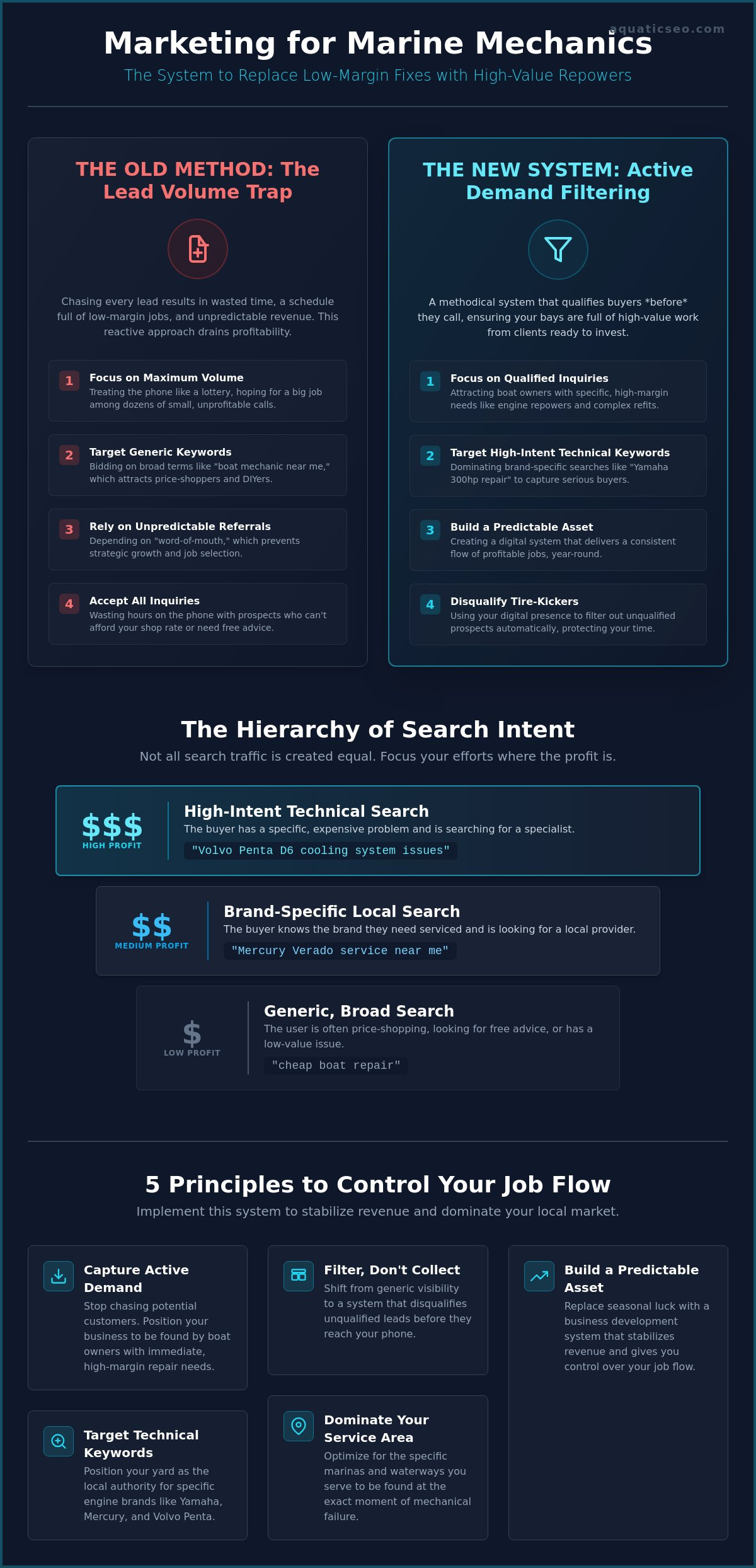
Most service yard owners fail to realize that not all search traffic is created equal. If you bid on broad terms like “boat repair,” you’re competing for the attention of everyone from the guy with a broken bilge pump to the owner of a 60-foot sportfish. You don’t want more traffic; you want Active Buyer Capture. This means targeting the boat owner who has an immediate, expensive problem that requires your specific technical expertise. A Qualified Inquiry for a full engine repower is worth 100 times more than a dozen clicks from people looking for “cheap boat parts.”
The hierarchy of search intent dictates your profitability. A search for “Yamaha 300hp lower unit repair” signals a high-intent buyer with a specific technical need and the budget to fix it. Conversely, “boat mechanic near me” is a generic query that often attracts price-shoppers. Effective marketing for marine mechanics prioritizes these high-value technical terms to ensure your shop appears at the exact moment a critical failure occurs. By positioning your shop as the local authority for specific engine brands like Mercury, Yamaha, or Volvo Penta, you bypass the noise of the general market.
Dominating Technical Search Queries
You earn the trust of high-net-worth yacht owners by proving you understand their hardware before they even call you. Create content that addresses specific failure points of popular engine models. If a boater is researching “Volvo Penta D6 cooling system issues,” they’re looking for a specialist, not a generalist. Providing technical precision in your digital presence signals that you operate a professional service yard. Given the specialized nature of the marine mechanic job outlook, owners are increasingly desperate for technicians who possess brand-specific certifications and deep diagnostic capabilities.
Beyond propulsion, showcasing your proficiency with advanced vessel health systems, such as remote monitoring and alert solutions from inTouch R&B, further solidifies your reputation as a forward-thinking technical authority. Highlighting these specialized services in your marketing helps attract proactive yacht owners who prioritize preventative care for their critical bilge and HVAC systems.
Targeting the Right Job Mix
Your digital visibility should act as a filter that prioritizes engine refits over minor electrical gremlins. Active Buyer Capture is the strategic targeting of boat owners who are currently experiencing a critical propulsion failure and require an immediate, high-cost technical solution. Use your online presence to signal your specialization in heavy mechanical work rather than simple dockside maintenance. This focus ensures your bays stay filled with high-margin projects that maximize your hourly billing potential. If you want to refine how you attract these specific engine jobs, consider reviewing our specialized Digital Marketing for Marine Mechanics and Electricians to see how a technical approach outmuscles generic advertising.
Implementing Demand Filtering to Protect Your Shop’s Schedule
Your website shouldn’t just exist to look pretty; it needs to work as a gatekeeper. If your current approach to marketing for marine mechanics simply increases the volume of people calling to ask for free advice, you’re essentially paying to be interrupted. Effective Demand Filtering turns your digital presence into a rigorous intake system. By setting clear expectations regarding your shop’s pricing and current lead times, you naturally repel low-budget inquiries and attract serious boat owners who value technical precision over the lowest price.
While general local marketing strategies for mechanics often emphasize visibility, a specialized marine service yard needs to prioritize filtration. You increase your annual margin by having the discipline to say “no” to the wrong jobs. This creates the necessary bay space to accept the high-margin engine refits that actually move the needle for your business financial health. Stop treating every phone call as a potential win and start treating your time as your most valuable inventory.
Automating the Pre-Qualification Process
Stop playing phone tag with people who don’t even know their own engine model. Use intake forms that ask for specific data: engine hours, vessel age, and exact propulsion brand. This professional friction doesn’t scare away high-value clients; it reassures them. They see a methodical operator who values precision, which is exactly who they want touching their complex marine systems. This automation ensures that when you do pick up the phone, you’re speaking with someone who has already passed your basic requirements.
Protecting Your Time for Billable Work
A filtering system acts as a virtual service writer that works 24/7. It sorts through the noise so your lead mechanic isn’t pulled away from a billable repower to answer a basic question about oil changes. There is a massive difference between a generic lead and a Qualified Inquiry. Your digital presence must reflect the high standards of your physical shop, proving to every visitor that you run a specialist yard rather than a general repair shop that takes any job that floats in.
Dominating Local Search for Mobile Mechanics and Service Yards
Most marine mechanics settle for being “near me” in a generic search result. You need to be the specific solution found at the exact slip where a boat owner is currently frustrated. If your service yard or mobile operation isn’t optimized for the specific marinas and waterways you serve, you’re handing high-margin jobs to the competition. Winning the local search battle doesn’t require a massive ad budget; it requires precision in how you anchor your business to the regional marine community.
Your Google Business Profile is your digital storefront. Don’t waste it on generic photos of your truck. Upload high-resolution images of complex engine work and technical diagnostics. Manage your digital reputation by encouraging brand-specific reviews. A testimonial that mentions you are the “Best Volvo Penta tech in the Keys” is far more valuable than a generic five-star rating. This technical specificity signals your industry-native expertise to both search engines and high-net-worth owners who demand specialized care.
Waterway-Specific SEO Tactics
Target keywords related to specific inlets, bay areas, or local yacht clubs. Your location strategy should follow the migration of the fleet, adapting to seasonal shifts in boat traffic. If you maintain Service Yard or Boatyard status, emphasize your facility’s capabilities to distinguish your operation from independent mobile techs. This geographic precision ensures you capture demand from owners who are physically located in your service area and ready to book a technician.
Building Local Authority Through Proof
Show, don’t tell. Use project galleries to demonstrate your capability for complex refits and engine overhauls. A detailed gallery showing a successful repower provides the visual proof that skeptical owners need to trust you with their vessel. This level of transparency builds authority and anchors your business as a premium operator. Effective marketing for marine mechanics uses this proof to turn local searchers into long-term clients who value technical proficiency over the lowest hourly rate. If you’re ready to stop paying for useless clicks and start owning your local waterways, secure your local market dominance today.
Scaling with the Marine Demand Control System
Stop viewing your digital presence as a monthly expense or a necessary evil. It’s a predictable business development asset that should provide oversight and precision to your operations. Traditional marketing for marine mechanics often fails because it lacks a fundamental understanding of shop logistics. Most agencies aim for volume, but we prioritize financial health. The Marine Demand Control System moves you away from the “hired hand” status and positions you as a premium, specialized partner for boat owners who value technical excellence.
A partnership model beats the traditional agency-vendor relationship every time. Vendors focus on superficial digital metrics and vague engagement counts to justify their retainers. A specialized partner understands that your bay space is finite and your time is expensive. We focus on high-intent business outcomes that stabilize your revenue patterns. You don’t need a general vendor who treats you like a generic small business; you need an operator who understands the high stakes of marine propulsion systems.
Stabilizing Seasonal Revenue Cycles
Inconsistent revenue is the primary threat to the longevity of a service yard. You can’t maintain a top-tier crew if you’re laying them off every winter. The Marine Demand Control System uses Demand Visibility to book major winter refits during the peak summer season. When you capture high-intent interest at the moment of peak usage, you build a consistent backlog of work that carries you through the off-season. This creates a “waitlist” effect that naturally increases your perceived value and allows you to maintain premium pricing regardless of the weather.
Your Next Steps to Demand Control
Take a hard look at your current inquiry flow. If your lead mechanic is still answering basic questions for people who won’t book a service, you’re losing billable hours. There’s a sharp difference between chasing the market and controlling your specific corner of it. You need a methodical system that filters out the noise and delivers only high-value opportunities to your desk. If you’re ready to transition from reactive lead chasing to a system-driven operation, Request a No-BS Marine Marketing Analysis to see if your shop is a fit for our system.
Take Command of Your Service Yard’s Future
Relying on luck and seasonal word-of-mouth is a dangerous way to run a professional marine operation. You’ve seen how generic marketing for marine mechanics fails by flooding your inbox with unqualified noise that drains your billable hours. By shifting your focus to Active Buyer Capture and implementing a rigorous Demand Filtering system, you protect your schedule and prioritize the high-margin engine refits that drive real growth. You don’t need more leads; you need a predictable system that delivers Qualified Inquiries while you focus on technical execution.
As industry-native experts specialized in $300K to $5M revenue marine businesses, we understand the operational stakes of your trade. Our proprietary Marine Demand Control System is designed to stabilize your revenue cycles and ensure your bays stay full of the right work year-round. Stop chasing the market and start controlling your job flow with a partner who understands the difference between a simple oil change and a complex repower. Request your Marine Demand Control Analysis today to see if your shop is a fit for our no-nonsense approach. It’s time to build the stable, profitable yard you’ve worked to create.
Frequently Asked Questions
Is marketing for marine mechanics really necessary if I have good word-of-mouth?
Word-of-mouth is a byproduct of good work, but it’s not a reliable growth strategy. You can’t control the quality or timing of referrals, which makes you a passive observer of your own revenue. Professional marketing for marine mechanics allows you to dictate your job mix. This ensures you fill your bays with high-margin repowers and complex refits rather than whatever work happens to float in through a friend.
What is the difference between a lead and a Qualified Inquiry?
A lead is just a contact name; a Qualified Inquiry is a prospect who has passed your specific technical and financial filters. Most agencies sell you leads that waste your time. We focus on inquiries from boat owners who have a specific engine model, a documented problem, and the budget for professional service yard rates. This distinction protects your billable hours from “tire-kickers” who just want free advice.
How long does it take to see results from a Marine Demand Control System?
You should expect to see a shift in inquiry quality within the first 90 days. While SEO is a long-term asset, our system immediately begins filtering out low-value noise. We prioritize capturing active demand from owners currently searching for technical solutions. This rapid filtration provides immediate relief to your administrative staff and starts stabilizing your schedule for the upcoming season without wasting money on useless clicks.
Can I target specific engine brands like Yamaha or Mercury with SEO?
Yes, targeting brand-specific technical queries is the most effective way to win high-margin jobs. Boat owners don’t search for a general mechanic; they search for “Mercury Verado lower unit repair” or “Yamaha 300hp diagnostics.” By dominating these specific technical terms, you position your shop as the local authority for those propulsion systems. This strategy attracts owners who value expertise over the lowest price and ensures your marketing for marine mechanics is focused on profit.
How do I stop getting calls for small boat rentals when I only service yachts?
You stop these calls by implementing a Demand Filtering system on your website. Your digital presence must explicitly state what you are not. By using technical intake forms that require vessel specifications and engine hours, you create professional friction. This automatically disqualifies owners of small boat rentals or other vessels that don’t fit your service yard’s operational scope, leaving your phone lines open for high-value yacht owners.
Will marketing make me too busy to actually do the mechanical work?
Proper marketing actually gives you more time by eliminating the hours you waste on bad leads. Our goal isn’t just to increase volume; it’s to control the job flow. A well-designed system acts as a virtual service writer. It handles the initial qualification so you and your lead techs only spend time on the high-value mechanical work that pays the bills. You become more efficient, not just busier.
What is the most common mistake mechanics make with their websites?
The biggest mistake is treating a website like a static billboard instead of a business development tool. Most mechanics use generic photos and vague service lists. They fail to distinguish their service yard from a marina or a boat dealer. Your site needs to prove your technical precision and use intake forms to qualify prospects before they ever pick up the phone. This oversight turns your site into a liability.
How do I handle marketing if my business is seasonal?
Seasonality requires a strategy that builds a backlog during peak months for the off-season. You use high-demand periods to capture data from owners who will need major refits or repowers in the winter. Our system helps you maintain visibility year-round. This ensures your bays stay full during the slow months, stabilizing your revenue and allowing you to keep your best technicians on staff without the stress of seasonal layoffs.