What if your marketing agency told you that a 50% increase in website traffic actually cost your boat dealership money? Most marine business owners are tired of being handed “engagement reports” that don’t translate into a filled service bay or a signed sales contract. You’ve likely seen the reports full of clicks and impressions while your staff spends hours fielding low-margin inquiries that go nowhere. It’s frustrating to watch your marketing spend vanish into “exposure” when what you actually need is a predictable job mix. Measuring marine marketing success shouldn’t be about digital noise; it’s about the bottom line.
You know that a click isn’t a customer, and a “like” doesn’t pay the dockage fees. We’ll show you how to move past these vanity metrics and start auditing the specific financial outcomes that stabilize your business. This article explains how to filter for high-intent buyers and implement a system for auditable ROI on every marketing dollar you spend.
Key Takeaways
- Identify why superficial metrics like impressions and clicks create “demand drag” instead of actual profit for your boatyard or dealership.
- Define a Qualified Inquiry based on vessel type, budget, and timing to ensure your staff only speaks with high-intent buyers.
- Understand why filtering out tire-kickers is a critical step in measuring marine marketing success and maintaining high operational margins.
- Learn how to implement conversion and call tracking to audit the financial health of every dollar spent on your digital presence.
- Discover how a Marine Demand Control System provides the oversight needed to move from inconsistent revenue to a predictable, high-value job mix.
Why Vanity Metrics Sink Marine Marketing ROI
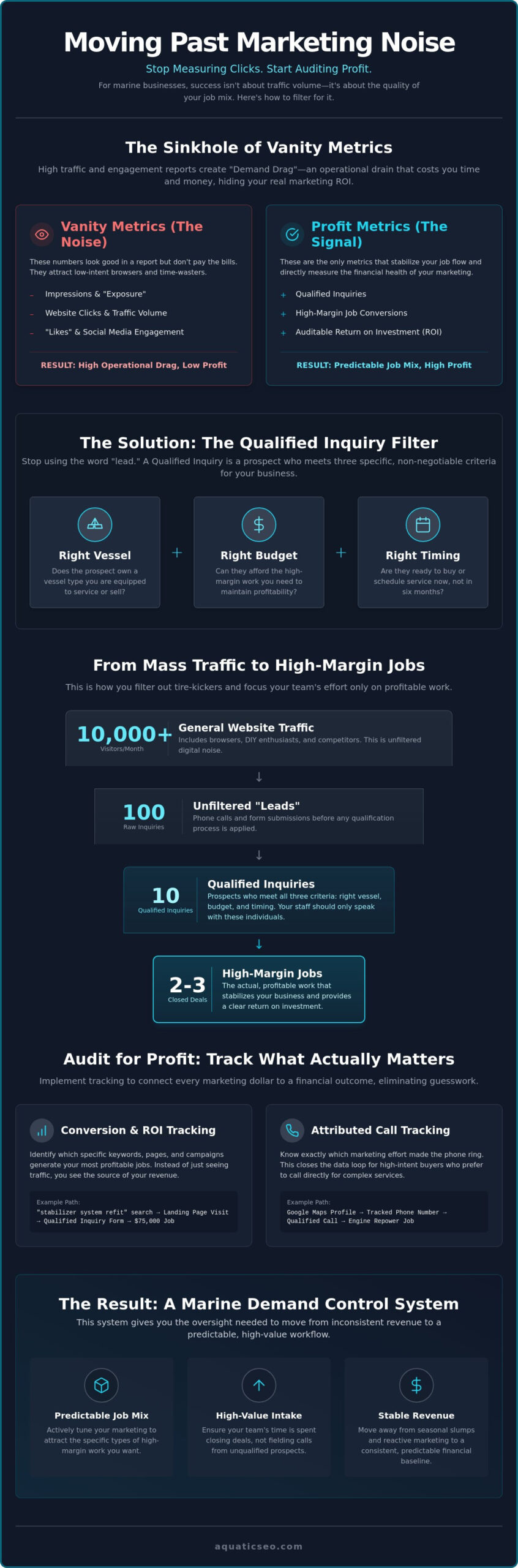
Clicks don’t pay the mortgage. Impressions don’t fill your service bays. Most agencies focus on these numbers because they are easy to generate and look impressive in a colorful PDF report. They call it “success,” but you call it a waste of money. True measuring marine marketing success starts with a simple question: How much profit did this click generate? If you can’t answer that, you aren’t marketing; you’re gambling. We focus on PROFIT, not PROMISES.
High traffic often creates a hidden problem known as demand drag. This occurs when your website attracts thousands of visitors who have zero intention of spending money. They want free advice, DIY repair tips, or they just want to browse photos of boats they can’t afford. Your staff then spends hours answering low-value emails and phone calls from people who will never sign a contract. This is NOT a win. It’s an operational drain on your resources that significantly lowers your total Return on Marketing Investment (ROMI). You need a filter, not a megaphone.
The Trap of the “Boat Trader” Mentions
Relying on third-party marketplaces is a dangerous game for any business owner. You’re renting someone else’s audience and paying for the privilege. When these platforms raise their prices or change their algorithms, your business suffers immediately. You need to own your demand. High-intent buyers should find your site directly, allowing you to control the narrative and the data. This is why digital marketing for boat dealers must prioritize direct-to-site traffic. It provides the oversight you need to control the sales cycle without a middleman taking a cut of your visibility.
Why “In Today’s Digital Landscape” Thinking Fails
Generalist agencies love to use “one size fits all” strategies. They apply the same logic to a local bakery as they do to a complex marine service yard. This fails because marine buyers are not average consumers. They have specific technical requirements and local needs that generic marketing fluff ignores. If your marketing doesn’t use industry-native language, you’re just adding to the noise. You don’t need “exposure” to the general public; you need visibility among boat owners who need your specific expertise right now. Precision beats volume every time when measuring marine marketing success. Stop counting heads and start counting the right heads.
The Qualified Inquiry: The Only Metric That Stabilizes Your Job Flow
Stop using the word “lead” in your office. It is a lazy term that groups high-value clients with time-wasters. When measuring marine marketing success, you must focus exclusively on the Qualified Inquiry. A Qualified Inquiry is a prospect who possesses the right vessel, the right budget, and the right timing for your specific operational needs. If an inquiry lacks even one of these three pillars, it is noise that slows down your team.
Tracking high-margin jobs back to specific SEO strategies requires more than a basic spreadsheet. You need to identify which search terms brought in the 60-foot refit versus the 20-foot outboard repair. Our Marine Demand Control System provides this level of oversight, allowing you to see exactly where your most profitable work originates. This data allows you to measure marketing effectiveness by looking at the quality of the intake rather than just the volume of the traffic.
Different sectors require different benchmarks. A Marine Surveyor might prioritize a higher volume of inquiries to fill a tight weekly schedule. Conversely, a boat dealer needs fewer, more intensive interactions to move high-value inventory. Understanding these nuances is the difference between a stable business and one that is constantly reacting to market swings. If you want to see how this applies to your specific sector, you can explore our specialized marine digital marketing services.
Defining “High-Intent” for Marine Contractors
There is a massive difference between a user searching for “best center consoles 2026” and someone searching for “stabilizer system refit near me.” The first is browsing; the second is buying. High-intent keywords signal a ready-to-buy state. We measure the conversion rate of landing pages designed specifically for these urgent, high-value needs. If your site doesn’t speak to the specific technical pain points of a vessel owner, you will continue to attract tire-kickers instead of contracts.
The Job Mix Audit: Are You Getting the Work You Want?
Effective marketing should give you the power to choose your work. By auditing your job mix, you can intentionally shift from low-margin troubleshooting to high-margin installations. Marine Mechanics and Electricians use this demand data to schedule their entire season months in advance. They don’t just hope the phone rings with a good job; they use demand filtering to ensure it does. This level of precision is the only way to achieve predictable growth while measuring marine marketing success.
Auditing Demand Quality: Distinguishing High-Intent Buyers from Tire-Kickers
Volume is the enemy of efficiency. Most agencies will tell you that an overflowing inbox is a sign of victory. If those emails come from people who cannot afford your services or are looking for something you don’t offer, your marketing is actually damaging your operations. True measuring marine marketing success involves auditing the Noise-to-Signal ratio of your incoming demand. High-quality demand filtering means having the confidence to say “no” to the wrong prospects before they ever touch your staff’s calendar.
Every unqualified lead is a tax on your payroll. When your team spends forty minutes explaining to a “boat rental” seeker that you only provide luxury Yacht Charters, that is forty minutes stolen from a high-margin client. Using our Marine Demand Control system allows you to automate this filtration process. By implementing simple and effective strategies for lead qualification at the point of entry, you ensure that only the most profitable inquiries reach your desk. This isn’t just about marketing; it’s about protecting your operational sanity.
The Cost of the Wrong Lead
For Boat Dealers, the cost of a “tire-kicker” is massive. It isn’t just the lost time; it’s the mental fatigue and the missed opportunity to close a serious buyer. If your marketing generates 100 leads but only 2 are qualified, your system is broken. We prioritize the 2 high-intent buyers and work to eliminate the 98 distractions. This creates a psychological relief for your sales team, allowing them to focus on closing instead of qualifying. More leads is often the worst thing for a $1M marine business if those leads lack intent.
Yacht Charter vs. Boat Rental Metrics
Precision in terminology is non-negotiable. If you run Yacht Charters, you are selling a premium, crewed experience. You are not a boat rental company. Measuring success using “boat rental” keywords will only flood your inbox with people looking for a cheap afternoon outing. Success metrics for luxury charters must focus on multi-day bookings and specific vessel-class inquiries. This distinction is a core part of measuring marine marketing success for high-end operators. Stop chasing generic volume and start capturing specific, high-value demand.
How to Track Marine Marketing Performance Without the Fluff
- Step 1: Set up conversion tracking for specific “Qualified Inquiry” forms. Don’t just track generic contact clicks. Track the specific forms that ask for vessel length, engine type, and service urgency to filter for intent.
- Step 2: Implement call tracking. Use unique numbers to differentiate between a parts vendor calling about an invoice and a new prospect looking for a repower or refit.
- Step 3: Audit your Google Business Profile. Focus on high-intent local calls and direction requests from boat owners in your immediate geography rather than global views.
- Step 4: Review your “Job Mix” monthly. If your marketing is bringing in 20-foot outboard repairs when you want 50-foot diesel overhauls, your strategy is misaligned with your operations.
- Step 5: Tie every inquiry to a vessel type. This verifies niche-alignment and ensures you aren’t wasting time on inquiries outside your specialty.
Auditable Tracking for Service Yards
Service Yards and Boatyards must distinguish between recurring customers and new demand. While repeat business is the lifeblood of a yard, new inquiries validate the effectiveness of your marine industry SEO. Use your CRM data to track how many new, high-margin projects originated from your digital presence this month. This creates “Demand Visibility,” allowing you to forecast labor needs and revenue with actual precision.
Rejecting Bloated Reporting for Specific Outcomes
If an agency sends you a 50-page report filled with colorful charts, they are likely hiding a lack of real results. These oversized reports are designed to overwhelm you with filler data like bounce rates and session durations. You should demand a “One-Page Audit” that highlights only three things: Qualified Inquiries, the source of those inquiries, and projected profit. Stop wasting time on measuring marine marketing success through vanity metrics found in these reports. You can book an audit call to see how a profit-focused dashboard should actually look.
Implementing a Marine Demand Control System for Predictable Growth
Marketing is not a faucet you turn on only when the yard is empty; it is an operational pillar that dictates your financial health. Implementing a Marine Demand Control System moves you away from the anxiety of hoping for calls and into a position of total oversight. This methodical approach ensures that your business does not just react to the market but actively shapes it. By measuring marine marketing success through the lens of demand control, you gain the precision required to scale without increasing your administrative burden.
One-off campaigns are for amateurs who do not understand the cyclical nature of this industry. Marine Contractors who rely on “boosted posts” or temporary ads will always suffer from inconsistent revenue patterns. You need a system that compounds over time. Specialized SEO acts as a long-term asset that filters out low-intent noise and consistently captures the specific, high-margin jobs you actually want to perform. This transition from “hoping” to “controlling” is what separates a stable operation from one that is constantly on the brink of a slow season.
Stabilizing Inconsistent Revenue
Inconsistent job flow is the silent killer of marine service yards. You can use demand data to fill the off-season gaps that usually drain your cash reserves. By identifying search trends for winterization or major refits months in advance, you can secure your schedule before the slow months arrive. This leads to higher margin durability because you are not forced to take low-value work just to keep the lights on. A controlled job flow allows you to maintain high standards and keep your best technicians busy year-round.
The Synthesis: Measuring What Matters
The metrics that actually matter are simple: Qualified Inquiries over clicks and job-flow control over generic traffic. If your current agency cannot show you exactly how many 50-foot vessel owners they put in your inbox this month, they are not helping you. The final audit of any marketing strategy is whether it offers you demand control. Measuring marine marketing success is ultimately an audit of your own profit and operational freedom. If you are ready to stop counting clicks and start auditing outcomes, you can Request a No-BS Marine Marketing Analysis today.
Take Control of Your Marine Business Demand
Success in the marine industry isn’t defined by how many people saw your ad; it’s defined by how many high-margin jobs are on your schedule for next month. You’ve learned that vanity metrics like clicks and impressions are often just “demand drag” that wastes your staff’s time. By shifting your focus to the Qualified Inquiry, you protect your operational efficiency and ensure your marketing spend produces a tangible return. Measuring marine marketing success requires a pivot from digital noise to auditable; profit-based tracking that aligns with your specific vessel specialties.
Our proprietary Marine Demand Control System is built specifically for businesses generating between $300K and $5M in revenue. We don’t offer vague promises of “exposure.” Instead, we provide no-nonsense oversight that filters out tire-kickers and captures high-intent buyers. If you’re ready to stop guessing and start auditing your actual ROI, it’s time to implement a system designed for the realities of the boatyard and the showroom. If you are also looking for high-level strategic guidance to address other organizational hurdles, learn more about Top7 and how they help companies navigate growth obstacles.
Request a No-BS Marine Marketing Analysis to see how we can stabilize your revenue and help you regain control of your job mix. You’ve worked hard to build your reputation; your marketing should work just as hard to protect your margins.
Frequently Asked Questions
How is a “Qualified Inquiry” different from a standard lead?
A Qualified Inquiry is a prospect who matches your specific operational requirements regarding vessel size, project budget, and service timing. Standard leads are often just generic names and emails from people who may not even own a boat. We prioritize these inquiries because they represent actual revenue potential rather than just administrative work for your sales team.
Can I track which marine marketing efforts lead to specific high-margin jobs?
You can track every high-margin job back to its source by implementing granular conversion tracking and dedicated call numbers. By assigning unique identifiers to service-specific landing pages, you see exactly which keywords produced an engine repower versus a simple oil change. This level of oversight is essential for measuring marine marketing success and allocating your budget effectively.
Why should a Service Yard avoid generic SEO agencies?
Generic agencies lack the industry-native knowledge to distinguish between a marina and a service yard. They often optimize for broad terms that attract “boat rental” seekers instead of owners needing complex refits. This ignorance leads to demand drag, where your staff wastes time filtering out unqualified traffic that a specialized partner would have blocked at the source.
What is the most important metric for a Yacht Charter business?
The most important metric for a Yacht Charter operator is the volume of inquiries for multi-day, crewed bookings. Clicks from people looking for cheap boat rentals are worthless to a luxury operator. You should focus on the Noise-to-Signal ratio in your inbox to ensure your marketing attracts high-end clients who understand the value of a professional crew.
How long does it take to see a shift in job-flow quality from SEO?
You will typically see an initial shift in inquiry quality within 90 days of implementing a specialized strategy. While total traffic might not skyrocket immediately, the signal in your inbox becomes clearer as low-intent keywords are phased out. Long-term stability and demand compounding usually take six to twelve months to fully stabilize your seasonal job flow.
Is social media engagement a valid way to measure marine marketing success?
Social media engagement is a vanity metric that rarely translates into profitable work for marine contractors or dealers. Likes and shares do not pay for dockage or technician payroll. Unless a social interaction converts into a Qualified Inquiry with specific vessel data, it provides zero operational value to your business.
What is a Demand Filtering System and why do I need one?
A Demand Filtering System uses intent-heavy SEO and technical intake forms to block unqualified prospects before they contact you. You need one to protect your staff’s time and maintain high profit margins. By forcing prospects to provide vessel details up front, you ensure your team only speaks with serious buyers who fit your ideal job mix.
How much should a $2M marine business spend on marketing measurement?
A $2M marine business should prioritize an auditable measurement system that provides a clear view of profit. Rather than a flat percentage, your spend should be calibrated to the complexity of your services. The goal is to ensure every dollar spent on measuring marine marketing success identifies exactly which campaigns are driving high-margin revenue and which are wasting your time.