
An uncontrolled surge in inquiries is not a sign of success; it is a direct threat to your profit margins. When your phone rings every ten minutes with people asking for basic pricing when you specialize in complex yacht charters or service yard refits, your operational efficiency collapses. You and your crew spend hours chasing dead-end inquiries that will never sign a contract. This noise masks the high-margin opportunities that actually drive your business forward. Learning how to manage an influx of new leads is the difference between a record-breaking season and a burnout-fueled disaster that leaves your bank account stagnant despite the high activity.
You’ve likely felt the frustration of a packed schedule that leads to a low-profit month because the job mix was poorly balanced. It’s time to stop treating every phone call as a priority. This guide will show you how to implement a system that filters for high-intent, Qualified Inquiries so you can focus on the work that pays. We will examine how to regain operational control over your leads and build a predictable flow of high-margin contracts.
Key Takeaways
- Stop treating lead volume as a success metric and start calculating your Noise-to-Margin ratio to protect your boatyard’s profitability.
- Learn how to manage an influx of new leads by establishing technical criteria that separate generic inquiries from high-margin marine contracts.
- Implement automated intake forms that ask the “hard” questions early, ensuring your crew only spends time on prospects who can afford your services.
- Shift your focus from increasing marketing spend to improving internal infrastructure with a CRM tailored for the specific needs of marine contractors.
- Deploy the Marine Demand Control System to create a predictable flow of work while maintaining operational control over your job mix.
The Operational Risk of Unfiltered Interest in Your Marine Business
Lead volume is a vanity metric. If you operate a service yard or boatyard, you already know that 100 inquiries for minor gelcoat repairs do not equal one major mechanical refit. Chasing every ring of the phone is a direct path to operational bankruptcy. It drains your administrative resources, confuses your sales team, and exhausts your technical crew. Your profitability depends entirely on your ability to distinguish a Qualified Inquiry from a general distraction.
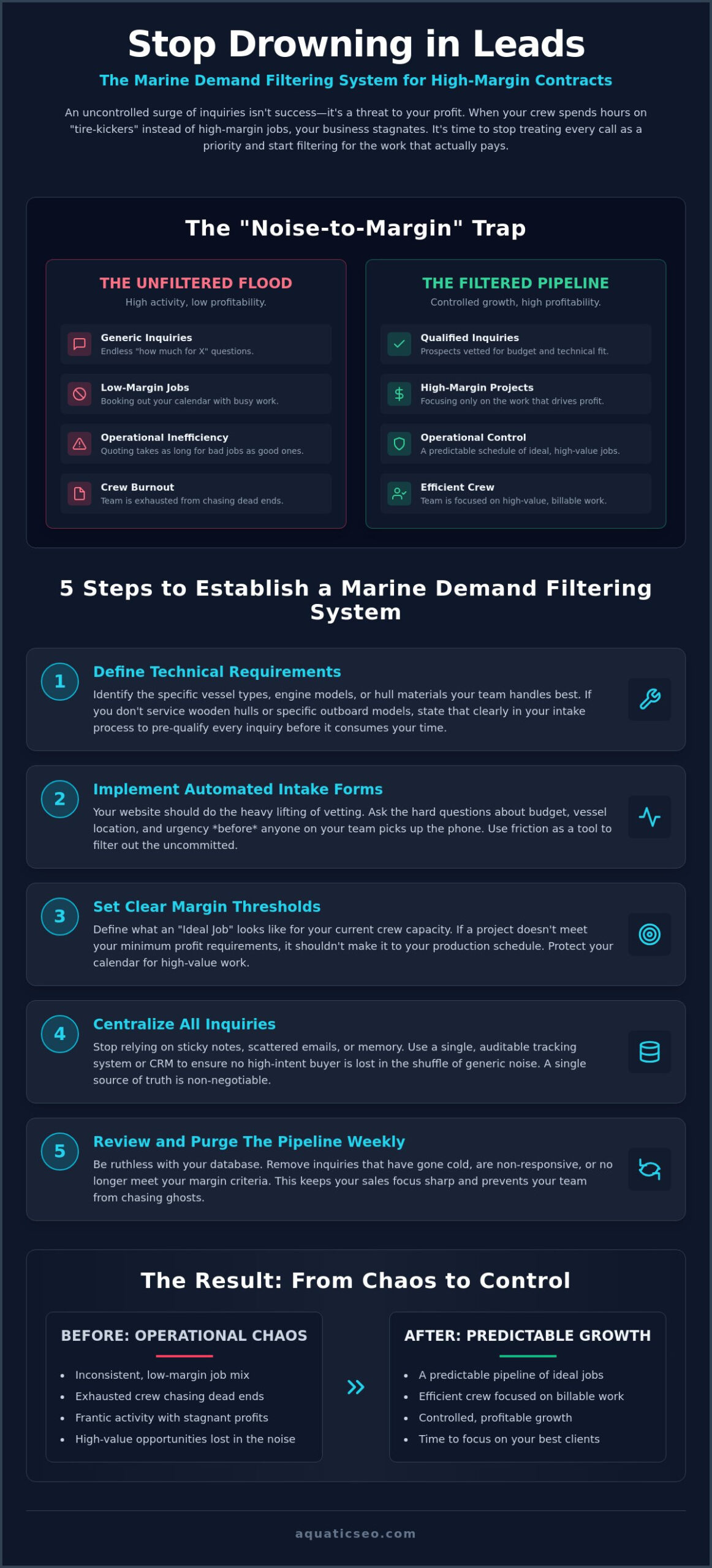
We measure the health of your intake process using the “Noise-to-Margin” ratio. High noise occurs when your office is flooded with “how much for X” questions from people who lack the budget or the intent to commit. Low margin is the result of your team doing busy work instead of high-value projects. You must understand how to manage an influx of new leads by prioritizing financial health over raw activity. Standard lead management principles often fail in this sector because they reward speed of response rather than the precision of the prospect.
Symptoms of a broken process are easy to spot in a boat dealership. When your sales staff is overwhelmed by generic inquiries, they often stop following up on high-intent buyers because they cannot see them through the clutter. This leads to a frantic, inconsistent job mix where you are busy but not profitable. A Demand Filtering System replaces this chaos with a methodical approach to vetting every person who contacts your business.
Why Generic Leads Kill Your Service Yard Efficiency
Quoting a low-margin maintenance job for a non-ideal client takes just as much time as quoting a high-value project. Every minute your lead mechanic spends explaining a basic quote to a “tire-kicker” is a minute they aren’t billing for a complex repower or electrical overhaul. For a marine contractor, an unqualified inquiry costs significantly more than the marketing dollar spent to acquire it; it costs the massive opportunity of the high-margin job you didn’t have time to close.
The Seasonal Surge Trap in Yacht Charter Marketing
A Yacht Charter is a premium, crewed experience, yet many marketing agencies treat it like a simple boat rental for the afternoon. When a seasonal surge hits, your inbox fills with people looking for cheap, hourly rentals. Booking out your high-value peak dates with these low-margin trips is a strategic failure that limits your annual revenue. You must protect your calendar for high-intent, multi-day bookings. This requires a system that filters out the noise before it ever reaches your desk.
5 Steps to Establishing a Marine Demand Filtering System
You don’t need more leads; you need a better way to process the interest you already have. Learning how to manage an influx of new leads requires moving beyond basic intake and toward a rigorous filtering methodology. Generic marketing advice often suggests that every inquiry is a gift, but a seasoned operator knows that an unqualified prospect is a liability. You must build a system that prioritizes technical fit and financial margin over raw volume. Follow these five steps to regain control of your pipeline.
- Step 1: Define technical requirements. Identify the specific vessel types, engine models, or hull materials your team handles best. If you don’t service wooden hulls or outboard engines over a certain age, state that clearly in your intake process.
- Step 2: Implement automated intake forms. Your website should do the heavy lifting of vetting. Ask the hard questions about budget, vessel location, and urgency before anyone on your team picks up the phone.
- Step 3: Set clear margin thresholds. Define what an “Ideal Job” looks like for your current crew capacity. If a project doesn’t meet your minimum profit requirements, it shouldn’t make it to your production schedule.
- Step 4: Centralize all inquiries. Stop relying on sticky notes or scattered emails. Use a single, auditable tracking system to ensure no high-intent buyer is lost in the shuffle of generic noise.
- Step 5: Review and purge the pipeline weekly. Be ruthless with your database. Remove inquiries that have gone cold or no longer meet your margin criteria to keep your sales focus sharp.
Automating the Initial Screening Process
Friction is your friend when demand is high. Most agencies try to make it as easy as possible for anyone to contact you, but this just invites low-intent noise. A marine mechanic should ask for engine hours, hull material, and the date of the last survey before ever picking up the phone. Use automated replies to set professional boundaries and timelines. This informs the prospect of when they can expect a response, which naturally filters out those looking for a “quick fix” that doesn’t fit your service model.
Setting Thresholds for High-Margin Contracts
Define your “Ideal Job” before the phone starts ringing. If your service yard specializes in major refits, spending time on minor gelcoat repairs is an operational loss. Redirect these smaller inquiries to a partner marina or a lower-tier shop to keep your best technicians available for high-value work. A lead is just a name on a screen, while a Qualified Inquiry is a vetted opportunity that meets your specific technical and financial thresholds. If you want to see how these systems integrate with your current operations, explore our tailored marketing services for marine professionals.
Qualified Inquiries vs. Generic Leads: Vetting for High-Margin Work
A Qualified Inquiry is the only metric that matters for your bottom line. While generic agencies brag about lead volume, they are often handing you a list of distractions that waste your time. Understanding how to manage an influx of new leads starts with recognizing that most leads are just noise manufactured by marketers who don’t know a transom from a tiller. You need prospects who have already been vetted by your technical content and operational requirements.
Leads are a distraction when they lack intent, budget, or a specific vessel need. High-intent buyers searching for marine construction services don’t want generic sales pitches; they want to know you understand the engineering requirements of their project. Industry-native content acts as a silent gatekeeper. It speaks the language of high-net-worth owners and filters out those who don’t understand the value of professional marine work before they ever reach your inbox.
Identifying High-Intent Buyers for Boat Dealers
There is a massive gap between someone “looking at boats” and a buyer ready for a fit-call. Serious buyers track specific inventory data and ask about engine hours or maintenance logs rather than just asking for the price. You must prioritize these inquiries immediately. If you don’t respond to a Qualified Inquiry within ten minutes, you risk losing a high-value sale to a dealer who is more operationally responsive and technically prepared.
Filtering Maintenance Requests for Service Yards
Your team must distinguish between routine dockage at a marina and technical work at a service yard. Marinas sell space, but you sell specialized labor and technical expertise. Filter your inquiries to prioritize emergency repairs or complex refits that command higher margins. This prevents your schedule from being clogged by low-value tasks that don’t justify your skilled labor overhead.
Stop giving away your expertise to DIY owners who only want free technical advice. Use your digital intake forms to create intentional friction. Ask for specific vessel details, hull numbers, and service history to ensure the owner is prepared to pay for professional results. This is a core component of how to manage an influx of new leads without burning out your best mechanics on dead-end conversations.
Infrastructure Requirements: Managing the Surge Without Crew Burnout
Your internal process is more significant than your marketing budget when the phone starts ringing. If your intake is broken, a larger ad spend just buys you more frustration. You must have the infrastructure to process interest without sacrificing your crew’s billable hours. This is the only way to understand how to manage an influx of new leads while maintaining high standards of service.
A CRM tailored for marine contractors and boatyards is not optional. Generic tools don’t account for the technical nuances of a yacht refit or a marine construction project. You need a system that tracks vessel specifications and service history alongside the prospect’s contact info. This oversight ensures that your team isn’t guessing when a high-value client returns for more work.
You can delegate lead triage without losing your expert reputation. By using the technical criteria established in earlier sections, your office staff can handle the initial vetting. This protects your lead mechanics and surveyors from wasting time on phone calls that lead nowhere. The Marine Demand Control System provides the framework to stabilize this flow, turning a seasonal surge into a year-round profit engine.
Centralizing Communication to Avoid Dropped Calls
“Pocket leads” are a silent killer of marine business growth. When inquiries stay trapped in a salesperson’s personal phone, you lose all operational visibility. You cannot manage what you cannot see. Every Qualified Inquiry must enter a single source of truth that is accessible to the owner and the production team.
Implementing Performance-Based Tracking
Stop paying attention to vanity metrics like clicks or impressions. These numbers are often manufactured by generic agencies to hide a lack of results. Watch your Qualified Inquiry rate instead. This metric tells you exactly how many people are actually a fit for your specific services.
Tying your marketing spend directly to closed, high-margin contracts is the only way to ensure financial health. You can see how this works in practice on our Digital Marketing for Marine Contractors page. If you are ready to stop the chaos and start filtering for margin, book a call to discuss your demand control strategy.
Achieving Predictable Growth with the Marine Demand Control System
Scaling a marine business without a filtering system is a recipe for operational collapse. You cannot sustain growth if every new inquiry requires an hour of unbilled technical consultation from your best mechanics. Learning how to manage an influx of new leads is about more than just answering the phone; it requires a rigorous vetting process. The Marine Demand Control System provides the demand you need to fill your schedule and the control you need to protect your margins. This dual approach ensures you aren’t just adding more names to a list, but rather adding more revenue to your balance sheet.
Skeptical owners often view marketing as a “black box” of wasted spend. Industry-native marketing changes this by focusing on technical precision rather than generic visibility. When your marketing speaks the language of a yacht refit or a marine construction project, it attracts the right buyers and repels the tire-kickers. You replace the stress of an unfiltered influx with the relief of a stable, high-margin schedule. This system ensures you maintain total oversight of your job mix at all times.
From Chaos to Consistent Job Flow
A filtered pipeline creates a stable environment for your crew. They spend their days on high-value projects that challenge their skills rather than repetitive, low-margin maintenance tasks. You stop being a slave to the seasonal surge because you’ve already secured the most profitable dates with Qualified Inquiries. Your bottom line benefits from the reduction in administrative waste and the increase in billable efficiency. The transition from being “busy” to being “profitable” occurs when you start valuing your billable hours more than your call volume.
Your Next Move: Securing a High-Margin Schedule
You don’t have to accept every call that comes through. You have the right to choose the clients and projects that align with your business goals. Stop chasing generic leads and start building a predictable flow of high-margin work that drives actual profit. A system that works should be auditable, technical, and focused on the specific needs of your boatyard or dealership.
Your next move is to secure a schedule that reflects the quality of your work. If you’re ready to implement a system that filters out the noise, schedule a marine service fit-call today. Remember, you aren’t looking for more leads; you are looking for better jobs.
Regain Control of Your Marine Operations
An influx of interest is only an asset if you have the technical infrastructure to filter it. You’ve seen how raw lead volume creates operational noise that masks your most profitable opportunities. By shifting your focus from vanity metrics to Qualified Inquiries, you protect your crew from burnout and ensure your boatyard remains focused on high-margin contracts. This methodical approach prioritizes financial health over superficial activity.
Mastering how to manage an influx of new leads requires a shift from passive intake to active demand control. The proprietary Marine Demand Control System is built specifically for marine contractors and boat dealers who are tired of chasing dead-end inquiries. It replaces the chaos of a seasonal surge with a predictable process designed for organizational stability. Stop letting unqualified prospects dictate your production schedule and start choosing clients based on technical fit.
Take the first step toward a predictable, high-value job mix today. Request a No-BS Marine Demand Analysis
Frequently Asked Questions
How do I tell the difference between a lead and a Qualified Inquiry?
A lead is a raw data point that hasn’t been vetted for intent, budget, or technical fit. A Qualified Inquiry is a prospect who has confirmed their vessel type, project requirements, and financial capability through your intake system. You stop wasting time on “noise” when you only prioritize prospects who meet your specific operational criteria.
What is the best way to handle a sudden surge in boat rental inquiries?
Redirect these inquiries to an automated self-service booking engine or a separate low-priority email queue. If your business focuses on high-margin crewed Yacht Charters, you cannot afford to have your staff answering phones for hourly rentals. Automation ensures these prospects get an answer without draining the resources needed for your high-value contracts.
Do I need a CRM if I only have a small crew at my service yard?
You need a CRM more than a large operation because your small team has zero margin for administrative waste. Small crews often suffer from “pocket leads” where inquiries are lost in personal text messages or scattered emails. A centralized system ensures every Qualified Inquiry is visible and actionable, preventing high-margin refits from slipping through the cracks.
How can I filter for high-margin jobs without offending potential customers?
Professionalism is maintained through technical precision, not by accepting every job that comes your way. Asking for hull numbers, engine specifications, or project budgets early in the process signals that you are a specialist boatyard. High-value clients respect this level of detail; those looking for the cheapest price will naturally fall away without a confrontation.
What should I do if my marketing is bringing in the wrong type of leads?
Update your digital content to include more technical language and very specific project requirements. If your marketing is too generic, it will attract a high volume of low-intent “noise” rather than the buyers you want. Learning how to manage an influx of new leads often starts with refining your message to intentionally repel the wrong audience.
How much time should my team spend following up on new inquiries?
Your team should spend zero time on prospects who haven’t passed your initial automated filtering criteria. Once a prospect becomes a Qualified Inquiry, your response time should be under ten minutes to secure the deal. Speed is only a competitive advantage when you apply it to the right prospects at the right time.
Can I use automation for yacht charter leads without losing the luxury feel?
Automation should handle logistical vetting, such as guest count and itinerary dates, so your human interaction is reserved for the premium experience. High-net-worth clients appreciate efficiency and technical accuracy. Vetting them through a system ensures that when they finally speak to your crew, the conversation is already focused on high-level consulting.
What happens if I turn away too many low-margin leads?
Your profit margins will stabilize and increase as you stop subsidizing low-value work with your skilled labor overhead. While the total volume of calls may drop, your operational efficiency will rise significantly. This is the core strategy for how to manage an influx of new leads without risking crew burnout or inconsistent monthly revenue.