
Stop burning your marketing budget on generic traffic that never converts into a signed contract. Many owners in this sector assume more leads equals more revenue, but the reality is that volume without filtration just creates administrative overhead. If you’re seeing a 6.1% decline in retail powerboat sales like the rest of the market in early 2026, you can’t afford to ignore the common mistakes in marine marketing that drive away high-intent buyers. You need a strategy that captures active demand rather than just chasing clicks.
It’s exhausting to deal with seasonal revenue drops and low-margin inquiries that waste your team’s time. You deserve a predictable schedule where every notification represents a serious prospect, not a boat rental seeker looking for a high-end Yacht Charter. This guide identifies the specific errors costing you high-margin jobs and explains how to implement a system that controls your demand. We’ll examine ten critical failures in your current strategy and provide the framework to dominate your local search results while protecting your profit margins.
Key Takeaways
- Identify why high traffic volume often fails to produce boat sales and how to pivot your focus toward capturing high-intent Qualified Inquiries.
- Learn why generalist agencies destroy your credibility by confusing a Service Yard with a Marina and how industry-native knowledge protects your brand.
- Discover how to eliminate the seasonal revenue drop by maintaining local search visibility in major hubs like Fort Lauderdale or Miami.
- Uncover the common mistakes in marine marketing that result in low-margin tire-kickers and generic inquiries clogging your schedule.
- Implement the Marine Demand Control System to transform your digital presence into a business development asset that ensures predictable, auditable revenue growth.
Prioritizing Vanity Traffic Over Qualified Inquiries
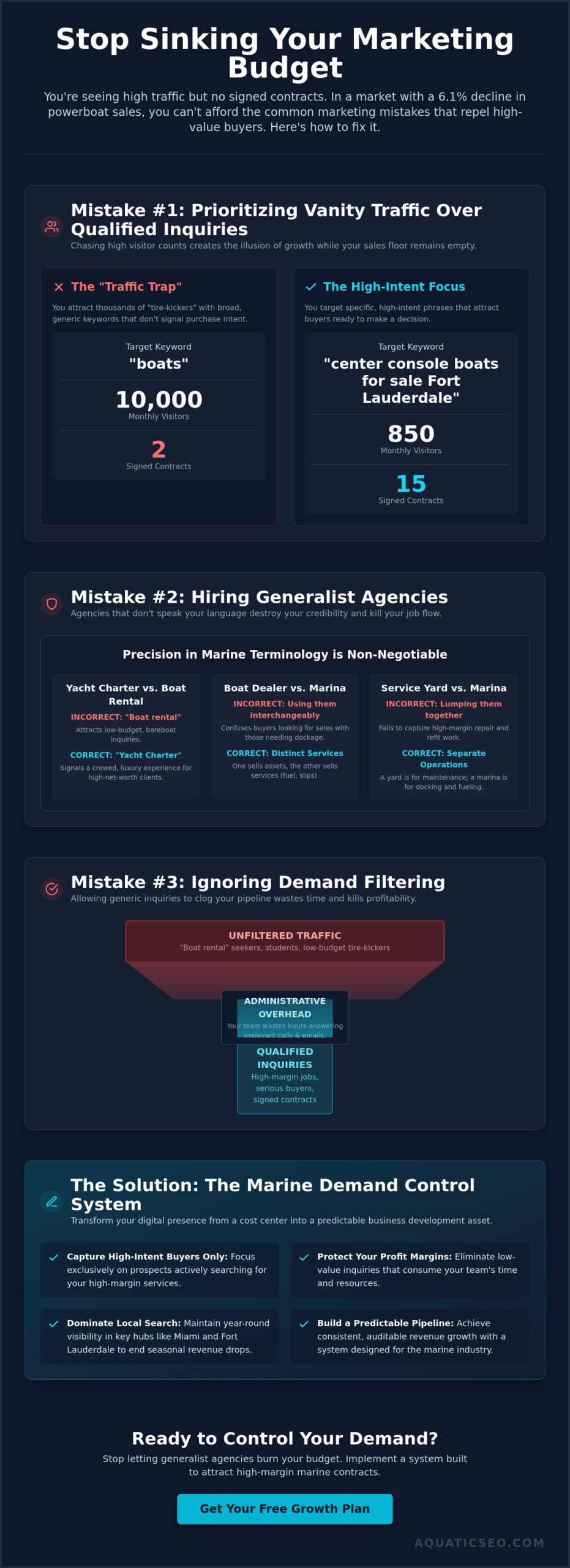
You might feel a surge of pride when your analytics dashboard shows 10,000 monthly visitors. But if your sales floor remains quiet, you’ve fallen into the “Traffic Trap.” This is one of the most frequent and costly common mistakes in marine marketing. High traffic volume is a vanity metric that often masks a complete failure to attract actual buyers. It creates the illusion of growth while your bank account remains stagnant.
Generic agencies often chase volume because it’s easy to report. They apply standard digital marketing principles without understanding the marine buyer’s journey. This approach floods your inbox with “tire-kickers” who have no intention of spending money on a repower or a new hull. Every minute your sales team spends explaining that you don’t offer hourly rentals is a minute they aren’t closing a five-figure contract. This waste of human capital is the hidden cost of poor demand filtering.
The Difference Between a Lead and a Qualified Inquiry
For a Yacht Charter operation, ranking for “boat rental” is a disaster. You’ll spend all day answering calls from people looking for a $200 pontoon for the afternoon. These aren’t just bad leads; they’re operational anchors that drag down your efficiency. A Qualified Inquiry is a prospect ready to sign a contract for specific marine services. Identifying high-margin signals requires looking at search behavior. A user searching for “70ft motor yacht charter rates Miami” has a different intent than someone searching for “boats for fun.”
Why Broad Keywords Are Sinking Your Budget
Ranking for the keyword “boats” sounds impressive, but it does nothing for your bottom line. It’s too broad. You’ll attract students doing research, kids looking for wallpapers, and people who can’t afford a trailer, let alone a vessel. If you’re a Boat Dealer, you need to target phrases like “center console boats for sale in Fort Lauderdale” or “authorized Mercury dealer near me.” These phrases indicate immediate need and financial capability. Generic traffic dilutes your conversion data, making it impossible to see what’s actually working. Focus on high-intent phrases that signal a need for immediate service or purchase to keep your job flow consistent and avoid the most common mistakes in marine marketing.
Hiring Generalist Agencies Without Marine Industry Native Knowledge
Hiring a generalist agency is one of the most frequent common mistakes in marine marketing. These firms claim they can market anything from dental offices to dry cleaners, but the marine sector operates on a different set of rules. When an agency doesn’t speak the language, your potential clients notice immediately. They see “boat rentals” listed on a Yacht Charter website and assume the operation is amateur. This credibility gap doesn’t just hurt your brand; it actively kills your job flow by signaling a lack of professionalism to high-net-worth owners.
Generalist agencies often push “holistic” strategies that fail because they ignore the brutal reality of marine seasonality. They don’t understand that a Boat Dealer has a completely different buyer profile than a marina looking for long-term slip tenants. This lack of nuance leads to many common marketing mistakes that waste your budget on the wrong searchers. To capture high-value demand, your marketing partner must be industry-native, understanding the technical differences between your services before they even open your account.
The Disastrous Confusion of Marine Terminology
Precision in terminology is the difference between a Qualified Inquiry and a wasted phone call. Generalists often fail to distinguish between these critical categories:
- Yacht Charter vs. Boat Rental: A charter involves a crewed vessel and a luxury experience. A rental is a bareboat transaction. Confusing these attracts a low-budget audience that will never book your $10,000 weekly charter.
- Boat Dealer vs. Marina: One sells assets; the other sells dockage and fuel. Their search intents are miles apart.
- Service Yard/Boatyard vs. Marina: A Service Yard focuses on maintenance and refits, while a marina focuses on storage. If your marketing lobs these together, you’ll get calls for fuel when you only offer engine overhauls.
The Hidden Cost of “Learning on Your Dime”
When you hire a generalist, you pay for their education. They typically spend the first six months of your contract “researching” the industry while your job flow remains stagnant. You need immediate execution based on proven marine frameworks, not a six-month onboarding period that yields zero results. If you want to see what industry-specific depth looks like, read our guide on Marine Marketing: The Ultimate Guide to Attracting High-Value Clients. If your current marketing partner is struggling to tell a surveyor from a mechanic, it’s time to look at specialized marine marketing services that deliver results without the learning curve.
Ignoring Demand Filtering for High-Margin Service Work
Stop treating every incoming notification like a gift. If you’re a marine contractor, an inquiry for a $50 fiberglass patch is a distraction from a $50,000 hull refit. One of the most damaging common mistakes in marine marketing is failing to filter demand before it reaches your phone. You end up with a chaotic schedule that looks full but a bottom line that indicates poor financial health. This lack of oversight leads to “busy-ness” rather than actual profitability.
A “take whatever comes” mentality is a recipe for operational burnout. It prevents you from stabilizing your revenue patterns because your crew is constantly pivoting between low-value tasks and high-stakes projects. You need a system that acts as a filter, ensuring that only the most profitable opportunities make it through to a consultation. This is where your digital assets must transition from passive pages to active business development tools that prioritize organizational stability over raw volume.
Controlling Your Job Mix for Better Margins
You must dictate the specific type of work that enters your yard. If your team excels at complex electrical overhauls or major structural repairs, your online presence should reflect that specialized expertise. Our Digital Marketing for Marine Contractors strategies focus on positioning your brand for the high-margin contracts you actually want. This approach isn’t about general visibility; it’s about being chosen by the right client for the right project. By showcasing technical case studies of major refits, you naturally repel the small-scale repair inquiries that dilute your focus.
Automated Filtration: Stopping the Tire-Kickers
Your website must function as a gatekeeper rather than just a brochure. High-intent content should answer the fundamental questions that typically clog your sales calls, effectively disqualifying “price shoppers” before they ever dial your number. We implement the Marine Demand Control System to provide this essential layer of automated oversight. Disqualification is a powerful tool for maintaining market effectiveness. A smaller number of Qualified Inquiries will always serve your business better than a flooded inbox of low-value junk that drains your team’s energy and wastes your time.
Mismanaging Seasonal SEO and Local Search Visibility
Turning off your marketing during the winter months is a tactical error that destroys your spring job flow. This “Off-Season Ghost Town” effect occurs when you stop building visibility just because the boats are out of the water. It’s one of the most frequent common mistakes in marine marketing. Search engines prioritize consistency; a dormant website loses authority that takes months to recover. By the time you start your spring campaign, your competitors in Fort Lauderdale or Miami have already captured the early-season demand.
Year-round visibility creates a “Demand Compounding” effect. Every piece of content you publish in November builds the authority needed to rank for high-margin projects in March. Neglecting your Google Business Profile for your service yard is another missed opportunity. Local search results are the primary way owners find help when an engine fails or an electrical system shorts out. If your profile isn’t optimized with technical photos and verified service areas, you’re invisible to the most profitable local inquiries.
Winning the Local Marine Market
Local SEO is the lifeblood of marine mechanics and electricians. When a boat owner is stuck at the dock, they don’t search for general services; they search for “mobile marine electrician near me.” You must optimize for specific boating destinations and marinas in your service area. We create location-specific service pages for boatyards to ensure you appear exactly where the demand is highest. This precision ensures you aren’t wasting spend on searchers outside your operational radius.
Using SEO to Stabilize Seasonal Revenue
You can use digital assets to smooth out the cyclical nature of the industry. Instead of waiting for the phone to ring in May, start building demand for winter storage and maintenance during the peak summer months. Content strategies that target “early bird” planners allow you to book your winter schedule months in advance. Our Seattle Boat Show Guide demonstrates how event-based planning captures intent long before the season starts. If you want to stop the feast-and-famine cycle, you need a system that maintains visibility 365 days a year. Secure your spring job flow now with specialized service yard marketing.
Deploying the Marine Demand Control System for Consistent Revenue
You must stop treating your digital presence like a digital brochure and start viewing it as a business development asset. Traditional marketing focuses on visibility, but the Marine Demand Control System focuses on command. It’s the difference between hoping for work and dictating your job flow. Most common mistakes in marine marketing stem from a complete lack of this systematic oversight, leaving owners at the mercy of seasonal whims.
We don’t act as a generic vendor. We function as a specialized partner for Boat Dealers and Service Yards who value precision over volume. This transition requires moving away from the “spray and pray” tactics of generalist agencies. You need auditable revenue growth that stabilizes your seasonal cycles and ensures your crew stays focused on high-margin projects rather than administrative busy-work.
Synthesis Summary: Stop chasing metrics that don’t deposit into your bank account. When you stop obsessing over raw traffic and start implementing a filtration-first framework, you regain control of your schedule. You move from a state of reactive panic to one of proactive operational stability. By correcting the common mistakes in marine marketing identified in this guide, you ensure that every inquiry hitting your inbox is a Qualified Inquiry ready for a contract.
Auditable Results Over Vanity Metrics
Clicks and impressions are vanity metrics that general agencies use to hide a lack of tangible results. We ignore these numbers in favor of Qualified Inquiries that move the needle for your financial health. Tracking the actual ROI of your marketing spend is the only way to ensure long-term organizational stability. A marine-specific SEO strategy must be measured by the profit margin per inquiry, not the total volume of visitors who will never buy a boat or book a refit.
- Precision Tracking: Every inquiry is audited to ensure it matches your ideal job mix.
- Financial Oversight: We prioritize spend on keywords that lead to high-margin contracts.
- Market Effectiveness: Your digital assets should repel “tire-kickers” automatically.
Your Next Step: A No-BS Marine Marketing Analysis
A fit call with Aquatic SEO is a direct, pragmatic assessment of your current job flow. We don’t use sentimental appeals or vague promises. We provide a diagnosis of your operational symptoms and present a system-driven solution. We explicitly reject businesses that are not a specialized fit because we only partner with operations where we can provide a massive, auditable impact. If you’re tired of waste and ready to stabilize your revenue patterns, it’s time to act. Request a No-BS Marine Marketing Analysis to see if your operation qualifies for our proprietary framework.
Take Command of Your Market Position
You’ve seen how common mistakes in marine marketing like chasing vanity traffic or hiring generalist agencies drain your budget and stall your job flow. Relying on agencies that can’t distinguish a Yacht Charter from a boat rental is an expensive gamble you don’t need to take. By prioritizing demand filtering and maintaining local visibility year-round, you stabilize your revenue and keep your crew focused on the high-margin service work they do best. This shift ensures your business remains resilient regardless of seasonal shifts.
We specialize in helping marine contractors and service yards with revenues between $300K and $5M move from reactive marketing to auditable business growth. Our proprietary Marine Demand Control System provides the oversight necessary to dictate your job mix and protect your financial health. As industry-native experts, we know the technical nuances of your business and understand that a yacht is not just a boat. Stop settling for generic leads and start capturing the specific inquiries that grow your bottom line.
Request your Marine Demand Control Analysis here
Your expertise on the water deserves a digital strategy that works just as hard as your crew does every day.
Frequently Asked Questions
What is the most common mistake boat dealers make with SEO?
The most frequent error is targeting broad, vanity keywords that attract unqualified traffic instead of high-intent buyers. Dealers often rank for generic terms like “boats for sale” but miss the specific, localized phrases that drive actual sales floor traffic. You must focus on model-specific search terms and localized intent to ensure your job flow remains consistent throughout the year.
How is a Yacht Charter different from a boat rental in marketing?
Marketing a Yacht Charter requires targeting high-net-worth individuals seeking a crewed, luxury experience rather than a “boat rental” seeker. A boat rental usually implies a bareboat transaction for a lower budget. If your marketing confuses these terms, you’ll flood your inbox with low-margin inquiries that waste your administrative time and destroy your operational efficiency.
Can a general digital marketing agency handle marine construction SEO?
A general agency cannot handle marine construction SEO effectively because they lack the technical knowledge of the industry. They often fail to distinguish between specialized marine contractors and general residential builders. For instance, while a homeowner might visit Herrings Carpentry for premium custom decks and pergolas, a marine client needs a contractor with entirely different environmental and structural expertise. This leads to common mistakes in marine marketing where your budget is wasted on keywords that attract homeowners looking for a small dock repair instead of a major commercial bulkhead project.
Why am I getting so many low-quality leads from my website?
You’re receiving low-quality inquiries because your website lacks a Demand Filtering System to disqualify price shoppers before they contact you. Without high-intent content that answers technical questions, your site acts as a magnet for everyone rather than a filter for the few. Implementing a proprietary framework ensures that only Qualified Inquiries with the right budget and project scope reach your sales team.
How much should a marine contractor spend on digital marketing in 2026?
Your marketing spend should be treated as a business development asset rather than a sunk cost. While general industry reports for 2026 suggest various ranges for digital services, your specific allocation should depend on your revenue goals and the complexity of your job mix. We prioritize financial health by focusing on auditable tracking and high-margin outcomes rather than arbitrary monthly fees.
What happens if I stop my marine marketing during the off-season?
Stopping your marketing during the off-season destroys your search authority and allows competitors to dominate results before the spring rush. Search engines reward consistent activity and year-round content updates. If you vanish in the winter, you’ll spend the first three months of the peak season trying to recover lost ground while your competitors are already booking out their schedules.
Is Google Ads or SEO better for a marine service yard?
Both have a place, but a marine service yard needs the long-term compounding effect of SEO to maintain organizational stability. Google Ads can capture immediate demand for emergency repairs, but it stops the moment you stop paying. SEO builds a permanent business development asset that generates Qualified Inquiries without a per-click cost, ensuring better margins over time.
How long does it take to see results from a Marine Demand Control System?
You’ll see a shift in inquiry quality almost immediately after implementing the filtration components of the Marine Demand Control System. While the compounding effects of SEO take several months to fully mature, the automated disqualification of tire-kickers happens as soon as the system is deployed. This allows you to regain control of your schedule and focus on high-margin contracts within the first 90 days.