
You are likely checking your analytics and seeing the traffic climb, yet your inbox is filled with tire kickers asking for fifty dollar impeller changes instead of fifty thousand dollar refits or long term storage contracts. High traffic is a vanity metric that doesn’t pay the yard’s mortgage or keep your skilled technicians busy during the off-season. If you are currently weighing the merits of DIY marine SEO vs professional services, you must realize that generic visibility is often the enemy of high-margin growth. Most marine business owners find themselves trapped in a cycle of high digital engagement that yields zero organizational stability.
It’s exhausting to manage your own keywords only to end up with a calendar full of low-margin filler work that clutters your schedule. We promise to show you how to stop wasting time on noise and discover if your current DIY approach is actually costing your business the high-value jobs it deserves.
We will compare the hidden labor costs of doing it yourself against a professional marketing system that works without constant babysitting. You’ll learn how to shift your focus from simple clicks to capturing the specific qualified inquiries that drive predictable revenue and higher-margin contracts.
Key Takeaways
- Calculate the true hourly rate of your time to see if managing your own SEO is actually draining your service yard’s profitability.
- Discover why generic search strategies fail to capture high-margin yacht charter contracts by confusing them with low-intent boat rentals.
- Compare the speed and precision of results when analyzing DIY marine SEO vs professional services to determine which model builds a scalable business asset.
- Identify the common pitfalls of AI-generated marketing that often destroy credibility with discerning boat and yacht owners.
- Learn how to transition from “scrappy” marketing efforts to a methodical demand filtering system that ensures financial health.
The Hidden Costs of Managing Your Own Marine SEO
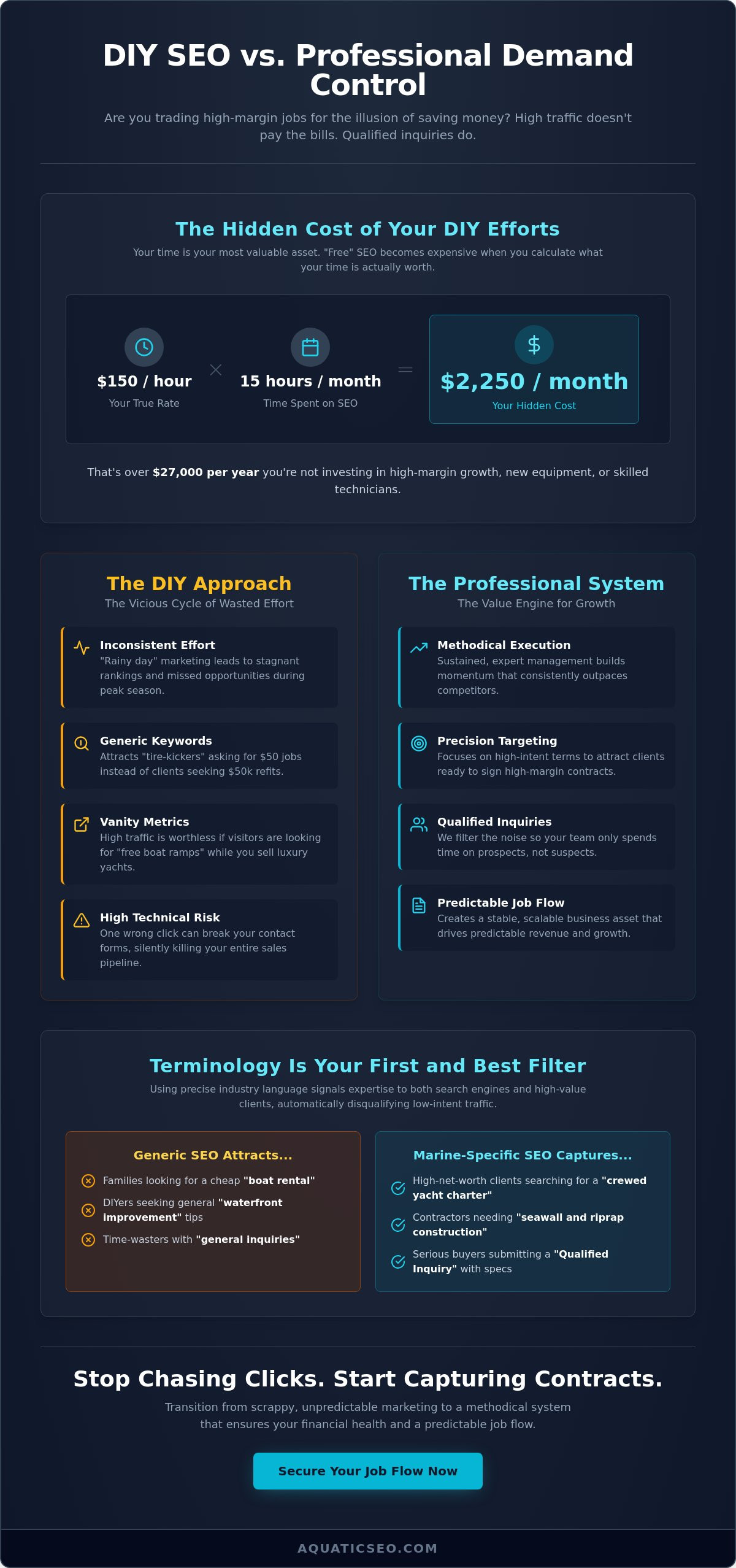
Managing your own digital presence often feels like a cost-saving measure, but for a business owner, “free” is a dangerous illusion. You need to calculate your true hourly rate before deciding between DIY marine SEO vs professional services. If your time is worth $150 per hour and you spend 15 hours a month tweaking titles or researching keywords, you are effectively paying $2,250 for those efforts. That is capital that could have been reinvested into expanding your fleet or upgrading your facility equipment.
The “drift” effect is another silent killer of profitability. Inconsistent DIY efforts lead to stagnant or declining rankings because search engines reward sustained, methodical updates. When you only touch your website during rainy days or slow weeks, you lose the momentum required to outpace competitors. This lack of oversight creates a cycle where your business remains invisible to high-value clients during the most critical booking windows of the season.
Understanding the technical side of Search Engine Optimization (SEO) is only half the battle. Surface-level keyword research often targets broad terms that attract low-intent traffic rather than high-margin jobs. You might rank for “boats for sale,” but if you aren’t capturing the specific intent of a buyer looking for a “center console fishing boat dealer,” you are just inviting noise into your inbox.
The Opportunity Cost of Technical Tinkering
Every hour you spend troubleshooting a broken plugin or editing meta descriptions is an hour you aren’t closing deals or managing high-margin repairs. Owners of a Service Yard or Boatyard often find themselves “stuck in the engine room” of their website. This technical tinkering is high-risk work; a single error in your site’s code can break your contact forms right as peak boating season begins, cutting off your revenue pipeline entirely.
The Trap of Vanity Metrics
It is easy to feel successful when your analytics show 1,000 monthly visitors. However, if those visitors are looking for “free boat ramps” or “used outboard parts” while you sell luxury yachts, that traffic is worthless. The core difference when evaluating DIY marine SEO vs professional services is the focus on the Qualified Inquiry. We prioritize filtering out tire-kickers so your team only spends time on prospects ready to sign high-margin contracts. Generic traffic is a vanity metric; predictable job flow is a business asset.
Why Generic SEO Strategies Fail Specialized Marine Sectors
Generic agencies apply the same template to a florist as they do to a yacht brokerage. This is the core failure in the DIY marine SEO vs professional services debate. Search engines look for authority, but they also look for relevance. A understanding how SEO works requires realizing that Google categorizes content based on specific intent markers. If your site uses “boat rental” when you actually offer a “Yacht Charter,” you’ll attract families looking for a pontoon rather than high-net-worth clients seeking a crewed experience.
Precision matters in marine construction. A generic writer will produce fluff about “waterfront improvement” that fails to mention seawalls, pilings, or riprap. This lack of technical depth tells both Google and your prospective clients that you don’t know the industry. Professionals in marine construction marketing ensure every page speaks the language of the job site to build actual trust.
Local SEO for marinas also requires more than just a map pin. It’s about transient dockage, fueling services, and slip availability. If your digital presence doesn’t distinguish between these operational realities, you’ll end up with a cluttered inbox full of irrelevant queries that waste your staff’s time.
Terminology as a Filtration Tool
Specific terms act as a gatekeeper for your inbox. Using “Qualified Inquiry” markers like “LOA” or “displacement” signals to search engines that your content is for serious owners. Consider these architectural differences:
- Boat Dealers: Focus on inventory turnover and specific brand search intent.
- Marinas: Prioritize recurring slip revenue and transient capture.
- Marine Surveyors: Need to target insurance and pre-purchase surveys rather than general inspections.
A Boat Dealer SEO strategy that doesn’t account for these nuances is just burning capital on generic noise.
The Failure of One-Size-Fits-All Content
Generic blog posts about “best sunscreen for boating” are a waste of resources. High-intent buyers aren’t looking for tips; they’re looking for solutions to specific operational problems. A yacht owner cares about engine reliability and haul-out schedules, not basic knot-tying. Your content must demonstrate “in the trenches” expertise to earn their business. If you want to see how a specialized system filters for quality, you can book a fit call to discuss your specific operational goals.
Comparing DIY Efforts to Professional Marine Demand Control
The core distinction between DIY marine SEO vs professional services is the difference between propulsion and drift. When you manage your own search presence, you’re often at the mercy of shifting algorithms and seasonal trends. You might catch a favorable current for a few weeks, but without a dedicated power source, your rankings will inevitably stall. Professional systems provide the mechanical force needed to maintain visibility even when the market gets choppy. We replace “best guess” keyword selection with rigorous intent mapping to ensure you’re visible to buyers, not just browsers.
Accountability is the hallmark of a professional partnership. You shouldn’t have to wonder if your marketing is working; you should be able to see it in your financial health. We use auditable tracking to connect every digital action to a tangible business outcome. This level of precision allows you to treat your marketing as a predictable investment rather than a monthly expense. It’s about moving from a “scrappy” mindset to one focused on organizational stability and long-term growth.
Strategic Oversight vs. Tactical Execution
Tactical execution without a roadmap is just busywork. A DIY approach might involve sporadic social media posts or half-hearted blog updates that don’t lead anywhere. Professional services develop a formal marketing plan that aligns your digital presence with your actual yard capacity. Our Marine Demand Control System stabilizes inconsistent revenue by focusing on high-margin contracts that keep your crew busy year-round. We provide performance-based assurances because we’re confident in our methodical methodology.
The Technology Gap
The technology gap is often the deciding factor when choosing between DIY marine SEO vs professional services. Premium industry data is the fuel for high-performance marketing. DIY tools often provide “watered down” statistics that don’t reflect the nuances of the marine sector. By implementing Demand Filtering Systems, we automate the qualification process so you don’t have to babysit your inbox. This technology is mandatory for high-value Yacht Charter sites that require heavy technical optimization to rank for competitive global terms. Professional-grade SEO ensures your site functions as a relentless business development asset that captures demand 24/7.
Avoiding Common Pitfalls in Self-Managed Marine Marketing
Managing your own search strategy often leads to a “set it and forget it” trap that invites digital decay. Search engines prioritize fresh, authoritative data. If your site has been stagnant since last season, you are losing ground to competitors who treat their presence as a live asset. In the debate of DIY marine SEO vs professional services, the professional path avoids the outdated tactics that now trigger swift Google penalties. By utilizing Google compliant review management, you ensure your reputation is handled ethically, protecting your business from the loss of visibility that comes with non-compliant practices. These penalties can erase your visibility entirely just as the spring haul-out season begins.
Technical neglect is another silent revenue killer. Many owners ignore the mobile experience, assuming clients only search from a desktop. In reality, boaters often search for services while standing on the dock or from the cockpit of their vessel. If your site fails to load quickly on a cellular connection, that prospect will bounce to the next listing before your header even appears. Professional oversight ensures your site remains functional and responsive under real-world conditions.
The AI Content Trap
Yacht owners and high-margin clients are discerning. They can spot generic, AI-generated fluff instantly. If your blog posts offer basic advice that any landlubber could write, you destroy your brand credibility before the first phone call. Google also devalues low-effort content that lacks “in the trenches” expertise. You need SEO rich text that reflects actual mechanical or operational knowledge. A confident, no-nonsense voice resonates with owners who want to know their vessel is in capable hands.
Inconsistent Local Visibility
Fragmented NAP (Name, Address, Phone) data is a common pitfall for boat dealers and service providers. If your contact information varies across different directories, Google loses trust in your location’s legitimacy. This inconsistency prevents you from appearing in the “Map Pack” where most local searches end. This is particularly damaging for marine contractors who rely on geographic proximity to secure seawall or dock repair jobs. You must maintain unified local citations to ensure you are visible when a local owner needs an emergency repair. To stop losing local jobs to less-qualified competitors, you should schedule a technical audit to identify and fix your current visibility leaks.
Securing Your Job Flow with Professional Marine Systems
Transitioning from “scrappy” marketing to a scalable business asset is the most significant move you can make for your firm’s long-term health. When you evaluate DIY marine SEO vs professional services, you are essentially choosing between being a technician of your own website or an operator of a growing enterprise. Specialized oversight provides the organizational stability required to move beyond inconsistent revenue patterns. It allows you to step out of the digital engine room and focus on high-level business development.
The relief of a predictable job mix cannot be overstated. When your marketing system works without constant babysitting, you gain the freedom to manage your crew and facility with precision. You no longer have to worry if next month’s slip fees or payroll will be covered by a sudden influx of work. Instead, you can rely on a stabilized revenue stream built on a foundation of methodical, industry-specific search strategies. This shift from reactive tinkering to proactive management is what separates stagnant yards from market leaders.
Capturing High-Intent Demand
Our systems focus exclusively on buyers who are actively searching for your specific marine service right now. We don’t care about general boating enthusiasts; we care about the Qualified Inquiry that leads to a high-margin contract. Professional systems act as a filtration layer, repelling the low-budget noise that clutters your inbox. This ensures your service advisors and sales teams only spend time on prospects who value expertise over the lowest price.
Positioning your brand as the premium choice in your local market requires more than just a website. It requires a digital presence that reflects the technical reality of your work. Whether you are a marine mechanic or a yacht dealer, your content must speak to the specific pain points of vessel owners. By capturing high-intent demand, you secure the types of jobs that keep your most skilled technicians productive and your margins healthy.
The Path to Demand Control
We reject vanity metrics like “impressions” or “engagement” in favor of tangible business outcomes. If a digital strategy doesn’t result in auditable tracking and financial growth, it is a waste of your capital. The “DIY drift” ends when you implement a methodical methodology that treats marketing as a controllable lever for your business. This partnership-based model ensures that your marketing is always aligned with your current yard capacity and long-term goals.
Stop wasting time on generic strategies that fail to distinguish a Service Yard from a marina. If you are ready to stabilize your job flow and secure your business’s financial future, it is time for a professional diagnosis. You can Request a No-BS Marine Marketing Analysis to discover exactly where your current efforts are leaking revenue and how to fix them with precision.
Stabilize Your Revenue and Reclaim Your Time
Managing your own search presence often results in a “DIY drift” that clutters your inbox with low-margin noise. We’ve established that the choice between DIY marine SEO vs professional services isn’t just about cost; it’s about the precision of your results. Industry-native specialists understand that a Yacht Charter is not a boat rental. They build systems to capture the specific high-margin Qualified Inquiries your business needs to thrive. This shift from reactive tinkering to proactive management is what separates stagnant yards from market leaders.
Our proprietary Marine Demand Control System replaces “best guess” tactics with an auditable roadmap for growth. By filtering out tire-kickers and focusing on high-intent buyers, we provide the organizational stability that allows you to focus on your yard’s operations. It is time to stop being a technician of your own website and start being the operator of a scalable enterprise. Your business deserves a marketing system as reliable as the vessels you service and sell.
If you are ready to secure a predictable job flow and stop wasting capital on vanity metrics, take the next step toward financial health today. Request a No-BS Marine Marketing Analysis and start building a marketing asset that works as hard as your crew.
Frequently Asked Questions
Is DIY SEO worth it for a small boat dealership?
DIY efforts are rarely worth the opportunity cost for a Boat Dealer focused on inventory turnover. While you might save on monthly fees, you lose hours that should be spent closing high-margin sales or managing your sales floor. When weighing DIY marine SEO vs professional services, remember that amateur efforts often attract low-intent traffic rather than the serious buyers your business requires for financial health.
How long does it take to see results from professional marine SEO?
Measurable traffic and inquiry increases typically occur between 6 and 12 months after implementation. You will likely see foundational ranking improvements around months 4 to 6. This is a long-term investment in your yard’s visibility rather than a temporary fix for next week’s empty schedule.
Can I use AI to write my marine business blog posts?
You shouldn’t rely on AI if you want to maintain credibility with discerning yacht owners. AI lacks the “in the trenches” experience required to distinguish technical nuances and often produces generic fluff that Google devalues. High-margin clients expect expertise that reflects actual mechanical or operational knowledge, not low-effort text that any landlubber could generate.
What is the difference between a lead and a Qualified Inquiry?
A lead is simply a contact name that may or may not have the budget for your services. A Qualified Inquiry is a prospect vetted for high-intent and high-margin potential, such as someone seeking a full engine refit or a crewed Yacht Charter. Our systems focus on filtering out the noise so your team only handles serious business opportunities.
Why do generic SEO agencies struggle with marine industry clients?
Generic agencies lack the industry-native knowledge to distinguish a Service Yard from a marina or a boat rental from a charter. This lack of precision leads to broad keyword targeting that attracts irrelevant traffic and tire-kickers. They apply the same template to every client, failing to address the unique operational challenges and buyer behaviors specific to the marine sector.
How much time should a marine business owner spend on marketing?
You should spend your time on oversight and high-level strategy, not technical execution. If you are spending 15 hours a month on DIY marine SEO vs professional services, you are effectively losing thousands of dollars in billable time. Your focus should remain on managing your crew and facility while a methodical system handles the demand generation.
Do I need professional SEO if I already have a good reputation in the marina?
Yes, because word-of-mouth has a limited reach that doesn’t capture new buyers entering the market. While a local reputation is valuable, professional SEO captures active demand from prospects who are searching online but don’t know your name yet. It ensures your business is the first choice for high-value contracts regardless of personal connections.
What is the Marine Demand Control System?
The Marine Demand Control System is our proprietary framework designed to stabilize inconsistent revenue patterns for boatyards and dealerships. It replaces “best guess” marketing with a methodical methodology that focuses on high-intent buyer capture and demand filtering. This system ensures a predictable flow of high-margin work without requiring constant babysitting from the owner.