You spent $40,000 on booth space, transport, and staffing for the last show, yet your sales team spent three days talking to “tire kickers” who just wanted a free hat. By the time the docks cleared, you had a stack of business cards but no clear path to a sale. This cycle of high-overhead gambling is why traditional digital marketing for boat shows fails. You’re chasing foot traffic when you should be capturing pre-qualified demand. Most boat dealers treat shows as isolated events rather than high-density data harvest opportunities, leaving their ROI to chance.
It’s frustrating to watch six-figure investments result in nothing but generic “we’ll think about it” emails. You know the high-intent buyers are there, but they’re usually buried under a mountain of unqualified noise. This article will show you how to install a Demand Control System that identifies serious prospects before they even step onto the pier. We’ll break down the precision-engineered strategy needed to transform show-floor chaos into a predictable stream of qualified inquiries that finally justify your show investment.
Key Takeaways
- Stop mistaking booth foot traffic for profit and learn why generic marketing fails to distinguish between casual browsers and high-intent buyers.
- Deploy a precision-engineered strategy for digital marketing for boat shows that identifies active buyers weeks before they ever reach the docks.
- Move beyond basic geofencing by implementing a Demand Filtering system that qualifies mobile device IDs in real-time on the show floor.
- Eliminate the post-show slump by using collected data to fuel a 12-month stream of predictable sales inquiries and job flow.
- Adopt the Marine Demand Control System to replace uncertain event outcomes with auditable business results and stable revenue growth.
The Boat Show ROI Trap: Why Generic Digital Marketing For Boat Shows Fails
Most boat show strategies are built on hope. You pay for the premium booth space; you polish the stainless steel; you hope the right buyers walk down your specific dock. Generic agencies often encourage this passive approach by focusing on “brand awareness” or “impressions.” These are vanity metrics that don’t pay for your transport costs or staffing overhead. If your strategy for digital marketing for boat shows centers on how many people saw your ad, you’re already losing money. You need a system that prioritizes financial health over superficial engagement counts.
Generic marketing providers fail in the marine sector because they lack industry-native precision. They don’t understand that a Yacht Charter is a crewed luxury experience, not a simple boat rental. They treat a boat dealer the same way they treat a car dealership, ignoring the long-tail research phase unique to high-ticket marine acquisitions. This lack of oversight leads to “tire kickers” flooding your booth. When your digital strategy is unfiltered, you’re essentially paying to be interrupted by people who can’t afford your inventory. You must shift to a Demand Control mindset where the show is a tool for closing, not just a destination for browsing.
To truly capture this high-end segment, your brand must be positioned as a sanctuary for the exceptional. This often involves working with a specialized agence branding luxe paris that understands how to craft a digital identity that speaks directly to the desires of luxury clientele, ensuring every digital touchpoint reinforces your premium status.
The Cost of Unfiltered Demand
Unqualified traffic is an operational drain. When your booth staff spends forty minutes explaining engine specs to a “tire kicker” who has no intention of buying, you’ve lost more than just time. You’ve lost the opportunity to engage the serious buyer standing three feet away. Generic digital ads often cast too wide a net, attracting general enthusiasts rather than high-intent prospects. This creates a psychological toll on your team; inconsistent results lead to burnout and a cynical view of the show circuit. Precision filtration ensures your staff only invests energy into a Qualified Inquiry.
Qualified Inquiries vs. General Attendance
You cannot bank “traffic.” Whether ten thousand people walk past your display or twenty thousand, the only metric that matters is the volume of high-value outcomes. For yacht charters and dealers, a Qualified Inquiry is a prospect whose intent and financial capacity have been verified before the first handshake. Traffic is a deceptive metric that masks poor performance. You need a system that filters intent through search behavior and historical data. By the time a prospect reaches the docks, they should already be halfway through your sales funnel. This is the difference between chasing the crowd and commanding the market.
Active Buyer Capture: Pre-Show Digital Strategies for 2026
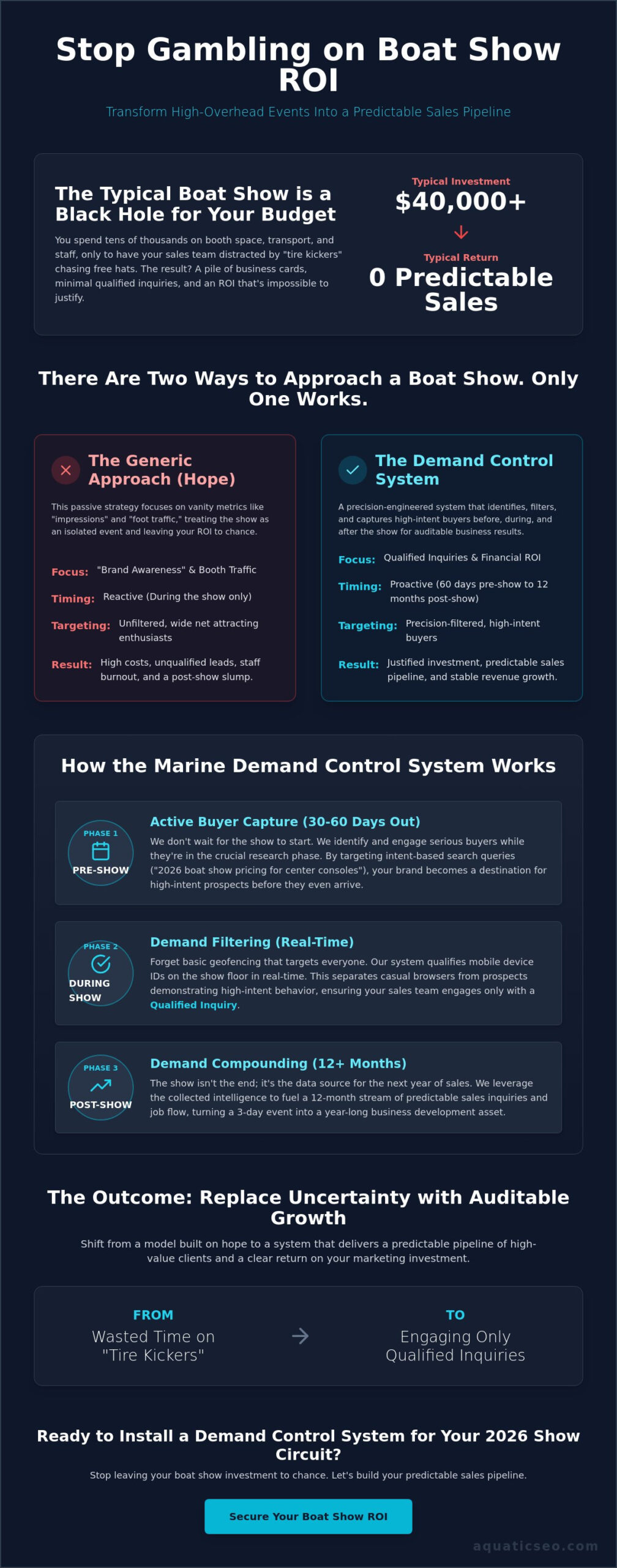
Waiting until the docks open to find your buyers is an expensive mistake. The most effective digital marketing for boat shows starts 30 to 60 days before the first vessel is tied up. During this window, serious buyers are already conducting technical research on specific hull designs, propulsion systems, and show-only incentives. If your brand isn’t visible during this phase, you aren’t just losing traffic; you’re losing the sale before it even begins. You must capture this high-intent demand while your competitors are still worrying about their booth carpet color.
Our Marine Demand Control System identifies these active search patterns early. We target prospects who are moving past general interest and into the specific evaluation phase. By deploying precision digital marketing for boat shows during this 60 day lead up, you “warm up” the market. This ensures that when the show starts, your display is already a destination for high-intent buyers rather than a random stop for browsers. It’s about engineering the outcome of the show before you even arrive at the venue.
Intent-Based SEO for Show Attendees
Generic show directories prioritize their own traffic, not your specific sales goals. You must outrank these broad listings by targeting long-tail queries like “2026 boat show pricing for center consoles” or “yacht dealer reveals at [Location] show.” Implementing seo rich text ensures your landing pages speak directly to the technical requirements of high-intent buyers rather than general hobbyists. Standard trade show marketing strategies often fail in the marine sector because they don’t account for the months-long research cycle inherent in luxury acquisitions.
The 4-Step Pre-Show Capture Sequence
To stabilize your show results and eliminate the gamble, we use a methodical 4-step sequence to fill your calendar:
- Step 1: Identify high-value prospects using search intent data that signals immediate purchase readiness.
- Step 2: Filter for qualified inquiries through niche-specific landing pages that disqualify “tire kickers” before they waste your time.
- Step 3: Establish authority with educational content, such as a guide from a marine surveyor on what to look for in a 2026 pre-purchase inspection.
- Step 4: Secure firm appointments to ensure your show schedule is filled with buyers who have already been vetted.
This sequence transforms the event from a high-stakes roll of the dice into a structured business development exercise. When you use a marine-specific Demand Control System, you stop hoping for sales and start scheduling them. Your team stays focused on closing deals with people who have already demonstrated their intent through their digital behavior.
Geofencing vs. Demand Filtering: Separating Real Buyers From Browsers
Geofencing is often marketed as a “silver bullet” for location-based targeting, but for most boat dealers, it’s a source of wasted spend. If you simply draw a virtual perimeter around a major event, you’re paying for impressions from every tourist, competitor, and child with a smartphone in the area. This is where traditional digital marketing for boat shows falls short. You don’t need more eyes on your ads; you need a system that qualifies mobile device IDs in real-time based on historical behavior and search intent. Real-world results require moving beyond basic proximity to implement a Demand Filtering system.
The difference between a vanity metric and a Qualified Inquiry lies in the oversight of your data. While many agencies chase greater brand visibility, we focus on auditable business outcomes. Seeing an ad is a passive event that doesn’t indicate a buyer’s capacity or intent. By layering intent filtering over your geofencing, you can track which specific zones of the show floor produce the highest-margin jobs and most serious buyers. This level of digital oversight ensures your budget is spent on high-value prospects rather than the general crowd.
The Limits of Traditional Geofencing
Targeting a virtual fence around the Miami International Boat Show or the Fort Lauderdale International Boat Show sounds logical, but the noise level is extreme. You’re competing for attention in a high-density environment where attention is fragmented. Broad digital advertising in these spaces often results in high-volume, low-margin inquiries that clog your sales pipeline. Without a layer of intent filtering, you’re essentially paying to reach people who are there for the spectacle, not the purchase. You must demand a higher standard of precision from your location-based ads.
Precision Targeting for Marine Contractors
For marine construction operators, the challenge is even more specific. You aren’t looking for the casual attendee; you’re looking for commercial leads or waterfront property owners who need seawall repairs or dock installations. Our Demand Filtering approach allows you to isolate these high-value prospects by cross-referencing their location with specific digital behaviors. We use CRM integration to score these leads as they move through the event, ensuring your team prioritizes the right handshakes. This methodology works equally well for marine mechanics and electricians looking for yacht owners who require specialized maintenance rather than a new vessel.
Stop settling for broad reach when you can have surgical precision. When you treat the show floor as a data harvest opportunity, you can identify the buyers who are ready to commit. This turns a chaotic event into a controlled environment where every digital touchpoint is designed to drive a predictable sales inquiry.
Demand Compounding: Turning 3 Days of Booth Traffic into 12 Months of Jobs
The “post-show slump” is an operational failure that most marine businesses accept as inevitable. You spend a week in a high-intensity environment, collect a stack of business cards, and then return to the office hoping the phone rings. This passive approach wastes the most valuable asset you gathered: high-intent data. Effective digital marketing for boat shows doesn’t end when the tents come down; it triggers a Demand Compounding sequence designed to stabilize your revenue for the next twelve months. You must stop treating show leads as one-time opportunities and start treating them as long-term business development assets.
By integrating show data into your Demand Control System, you can bypass the feast-or-famine cycle that plagues the industry. This is about more than just “staying in touch” through generic email blasts. It’s about using the specific digital behaviors observed during the event to trigger automated follow-up sequences that prioritize high-margin qualified inquiries. Whether you are a boat dealer or a service yard, your goal is to bridge the gap between the show floor excitement and a firm contract.
The Retargeting Engine
Most attendees leave a show feeling overwhelmed and indecisive. A systematic retargeting engine keeps your specific inventory or services in front of them while they are back in their normal routine. We use educational content to dismantle lingering objections and move skeptical prospects toward a fit call to discuss their specific needs. Using video tours and “virtual walkthroughs” of the vessels or systems they saw in person allows you to close leads months after the physical event has ended. This persistent, precision-based digital marketing for boat shows ensures you are the only logical choice when they are finally ready to commit.
Stabilizing Your Job Mix
Show data allows you to be selective about your operational calendar. Instead of taking every job that comes through the door to keep the lights on, you can filter for the exact types of high-margin work your crew prefers. If your boatyard is better suited for major refits rather than simple oil changes, your post-show digital strategy should reflect that preference. You can use show-floor data to fill specific gaps in your 2026 schedule, ensuring a predictable job flow that protects your financial health. This methodology turns a three-day event into a year-round engine for organizational stability.
Don’t let your show investment evaporate the moment you pull the boats out of the water. If you are ready to stop gambling on show results and start engineering a predictable revenue stream, schedule a fit call with our team today to see if your business is a match for our Demand Control System.
Implementing the Marine Demand Control System for Your 2026 Show Circuit
Most agencies treat boat shows as a branding exercise. They focus on impressions and social media engagement, but these metrics don’t provide the organizational stability you need to grow. At Aquatic SEO, we reject vanity metrics in favor of auditable business outcomes. If your digital marketing for boat shows doesn’t result in a Qualified Inquiry that your sales team can actually close, it’s a waste of your capital. We prioritize financial health by installing a system that treats every show as a data harvest rather than a high-stakes gamble.
Our show-specific Demand Control framework is built on three non-negotiable pillars. First, we use Intent Capture to identify active buyers 60 days before the docks open. Second, we implement Demand Filtering during the event to separate high-margin prospects from casual “tire kickers” in real-time. Finally, we trigger Revenue Compounding, which uses show data to fill your operational calendar for the next twelve months. This methodology moves your business from “marketing” to a state of operational control where results are predictable and auditable.
Why We Are Not a Generic Agency
We are industry-native operators who understand the nuances of your business. We know that a marina provides dockage while a boatyard provides maintenance; confusing the two destroys your credibility with serious owners. This specialized oversight allows us to build high-performance systems for boat dealers and yacht charters that generic providers simply cannot replicate. We don’t rely on “cutting-edge” jargon to hide a lack of results. Instead, we provide a transparent, performance-based partnership that focuses on your bottom line and long-term stability.
Next Steps for Your Business
Your preparation for the 2026 show circuit starts with an audit of your previous performance. You must identify the “digital leaks” where high-intent buyers were lost due to poor follow-up or unfiltered targeting. Once these gaps are closed, you can begin preparing your digital infrastructure to capture demand before your competitors even arrive at the venue. This requires a shift in perspective; you aren’t just exhibiting boats, you are operating a data-driven inquiry engine.
Synthesis Summary: Stop treating boat shows as an isolated expense and start treating them as a predictable data harvest. By implementing the Marine Demand Control System, you replace the uncertainty of event-based sales with a structured framework for year-round job flow. You don’t need more traffic; you need a precision-engineered strategy that captures, filters, and compounds demand. It’s time to take command of your market and ensure every show appearance delivers a measurable return on your investment.
Command Your 2026 Boat Show Results
You don’t have to settle for uncertain outcomes and “tire kickers” at your next event. By shifting your focus from general attendance to high-intent buyer capture, you transform a massive overhead expense into a precise business development asset. We’ve detailed how the Marine Demand Control System filters out the noise and ensures your team spends their time with serious prospects rather than browsers. You now have the framework to deploy digital marketing for boat shows that prioritizes financial health and organizational stability over vanity metrics.
Stop gambling on foot traffic and start engineering a predictable stream of Qualified Inquiries. Our proprietary methodology is built for marine operators who demand accountability and auditable results from their marketing investment. We exclusively serve the marine industry because we understand the high-stakes nature of yacht sales and marine services. It’s time to stabilize your revenue and take control of your show floor performance.
Request a No-BS Marine Marketing Analysis for Your Next Show
Frequently Asked Questions
How far in advance should I start digital marketing for a boat show?
You should initiate your campaign at least 60 days before the docks open. This window allows you to capture active buyers during their critical technical research phase. If you wait until the event starts, you’re merely fighting for fragmented attention against every other display on the pier. Early deployment ensures your brand is the primary destination when the show begins.
Is geofencing effective for attracting high-end yacht buyers?
Geofencing is only effective if you layer it with intent filtering. While it identifies devices in a specific radius, it cannot distinguish between a serious buyer and a tourist. You must cross-reference location data with specific search behaviors to ensure your budget targets prospects with the actual capacity to buy. Without this oversight, you’re paying for impressions that will never convert.
What is the difference between a lead and a qualified inquiry at a marine event?
A lead is a generic contact that often results in wasted time and “tire kicking.” A Qualified Inquiry is a prospect whose search behavior and financial intent have been verified through a Demand Control System. In the marine sector, chasing leads is an operational drain on your staff. Capturing inquiries is a targeted business development strategy that leads to signed contracts.
Can digital marketing help a small marine contractor compete with big manufacturers at a show?
Precision digital marketing for boat shows allows smaller operators to outmaneuver large manufacturers with surgical accuracy. You don’t need the biggest booth if you own the search results for specific niche services or boat models. By targeting long-tail queries, you capture the buyer’s attention weeks before they ever see a competitor’s massive display. Precision beats a large budget every time.
How do I measure the ROI of my digital ads for a specific boat show?
ROI must be measured through auditable contract values rather than vanity metrics like “clicks” or “reach.” You should track the journey from the initial digital touchpoint to the final handshake at the show. Use a CRM to link specific device IDs to signed work orders or sales contracts. This provides a clear, data-driven view of your true return on investment.
What is a Demand Filtering System and how does it work for boat shows?
A Demand Filtering System is a methodology that qualifies prospects based on real-time and historical digital behavior. It moves beyond basic proximity to identify which attendees are actively researching hull specs or service yard reputations. This ensures your team prioritizes high-value interactions over casual conversations. It’s about engineering a predictable result rather than hoping for a sale.
Should I focus on social media or SEO for my next show appearance?
SEO is your primary tool for capturing high-intent researchers, while social media serves as a secondary visibility anchor. Most serious buyers start with a specific search query 30 to 60 days before a show. Focus your budget on digital marketing for boat shows through SEO to capture that demand early. You want to be the solution they find when they’re still in the decision-making phase.