
Most marine marketing agencies brag about visibility and clicks, but they rarely mention that 80% of that traffic is a drain on your staff’s time. If your inbox is full of price shoppers instead of high-margin service yard inquiries, your brand is failing its most important job. You need to understand how to build a premium marine brand online that acts as a rigorous filter rather than just a megaphone.
You already know that a packed schedule means nothing if the margins aren’t there to support it. You’ve likely been burned by agencies promising more traffic while your operational headaches only increased. This article will show you how to move beyond vanity metrics to build a digital presence that captures high-margin, qualified inquiries. We will break down our Demand Control Framework to help you stabilize your schedule and enforce the premium positioning your business deserves.
Key Takeaways
- Stop wasting staff time on vague lead counts and start prioritizing qualified inquiries that protect your boatyard’s margins.
- Establish expert authority by targeting high-intent buyers instead of general “marine fans” who never convert into revenue.
- Turn your website into a demand enforcer that filters out low-margin noise and captures serious service yard prospects.
- Discover how to build a premium marine brand online by deploying a system that dominates search results for active buyer triggers.
- Move from a replaceable vendor to a growth partner by implementing demand compounding to ensure long-term schedule stability.
Beyond Vanity Metrics: Why Most Marine Branding Efforts Sink Margins
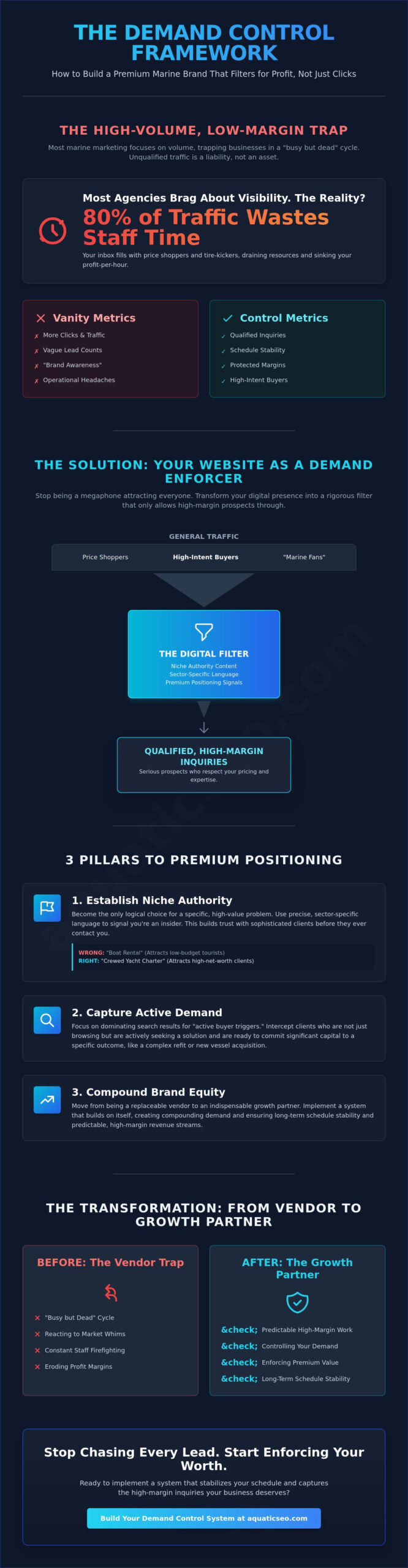
Many service yard owners find themselves trapped in a “busy but dead” cycle. You spend three weeks working 14 hour days to clear a backlog, only to face a silent phone and an empty shop for the next month. This happens because your marketing is focused on volume rather than control. Most agencies promise “more traffic” or “vague lead counts,” but they don’t understand that unqualified traffic is a liability. Learning how to build a premium marine brand online means moving past these vanity metrics. You need a system that prioritizes qualified inquiries over raw numbers to protect your time and your profit margins.
Revenue growth is a dangerous metric when it comes at the expense of your schedule. If you increase your sales by 25% but your staff spends half their day responding to tire-kickers, your actual profit per hour drops. This is why we developed the “Marine Demand Control System.” It’s the antidote to the waste created by traditional brand management strategies that focus on “awareness” instead of operational stability. When you understand how to build a premium marine brand online, you stop chasing every lead and start enforcing your worth.
The High-Volume, Low-Margin Trap
Every time a boat dealer handles an unqualified inquiry, it costs the business money. Sales staff spend hours explaining basic specs to people who aren’t in the market for a premium vessel. This “high-volume” approach creates the illusion of success while eroding your bottom line. A premium brand must act as a filter. It should discourage low-budget prospects before they ever reach your inbox, ensuring your team only talks to high-intent buyers who respect your pricing.
Why Generic Digital Strategies Fail Marine Contractors
Standard SEO agencies fail because they don’t know the difference between a marina and a service yard. They optimize for broad terms that attract “marine lovers” rather than active buyers needing specific repairs or refits. These agencies often use filler phrases like “in today’s digital landscape” to hide their lack of industry knowledge. We are not a traditional marketing agency. We act as a growth partner for boat dealers and contractors who need predictable demand, not just more clicks.
Defining Your Niche Authority: The Foundation of Premium Positioning
Premium Marine Positioning is the strategic enforcement of expert authority that signals to high-net-worth clients that your business is the only logical choice for high-stakes maritime requirements. It is not about being “well-known” or having a large social media following. It’s about being the recognized specialist for a specific, high-value problem. When you are figuring out how to build a premium marine brand online, you must first accept that your primary audience is not “marine lovers” or casual fans. You are speaking to high-intent buyers. These are individuals ready to commit significant capital to a specific outcome, whether it’s a complex refit or a new vessel acquisition.
Credibility in this industry is fragile. If you call a crewed vessel a “boat rental,” you have already lost the high-end charter client. A Yacht Charter implies a level of service, crew expertise, and vessel quality that “rental” simply cannot convey. Similarly, a Boat Dealer must position themselves around sales cycles and inventory acquisition, which is fundamentally different from the recurring dockage and fueling focus of a marina. According to 2026 market data, pre-owned boats account for approximately 80% of total unit sales. If you are a Boat Dealer, your brand must focus on the transparency of the survey process and inventory reliability to protect your margins. Mixing these terms destroys your authority because it attracts the wrong type of inquiry.
Sector-Specific Language as a Trust Signal
Using the wrong terminology is the fastest way to signal that you are an outsider. Sophisticated clients look for “industry-native” cues before they even consider picking up the phone. When we implement digital marketing for marine contractors, we ensure every technical term is used with surgical precision. This alignment with niche market strategies ensures your brand resonates with those who actually own and operate the vessels you service. It turns your website content into a secret handshake that only qualified prospects understand.
Identifying Your Most Profitable Job Mix
You must audit your current operations to identify which jobs provide the best margins versus which ones cause the most headaches. A premium brand is built around your “best fit” services, not a “we do everything” approach. If your service yard excels at complex electrical refits but struggles with basic bottom painting, your online presence should reflect that specialty. This is how to build a premium marine brand online that enforces schedule stability. By focusing your visibility on high-margin work, you naturally filter out the low-value noise that clogs your shop. If you want to see how this works in practice, you can explore our Demand Filtering Systems to see how we protect our partners’ time.
Building a Digital Filter: Your Website as a Demand Enforcer
Your website is not a digital brochure; it is a gatekeeper. Most marine agencies focus on “pretty pictures” of sun-drenched hulls and clear water, but visual appeal alone is useless if it doesn’t capture high-intent buyers. While the American Marketing Association’s definition of branding focuses on names and symbols, a premium marine brand is defined by its ability to enforce demand control. To understand how to build a premium marine brand online, you must view your site as a technical business tool designed to filter out low-margin noise before it ever reaches your desk.
A high-performance marine website requires five essential elements to drive real revenue. First, it must have sub-two-second load times to meet the expectations of high-net-worth users. Second, it needs specific service pages that define exactly what you do and, more importantly, what you don’t do. Third, you must implement auditable conversion tracking that follows a prospect from their first click to a signed work order. Fourth, it needs authority signals like technical certifications or specific project case studies. Finally, it must feature clear, intent-based entry points that separate a casual browser from a qualified inquiry.
Auditable tracking is the only way to move past the “vanity traffic” reports that generic agencies use to hide poor results. If your agency brags about a 50% increase in traffic but your service yard schedule is still inconsistent, those clicks are worthless. You need to know exactly which search terms lead to high-margin refits. This level of transparency allows you to “filter” out prospects who cannot afford your expertise by framing your pricing and process upfront. This is how to build a premium marine brand online that protects your staff’s time and your company’s reputation.
User Experience for the High-Value Buyer
High-value buyers are impatient. Your site must load faster than a generic “Atelier” template or a bloated WordPress theme. Every second of delay increases the bounce rate for users who value their time above all else. Your calls to action must be declarative and calibrated to specific buyer intent. For example, a button that says “Get a Quote” is too vague for a premium brand. Instead, use specific triggers like having yacht dealers book a fit call to ensure the prospect is ready for a professional consultation.
SEO That Captures Demand, Not Just Clicks
Targeting broad keywords like “boat parts” is a waste of resources for a premium service yard. These terms attract DIYers and price shoppers who will never pay your shop rate. You must focus on long-tail, high-intent keywords that signal a specific, urgent need. Terms like “stabilizer system refit” or “marine electrical system audit” attract the qualified inquiry you actually want. For a deeper look at this strategy, our Marine Marketing Guide breaks down how to attract high-value clients without the typical agency fluff.
Capturing High-Intent Buyers: The Active Demand Strategy
Most marketing agencies focus on top-of-funnel awareness, which is a polite way of saying they waste your budget on people who aren’t ready to buy. Learning how to build a premium marine brand online requires a shift from passive awareness to active capture. You must identify the specific triggers that force a high-net-worth individual to seek a professional. These triggers are rarely generic; they are specific, urgent, and high-value events like a failed survey or a critical system alarm during a crossing.
Our “Marine Demand Control System” works by following a four-step framework to dominate these triggers. First, we identify the exact search terms used by active buyers in your niche. Second, we deploy technical content that positions you as the only logical solution. Third, we implement a “Demand Filtering” mechanism—such as qualifying questions on your contact forms—to ensure your sales team doesn’t waste hours on the phone with people looking for a “boat rental” when you offer a crewed Yacht Charter. Finally, we use auditable data to refine your job flow, focusing your budget only on the services that yield the highest profit margins.
The 2026 market has transitioned into a buyer’s market, with interest rates from lenders like Navy Federal starting at 6.95% APR. This means buyers are more selective and price-conscious than they were two years ago. To maintain your margins, you can’t afford to be a generalist. You must capture demand at the moment of peak necessity to avoid competing on price alone. This is how to build a premium marine brand online that remains stable even when broader economic conditions fluctuate.
Dominating Local Search for Marine Mechanics
For marine mechanics and electricians, local authority is the difference between a consistent schedule and a dead week. You don’t want to be seen as a “roadside” repairman. You want to be the premium specialist that captains call when a system failure threatens a season. We focus on securing high-margin emergency repair work by positioning your brand as the technical authority in your specific port or service yard. This strategy captures demand at the moment of peak necessity, ensuring you aren’t competing on price with uncertified freelancers.
Active Buyer Capture for Yacht Charters
Effective yacht charter marketing must distinguish between a casual boat rental and a professional crewed experience. High-net-worth individuals aren’t looking for the cheapest hull; they are looking for a specific vessel type and a level of service that justifies the premium. We filter for clients who value this expertise over a discounted rate. By capturing demand from individuals searching for specific yacht classes or crewed itineraries, we ensure your calendar is filled with high-margin bookings rather than low-value inquiries from “fans” who will never book.
If you are ready to stop chasing clicks and start capturing demand, you should book a call to discuss your demand control strategy.
Compounding Brand Equity: Moving from Vendor to Growth Partner
Many marine business owners treat marketing like a utility bill; they pay it every month but never see it build long-term value. If you are starting from zero every month to find new jobs, you don’t have a brand; you have a lead-buying habit. True stability comes from “Demand Compounding.” This is the process where your digital presence becomes more efficient at filtering and capturing high-intent buyers as it matures. Understanding how to build a premium marine brand online means creating an asset that lowers your cost of customer acquisition over time. You must stop looking for a vendor and start demanding a growth partner who understands the operational reality of a service yard or boat dealership.
Demand compounding is the result of building an authoritative footprint that high-value clients can’t ignore. As your site accumulates auditable data and technical case studies, your “Marine Demand Control System” becomes more precise. You stop paying for the same clicks twice because your brand starts to own the search results for critical industry triggers. This shift transforms your marketing from a recurring expense into a compounding business asset that protects your margins even during seasonal dips.
The ROI of Demand Control
Controlling your demand leads to better margins because it eliminates the desperation of a slow week. A growth partner focuses on your bottom line and shop capacity, not just your Google rankings. While a traditional agency might celebrate “more traffic,” we focus on the stability of your operations. The long-term value of a brand that filters while it finds is that it protects your staff from burnout. It ensures every hour billed is at your premium rate because you’ve already filtered out the price shoppers.
Next Steps: Auditing Your Current Demand
You can start today by auditing your current reports for “vanity traffic.” If you see high visitor counts but your inquiry-to-job ratio is below 10%, you are likely attracting the wrong audience. You must be willing to tell a potential client if they aren’t a “best fit” for your service yard. Exclusivity is a core pillar of premium positioning. If you are ready to see if our system fits your operations, you should Book a Fit Call to see if your business is a candidate for our framework.
- Branding: Establishes expert authority using sector-specific language to signal “industry-native” expertise.
- Filtering: Uses your website as a demand enforcer to remove low-margin noise before it reaches your sales team.
- Control: Deploys the Marine Demand Control System to dominate active buyer triggers and stabilize your schedule.
Together, these elements move your business from inconsistent job flow to predictable, high-margin stability. This is how to build a premium marine brand online that lasts.
Take Command of Your Marine Demand
A premium brand is an operational asset, not just a visual identity. You now understand that how to build a premium marine brand online requires moving past vanity metrics to enforce a rigorous digital filter. By focusing on qualified inquiries and auditable tracking, you protect your margins and eliminate the “busy but dead” cycle. This framework ensures your service yard or dealership remains stable regardless of broader market fluctuations.
We act as a specialized growth partner for marine businesses generating $300,000 to $5,000,000 in annual revenue. Our proprietary Marine Demand Control System replaces vague agency promises with margin-focused results you can see in your shop schedule. You don’t need more clicks; you need better control over the work that enters your inbox. We prioritize your bottom line over generic traffic counts every time.
Stop wasting staff time on tire-kickers and take the first step toward predictable growth. Request a No-BS Marine Marketing Analysis to see how our system fits your operations. Your business is ready for a presence that filters while it finds.
Frequently Asked Questions
How is a premium marine brand different from a standard marketing setup?
A premium brand setup focuses on demand control and filtering, while standard marketing prioritizes raw volume and visibility. Standard setups often clutter your inbox with unqualified leads that drain staff resources. A premium approach ensures that your online presence acts as a rigorous gatekeeper. It prioritizes margin protection over vanity traffic counts; this allows you to dominate specific high-value search triggers rather than chasing every click.
What is the difference between a Yacht Charter and a boat rental for branding?
A Yacht Charter refers to a professional, crewed experience, whereas a boat rental typically involves a bareboat or self-captained transaction. For branding, this distinction is mandatory to attract high-net-worth clients who value service and expertise. If your marketing uses these terms interchangeably, you signal a lack of industry knowledge. This destroys your authority and attracts low-budget inquiries that will never convert into high-margin bookings.
Can I build a premium brand if I am a small Service Yard?
Yes, you can build a premium brand as a small Service Yard by dominating a specific technical niche. Expert authority is not determined by the size of your facility, but by the precision of your demand control. By focusing your visibility on high-complexity refits or specific engine systems, you position your yard as a specialist. This strategy allows you to maintain high margins and schedule stability even with a smaller team.
How much traffic do I need to see a return on my branding?
You don’t need high traffic volume to see a return if your system captures the right intent. A few dozen visitors searching for “stabilizer system refit” are worth more than 10,000 people looking for “boat pictures.” When you understand how to build a premium marine brand online, you stop measuring success by hits and start measuring it by the dollar value of your qualified inquiries. Quality traffic always outpaces quantity.
What is a “Qualified Inquiry” in the marine industry?
A Qualified Inquiry is a prospect who has the budget, the specific need, and the intent to book your services immediately. Unlike a generic lead, these individuals have already been filtered by your website’s technical content and qualifying questions. They respect your shop rate and understand your process before they pick up the phone. This reduces the time your staff spends on administrative waste and increases your overall operational efficiency.
How does the Marine Demand Control System help with profit margins?
The Marine Demand Control System protects profit margins by ensuring your shop is only filled with high-value work. By dominating search results for Active Buyer triggers, you eliminate the need to compete on price during slow seasons. The system acts as a demand enforcer, allowing you to reject low-margin jobs that clog your schedule. This creates a predictable job flow that supports higher pricing and better business stability.
Why do you reject generic marketing jargon?
We reject jargon because phrases like “holistic approach” or “cutting-edge” are used to hide a lack of industry results. Marine business owners are skeptical of agencies that don’t understand the difference between a marina and a boatyard. Our focus is on tangible business outcomes like margin growth and schedule stability. Using industry-native terminology is how to build a premium marine brand online that earns immediate trust from sophisticated vessel owners.
How long does it take to see results from a Demand Filtering system?
You will typically see a shift in inquiry quality within 30 to 60 days of implementing a Demand Filtering system. While SEO compounding takes longer, the immediate addition of qualifying mechanisms on your site starts removing low-margin noise instantly. By the 90-day mark, your staff should report a measurable decrease in time spent on unqualified prospects. This allows your team to focus entirely on closing high-value contracts and managing active refits.