Your marketing agency is likely celebrating a 20% increase in website traffic while your sales team spends 40 hours a week filtering out “tire-kickers” who can’t afford a $10,000 monthly retainer, let alone a superyacht. In 2026, visibility is a vanity metric that kills profit margins. If your current approach relies on generic brand awareness rather than a rigid system to capture high-intent demand, you’re simply subsidizing an agency’s lack of industry knowledge. You don’t need more clicks. You need a Marine Demand Control System that enforces quality before a prospect ever reaches your inbox.
You understand that the luxury market has shifted, with the average owner age now firmly in the 35 to 45 demographic and new EU ETS regulations adding layers of operational friction. You’re likely exhausted from explaining the nuances of a crewed yacht charter to marketers who treat your business like a local car rental. This article will teach you how to implement marketing strategies for luxury yacht brands that move past vanity metrics to capture a predictable stream of qualified inquiries. We’ll examine how to leverage 2026 regulatory shifts as a competitive advantage and build a filtering system that protects your sales team’s time.
Key Takeaways
- Stop chasing vanity metrics and identify why generic agencies fail by attracting low-margin “lookie-loos” who waste your sales team’s time.
- Implement the Marine Demand Control System to move past inconsistent job flow and capture high-intent buyers who are actively searching for your services.
- Learn how precise industry terminology filters your inquiries, ensuring you attract “Yacht Charter” clients rather than unqualified boat rental seekers.
- Discover how auditable marketing strategies for luxury yacht brands create a predictable stream of inquiries that protect your profit margins and schedule stability.
- Shift from the traditional agency model to a growth partner relationship that focuses on tangible business operations rather than just clicks and rankings.
The High-Cost Failure of Generic Marketing for Luxury Yacht Brands
Most yacht brands with revenues between $300K and $5M operate in a state of perpetual anxiety. You experience busy weeks where the sales team is underwater, followed immediately by dead weeks where the phones go silent. This isn’t a market problem; it’s a failure of your marketing system. Generic agencies sell you on brand visibility and aesthetic appeal, but these are empty promises if they don’t stabilize your operations. Within the luxury goods market, yachts represent the highest tier of complexity and intent.
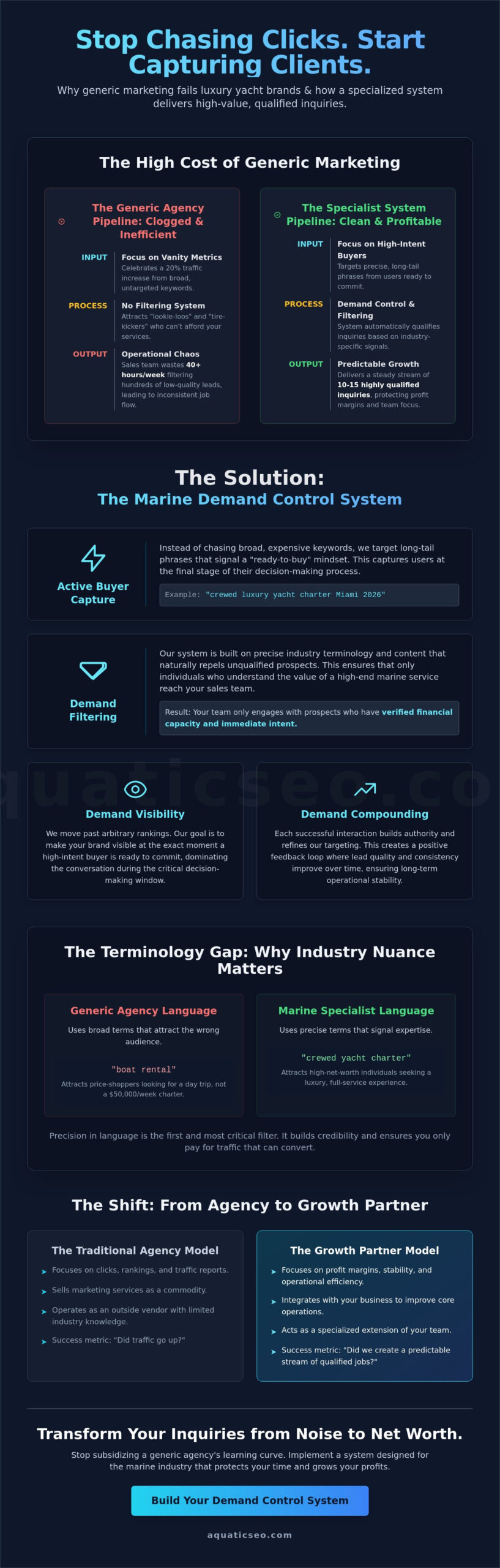
When your marketing strategies for luxury yacht brands focus on broad reach, you invite lookie-loos who want to take photos of a boat they can’t afford. This wastes your time, erodes your profit margins, and prevents you from focusing on the high-intent buyers who actually keep your crew paid. You don’t need a prettier website; you need a filter that protects your sales team from low-value noise. An industry-native approach ensures your spend is an investment in stability rather than a donation to a generalist agency’s learning curve.
Why Clicks and Rankings Are Vanity Metrics
If your agency sends you a report full of upward trending click graphs while your bank account stays stagnant, you’re being sold vanity. High traffic is a liability if it isn’t filtered. A small sales team can’t handle 500 low-quality leads; they need 10 qualified inquiries. Clogging your pipeline with people looking for cheap boat rentals when you offer a $50,000 per week crewed charter is an operational failure. A Qualified Inquiry is a prospect with the verified financial capacity and immediate intent to book a specific crewed vessel or purchase a high-value hull.
The Marine Industry Nuance Generic Agencies Miss
Generic agencies often treat Digital Marketing for Yacht Charters like they’re selling sneakers or software. They don’t understand that a yacht charter is a crewed service, not a bareboat rental. They confuse a service yard with a marina. This lack of precision destroys your credibility with high-net-worth individuals who expect expertise. When an agency uses generic SEO tactics, they rank you for keywords that attract the wrong demographic. You end up paying for traffic that has zero chance of converting into a high-margin contract. You need a partner that knows the difference between a hull survey and a dockage agreement.
Implementing the Marine Demand Control System for Luxury Yachts
Stop reacting to the market and start enforcing it. The Marine Demand Control System isn’t a collection of separate marketing tactics; it’s a methodical framework designed to provide operational stability. This system rests on four pillars: Active Buyer Capture, Demand Filtering, Demand Visibility, and Demand Compounding. By moving past the “Agency” mindset of selling services, you adopt the Growth Partner model that prioritizes your profit margins over simple traffic counts.
Effective brand management for yacht builders and charter fleets requires more than just high-resolution photography. It requires a systematic approach to exclusivity. While traditional SEO focuses on arbitrary rankings, our system focuses on Demand Visibility. This means your brand appears specifically when a high-intent buyer is ready to commit, ensuring you dominate the conversation during the critical decision-making window. When you deploy marketing strategies for luxury yacht brands through our system, you gain the ability to dictate your schedule rather than letting an unpredictable market dictate it for you.
Capturing High-Intent Searchers
Capture begins by ignoring broad, expensive keywords that attract the general public. Instead, we target long-tail phrases that signal a “ready-to-buy” mindset, such as “crewed luxury yacht charter Miami 2026” or “70 foot Sunseeker for sale Fort Lauderdale.” These searchers aren’t browsing; they’re looking for an immediate solution. High-intent assets like our Luxury Yacht Charter Guide act as a magnet for these individuals, providing value while positioning your brand as the industry-native authority. Dominating local hubs like Fort Lauderdale or Miami is essential, as these geographic anchors serve as the primary entry points for the global yachting elite.
Controlling Your Revenue Mix
A successful business isn’t just about more work; it’s about the right work. Our system uses digital signals to prioritize high-margin yacht maintenance and sales inquiries over low-margin, time-consuming repairs. This level of demand control ensures your crew has a consistent, predictable schedule, which reduces turnover and maintains service standards. If you want to move from reactive busy-ness to proactive control, you can schedule a fit call to see if your operation matches our system. By implementing these marketing strategies for luxury yacht brands, you transition from a vendor to a dominant market force that can choose which jobs to accept and which to filter out.
Filtering Demand: Identifying Qualified Inquiries in a Crowded Market
If your inbox is full but your schedule is empty, you don’t have a lead problem; you have a filtering problem. Most marketing strategies for luxury yacht brands fail because they cast a net too wide, capturing “boat rental” seekers instead of “Yacht Charter” clients. There is a strict operational difference between a family looking for a $500 pontoon rental and a high-net-worth individual seeking a $50,000 crewed voyage. By using Demand Filtering Systems, you enforce quality standards that ensure your sales team only speaks with prospects who have the intent and capital to close.
Precision in Yacht Charter Marketing acts as a natural barrier to unqualified noise. You must target crewed vessels specifically to signal exclusivity and professional service. This technical filtering happens before the first phone call, preserving your profit margins and preventing your team from chasing low-value inquiries that never convert. You are here to dominate a specific tier of the market, and that requires the discipline to turn away the wrong traffic through automated qualification.
Terminology as a Filter
Calling a yacht a “boat” in your copy is an expensive mistake. It signals a lack of industry native expertise and attracts a demographic that doesn’t fit your business model. You must also distinguish between a Boat Dealer and a Marina in your SEO strategy to avoid attracting people looking for fuel when you are trying to sell a multi-million dollar hull. Specific industry language builds immediate trust with high-net-worth individuals who speak the same lexicon. When you use the right terms, you filter out the 80% of searchers who are just looking for a day on the water without a crew.
Automated Lead Qualification
High-intent content educates your buyer before they ever reach out to you. By providing detailed insights into operational costs, crew requirements, and specific vessel capabilities, you pre-qualify the lead. Our Marine Demand Control System enforces these quality standards by tracking behavior and intent signals. This methodical approach reduces sales friction by only passing through vetted prospects. You get control over your time and your job mix, ensuring that every inquiry in your CRM is a legitimate opportunity for growth.
Operational Stability: Turning Search Intent into Consistent Job Flow
Stop letting the calendar dictate your revenue. Most yacht brands accept the “Busy-Dead Cycle” as an inevitable part of the marine industry, but it’s actually a symptom of a weak demand system. You need Demand Compounding to ensure your brand stays visible year-round, regardless of seasonal shifts. By implementing methodical SEO for the Marine Industry, you build a digital asset that works while your crew is at sea. This approach turns search intent into a predictable schedule that protects your profit margins during the transition from peak season to the off-months.
You might think you’re too busy to market because your current backlog is full. This is a dangerous trap. A full schedule without active marketing strategies for luxury yacht brands is just a countdown to your next dead week. If you wait until the phones stop ringing to start your next campaign, you’ve already lost three months of momentum. Stability comes from having more qualified inquiries than you can handle, giving you the power to choose high-margin jobs and fire low-value clients who drain your resources.
Winning the Local Market
Regional dominance is the foundation of operational stability. For Boat Dealers, winning the local market means appearing at the top of search results in critical hubs like Miami, Fort Lauderdale, or Palm Beach. We use “SEO Rich Text” to establish your authority in these specific yachting corridors. This isn’t about generic keywords; it’s about technical precision that proves to Google and your prospects that you are the industry-native expert in your territory. Local dominance ensures that when a buyer in your backyard is ready to move, your brand is the only logical choice.
Eliminating the Dead Weeks
You must build a “backlog of demand” that exists independently of your current work orders. Consistent marketing is mandatory even when your schedule is full because it builds the pressure required to maintain high prices. Stopping your marketing efforts during busy periods is a strategic error that guarantees a revenue cliff in ninety days. A robust system keeps your pipeline primed with vetted prospects, allowing you to maintain crew stability and operational focus year-round. If you’re ready to stop the feast-and-famine cycle, book a call to stabilize your job flow and take control of your revenue mix.
Choosing a Growth Partner Over a Traditional Marketing Agency
You don’t need another vendor; you need a partner who understands that your profit margins are more important than your Instagram likes. Most agencies are built to sell you monthly services regardless of whether they generate a return. A growth partner is built to sell you control over your business operations. When evaluating marketing strategies for luxury yacht brands, the distinction between these two models determines if you’ll finally break the cycle of dead weeks or remain stuck in a loop of wasted spend.
We reject vanity metrics like clicks and rankings because they don’t pay your crew. Our focus is on auditable business results: qualified inquiries that lead to high-margin contracts. We provide a direct, auditable analysis of your current performance. We identify exactly where your budget is being drained by generic tactics that ignore the nuances of the luxury yacht sector. This isn’t about giving you a list of things to do; it’s about identifying the 80% of your current marketing that is actively wasting your money. We prioritize the 20% of actions that capture high-intent buyers and stabilize your job mix.
Questions to Ask Your Current Agency
A specialist operator should answer these without hesitation. If they fumble, they don’t know your industry. Ask them: Do you know the difference between a service yard and a boatyard? Can you explain how your system directly improves my profit margins by filtering out low-value noise? Are you providing more traffic, or are you delivering more qualified inquiries? If they talk about “engagement” instead of “operations,” it’s time to move on. You need a partner who can distinguish between a hull survey and a dockage agreement without a manual.
Your Next Steps for Demand Control
The Marine Demand Control System isn’t for everyone. We are exclusive because our system requires a specific level of operational maturity and a commitment to quality. We only work with businesses where we can dominate the market and enforce high standards. Instead of requesting a generic proposal that will sit in your inbox, you should Book a Fit Call to see if your brand is ready for a systemized approach. This is the final step in transitioning from a reactive marketing strategy to a demand-driven model that captures high-intent buyers in 2026.
We’ll tell you straight away if we aren’t a good match, saving you the frustration of another failed agency relationship. You deserve a partner who understands that a Yacht Charter is not a boat rental and that your time is your most valuable asset. Capturing high-intent demand in 2026 requires more than visibility. It requires a rigid system that filters for quality and enforces operational stability across every month of the year.
Take Control of Your Marine Business Growth
You now have the framework to move past the frustration of inconsistent job flow and low-margin inquiries. Implementing methodical marketing strategies for luxury yacht brands isn’t about chasing the latest social media trend; it’s about enforcing a Marine Demand Control System that protects your time. You’ve learned that precision in terminology filters out the lookie-loos, while local search dominance ensures you capture high-intent buyers in critical hubs like Miami or Fort Lauderdale. This methodical approach ensures your revenue mix stays profitable through 2026 and beyond.
We are industry-native experts who understand that a 100-foot crewed vessel has nothing in common with a weekend boat rental. Our approach is built specifically for marine businesses with revenues between $300K and $5M that are ready to stop the “Busy-Dead Cycle.” It’s time to stop paying for vanity traffic and start investing in auditable business results that stabilize your schedule and your bank account. You don’t need a marketing agency; you need a growth partner who understands your operations.
Request a No-BS Marine Marketing Analysis and Book Your Fit Call to see if your brand is a match for our system. We’ll provide a direct assessment of your current pipeline and show you where your budget is being wasted. Your path to predictable, high-value demand starts with a single decision to prioritize quality over volume. It’s time to take command of your market.
Frequently Asked Questions
What is the difference between a yacht charter and a boat rental for marketing purposes?
A Yacht Charter refers specifically to a crewed vessel providing a professional service, while a boat rental typically involves bareboat or day-use vessels. Marketing for charters requires targeting high-net-worth individuals who prioritize service and exclusivity. Using the term “boat rental” in your copy is a strategic error that attracts low-margin inquiries and wastes your sales team’s time.
How long does it take to see results from a Marine Demand Control System?
You will typically see a shift in inquiry quality within 90 days of implementing the system. This window allows the filtering mechanisms to clear out existing low-intent traffic while the capture phase begins targeting high-intent searchers. Operational stability and the full benefits of demand compounding usually manifest between six and twelve months of consistent execution.
Why do most generic marketing strategies fail for luxury yacht brands?
Generic strategies fail because they prioritize vanity metrics like clicks and broad rankings over tangible business outcomes. Most generalist agencies don’t know the difference between a service yard and a marina, leading to wasted spend on keywords that attract lookie-loos. These marketing strategies for luxury yacht brands often generate high traffic volumes that have zero chance of converting into high-margin contracts.
Can SEO really reach high-net-worth individuals (HNWIs)?
High-net-worth individuals use search engines to find specific solutions for their maritime needs, such as “crewed yacht charter Miami” or “70 foot yacht for sale.” SEO captures these buyers at the exact moment of intent. By dominating long-tail keywords that signal a ready-to-buy mindset, you position your brand as the authoritative choice before a prospect ever reaches your sales team.
What are the most important keywords for luxury yacht sellers in 2026?
In 2026, the most critical keywords focus on technical specificity and new regulations, such as “EU ETS compliant yachts” or “hybrid propulsion superyacht sales.” Buyers are searching for vessels that meet the methane and nitrous oxide emissions standards expanded on January 1, 2026. Keywords that combine specific model names with geographic hubs like Fort Lauderdale or Monaco remain the highest-converting assets in your portfolio.
How much should a yacht brand with $1M revenue spend on digital marketing?
Luxury brand retainers in 2026 typically range from $10,000 to $25,000 per month for specialized digital marketing expertise. For businesses scaling aggressively, PPC management fees are generally 10% to 20% of the monthly ad spend. These figures reflect the cost of hiring an industry-native partner who understands how to protect your profit margins and maintain a consistent job flow.
Is social media marketing effective for selling multi-million dollar yachts?
Social media acts as a demand visibility tool but rarely serves as the primary driver for multi-million dollar yacht sales. It’s effective for reinforcing brand authority and showcasing vessel aesthetics after a buyer has already discovered you via search. Relying on social media as your primary capture method usually results in high vanity metrics but a lack of qualified inquiries.
What is a qualified inquiry in the yachting industry?
A qualified inquiry is a prospect with verified financial capacity and immediate intent to book a crewed vessel or purchase a hull. It’s not just a “lead” or a person asking for a price list out of curiosity. Our marketing strategies for luxury yacht brands use strict demand filtering to ensure your sales team only spends time on prospects who have a high probability of closing.