
Most boatyard owners and yacht charter operators treat their digital marketing budget for marine business as a necessary evil or a line-item expense they hope will eventually return a result. If your spending isn’t directly tied to a predictable flow of qualified inquiries, you aren’t investing; you’re gambling. You’ve likely experienced the cycle of “feast or famine” where overwhelmed weeks are followed by dead schedules that force you to accept low-margin jobs just to keep your crew busy. This instability isn’t an industry requirement. It’s a symptom of a budget that lacks an operational system to filter out tire-kickers and capture high-value demand.
You already know that vague agency reports about clicks and impressions don’t reflect the actual health of your service yard or dealership. This article will show you how to stop guessing and start controlling your job flow with a budget strategy built specifically for marine industry margins. We’ll examine the precise allocation needed to transform your marketing from an unpredictable cost into a Marine Demand Control System that delivers stability and higher-margin jobs.
Key Takeaways
- Stop wasting money on vanity metrics like clicks and impressions that don’t translate to a stable schedule. Focus your budget on capturing high-intent demand from qualified inquiries instead of broad awareness.
- Learn how to structure your digital marketing budget for marine business around a three-pillar system: Capture, Filter, and Enforce. This approach ensures you only pay to reach prospects who respect your margins.
- Understand the operational cost of “cheap” marketing and why low-cost providers act as a liability to your service yard or dealership. High-quality demand filtering saves you time by removing tire-kickers before they reach your phone.
- Discover the step-by-step process to calculate your 2026 investment based on your specific target job mix and current conversion rates. Move from guessing to knowing exactly what’s required to hit your growth goals.
- Shift your perspective from being “found” online to dominating the specific inquiries that keep your crew busy with high-margin work year-round.
Why Your Previous Digital Marketing Budget Failed to Deliver Results
Most marine business owners view their digital marketing budget for marine business as an overhead cost rather than an operational lever. You’ve likely hired an agency that promised “more traffic” and “first-page rankings,” only to find your inbox filled with price-shoppers and tire-kickers. This happens because generic agencies optimize for volume, not value. They don’t understand that for a specialized boatyard or yacht dealer, ten qualified inquiries are worth more than a thousand clicks from people who can’t afford your slip fees. Traffic doesn’t pay the bills; qualified inquiries do.
When you focus on broad metrics, you fall into the trap of the busy-dead cycle. One week your crew is overwhelmed and rushing jobs; the next week the shop is silent and you’re burning cash on payroll. This inconsistency destroys your profitability. A real digital marketing budget for marine business should act as a valve, controlling the flow of high-margin work to ensure schedule stability. If your current spending doesn’t give you that control, you’re just paying for noise.
The High Cost of Unfiltered Demand
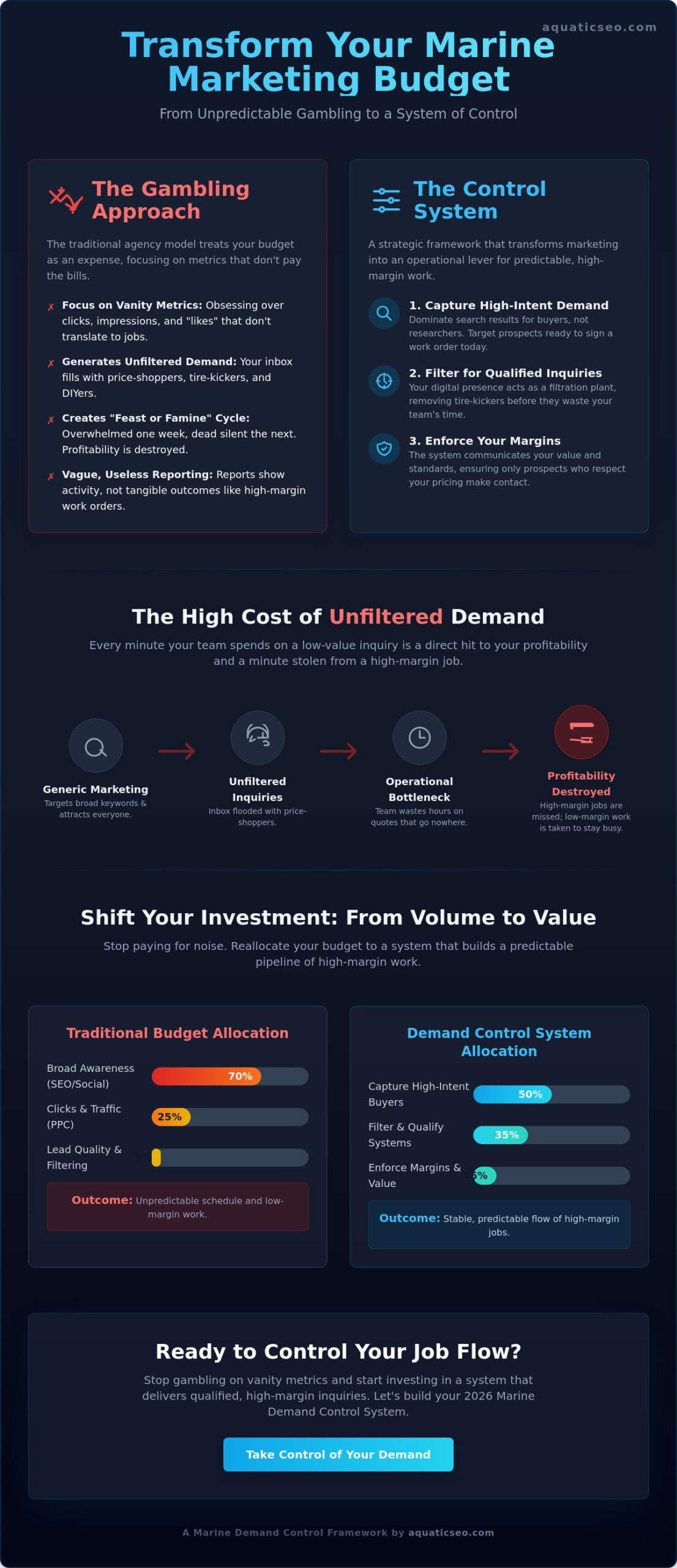
Every minute your team spends quoting a price-shopper is a minute stolen from a high-margin project. If your marketing doesn’t filter out low-value inquiries, it becomes an operational liability. Generic SEO often targets broad keywords that attract DIYers or bargain hunters who will never book your premium services. For service yards and boatyards, this unfiltered demand creates a bottleneck in the office without adding a dime to the bottom line. You need a system that enforces your standards before the phone even rings.
Rejecting the Traditional Agency Model
The traditional agency model is built on vanity. They provide reports filled with “likes” and “impressions” because those numbers are easy to inflate. General Digital marketing tactics often fail here because they lack the technical nuance required for high-ticket marine sales. A “post once a day” social media strategy won’t fix a dead schedule in February. You don’t need another vendor to manage your “online presence”; you need a growth partner who implements a system designed to dominate your specific market. Stop paying for activities and start investing in outcomes that protect your margins.
The Marine Demand Control Framework: Allocating Funds for Qualified Inquiries
The Marine Demand Control System isn’t a vague marketing theory. It’s an operational framework that treats your digital presence as a filtration plant. Instead of casting a wide net that catches everything from high-value yacht owners to “window shoppers” with no budget, this system focuses your digital marketing budget for marine business on three specific actions: Capture, Filter, and Enforce. This approach ensures your marketing spend isn’t an expense; it’s a controlled investment in your shop’s stability.
Traditional agencies spend your money on broad awareness. They want everyone to know your name. We want the right people to find your solution when they have an immediate, high-intent need. This shift in 2026 digital marketing budget allocation means you stop paying for vanity traffic and start paying for visibility where qualified prospects are actually searching. You’re not just buying ads; you’re buying a predictable flow of work that fits your specific operational capacity.
Capturing High-Intent Marine Buyers
Capturing demand requires understanding the difference between a researcher and a buyer. A yacht charter client searching for “best Caribbean islands” is a researcher. A client searching for “crewed yacht charter BVI March 2026” is a buyer. Your budget must prioritize the latter. For those in specialized trades, such as Digital Marketing for Marine Contractors, this means dominating search results for specific, high-margin services rather than general industry terms. You don’t need to be everywhere. You need to be in front of the person ready to sign a work order today. This precision allows you to capture demand without bloating your ad spend on irrelevant clicks.
Filtering for Quality Over Volume
This is where most marine businesses fail. They assume more inquiries equal more revenue. In reality, a flood of low-quality inquiries creates an operational bottleneck that ruins your margins. Your budget must include a filtering mechanism. This system uses targeted messaging and qualifying questions to disqualify “bad fits” before they ever talk to your team. By the time an inquiry reaches your desk, it should already be vetted for budget, scope, and timeline. This process protects your time and ensures your crew stays focused on profitable projects. If you’re ready to stop chasing tire-kickers, you can book a fit call to see how this system applies to your operations.
Investment Benchmarks: Comparing Lead Capture vs. Demand Filtering Costs
Setting a digital marketing budget for marine business requires more than picking a random number. Industry data regarding a Small Business Marketing Budget suggests that companies earning under $5 million typically reinvest 7% to 8% of their gross revenue into growth. In the marine sector, this investment must be split between capturing new demand and filtering out noise. If you spend your entire budget on capture without filtering, you’ll end up with a high volume of low-margin inquiries that drain your staff’s energy and kill your shop’s efficiency.
By 2026, the market has shifted toward “Digital Consensus.” This means prospects look for multiple points of authority before they trust a service yard or boat dealer with their vessel. You can’t just buy a few ads and expect high-margin jobs to fall into your lap. You must build a system that establishes your business as the obvious choice through technical authority and industry-specific proof. This is why knowing how to choose a marine digital marketing agency in 2026 is critical. A generalist firm won’t understand the difference between a crewed yacht charter and a simple boat rental; that lack of nuance leads to wasted spend on the wrong audience.
The Reality of Marine SEO Costs
Specialized SEO isn’t cheap because it requires industry-native knowledge. If your content is written by someone who doesn’t know the difference between a boatyard and a marina, your prospects will notice immediately. Cheap SEO providers are an operational liability. They use generic tactics that attract price-shoppers, clogging your sales funnel with inquiries that never convert into profitable jobs. You should budget for long-term visibility that builds equity in your brand rather than chasing short-term spikes in vanity traffic that doesn’t move the needle.
Allocating for Paid Media and Search
Paid media should act as a precision tool to fill specific gaps in your schedule. It’s about turning a dial to maintain stability. To ensure this spend isn’t wasted, you need strict “smarketing” alignment where your sales process is built to handle high-intent inquiries immediately. We recommend testing for incrementality to ensure every dollar spent on your digital marketing budget for marine business is driving a new job that wouldn’t have found you otherwise. Focus your paid spend on these three areas:
- High-Intent Search: Dominating the exact terms used by ready-to-buy prospects.
- Remarketing: Staying in front of qualified inquiries who have already interacted with your brand.
- Margin Protection: Prioritizing ad spend for your most profitable service lines to ensure a healthy return on investment.
Calculating Your 2026 Digital Marketing Budget for Marine Business Needs
Calculating your 2026 digital marketing budget for marine business isn’t about looking at last year’s tax returns and adding a random percentage. It is an engineering problem. You must work backward from your desired profit margins and operational capacity to find the right number. Follow these five steps to build a budget that actually produces a result:
- Step 1: Define your target job mix. Don’t just ask for “more work.” Identify the specific high-margin jobs you want to dominate, such as engine repowers or major refits, and prioritize spend there.
- Step 2: Audit your conversion rate. Track how many qualified inquiries it currently takes to secure one signed work order. If you don’t know this number, your budget is just a guess.
- Step 3: Determine the capacity gap. Calculate exactly how many more high-value jobs your crew can handle before quality slips. This gap defines your growth target.
- Step 4: Map the budget to goals. Assign a cost-per-acquisition to your growth target. This is your baseline digital marketing budget for marine business.
- Step 5: Factor in niche requirements. A Boat Dealer selling new inventory has a longer sales cycle and higher visual requirements than a surveyor, requiring a different allocation of funds.
Budgeting for Yacht Charters and Tour Operators
A successful Yacht Charter marketing strategy requires a heavy investment in visual authority. You aren’t just selling a boat ride; you’re selling an elite experience. Your budget must include high-end photography and video production to justify premium pricing and filter out price-shoppers. Focus your spend on seasonal demand capture and early booking incentives to ensure your calendar stays full months in advance.
Budgeting for Service Yards and Boatyards
For Service Yards/Boatyards, the priority is local search dominance. When a vessel owner has an immediate maintenance need, they search for the closest expert. Your budget should prioritize reputation management and local SEO to ensure you are the first name they see. Use digital tools to manage seasonal overflow by adjusting your demand capture when your shop reaches full capacity. This prevents the “busy-dead” cycle and keeps your margins healthy. If you’re ready to stop guessing and start controlling your job flow, schedule a strategy session to map out your specific 2026 numbers.
Controlling Your Job Mix with Aquatic SEO’s Specialized Systems
Traditional agencies want to sell you a recurring monthly package and a report filled with vanity metrics. We provide a system designed to give you operational control over your schedule. Your digital marketing budget for marine business shouldn’t be a black hole where money disappears in exchange for vague “brand awareness.” It should be a predictable input that results in a specific, high-margin job mix. We focus on auditable tracking so you can see exactly which inquiries turned into profitable work orders.
Moving from “getting found” to dominating the right inquiries requires a rejection of the vendor mindset. Vendors perform tasks; growth partners deliver outcomes. Our Marine Demand Control System identifies the invisible drains in your current spending and redirects those resources toward qualified inquiries that respect your margins. We provide the stability you need to stop accepting low-value jobs just to keep your crew on the clock. This is about building a business that works for you, rather than you working to feed an inefficient marketing machine.
Building Your Marine Demand Control System
We integrate SEO, paid search, and demand filtering into a single growth engine tailored to your specific niche. This isn’t a one-size-fits-all strategy. A boat dealer needs a different capture mechanism than a marine surveyor or a service yard. By aligning your digital marketing budget for marine business with your actual shop capacity, we ensure you never face the “busy-dead” cycle again. For a deeper look at how we structure these systems for technical trades, review our 2026 Demand Control Guide. We help you enforce your standards online so only the best prospects reach your desk.
Request Your No-BS Marine Marketing Analysis
A fit call with an Aquatic SEO specialist isn’t a high-pressure sales pitch. It is a technical audit of your current digital presence and operational goals. We look at your inquiry-to-job conversion rates and identify exactly where you are losing money to price-shoppers and tire-kickers. If we don’t think our system is the right fit for your current revenue level or business model, we will tell you directly. We only partner with marine businesses where we can provide a massive, auditable return on investment. Book your fit call today to stabilize your 2026 job flow.
Take Command of Your 2026 Operational Stability
Your digital marketing budget for marine business should be the most predictable part of your operation. By treating your marketing as a filtration system rather than a broad net, you eliminate the “busy-dead” cycle and protect your crew’s time. You’ve seen how generalist agencies fail by chasing vanity metrics; it’s time to shift your focus to qualified inquiries that actually fit your shop’s capacity and profit goals.
Aquatic SEO isn’t another vendor. Our founder comes from the trenches of the marine industry, which is why we built the proprietary Marine Demand Control System. We don’t care about clicks or impressions. We care about your margins and schedule stability. If you’re tired of vague reports and want a growth partner that understands why a service yard isn’t a marina, we’re ready to show you a better way.
Request your No-BS Marine Marketing Analysis and stop wasting your budget.
It’s time to stop guessing and start dominating your market with a system built for the real world of marine operations.
Frequently Asked Questions
How much should a marine business spend on digital marketing in 2026?
Most marine businesses with revenues between $300K and $5M should allocate 7% to 10% of their gross revenue to their digital marketing budget for marine business. This figure covers both demand capture and the filtering systems required to protect your margins. If you operate in a highly competitive region like South Florida, staying at the higher end of this range is necessary to maintain visibility against larger dealerships and service yards.
Is SEO better than Google Ads for a boat dealership or service yard?
Neither is inherently better; they serve different operational roles. Google Ads acts as a valve you can turn for immediate demand capture when your schedule has gaps. SEO builds a foundation of technical authority that lowers your cost per acquisition over time. A balanced budget uses paid search for short term stability and SEO for long term dominance in your specific local market.
What is the difference between a lead and a qualified inquiry in the marine industry?
A lead is just contact information from someone who might be a price-shopper. A qualified inquiry is a prospect who has been vetted through your system for vessel type, project scope, and budget. For a boatyard, a lead is someone asking for a generic quote; a qualified inquiry is a 50 foot yacht owner ready to book a bottom job and engine service next week.
Can I manage my own digital marketing budget as a small boatyard owner?
You can manage your own spend, but it often results in a high opportunity cost. Small boatyard owners usually lose more money in wasted ad spend and low margin jobs than they save by avoiding professional management. Your focus should remain on shop operations and crew management rather than trying to master technical search algorithms that change every few weeks.
How long does it take to see a return on a marine digital marketing budget?
Paid demand capture typically shows results within 30 to 60 days. Technical SEO and authority building are long term investments that usually take 6 to 12 months to reach full performance. A properly structured digital marketing budget for marine business includes a mix of short term wins and long term equity to ensure you aren’t waiting a year for your first high margin job.
What are the biggest mistakes marine contractors make with their marketing budgets?
The biggest mistake is treating marketing as an optional expense rather than an operational requirement. Many contractors spend heavily during dead weeks and stop during busy weeks, which kills their momentum and search rankings. They also fail to implement filtering, which forces their most expensive employees to waste hours quoting tire-kickers who will never book a profitable project.
Why do generic marketing agencies fail when working with yacht charter companies?
Generic agencies fail because they don’t understand the specific language and margins of the industry. They often optimize for boat rentals when you sell high ticket crewed yacht charters. This attracts the wrong audience and wastes your budget on clicks from people looking for a four hour pontoon rental rather than an elite luxury experience that requires a five figure deposit.
How does a Demand Filtering System actually save my business money?
A Demand Filtering System saves money by acting as a digital gatekeeper for your office. It automatically disqualifies prospects who don’t meet your minimum project size or vessel requirements before they ever reach your phone. By ensuring your team only speaks to ready to buy prospects, you reduce administrative overhead and keep your experts focused on billable hours rather than dead end quotes.