
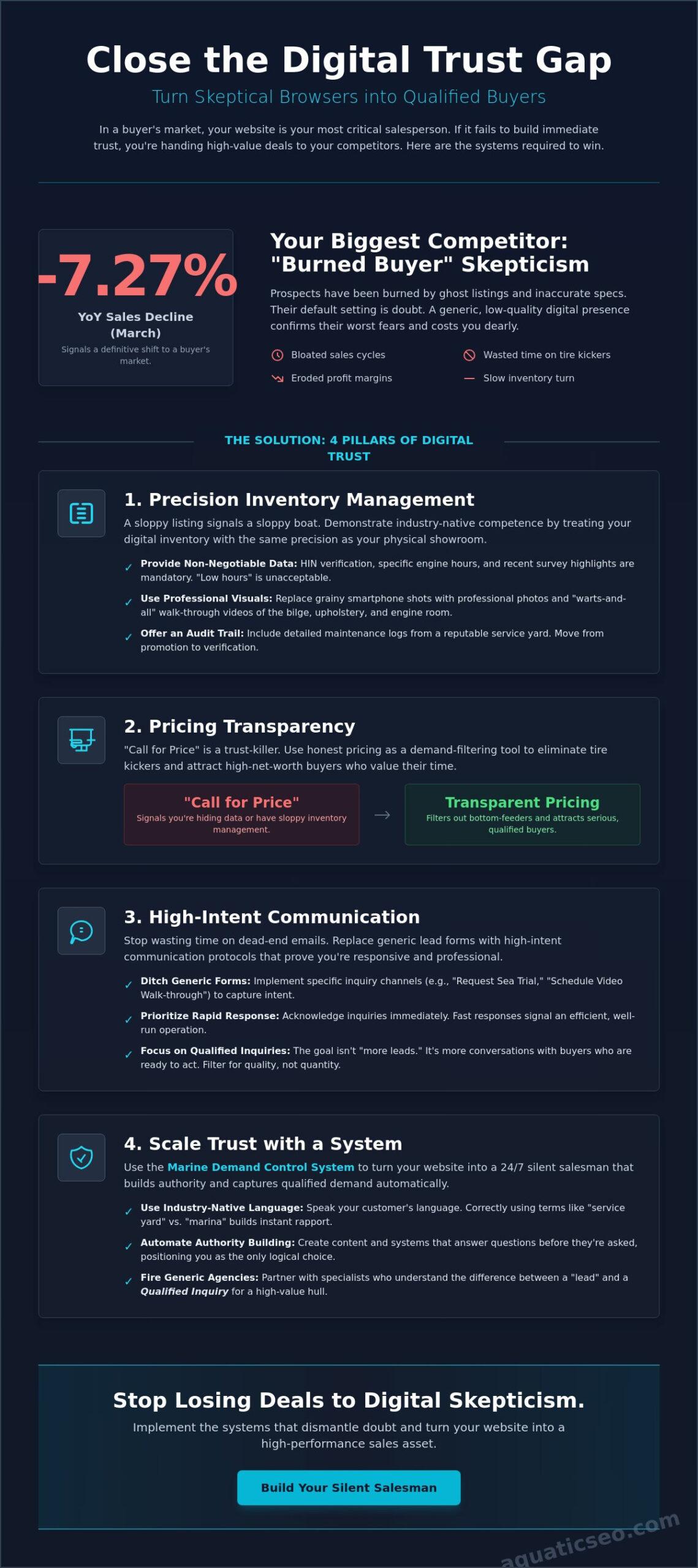
The marine industry saw a 7.27% year-over-year decline in sales this March, signaling a definitive shift into a buyer’s market where skepticism is the default setting. You aren’t just competing with the boat dealer down the creek; you’re fighting a digital wall of doubt that turns high-value prospects into ghosting tire kickers. When a buyer sees a listing online, they don’t see a premium vessel; they see a potential headache. If your digital presence feels like a generic template, you’re handing your margins to competitors who actually understand how to build trust with online boat buyers.
You already know that traditional sales tactics fail when the prospect doesn’t believe the person behind the screen. It’s frustrating to watch high-intent leads vanish because your website lacks the operational precision they expect. This guide provides the exact systems to dismantle that skepticism and turn browsers into qualified inquiries. We’ll break down the demand filtering methods and authority-building frameworks required to transform your website into a 24/7 silent salesman that works as hard as your best closer.
Key Takeaways
- Eliminate “burned buyer” skepticism by providing the precision data points, like HIN verification and engine hours, that high-value prospects demand.
- Adopt transparent pricing as a filtration system to stop wasting your sales team’s time on bottom-feeders and focus on serious buyers.
- Learn exactly how to build trust with online boat buyers by replacing dead-end lead forms with high-intent communication protocols and rapid response times.
- Scale your dealership’s authority using the Marine Demand Control System to turn your website into a silent salesman that captures qualified inquiries.
The Digital Trust Gap: How to Build Trust with Online Boat Buyers in 2026
The digital trust gap is the disconnect between the premium quality of your hulls and the low-quality nature of your online presentation. When a prospect sees a high-value cruiser represented by pixelated photos and vague descriptions, they don’t just leave; they lose faith in your entire operation. Closing this gap is the first step in how to build trust with online boat buyers before they ever set foot on your dock.
Most prospects suffer from “burned buyer” syndrome. They’ve spent months chasing ghost listings or vessels that didn’t match the advertised specs. This skepticism is a rational defense mechanism. High-stakes marine transactions require a level of Trust-based marketing that generic retail businesses can’t replicate. If your website feels like a generic template, you’re confirming their worst fears about the industry.
Skepticism carries a heavy operational cost. It manifests as bloated sales cycles and a floor full of tire kickers who require endless verification. When you fail to provide digital transparency, you force your sales team to act as manual data checkers instead of closers. This friction erodes your margins and slows down your inventory turn by forcing prospects to seek verification elsewhere.
The Evolution of the Hyper-Educated Marine Consumer
Modern buyers use third-party platforms to verify every claim you make. They aren’t looking for basic information; they’re looking for verification of what they’ve already found. Using “Call for Price” signals that you’re hiding data or that your inventory management is sloppy. In a market where transparency is the baseline, hiding the numbers is a trust-killer for high-net-worth individuals who value their time above all else.
Why Generic SEO Agencies Fail to Build Marine Trust
If your marketing partner doesn’t know the difference between a service yard and a marina, your prospects will smell the amateurism instantly. Generic agencies focus on “more leads” by targeting broad keywords that attract information seekers. You need a Qualified Inquiry, not a higher volume of dead-end emails. To capture serious demand, you must use industry-native terminology that establishes immediate rapport through specialized Digital Marketing for Boat and Yacht Dealers.
Precision Inventory Management: Demonstrating Industry-Native Competence
In the marine sector, precision isn’t just a preference; it’s the ultimate trust signal. If your listing is missing the hull identification number (HIN) or lists “low hours” instead of a specific digit, you’ve already lost the high-intent buyer. They assume a sloppy listing reflects a sloppy boat. Understanding how to build trust with online boat buyers starts with treating your digital inventory with the same oversight you apply to your physical showroom floor.
Every listing must include mandatory data points that prove your authority. This means engine hours, recent survey highlights, and HIN verification are non-negotiable requirements. Grainy smartphone shots don’t cut it when you’re selling a six-figure asset. Professional photography creates a sense of financial health and stability that grainy photos destroy. You must also maintain strict inventory-ad alignment. If a prospect clicks an ad for a specific center console, they expect to land on that exact hull, not a generic “similar model” landing page.
The Technical Spec Sheet as a Credibility Tool
Detailed specifications filter out the tire kickers while attracting serious prospects. Including maintenance logs and history from a reputable service yard provides the audit trail buyers crave. It’s about moving from promotion to verification. When you provide every detail up front, you’re signaling that you have nothing to hide. Detailed specs act as a silent surveyor for the online buyer.
Visual Proof: Beyond the Standard Gallery
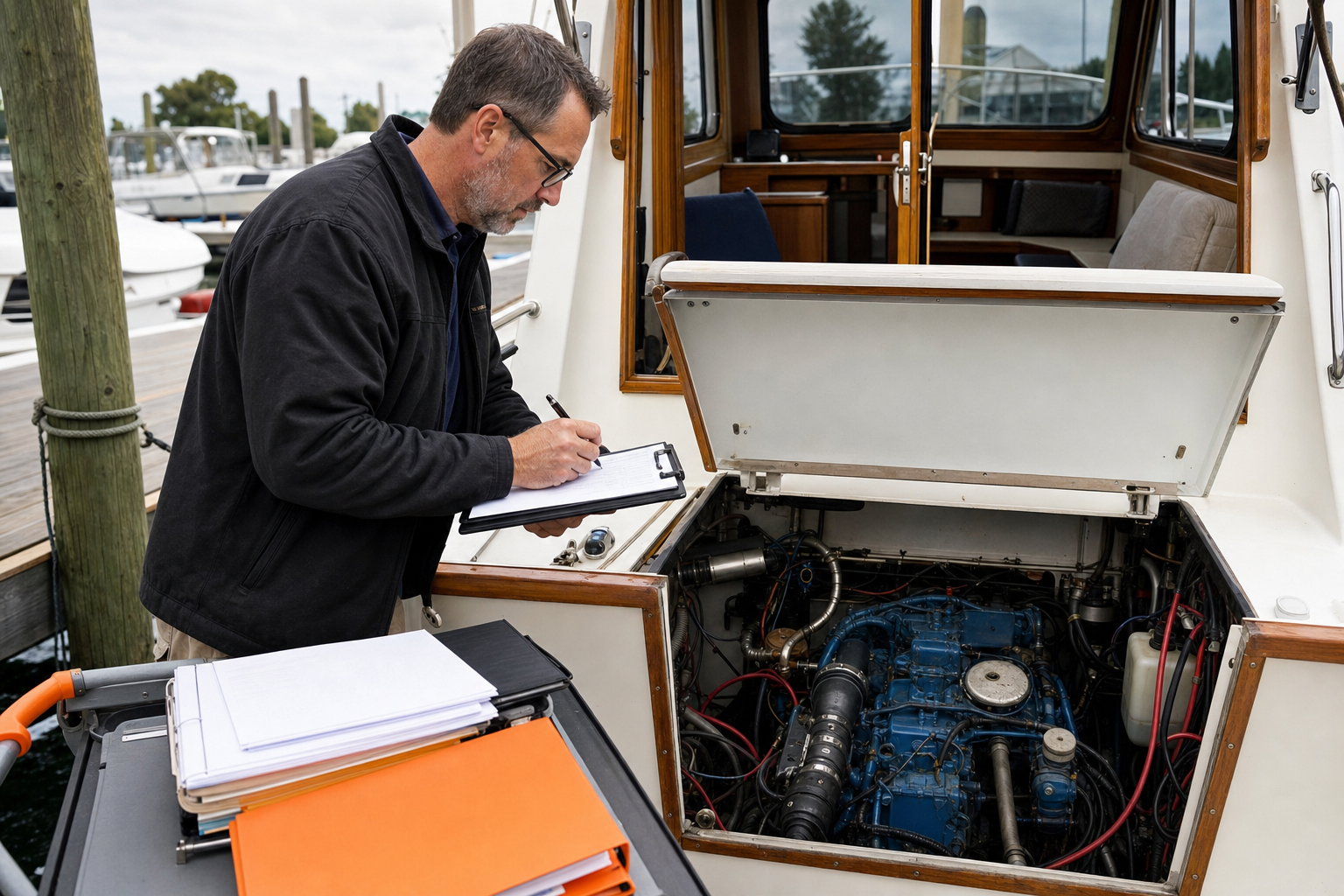
Standard galleries are easy to manipulate. To stand out, provide walk-through videos that address the “scary” parts of a used boat, such as the bilge condition, upholstery wear, and engine room cleanliness. This “warts-and-all” transparency builds more trust than a polished brochure ever could. Following FTC consumer advice on providing clear and accurate descriptions helps protect your reputation and ensures you’re meeting modern standards for digital commerce. For out-of-state buyers, 360-degree tours reduce anxiety and accelerate the decision-making process.
If your current inventory presentation is failing to convert, our Digital Marketing for Boat and Yacht Dealers can help you implement these precision systems to capture more qualified inquiries.
Pricing Transparency: Using Honesty as a Demand Filtering Tool
Hiding your prices doesn’t protect your margins. It signals a lack of confidence in your inventory. High-intent buyers aren’t looking to play games; they’re looking for a dealer who respects their time. When you refuse to list a price, you’re telling a prospect that your sales process is built on friction rather than facts. This is a fundamental mistake when learning how to build trust with online boat buyers.
Transparent pricing serves as a powerful filtration system. It immediately disqualifies “bottom-feeders” who are only hunting for the lowest possible number regardless of hull condition or service history. By being upfront, you save your sales team from chasing dead-end leads. This allows them to focus on high-value prospects who understand that a fair deal is more valuable than a “cheap” boat from an unverified source.
The “Call for Price” strategy is a trust-killer in 2026. It suggests that your pricing is arbitrary or that you’re waiting to see how much you can squeeze out of a buyer. Shift to a market-based pricing strategy instead. Explain the data behind your number. In the luxury marine sector, buyers prioritize organizational stability and expertise over a bargain basement price tag. They want to know they are paying a fair market rate for a vessel that has been properly vetted.
This level of detail should extend to any add-on technology or safety systems included in the sale; you can learn more about Hardware Sales and Recurring Subscription Fees to see how Sensar Marine provides a clear framework for presenting these ongoing costs to your customers.
Total Cost of Ownership Disclosure
You build massive authority by moving from a salesperson to a consultant. Provide estimated costs for docking, insurance, and routine maintenance right on the listing. This level of honesty proves you understand the operational reality of boat ownership. We show our clients exactly how to frame these high-stakes conversations through our Digital Marketing for Boat Dealers framework.
The Role of Trade-In Transparency
Trade-ins are often where the sales process breaks down. Use a clear framework for online trade-in valuations to manage expectations before the prospect ever hits the dock. This reduces friction during the final negotiation and proves your process is methodical. Implementing these Demand Filtering Systems ensures your team prioritizes buyers with clean trades and realistic expectations, stabilizing your revenue patterns and protecting your time.
High-Intent Communication: Moving Beyond Generic Lead Forms
A generic “Contact Us” form is where trust goes to die. It signals that your dealership is a faceless corporation rather than a specialized operator. If a buyer is ready to spend $200,000 on a center console, they won’t wait 48 hours for a “we’ll get back to you” email. This black hole of communication is the most overlooked aspect of how to build trust with online boat buyers.
Speed is your best trust signal in a buyer’s market. In 2026, responding within 5 minutes is non-negotiable for high-intent prospects. If you wait an hour, the buyer has already moved on to a competitor with a faster response protocol. High-value, automated responses that provide immediate technical data or clear next steps build credibility while your sales team prepares a personal touch.
Specialized intake forms are your first line of defense against waste. Instead of asking for a name and email, ask industry-native questions that prove you understand their needs. When you ask about their preferred docking location or their current trade-in hull, you’re signaling that you’re a partner in the process, not just a vendor looking for a credit card.
Filtering Inquiries for Quality Over Volume
You must distinguish between a generic lead and a qualified inquiry. One is a curiosity seeker; the other is a high-intent prospect with an operational plan. Use qualifying questions like “Do you have a slip?” to prioritize your sales flow and ensure your best closers aren’t wasting time on tire kickers. Implementing a rigorous Marine Demand Control System allows you to prioritize these high-value interactions over empty volume.
This filtration system protects your sales team’s sanity and your dealership’s financial health. It forces the buyer to self-identify as a serious prospect before they ever take up a minute of your time. This methodical approach ensures that every conversation your team has is grounded in a high probability of conversion.
The Power of Human-Centric Automation
Automation shouldn’t feel robotic or cold. Use video replies to personalize the first touchpoint and introduce the specific marine mechanic who performed the inspection or the salesperson who knows the vessel’s service history. This human connection dismantles the digital wall of doubt and creates immediate rapport.
Adopt a “No-BS” communication style that answers the hard questions before the buyer even asks them. If there’s a stress crack in the gelcoat or the engine hours are high for the year, say it upfront. This level of transparency eliminates skepticism and positions you as a premium, accountable partner. If your current lead forms are failing to convert, book a fit call to audit your communication systems.
Scaling Trust with the Marine Demand Control System
Scaling trust isn’t about working harder; it’s about implementing a framework that automates authority. The Marine Demand Control System provides this foundation by aligning your digital presence with your operational reality. It moves you past the basic question of how to build trust with online boat buyers and focuses on the logistics of market dominance. You need a system that works while you are on the water.
Demand Visibility ensures your inventory appears in front of high-intent prospects who are looking for verification, not just information. We don’t chase vanity metrics like “engagement counts” or superficial “likes.” We focus on the financial health of your dealership by capturing prospects ready to sign, not just browse. We prioritize visibility that leads directly to a qualified inquiry, filtering out the noise before it ever reaches your desk.
Demand Compounding is the long-term result of this trust-based approach. When you deliver on the promises made in your digital presentation, you create a cycle of repeat business and high-value referrals. Trust built through precision today stabilizes your revenue patterns for years to come. Aquatic SEO acts as your specialized operator, managing the Demand Filtering and oversight so you can focus on closing deals and managing your fleet.
From Inconsistent Sales to Controlled Job Flow
Stop relying on the “spray and pray” marketing approach that attracts tire kickers and wastes your sales team’s time. A system-driven strategy allows you to control your “job mix,” targeting the specific hulls and price points that yield the highest margins. This operational oversight turns your website into a predictable business development asset rather than a source of frustration. You gain the relief of knowing your revenue isn’t tied to the whims of a generic vendor.
Request a No-BS Marine Marketing Analysis
The Synthesis: Trust as a Competitive Advantage
Trust is the only sustainable moat in the 2026 marine market. As inventory levels rise and the market shifts, buyers will choose the dealer who demonstrates the most competence and transparency. Precision in your listings, honesty in your pricing, and systems in your communication are the pillars of this advantage. This is the definitive method for how to build trust with online boat buyers while maintaining your margins. A website that acts as a 24/7 silent salesman isn’t a luxury; it is a necessity for dealers who value quality over volume. Don’t just increase traffic; control your demand.
Secure Your Moat with Systematic Trust
Trust in the 2026 marine market isn’t a feeling; it’s a verifiable result of your operational precision. You’ve seen how precision inventory data and transparent pricing act as the ultimate filters for high-intent prospects. Implementing these systems ensures you stop wasting time on tire kickers and start converting a qualified inquiry with higher margins. Understanding how to build trust with online boat buyers is the only way to stabilize your revenue as the market shifts.
We specialize in scaling marine businesses with revenues between $300K and $5M using our proprietary Marine Demand Control System. Our team has the industry-native expertise to know the difference between a Yacht Charter and a boat rental. We manage the demand filtering and oversight so you can focus on closing. It’s time to turn your website into a 24/7 silent salesman that works as hard as your best closer. The water is waiting for dealers who lead with authority.
Ready to stop chasing junk leads? Request your Marine Demand Control Analysis here.
Frequently Asked Questions
How do I build trust with out-of-state boat buyers?
Build trust with out-of-state buyers by providing high-definition 360-degree tours and inviting third-party marine surveyors to inspect the vessel on their behalf. Out-of-state prospects need to know you aren’t hiding structural issues or upholstery wear. Providing a direct link to a recent survey or a video of the engine room in operation proves you operate with oversight and precision.
Is ‘Call for Price’ still effective for luxury yacht listings?
‘Call for Price’ is largely ineffective in 2026 and often acts as a trust-killer for high-net-worth individuals. Most buyers assume a hidden price means the vessel is overpriced or your inventory management is sloppy. Using market-based pricing is a core part of how to build trust with online boat buyers because it respects their time and signals organizational stability.
What are the most important trust signals for a boat dealer’s website?
The most critical trust signals include HIN verification, a physical dealership address, and technical specifications that match the manufacturer’s data. Buyers also look for proof of your connection to a reputable service yard or boatyard. If your site lacks these specific, industry-native details, prospects will treat your dealership like a generic vendor rather than a specialist.
How can I prove the condition of a used boat online?
Prove a used boat’s condition by using “warts-and-all” video walk-throughs that highlight common pain points like bilge cleanliness and engine hours. Don’t just show the polished gelcoat; show the mechanical systems. This level of transparency filters out the wrong buyers and confirms your authority to serious prospects who value honesty over promotional fluff.
What is the difference between a generic lead and a qualified inquiry?
A generic lead is simply a name and email from someone who might be browsing; a qualified inquiry is a prospect with a specific operational plan, such as a slip location or a trade-in hull. You need to distinguish between the two to protect your sales team’s sanity. Using specialized intake forms ensures you spend your time closing high-value deals rather than chasing tire kickers.
How fast should I respond to an online boat inquiry?
You should respond to an online boat inquiry within 5 minutes to maintain high-intent momentum. In a buyer’s market, speed is a primary trust signal. If you wait more than an hour, the prospect has likely already contacted a competitor who understands that rapid response times are non-negotiable for capturing demand in 2026.
Can automated emails actually help build trust with buyers?
Automated emails help build trust if they provide immediate, high-value technical data instead of generic marketing platitudes. An automated response that includes a spec sheet, service history, or a video introduction from the salesperson proves you have a methodical system. This professional oversight reassures the buyer that your dealership is accountable and organized.
Why is professional photography necessary for marine listings?
Professional photography is necessary because it signals financial health and a commitment to precision. Grainy smartphone photos suggest a lack of resources or a “side-hustle” mentality that high-value buyers avoid. High-quality imagery is a fundamental step in how to build trust with online boat buyers, as it allows them to see the vessel’s true condition before visiting the dock.