Your marketing budget isn’t a bill you pay to keep the lights on; it’s the capital you deploy to seize control of your schedule. Most owners treat a marketing investment for new marine business like a tax, throwing money at generic agencies that can’t tell a center console from a sportfisher. They end up with “likes” and “engagement” while their revenue stays stagnant or, worse, their time is consumed by low-margin tire-kickers. You didn’t start this venture to chase ghosts; you started it to dominate your market with high-value, qualified inquiries that actually move the needle for your bottom line.
You probably already know that paying for “leads” often leads to nothing but a full voicemail box and an empty bank account. It’s exhausting to deal with inconsistent job flow while generic marketers promise the world and deliver zero signed contracts. This guide will show you how to calculate and allocate your budget to capture high-intent buyers and stabilize your operations from day one. We’re breaking down the mechanics of demand filtering and showing you exactly how to stop buying vanity and start buying a predictable, profitable business.
Key Takeaways
- Identify the difference between generic visibility that wastes time and industry-specific demand capture that fills your schedule.
- Calculate a marketing investment for new marine business based on operational goals rather than outdated revenue percentage myths.
- Focus your initial budget on Active Buyer Capture to secure high-value projects from prospects who are already searching for your services.
- Use a Demand Filtering System to protect your team from administrative bloat and ensure you only talk to qualified inquiries.
- Master the Marine Demand Control System to stabilize your revenue patterns and gain total oversight of your job mix.
The Trap of Generic Growth for New Marine Contractors
Most new marine business owners believe that “more traffic” is the solution to their revenue problems. This is a dangerous fallacy. If you are a specialized marine contractor, 1,000 website visits from people looking for “cheap boat rentals” is not an asset; it is an operational nightmare. Your inbox fills with noise, your phone rings with low-budget questions, and your actual profit margins are buried under administrative bloat. A misguided marketing investment for new marine business often focuses on broad visibility when it should be focused on surgical demand capture.
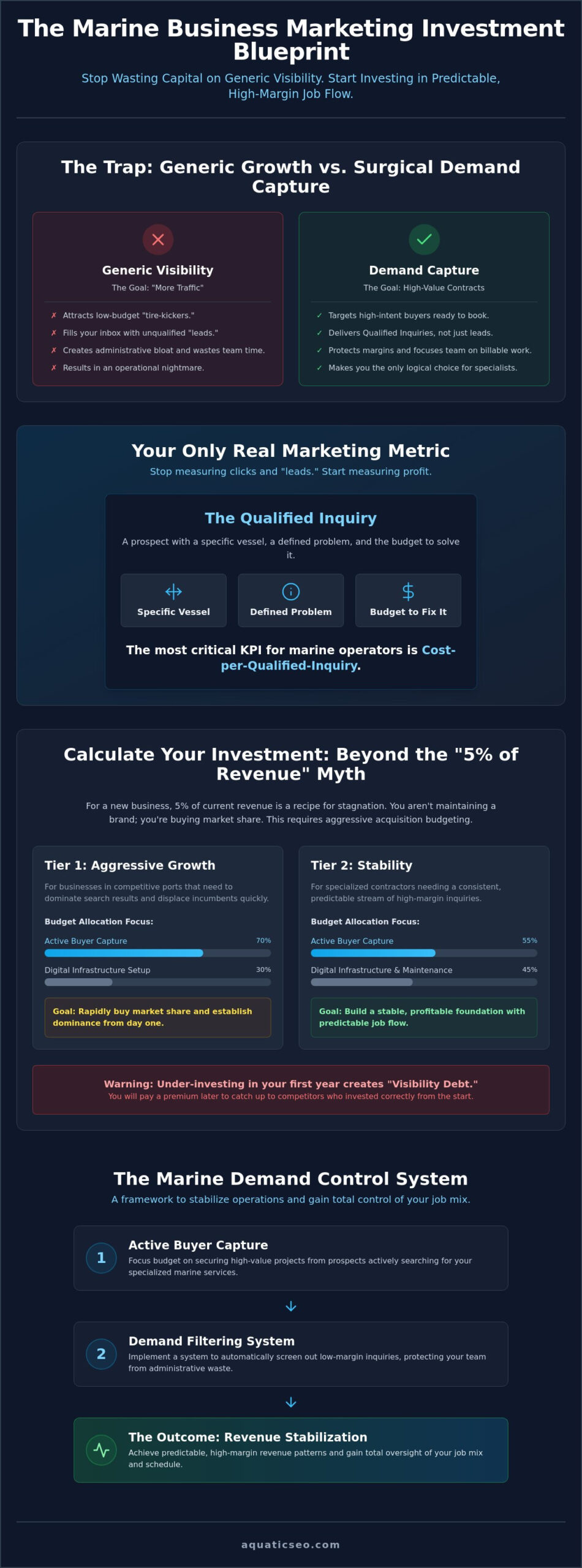
Generic visibility is about being seen by everyone. Industry-specific demand capture is about being the only logical choice for a high-intent buyer at the exact moment they need a specialist. We prioritize the Marine Demand Control System because it acts as a stabilizer for your operations. Instead of riding a roller coaster of inconsistent job flow, you implement a framework that filters out the tire-kickers before they ever reach your desk. This ensures your team spends time on billable hours rather than chasing prospects who can’t afford your yard rates.
Why Generic Agencies Fail the Marine Industry
Generalist agencies rarely understand the critical distinctions that define your world. They don’t know that a service yard focuses on complex maintenance while a marina provides dockage and fueling. When you hire a firm that lacks an industry-native perspective, you spend your own time teaching them your business. Their basic marketing strategy might work for a local plumber, but it fails in high-stakes niches like yacht charters or marine construction. Clicks do not pay your bills; only signed contracts for high-value projects do.
The Qualified Inquiry: Your Only Real Marketing Metric
Stop measuring “leads” and start measuring qualified inquiries. In the marine sector, a lead is just a data point, but a qualified inquiry is a prospect with a specific vessel, a defined problem, and the budget to fix it. You must value every inquiry based on the potential job margin and the long-term value of the client. For a marketing investment for new marine business to be successful, you must stop chasing volume and start demanding precision. Our approach to Digital Marketing for Marine Contractors is built on this distinction. Cost-per-qualified-inquiry is the most critical KPI for marine operators in 2026 because it tracks the actual health of your sales pipeline.
Calculating Your Marketing Investment: Beyond the Revenue Percentage Myth
Following the “5% of revenue” rule is a recipe for stagnation if you are launching a new brand. For a startup or a business in a growth phase, 5% of your current revenue is likely a negligible amount that won’t move the needle. You aren’t maintaining a legacy brand; you are buying market share from established competitors. A strategic marketing investment for new marine business requires a shift from maintenance budgeting to aggressive acquisition budgeting. You must fund the “Active Buyer Capture” phase to ensure your service bays are full from day one.
Your allocation should vary significantly based on your sub-sector. A yacht charter operator in a saturated market like Fort Lauderdale faces different acquisition costs than a specialized marine surveyor in a niche territory. When you are Calculating Your Marketing Investment, you must account for the initial setup of your Marine Demand Control System. This setup is a one-time capital expenditure that builds your digital infrastructure, while ongoing maintenance covers the tactical execution required to keep your job flow stable.
Investment Tiers for Marine Startups
We categorize investments into two primary tiers. The aggressive growth tier is for businesses that need to dominate a competitive port quickly. This requires a front-loaded budget to displace incumbents who have owned the local search results for years. The stability tier is designed for specialized contractors who need a consistent, predictable stream of high-margin inquiries. Under-investing in SEO for the marine industry during your first year creates a “visibility debt.” You will eventually have to pay a premium to catch up to competitors who invested early in organic authority.
Traditional vs. Intent-Based Budgeting
Stop wasting money on interruptive social media ads that target people who might buy a boat someday. New businesses must prioritize intent-based search terms where buyers are actively looking for a solution. This approach ensures your first marketing dollars are spent on prospects who are ready to book a service or sign a contract. The table below illustrates why building an organic asset is superior to renting space on an ad platform.
| Feature | Organic Marine SEO | Paid Search Advertising |
|---|---|---|
| Long-Term Value | Compounding asset that builds equity over time. | Fleeting visibility that disappears when the budget stops. |
| Trust Factor | High; users trust organic results over “sponsored” tags. | Lower; perceived as a paid interruption. |
| Cost Efficiency | Decreasing cost-per-inquiry as authority grows. | Fixed or increasing costs based on auction competition. |
If you want to see how this framework applies to your specific operational goals, you can schedule a fit call to discuss a tailored strategy for your yard or dealership.
Prioritizing Active Buyer Capture in the Marine Sector
Your first marketing dollar must go where the buyers are already searching. Most agencies want you to pay for broad awareness, but awareness does not book jobs. You need to capture existing demand from people who have a vessel in the yard or a deadline to meet. This is why a targeted marketing investment for new marine business focuses on high-intent search queries rather than generic social media noise. You are not looking for fans; you are looking for owners with immediate operational needs.
If you are a specialist, Digital Marketing for Marine Contractors is about securing high-value projects, not just collecting clicks. For marine mechanics, electricians, and surveyors, “money keywords” are highly specific and localized. Think “emergency pod drive repair Fort Lauderdale” or “pre-purchase yacht survey Miami.” These terms signal a buyer with an immediate problem and the budget to fix it. Dominating local search in major hubs requires a strategy that proves your technical expertise in the specific ports where your target clients dock.
SEO for Marine Industry: Capturing High-Intent Search
Niche-specific SEO outperforms general marketing because it targets the technical language your clients actually use. Ranking for “emergency” or “specialized” service terms puts you in front of a buyer who needs a solution right now. This is the difference between being a general vendor and a trusted specialist. For a deeper look at the tactical execution of this strategy, read our SEO for the Marine Industry: A No-Nonsense Intro. We focus on the search terms that lead directly to a qualified inquiry.
Why Yacht World and Boat Trader Are Not Enough
Relying on third-party marketplaces for your entire job flow is a high-risk strategy. These platforms own the relationship with the customer, and they can change their algorithms or pricing at any time. You are essentially renting your growth from a middleman who also promotes your direct competitors on the same page. It’s a race to the bottom on price that erodes your margins.
You must own your digital assets to ensure long-term demand visibility and control. Marketplaces should be a supplement to your strategy, not the foundation of it. When you build your own authority, you dictate the terms of the engagement. This allows you to filter for high-margin jobs and maintain a predictable schedule without being at the mercy of a third-party site’s traffic fluctuations.
The Demand Filtering System: Protecting Your Margins
A common mistake when planning a marketing investment for new marine business is assuming every inquiry is a good inquiry. In reality, bad leads are expensive. They create administrative bloat, distract your estimators, and steal time from high-margin billable work. If your team spends three hours a day chasing prospects who eventually ghost you, that’s time stolen from your paying clients and your bottom line. You need a system that identifies the right projects before you ever pick up the phone.
Saying “no” to the wrong jobs is the fastest way to grow a new marine business. It preserves your operational capacity for the work that actually pays the yard bills. High-value marine services require high-intent buyers. If you are providing Marine Surveying, you don’t want to spend half your day explaining why you don’t do cheap inspections on aging runabouts. Digital “gates” allow you to qualify prospects based on vessel size, age, and location. This ensures your expertise is reserved for the clients who value it and have the budget to pay for it.
Automated Qualification for Marine Services
Effective intake forms are the first line of defense. By implementing specific fields for vessel type, service urgency, and hull material, your Marine Demand Control System handles the heavy lifting of prospect vetting. You move from a reactive state of taking whatever comes in to a proactive state of selecting the best fit for your yard. This shift protects your operational capacity and keeps your team focused on the complex, profitable jobs they were trained to handle. It turns your website from a simple brochure into a functional business development asset.
Preventing Low-Margin Inquiries from Day One
The psychology of the “tire-kicker” is predictable. They look for the lowest price and the fastest response, often without understanding the technical requirements of the job. You repel these individuals by using clear, assertive messaging that positions your brand as a premium partner. For example, Yacht Charters that emphasize crewed luxury and specific itineraries—or even provide high-quality gear from Ocean Motion Wear—naturally filter out those looking for a basic boat rental. Implementing a rigorous filtering layer increases the “Qualified Inquiry” rate while significantly decreasing the total noise in your sales pipeline. When you evaluate your marketing investment for new marine business, remember that the goal isn’t just more inquiries, but better ones.
If you are ready to stop wasting time on low-value leads, book a call to discuss our Demand Filtering Systems today.
Implementing the Marine Demand Control System
Transitioning from a new startup to an established operator requires a methodical approach to revenue. Your marketing investment for new marine business should follow a three-phase implementation plan designed for stability. Phase 1 focuses on capturing existing market demand through targeted marine SEO. This ensures you are visible to the high-intent buyers who are already searching for specialized help in your local port.
Phase 2 introduces the filtering layer to protect your operational margins. This vets prospects before they consume your time or distract your crew. Finally, Phase 3 focuses on compounding demand. By building long-term organic authority, you eventually create a waiting list for your services. This allows you to dictate pricing and select only the highest-value projects. Aquatic SEO acts as your specialized partner throughout this process, bringing “in the trenches” experience to your digital strategy.
Establishing a physical presence in a new region requires similar methodical planning. For those considering the Middle East, Sarsan Corporate Services provides a detailed analysis of the cost of business setup in the UAE, helping you plan your expansion with the same oversight you apply to your marketing.
Why Now is the Time to Invest in Marine SEO
The 2026 landscape is unforgiving for generalists. With boat loan interest rates currently ranging from 7.49% to over 35%, buyers are more cautious and conduct deeper research before choosing a provider. Generic marketing is becoming more expensive and less effective as ad costs rise and consumer skepticism grows. You gain a massive competitive advantage by being the only “industry-native” voice in your local market. For more on navigating these choices, see our guide on How to Choose a Marine Digital Marketing Agency in 2026.
Your Next Steps: From Expense to Asset
Stop viewing your budget as a gamble. A properly executed system turns marketing into a predictable business asset rather than a recurring bill. You deserve oversight and precision in your financial health. Request a No-BS Marine Marketing Analysis to identify the gaps in your current visibility and demand capture. Book your fit call today to take control of your demand and stabilize your job flow.
Secure Your Operational Future
You now have a framework to move beyond the frustration of inconsistent job flow and wasted spend. Your marketing investment for new marine business must be treated as a strategic asset that buys you oversight and precision, not just digital noise. By prioritizing high-intent search and implementing a rigorous filtering layer, you ensure that every inquiry reaching your desk is worth your time and expertise. This approach stabilizes your revenue and allows you to focus on the high-margin work you were trained to perform.
Aquatic SEO specializes in helping marine contractors, surveyors, and yacht charters implement the proprietary Marine Demand Control System. We focus exclusively on capturing high-intent buyers to stabilize your revenue and protect your profit margins from day one. It’s time to stop chasing vanity metrics and start demanding tangible business outcomes that actually pay the yard bills. You’ve built the business; now build the system that fuels it.
Book your Marine Demand Control Fit Call to find your gaps and take command of your market today. You have the skills to dominate your port, and we have the system to make it a reality.
Frequently Asked Questions
How much should a new marine business spend on marketing in 2026?
A new marine business should expect monthly retainers for specialized agency management to range from $3,500 to $15,000. Ad spend is a separate cost, typically requiring a budget of two to four times the management fee to be effective. For a single-location boat dealer, a monthly ad spend of $5,000 to $20,000 is common to maintain visibility against established competitors.
What is the difference between a lead and a qualified inquiry?
A lead is simply a contact name or email address with unverified intent. A qualified inquiry is a vetted prospect who has confirmed their vessel type, service needs, and budget alignment. We focus on qualified inquiries because they represent actual revenue opportunities rather than just administrative noise that drains your team’s time.
Why does generic SEO fail for marine contractors and service yards?
Generic SEO fails because generalist agencies don’t understand the technical distinctions of your business. They often confuse a service yard with a marina or a yacht charter with a boat rental. This lack of industry-native knowledge results in content that attracts low-value traffic instead of the high-intent vessel owners you need to fill your bays.
How long does it take to see a return on a Marine Demand Control System?
You should expect to see measurable results within three to six months as your organic authority begins to build. While the initial setup requires an upfront investment, the system is designed to compound value over time. This creates a predictable job flow that eventually reduces your reliance on expensive third-party marketplaces and paid advertising.
Can I just use social media to grow my new boat dealership or charter business?
Relying solely on social media is a high-risk strategy because it targets users with low buying intent. A yacht charter or boat dealer needs search-based visibility to capture buyers who are actively looking for specific vessels right now. A marketing investment for new marine business must prioritize search intent to ensure you aren’t just buying vanity metrics that fail to convert.
What is the most important marketing metric for a marine surveyor or mechanic?
The most critical metric for any specialized marine technician is the cost-per-qualified-inquiry. Clicks and “likes” are irrelevant metrics that don’t pay your yard bills or fuel your trucks. You must track how many vetted prospects contact you for high-margin service work to ensure your marketing spend is actually driving operational growth.
Should I invest in Google Ads or SEO first for my new marine business?
You should ideally launch both simultaneously to balance immediate cash flow with long-term asset building. Google Ads capture existing market demand today, while SEO builds the organic authority that reduces your acquisition costs over time. This dual approach ensures your marketing investment for new marine business produces both short-term revenue and long-term organizational stability.
How do I filter out low-value tire-kickers from my inquiry list?
You filter out low-value prospects by implementing digital gates like specific intake forms that require vessel details and service urgency. These forms vet prospects before they ever reach your phone, protecting your team from administrative bloat. By forcing prospects to provide technical details upfront, you naturally repel those who aren’t serious about booking a high-margin job.