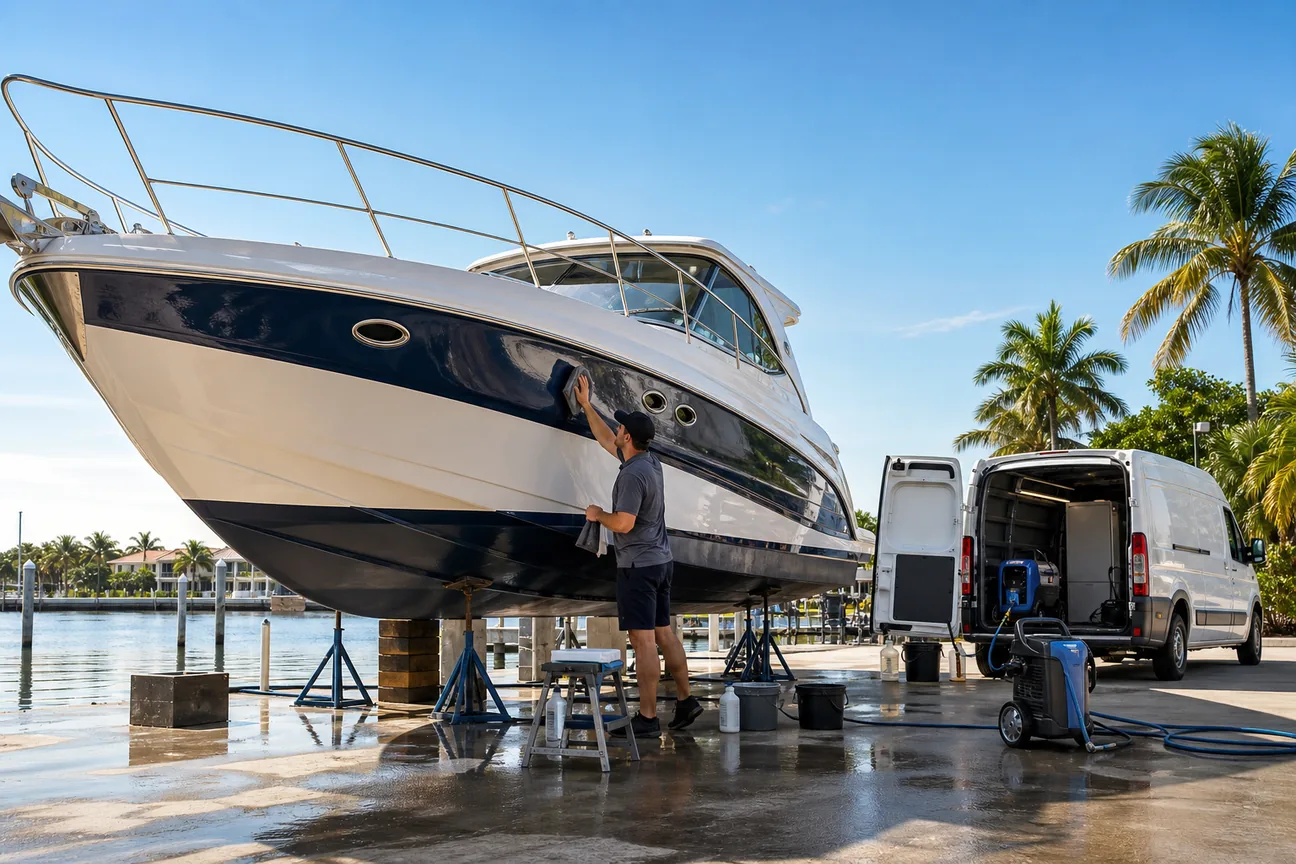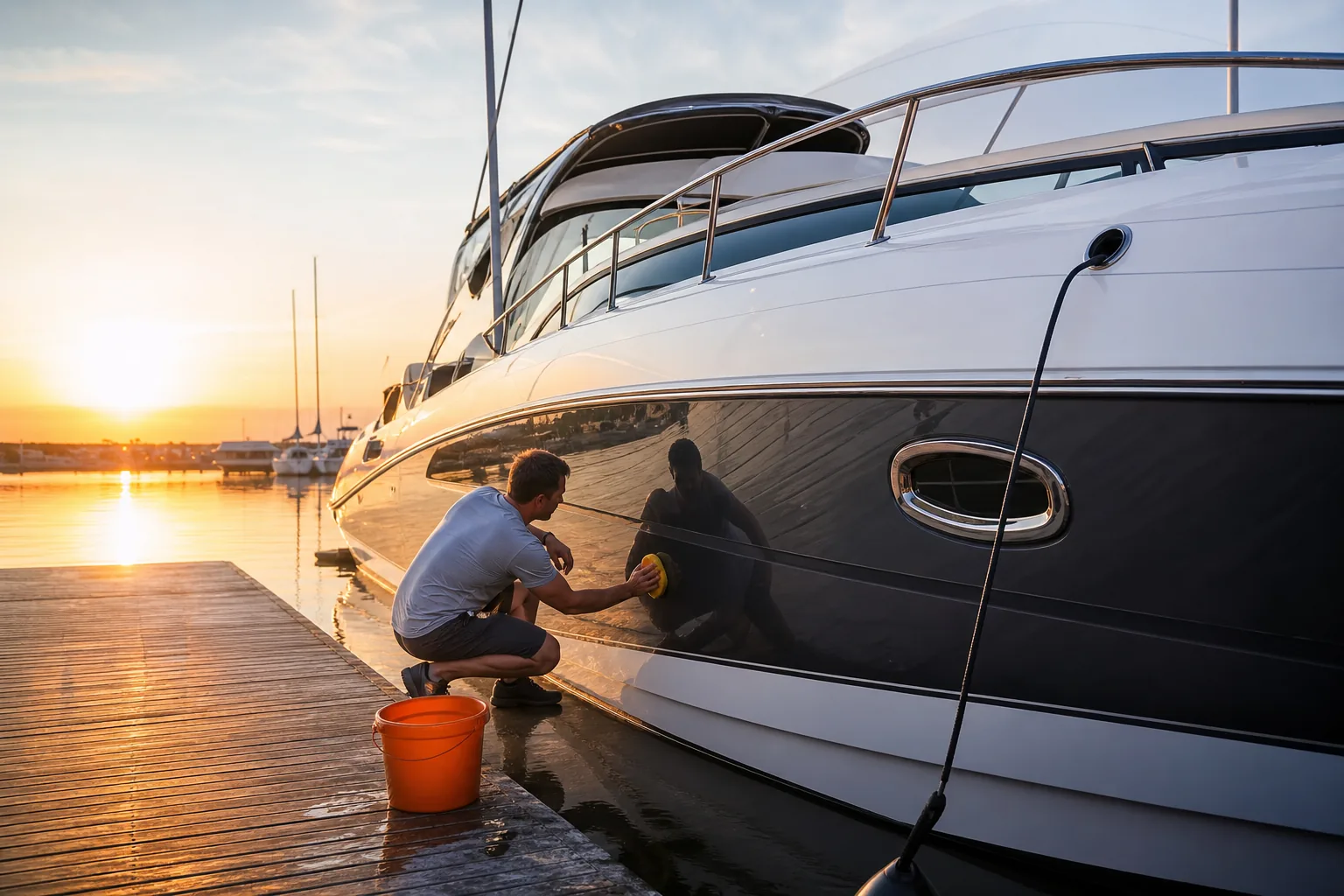

A 30-foot yacht can face a $6,000 correction and ceramic job, yet a full-detail package may cost under $2,000. That sounds backward until you compare the work included. Boat detailing prices depend on length, gel coat condition, access, finish goals, and how much of the boat gets treated. Use the steps below to build a fair estimate before you request quotes.
Step 1: Measure the Boat and Define the Work Area
Boat detailing prices often start with length, but length alone won’t tell you the final bill. First, measure the vessel from bow to stern. Then write down which areas need work.
At minimum, note the hull, topsides, cockpit, deck, cabin, helm, metal trim, glass, isinglass, cushions, storage spaces, and bilge area. A boat owner asking for a “full detail” may picture a clean hull and deck. The detailer may read that phrase as interior work too. Spell out the scope before anyone prices the job.
Also record the boat’s layout. A 28-foot center console usually has fewer enclosed surfaces than a 28-foot cabin cruiser. A flybridge, tower, hardtop, tight cabin, or large amount of stainless steel adds labor even when the boat’s length stays the same.
Take clear photos in daylight. Include the port side, starboard side, bow, stern, cockpit, helm, cabin, and any damaged or stained area. Add one close photo of the gel coat. These images help a detailer spot oxidation, old wax, stains, mildew, and access problems before visiting.
If you’re also preparing the boat for sale, condition affects more than detailing cost. It can affect the asking price and how buyers judge the vessel. Our guide to how to value a boat using condition and market data can help you separate cosmetic work from repairs that affect value.
Know the difference between length overall and the area you want cleaned. Some firms price the whole vessel by length. Others quote separate zones, such as hull correction, interior cleaning, or trailer work.
For a useful first estimate, make a short scope sheet:
- Boat length and type.
- Work location and access limits.
- Exterior surfaces that need cleaning.
- Interior areas that need cleaning.
- Finish issues, including oxidation, stains, scratches, or peeling protection.
- Requested protection, such as wax, sealant, or ceramic coating.
Gel coat is the hard finish over many fiberglass boats. It can lose gloss and develop oxidation after long exposure to sun and weather.
Milestone: By now, you should have the boat’s length, layout, work zones, photos, and a plain description of the finish problem. That makes the next step much easier.

Step 2: Match the Boat’s Condition to the Right Service Level
Boat detailing prices rise when the finish needs correction instead of simple cleaning. The key question is whether you’re removing dirt or removing damaged surface material.
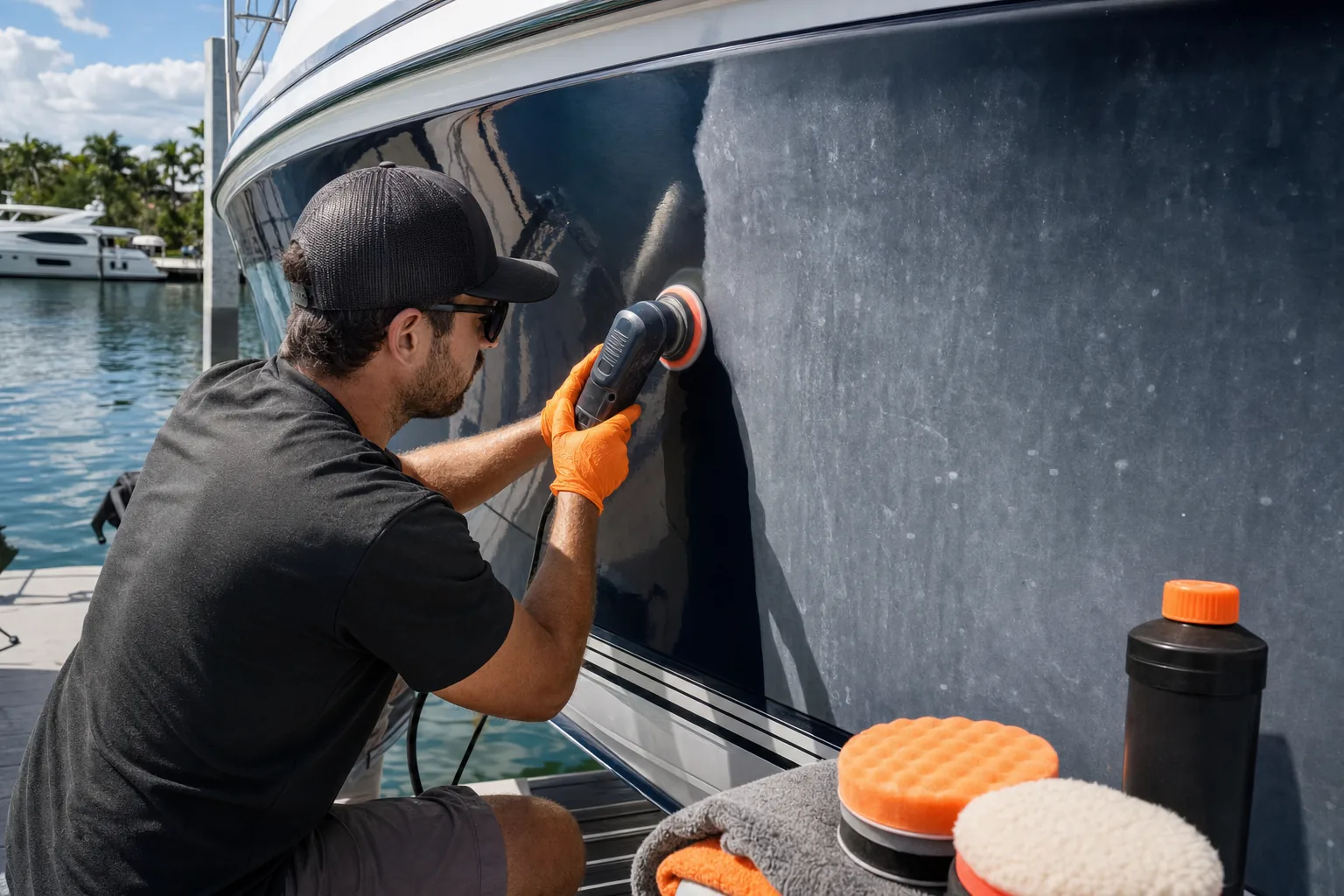
Run your hand over a clean section of gel coat. A smooth surface with little or no chalky residue may need a polish and fresh protection. A white, dusty residue on your palm points to oxidation. That calls for machine correction, not another wash.
Use the service level that matches the problem:
| Condition or goal | Typical work | Useful decision rule |
|---|---|---|
| Routine upkeep | Wash and maintenance | Choose this when the finish is already in good shape. |
| Clean finish with light haze | Machine polish | Use polish when there is no heavy oxidation. |
| Chalky or oxidized gel coat | Machine correction | Expect more labor and more passes. |
| Severe surface damage | Wet sanding or restoration | Ask for an in-person inspection before accepting a price. |
| Finished surface that needs protection | Wax, sealant, or ceramic | Protection comes after the surface is ready. |
Published service ranges show how wide the gap can be. Recurring wash and maintenance is listed around $7 per foot. Machine polishing without oxidation is listed at $35 to $60 per foot. Machine correction on oxidized gel coat is listed at $50 to $75 per foot. Deep finish work can reach about $100 per foot.
Those bands are not interchangeable. A wash removes surface dirt. A correction cuts through oxidation with a machine and compound. If a quote uses the word “polish,” ask whether it includes oxidation removal. That single question can prevent a large scope dispute.
Dark gel coat deserves special attention. Navy and black surfaces show haze, swirls, and uneven correction more clearly than white surfaces. A detailer may need extra refining passes to make the finish look clean in direct sun. That is a labor issue, not an arbitrary surcharge.
Interior work can also change the service level. A full detail may include decontamination washing, hull and topside polishing, metal polishing, vinyl and upholstery cleaning, glass and isinglass cleaning, interior surfaces, storage spaces, and protection. A smaller interior package may focus on vinyl, cushion covers, storage compartments, the helm, and the bilge area.
Ask for the inclusions in writing. A low quote may cover a wash and spray wax, while a higher quote includes interior work and protection.
Milestone: You should now know whether the boat needs upkeep, polishing, correction, restoration, interior work, or protection. Next, put a base number on the exterior work.
Step 3: Calculate a Base Boat Detailing Price per Foot
Per-foot pricing gives you a quick starting point for boat detailing prices. Multiply the boat’s length by the rate that matches its condition. Treat the result as a planning figure, not a guaranteed quote.
- Recurring wash and maintenance: about $7 per foot.
- Machine polish with no oxidation: $35 to $60 per foot.
- Machine correction on oxidized gel coat: $50 to $75 per foot.
- Deep finish work: about $100 per foot.
- Ceramic added after correction: $60 to $70 per foot.
- Standalone ceramic re-coat: about $75 per foot.
- Full correction with ceramic: $175 to $250 per foot.
For example, a 30-foot boat with oxidized gel coat may require a separate correction quote before other work. A 30-foot boat in better condition may fall into the machine-polish pricing range. The actual number depends on the amount of oxidation, the color, the layout, and the finish standard.
A full correction with ceramic can put that same 30-foot boat into a premium pricing tier. That explains how a premium correction can cost several times more than a flat-fee detail package.
The spread is a reminder that mixed pricing models can distort a simple average.
The lowest listed per-foot wash range was $4 to $6 for recurring service. The highest was $175 to $250 for full correction with ceramic. That is more than a 40-fold gap, but the services do different jobs.
Flat-fee pricing can look better on a larger vessel. One full-detail package listed $1,288 for a 28-foot boat and $1,966.50 for a 38-foot boat. The package included a full workday of service. Divided by length, those figures can sit well below high-end correction rates.
Ask the detailer which pricing model fits the job. Per-foot pricing works well when the surface condition changes the labor rate. Flat-fee pricing may be easier when the package has a fixed scope and the boat fits the stated size range.
If a provider gives only one number, ask for the math behind it. You want to know the boat length used, the rate per foot, the included surfaces, and the work that would trigger a change order.
Milestone: You now have a base estimate. Keep it separate from add-ons, access charges, and protection. Those belong in the next calculation.
Step 4: Add Condition, Access, and Protection Costs
The base rate rarely tells the whole story. Boat detailing prices move when the crew must spend more time correcting the surface, reaching difficult areas, or applying a longer-lasting finish.
Start with condition. Light haze may need one polishing approach. Heavy oxidation needs compound work and more machine passes. A surface that has passed the chalky stage may need wet sanding. That is restoration work, so it often requires an in-person quote.
Next, review access. A boat in a yard with easy shore access is a different job from one in the water with limited dock space. Ask whether the quote assumes shore power, water access, a safe work area, and permission to use ladders or staging. If the boat must be moved before service, confirm who handles that cost.
Layout adds labor too. A hardtop, tower, flybridge, cabin, complex curves, or crowded cockpit can slow the work. So can heavy metal trim, large areas of isinglass, stained upholstery, and storage spaces packed with gear.
Protection is a separate choice. A premium wax upgrade was listed at $75 extra in one package. Ceramic added to correction was listed at $60 to $70 per foot. A standalone ceramic re-coat was listed at $75 per foot. Full correction with ceramic reached $175 to $250 per foot.
Ceramic should go on after correction. Coating over oxidation or visible flaws can trap those flaws beneath the finish. Ask which surfaces receive the coating. Some owners want the hull only. Others want the topsides and other sun-exposed areas treated too.
Compare that with routine washing. Basic recurring wash pricing was listed at $4 to $6 per foot, with monthly service recommended for one 25-foot boat example. Regular washing can reduce the amount of grime and salt left on the finish, but it won’t replace correction when oxidation has already formed.
Use a quote checklist before approving extras:
- Does the price include the hull, topsides, deck, or only selected areas?
- Is oxidation removal included?
- Are metal, glass, vinyl, cushions, and isinglass included?
- Does the quote include travel, dock access, ladders, or haul-out needs?
- What protection is applied, and to which surfaces?
- How long must the boat stay dry or unused?
- What condition would trigger a revised quote?
Don’t pay for ceramic because the label sounds premium. Pay for it when the prep, surface coverage, expected care cycle, and curing plan make sense for your boat.
Step 5: Compare Quotes and Choose One-Off or Recurring Service
Good quote comparison means matching scope before comparing price. A $2,000 full detail and a $2,000 correction may have little work in common.
Put each quote into the same format. Record the base service, boat length used, included areas, finish condition, protection, access assumptions, time on site, and exclusions. If one provider leaves a field blank, ask before you compare totals.
Look for vague phrases such as “full restoration,” “complete detail,” or “premium protection.” Ask what each phrase means in labor terms. Does “full” include the cabin? Does “restoration” include wet sanding? Does “protection” mean spray wax, sealant, or ceramic?
Check the time estimate too. A quote that promises a high-end correction in a few hours deserves more questions.
Choose recurring service when the boat needs steady upkeep and the finish is already sound. Monthly washing can make sense for a boat kept in active saltwater use, but the right schedule depends on location, exposure, storage, and use.
Choose a one-off detail when you’re preparing for launch, sale, delivery, an event, or a major cleanup. If you’re listing the vessel, our guide to selling a boat with better preparation and buyer screening can help you decide which cosmetic work earns its place in the budget.
Don’t ignore the trailer. One listed trailer and tire detail cost $200 and covered a quick scrub plus tire dressing. That may be useful when the trailer is part of the sale presentation, but it should remain separate from the boat’s hull and interior work.
Ask for a written change-order rule. For example, the provider might quote correction based on a test spot, then revise the price if the oxidation extends deeper than expected. That is fair when the condition cannot be known from photos. It is less fair when the provider adds broad fees without showing what changed.
Before you approve, check insurance requirements at the marina or yard. Confirm who pays for damage caused by moving gear, opening storage areas, or working near fragile hardware. The cheapest quote is a poor deal if it leaves key risks undefined.
Pick the quote with the clearest scope when prices are close. Clear work beats a vague promise every time.
Step 6: Turn Your Pricing Into Qualified Detailing Inquiries
If you run a detailing business, clear boat detailing prices can improve the quality of inquiries. You don’t need to publish one rigid price for every boat. You do need to explain the inputs that shape the estimate.
Build a service page around the questions customers already ask:
- Do you price by the foot or by package?
- What changes the rate?
- What does a wash include?
- When does a boat need correction?
- Is ceramic separate from correction?
- How long does each service take?
- What photos should an owner send?
Show service bands with plain language. Use “routine wash,” “machine polish,” “oxidation correction,” and “correction with ceramic.” Then state that severe oxidation, wet sanding, complex layouts, and access limits need review.
Add a quote form that asks for boat length, vessel type, location, service area, finish condition, and photos. This filters tire-kickers before they take up a long sales call. It also gives your estimator the details needed to spot margin variance, which is the gap between the planned labor cost and the actual time required.
Your service radius matters too. A mobile detailer may need to price travel, water access, parking, fuel, and setup time. Make those rules visible. Customers handle a higher quote better when they understand the work behind it.
Use local SEO to show up when owners search for service near a marina or city. Your Google Business Profile, service area pages, and review process should all use the terms customers use. Keep the page focused on marine work rather than generic auto detailing.
Organic authority is an asset because a useful pricing page can keep attracting demand after the first campaign ends. Paid ads can create faster traffic, but they also charge for each visit. We help marine operators connect those channels so ads capture urgent demand while organic pages build owned visibility.
Aquatic SEO works only with marine businesses, including service yards, marinas, boat dealers, yacht charter operators, and rental companies. We can help a detailing business map its service radius, build pages around qualified inquiries, and track the difference between a form fill and a buyer-ready quote request.
Keep the page honest. Don’t promise a firm rate before seeing the boat if condition can change the work. Give owners a useful range, explain the inspection point, and ask for the photos that close the gap.
If your business also manages rental inventory, pricing pages need a different structure because customers compare time, boat type, location, and fees. Our resource on boat rental pricing by trip length and vessel type shows why a service quote page should answer the customer’s exact buying question.
Milestone: You should now have a pricing framework that helps buyers self-qualify. That means fewer vague requests and more inquiries with enough detail to quote.
FAQ: Boat Detailing Prices
How much does boat detailing cost per foot?
Boat detailing can cost about $4 to $7 per foot for recurring washing, while machine polishing may run $35 to $60 per foot. Oxidation correction may reach $50 to $75 per foot. Full correction with ceramic can run $175 to $250 per foot. The boat’s condition and the included work explain most of the difference.
What is the difference between a boat wash and a full detail?
A boat wash removes surface dirt and may include spray wax, while a full detail covers a wider scope. Full-detail packages may include hull and topside work, metal polishing, interior cleaning, upholstery, glass, isinglass, and protection. Always request the inclusion list because service names vary between providers.
Is ceramic coating included in boat detailing?
Ceramic coating usually costs extra unless the package clearly includes it. Ceramic needs a properly corrected surface first, so ask whether prep, coverage, curing time, and future re-coating are part of the quote.
How often should a boat be detailed?
Basic washing is commonly planned on a recurring schedule, with one pricing reference recommending monthly service for a 25-foot boat. Your schedule should follow exposure, saltwater use, storage, and the finish condition rather than a fixed calendar alone.
Why do two detailers quote different prices for the same boat?
Two detailers may be pricing different work even when they use the same boat length. One quote may cover washing and spray wax, while another includes oxidation correction, interior cleaning, metal polishing, and ceramic protection. Compare scope, labor time, access needs, exclusions, and finish goals before comparing the totals.
Conclusion
Start with the boat’s length, then let condition and scope set the rate. Ask for an itemized quote that names each surface, protection step, access assumption, and possible change order. If you’re a marine service business that needs more qualified quote requests, Aquatic SEO can help turn clear pricing content into owned visibility and better schedule stability. Your next move is simple: gather photos, write the scope, and request quotes that use the same checklist.