

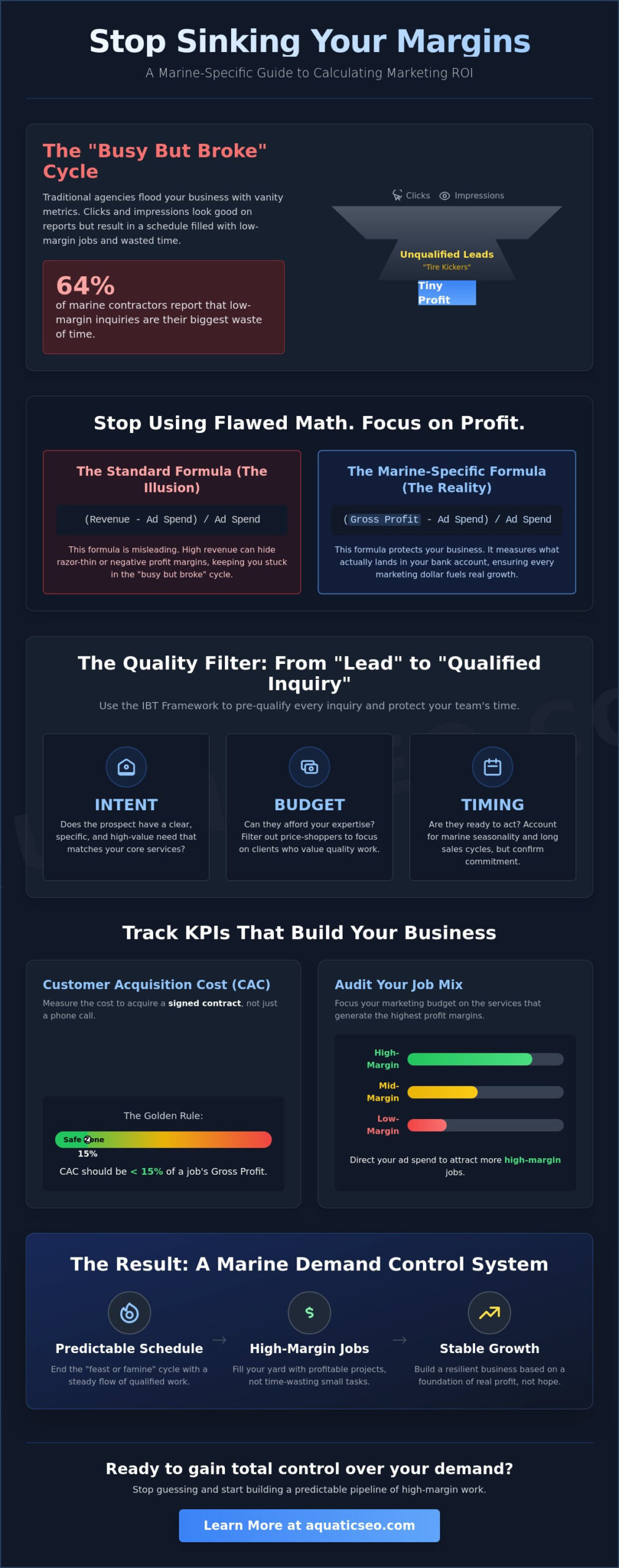
Your marketing agency is likely handing you a report full of vanity metrics while your schedule remains a mess of busy weeks followed by dead weeks. Clicks and impressions don’t pay for technician salaries or facility overhead. If you can’t point to a specific job in your service yard and trace it back to a specific ad dollar, you don’t have a marketing strategy; you have a leak in your cash flow. You deserve to know exactly how to calculate marine marketing ROI without the fluff, especially when 64% of marine contractors report that low-margin inquiries are their biggest waste of time.
You probably already suspect that “more leads” usually just means more noise and less time for your high-value clients. This guide provides the rigorous, marine-specific math you need to measure qualified inquiries and protect your actual job margins. We’ll break down the auditable framework required to stop the cycle of inconsistent work and finally gain total control over your demand.
Key Takeaways
- Stop chasing vanity metrics like clicks and impressions that fail to pay for diesel or dockage.
- Master the specific math on how to calculate marine marketing ROI by shifting your focus from top-line revenue to actual gross profit.
- Learn to use the IBT framework—Intent, Budget, and Timing—to filter out tire-kickers and capture only high-value Qualified Inquiries.
- Audit your specific job mix to ensure your marketing spend is fueling the high-margin sectors of your marine business.
- Implement a Marine Demand Control System to replace hope-based marketing with a predictable method for schedule stability and growth.
Why Your Current Marine Marketing ROI Math is Sinking Your Margins
You know the cycle. One week the shop is a ghost town and you’re staring at an empty schedule. The next, your phone rings off the hook with “tire kickers” asking for small repairs that barely cover your overhead. You’re working 70-hour weeks, yet your bank balance stays flat. This “busy but broke” reality happens because you’re measuring the wrong things. If you want to know how to calculate marine marketing ROI, you must stop looking at clicks and start looking at margin.
Generic marketing agencies love to talk about “impressions” and “brand awareness.” These are vanity metrics. Impressions don’t pay for dockage. They don’t fill your diesel tanks. A thousand clicks from people looking for “cheap boat parts” is worthless if you run a high-end service yard. When an agency doesn’t understand your job mix, they flood your intake with low-quality demand. This destroys your operational efficiency. You end up with a schedule full of $500 jobs that prevent you from taking on a $50,000 refit. While the basic Return on Marketing Investment (ROMI) formula seems simple, it often fails in the marine sector because it ignores the cost of your time.
The Hidden Cost of Unqualified Inquiries
Every time your lead technician stops work to talk to a prospect who won’t commit to a contract, you lose money. If an estimate takes two hours of shop time and the job never happens, that’s a direct hit to your bottom line. Unqualified inquiries act like a filter clog in your sales engine. They crowd out high-value yacht charter bookings or service yard contracts that actually move the needle. This creates a psychological toll on your team. When your sales staff spends all day chasing leads that go nowhere, their performance on high-value opportunities drops. You need a system that filters for intent before the phone even rings.
Context Framing: Why Standard Formulas Fail
Most marketing models use a 30-day window to judge success. In the marine industry, that’s a recipe for bad decisions. Marine seasonality means a lead captured in November might not convert until the spring haul-out in April. You can’t judge a campaign’s success on a month-to-month basis when your sales cycle is tied to the weather or boat show dates. High-ticket marine services aren’t impulse buys. They require technical expertise and precise timing. To understand how to calculate marine marketing ROI correctly, you have to account for these long lead times and the complexity of the marine buyer. For a deeper look at managing this flow, see our guide on Digital Marketing for Marine Contractors.
The Marine-Specific ROI Formula: Moving Beyond Basic Math
Most marketing agencies report on “cost per click,” but clicks don’t pay for your slip fees. To understand the actual health of your business, you need a formula that accounts for marine-specific overhead. The standard ROI calculation fails because it treats all revenue as equal. In this industry, revenue is a vanity metric that hides shrinking margins. If you want to know how to calculate marine marketing ROI effectively, you must use this formula: (Gross Profit from Qualified Inquiries – Marketing Spend) / Marketing Spend.
Using Gross Profit instead of top-line revenue protects your business from “busy fool” syndrome. If a service yard generates $100,000 in revenue from a campaign but spends $85,000 on parts and specialized labor, the “ROI” based on revenue looks great while the bank account stays empty. You must also factor in “Time-to-Contract.” A yacht refit inquiry might take 4 months to move from initial contact to a signed work order. If you only look at monthly snapshots, your data will be fundamentally flawed. This framework for evaluating ROI provides a solid baseline for aligning these long-term objectives with your actual operational cycle.
Calculating Your Customer Acquisition Cost (CAC)
CAC for marine contractors measures the total marketing investment required to secure one high-intent, qualified inquiry that signs a contract. You cannot simply divide your budget by the number of phone calls. You must filter for quality. A boat dealer might tolerate a CAC of $1,800 for a $120,000 center console sale. However, a marine mechanic needs a CAC closer to $125 to maintain profitability on routine maintenance calls. If your cost to acquire a customer exceeds 15% of the initial job’s gross profit, your growth system is broken.
Understanding Marine LTV (Lifetime Value)
A single hull repair or engine diagnostic is rarely just one transaction; it’s the entry point for a decade of winterization and eventual repowers. We weight LTV differently based on the client profile. Local boaters typically have a 4.5x higher LTV than seasonal charter guests because they provide consistent, predictable demand. When you analyze how to calculate marine marketing ROI, you must include referral value. Data shows that one satisfied yacht owner often brings 2.3 additional high-net-worth clients into your ecosystem through dockside word-of-mouth. If your current reports focus on vanity traffic instead of these multi-year margins, it’s time to look at a demand system built for contractors.
Qualified Inquiries vs. Leads: The Invisible ROI Gap
Most marine agencies brag about lead volume while your service manager wastes 10 hours a week on the phone with people who cannot afford your shop rate. This is the invisible gap in your profit margins. A lead is simply a name and a number; a Qualified Inquiry is a business asset defined by Intent, Budget, and Timing (IBT). If you want to know how to calculate marine marketing ROI accurately, you must stop counting clicks and start measuring the quality of the conversation.
Our Marine Demand Control System acts as a mechanical filter for your business. It identifies the “tire-kickers” and “window shoppers” before they ever reach your phone. By enforcing strict criteria through industry-native content, we ensure that the inquiries hitting your inbox are ready to sign a contract. A lower volume of high-intent inquiries consistently results in a higher net profit because it reduces your operational overhead. You spend less time quoting and more time billing high-margin jobs.
The Demand Filtering Framework
Generic SEO is a waste of capital. Ranking for broad terms like “boats for sale” attracts thousands of visitors who have no intention of hiring a professional. We utilize specialized SEO to target high-value, specific terms. For example, a marine surveyor needs prospects searching for “pre-purchase engine survey” rather than “how to buy a boat.” This industry-native approach pre-qualifies your prospects. It ensures the traffic you pay for is looking for your specific expertise, not a free consultation or a DIY guide.
Auditing Your Current Inquiry Quality
If your current agency sends you a monthly report full of “leads,” perform this simple 3-question test to see if they are sending you junk. First, did the prospect mention a specific vessel make or model? Second, is their project timeline within the next 30 to 60 days? Third, did they reach out through a channel that specifically highlights your premium pricing? If the answer is no, you are looking at vanity metrics, not revenue.
Rankings don’t matter if they don’t lead to a signed contract. True Demand Visibility allows you to pick and choose the best jobs rather than taking whatever comes your way to keep the lights on. When you understand how to calculate marine marketing ROI based on the acquisition cost of a Qualified Inquiry, you gain total control over your schedule and your stability. You stop being a slave to the “busy season” and start building a predictable, high-margin operation.
Auditing Your Job Mix: Tracking ROI Across Marine Sectors
Calculating ROI isn’t a simple math problem that applies to every business equally. A $10,000 marketing spend might yield a 5x return for a marine construction firm but look like a failure for a yacht charter operator. It depends entirely on your specific job mix. You shouldn’t treat every inquiry with the same weight. If you’re wondering how to calculate marine marketing ROI accurately, you must audit your job origins against your actual profit margins rather than just top-line revenue.
The most common mistake is over-marketing low-margin services during your peak season. If your boatyard is already at 95% capacity in June, spending money to acquire more “emergency repair” leads is a waste of capital. These jobs often carry lower margins and disrupt your production schedule. Instead, a disciplined Marine Demand Control System reallocates that budget to secure high-margin refit projects for the off-season. You want to put your money where the profit is, not just where the noise is.
- Track every job back to its digital source using auditable tracking tools.
- Categorize revenue by service type to see which marketing channels drive the highest margins.
- Stop spending on “busy work” leads when your schedule is already full.
ROI for Service Yards and Boatyards
For service yards, the ROI on a $200,000 refit project is vastly different from a dozen $1,500 emergency repairs. Refits provide schedule stability and predictable labor utilization. We use localized SEO to drive high-value traffic to specific service yards and boatyards, ensuring you capture owners looking for long-term maintenance. When you analyze how to calculate marine marketing ROI for a yard, you must weigh the cost of acquisition against the long-term value of a refit client.
ROI for Yacht Charters and Tour Operators
In the charter sector, timing is everything. You need to track seasonal booking cycles to understand your early-bird ROI. There is a massive financial gap between “boat rental” seekers and high-value “yacht charter” clients. Our system filters out the price-shoppers looking for a four-hour rental and captures the luxury clients ready to book week-long crewed charters. Check out how we optimize for yacht charters and tour operators to maximize your seasonal yield and eliminate wasted spend on low-value inquiries.
Ready to see which of your jobs are actually driving profit? Book a fit call today to audit your current lead tracking.
Implementing a Marine Demand Control System for Predictable Growth
Most boatyard owners and marine contractors operate on a cycle of “hope-based marketing.” You hope the phone rings when the season starts; you hope the local boat show brings in enough work to survive the winter. This lack of control is what causes the feast-or-famine stress that leads to burnout. To break this cycle, you must move from passive lead generation to a repeatable system of demand capture. When you finally master how to calculate marine marketing ROI, you stop viewing marketing as an overhead expense and start seeing it as a precision tool for schedule stability.
A Marine Demand Control System does more than just generate volume. It enforces a barrier between your team and the “tire-kickers” who waste your estimators’ time. If your crew is consistently working 60-hour weeks but your bank account isn’t reflecting that effort, your filtering is broken. By focusing on qualified inquiries rather than vanity metrics, you protect your margins and your team’s sanity. Your 2026 growth strategy should be driven by one metric: the actual profit generated per marketing dollar spent. This synthesis of data and operations ensures you only scale what is already working.
The 4 Pillars of Demand Control
- Visibility: You don’t need to be everywhere. You need to be found by high-intent buyers exactly when they search for your specific services.
- Capture: This is the process of turning a high-intent searcher into a qualified inquiry through direct, industry-native messaging.
- Filtering: This is the most critical step. Your system must automatically vet prospects so your estimators only talk to serious buyers with realistic budgets.
- Compounding: Once you know how to calculate marine marketing ROI for each service line, you reinvest your budget into the top 20% of jobs that produce 80% of your profit.
Your Next Steps for ROI Mastery
Stop guessing about your growth. Start by performing a 30-day audit of your current inquiry-to-job ratio to see where your bottleneck truly exists. Identify your top three highest-margin services, such as specialized engine refits or fiberglass repair, and focus your entire acquisition budget there for the next quarter. If you want to see how your current numbers stack up against industry benchmarks, you can Request a No-BS Marine Marketing Analysis to get a clear picture of your potential for 2026. This isn’t about getting more traffic; it’s about gaining total control over your schedule and your profit.
Synthesis Summary: Transitioning from hope-based marketing to a Demand Control System shifts your focus from vanity metrics to qualified inquiries. This shift ensures that every dollar spent is an investment in predictable, high-margin growth rather than a gamble on “more leads” that never convert into profitable jobs.
Stop Guessing and Start Scaling Your Marine Profits
Mastering how to calculate marine marketing ROI requires moving past the fluff of generic agencies. You need to distinguish between a low-value lead and the qualified inquiries that actually impact your bottom line. Most contractors fail because they track clicks instead of the specific revenue generated across their highest-margin marine sectors. Our Marine Demand Control System was built for businesses generating between $300,000 and $5,000,000 who are tired of revenue growth that comes at the expense of their operational stability.
By auditing your job mix and enforcing a strict demand filtering process, you can finally achieve predictable growth. We bring industry-native expertise to the table; we know the difference between a service yard and a marina because we’ve been in the trenches. Don’t settle for vanity metrics when you can have total visibility into your margins. You’ve worked hard to build your reputation; now it’s time to use a system that protects it while driving real profit.
Stop wasting money on vanity metrics—get your Marine Demand Control Analysis
Your business deserves the clarity of a system designed by experts who understand the water. You’ve got the skill; we’ve got the system to make it pay off.
Frequently Asked Questions
What is a good ROI for marine digital marketing?
A 5:1 ratio is the standard benchmark for healthy growth in the marine sector. For every $1,000 you invest, you should see $5,000 in gross profit. If your ratio falls below 3:1, your margins are likely too thin to sustain long-term operations. High-performing systems often reach a 10:1 ratio once your demand control is fully optimized for high-value boat buyers.
How long does it take to see a return on Marine SEO?
You should expect to see measurable movement in search visibility within 90 days, with profit-shifting ROI typically appearing between month six and month nine. SEO is a compound asset rather than a quick switch. Unlike paid ads that stop the moment you stop paying, a solid SEO foundation continues to capture high-value inquiries for 24 months or more without additional per-click costs.
Can I calculate ROI if my sales cycle is over six months?
Yes, you calculate ROI by tracking the original lead source through your CRM over the full 180-day or 365-day cycle. To understand how to calculate marine marketing ROI for long-term sales like yacht brokerage or major refits, you must attribute the final closing back to the initial Qualified Inquiry. Don’t look at monthly snapshots; instead, use a rolling 12-month average to account for the lag between the first click and the final wire transfer.
What is the difference between a lead and a Qualified Inquiry?
A lead is just contact information, while a Qualified Inquiry is a prospect who has the budget, a specific boat model interest, and a clear timeline. Leads often include tire kickers who waste your service manager’s time and drain your resources. We focus on Qualified Inquiries because they represent actual revenue potential, filtering out the 70% of noise that creates operational drag without adding to your bottom line.
How do I track ROI if my customers call me instead of filling out a form?
You must use dynamic number insertion (DNI) to track exactly which marketing channel triggered the phone call. This technology assigns a unique number to different traffic sources, allowing you to see if a $50,000 engine refit job came from a specific search term or a referral. Without call tracking, you’re guessing where 60% of your marine business revenue actually originates, which makes scaling impossible.
Should I include my team’s labor costs in the marketing ROI formula?
No, you should keep marketing ROI calculations focused on direct spend to maintain clarity on specific channel performance. Labor is an operational expense that belongs in your overhead or COGS calculations. Mixing internal payroll with external ad spend muddies the data; it makes it impossible to see if your Marine Demand Control System is actually performing against the broader market.
What happens to ROI during the marine off-season?
ROI often appears lower in the off-season if you only look at immediate sales, but this is when you capture the demand for the upcoming spring season. Smart operators in northern climates use Q4 and Q1 to build a massive backlog of service yard work. If you stop marketing in the winter, you’ll spend Q2 playing catch-up while your competitors have already filled their slips and service bays for the year.
Is it possible to have a high ROI but still lose money?
Yes, if your margins are miscalculated or your operational overhead is too high, a 10:1 ROI won’t save your business. Marketing can bring in a $100,000 boat sale, but if it costs you $105,000 to acquire, prep, and deliver that vessel, you’re losing money on every win. You need to ensure your system is targeting high-margin services that actually contribute to your net profit rather than just increasing your top-line revenue.