You didn’t get into the marine industry to spend your afternoons chasing $50 parts inquiries or arguing with tire-kickers who can’t stomach an 8.40% interest rate. Most owners treat their marketing budget like a tax they have to pay, but in a market where new powerboat sales have cooled by 9%, that passive approach is a recipe for seasonal burnout. Justifying marketing spend for a marine business in 2026 isn’t about buying more “visibility” or generic clicks. It’s about building a precision filtration system that stops the noise and secures your profit margins.
We know you’re likely skeptical because you’ve been burned by generic agencies that don’t know a transom from a tiller. You’re tired of inconsistent job flows and inquiries that never convert into high-value service yard work or yacht sales. This article will show you how to stop viewing marketing as an overhead expense and start using it as a dial to control your job flow and lead quality. We’ll explore how to shift from volume-based metrics to high-intent outcomes, ensuring every dollar spent protects your operational stability and financial health.
Key Takeaways
- Learn why chasing high traffic volumes often backfires by flooding your office with low-margin tire-kickers instead of high-value work.
- Discover how to transition from passive advertising to a Demand Control System that regulates the flow of jobs into your service yard or dealership.
- Master the specific metrics for justifying marketing spend for a marine business by calculating the true cost of a Qualified Inquiry rather than just generic leads.
- Understand why a Yacht Charter operator requires a different budget strategy than a marine surveyor to capture active buyers in competitive hubs like Fort Lauderdale.
- Shift your perspective to see specialized marketing spend as a core piece of your business infrastructure that ensures year-round operational stability.
Why Most Marine Marketing Spend Feels Like a Sunk Cost
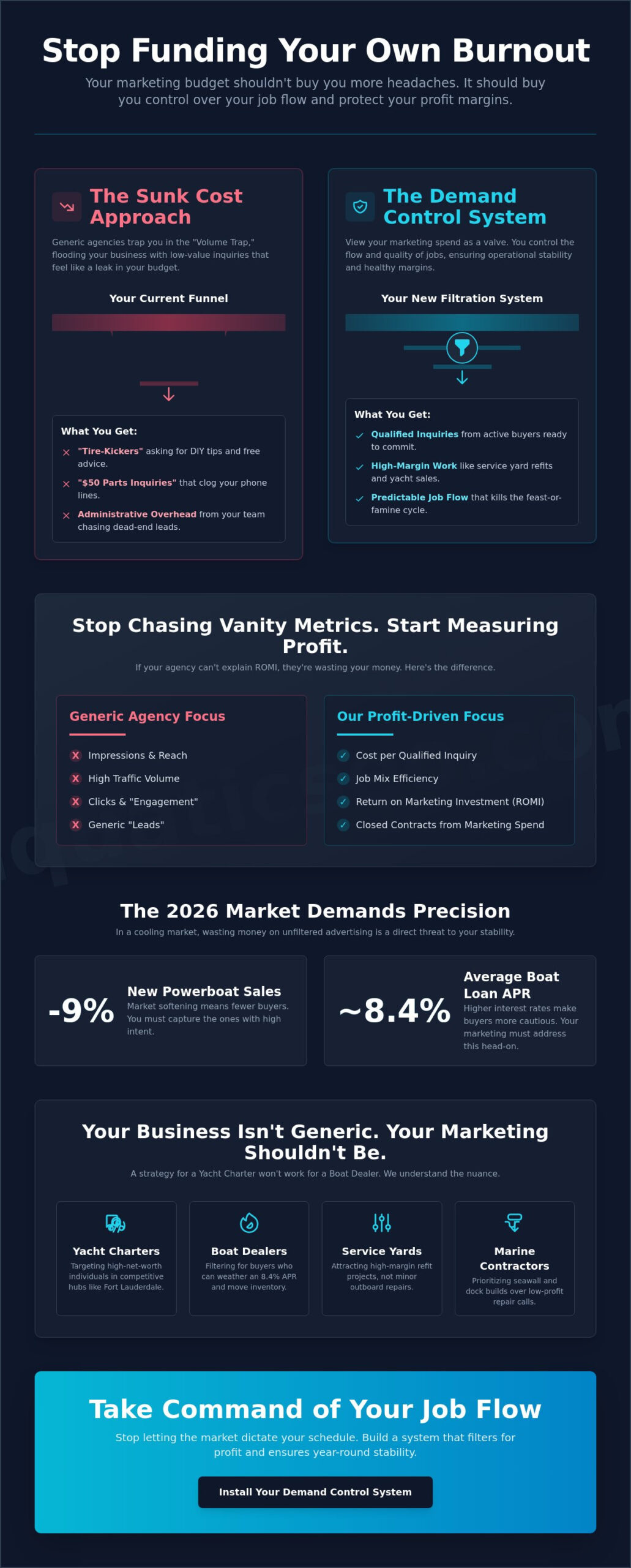
Most owners see their marketing budget as a monthly leak. You pay for clicks, but your phone rings with people asking for advice on 20-year-old outboards or $50 gasket repairs. This is the Volume Trap. High traffic numbers look good on a report, but they often lead to more administrative headaches rather than more profit. If you are struggling with justifying marketing spend for a marine business, it’s usually because your current strategy lacks a filter.
You’ll find that generic agencies treat your business like a local bakery or a law firm. They don’t understand that a Yacht Charter inquiry requires a different level of qualification than a simple boat rental. They focus on impressions and reach, which are vanity metrics that don’t pay the bills. To truly measure success, you need to look at your Return on Marketing Investment (ROMI) based on closed contracts, not just website visitors.
The High Cost of Unfiltered Demand
Rejecting the Traditional Agency Model
Stop falling for traditional agencies that offer wide-reaching strategies promising everything to everyone. In reality, these plans are usually expensive, unfocused, and slow. They might get you to the top of Google for “boat repair,” but if that traffic consists of people looking for DIY tips, your investment is wasted. You need to watch for red flags, such as marketers who can’t explain the difference between a service yard and a marina. If they don’t understand your logistics, they can’t possibly find your ideal client.
The Marketing Black Hole
Look closely at the “Marketing Black Hole” where your ad spend disappears into reports filled with engagement and likes. These metrics are useless if your boat dealership isn’t moving inventory. In 2026, with interest rates for boat loans averaging between 7.45% and 9.90% APR, consumers are more cautious. You cannot afford to waste money on broad campaigns that don’t account for this market softening. If your marketing doesn’t address the specific financial climate of the industry, it is simply a sunk cost.
Reframing Marketing as a Marine Demand Control System
Marketing isn’t a megaphone; it’s a valve. When you view your budget as a Demand Control System, you stop being a victim of market fluctuations and start dictating your own schedule. Justifying marketing spend for a marine business becomes simple when you see it as an operational lever to regulate the flow of work. You don’t just want more calls. You want the right calls at the right time to keep your crew productive and your margins healthy.
There is a massive difference between “getting found” and “being chosen.” A generic SEO agency might get you to rank for broad terms, but they won’t help you win a specific refit contract over a local competitor. You need a system that filters for intent before a prospect ever picks up the phone. This ensures your office isn’t bogged down with low-value inquiries while high-margin opportunities slip through the cracks. It’s about winning the jobs you actually want, not just the ones that happen to show up in your inbox.
Controlling Your Job Mix
Operational stability comes from knowing exactly what your pipeline looks like three months from now. By using targeted demand visibility, Marine Contractors can prioritize high-margin seawall or dock projects over minor repairs that eat up crew time without moving the needle. This level of precision allows you to schedule work in advance, effectively killing the feast or famine cycle that plagues the industry. When you are calculating marketing ROI, you must factor in the efficiency of your job mix, not just the raw number of leads.
Specialized vs. Generic Demand Generation
Generic marketing strategies fail because they don’t speak the language of the water. Marine Mechanics and Electricians face different logistical challenges than yacht brokers or retailers. A specialist system uses industry-native terminology to build immediate trust with high-value prospects who are looking for technical expertise, not just a low price. This filtration process identifies the difference between a high-intent buyer and a casual browser before they waste your time. If your current strategy feels like a series of expensive guesses, you can book a call to discuss your job flow and see how a filtered approach changes your bottom line.
The ROI Math for High-Intent Marine Inquiries
Stop measuring success by how many people visited your website. In the marine world, a visitor looking for a free wiring diagram is a liability, not an asset. Justifying marketing spend for a marine business requires a shift in focus from “Cost Per Lead” to “Cost Per Qualified Inquiry.” A Qualified Inquiry represents a prospect who owns a vessel, has a specific need, and possesses the financial capacity to pay your rates without demanding a discount.
When you attract high-intent inquiries, you protect your profit margins. You no longer have to compete on price because you are reaching clients who value expertise over the lowest bid. This creates a Demand Compounding effect. As your visibility among the right audience increases, your long-term acquisition costs drop because your brand becomes the default choice for premium work in your region. Many owners struggle with justifying marketing spend because they use generic formulas that don’t account for the massive variance in marine job values.
Reverse-Engineering Your Desired Outcome
Don’t guess your budget. Start with your annual revenue target and work backward to determine exactly what you need to spend. For Service Yards and Boatyards, this means looking at your average refit or maintenance ticket size. If your goal is an additional $500,000 in revenue and your average job is $25,000, you only need 20 closed contracts. A 5% increase in qualified inquiries is more valuable than a 50% increase in raw traffic because it directly impacts your capacity to hit those high-value targets.
The Hidden Cost of Inactivity
An empty service bay is the most expensive thing in your yard. Every hour your technicians spend sweeping floors instead of turning wrenches is lost revenue you can never recover. Losing a single high-value repower or hull repair to a competitor doesn’t just cost you that job; it destabilizes your entire annual revenue flow. View your marketing spend as an insurance policy against the off-season. It ensures that when the market softens, your schedule remains full of the jobs that actually keep your business healthy. You aren’t just buying ads; you are buying the right to select your jobs and maintain operational stability throughout the year.
Strategic Allocation for Specific Marine Sectors
You cannot use a yacht dealer’s budget to run a marine surveying business. Each sector has a unique rhythm, and your allocation must reflect the specific behavior of your ideal client. Justifying marketing spend for a marine business depends on your sales cycle and the local competition in hubs like Fort Lauderdale or Miami. In these high-density markets, average Google Ads CPC has climbed to nearly $3.00, making precision even more critical to your financial health.
Your choice between SEO and Paid Search should be a tactical decision based on your current job flow. SEO provides long-term organizational stability by building a foundation of organic visibility that you own. Paid Search acts as a dial, allowing you to increase inquiries immediately when you see a gap in your schedule. Balancing these two channels ensures you aren’t overpaying for leads during your busiest months while maintaining a steady pipeline during the off-season.
Budgeting for Yacht Charters and Tour Operators
Yacht Charter operators need immediate demand capture. Your lead-to-booking window is often short, especially for seasonal travelers. Avoid bidding on “boat rental” keywords; these terms attract tourists looking for small self-drive boats, not premium crewed experiences. You need to target high-intent searchers who are ready to book. If you are ready to scale your bookings with high-intent clients, you can join a Charter Operators fit call to audit your current strategy.
Budgeting for Marine Construction and Operators
Marine Construction SEO requires a methodical mindset. Seawall and bulkhead projects have long sales cycles and high ticket prices. You must maintain visibility throughout the months-long decision process to ensure you are the final choice. Focus on technical authority and case studies rather than superficial social media metrics. B2B and municipal contracts are won through perceived reliability and auditable performance, not “likes” or “shares.”
Seasonal weighting is your secret weapon for maintaining a full schedule. Many owners make the mistake of turning off their marketing in the winter, only to struggle for visibility when spring arrives. Use the quieter months to capture demand for major repowers or summer charters before your competitors wake up. This consistent presence lowers your long-term acquisition costs and ensures your crew stays productive year-round. Review our sector-specific marketing systems to see how we align spend with your business model.
Taking Command of Your 2026 Operational Stability
Marketing is the only department in your company that directly controls your revenue ceiling. While your service manager handles production and your bookkeeper tracks the past, your marketing system dictates your future capacity. Viewing this spend as a line-item expense is a tactical error that limits your growth. Justifying marketing spend for a marine business in 2026 requires seeing it as a core piece of your business infrastructure, similar to your travel lift or your service bays.
When you implement a Marine Demand Control System, you move from a state of hoping for work to a position where you can select your jobs. This transition is vital for protecting your profit margins. If your schedule is full of high-intent, high-margin projects, you have the leverage to walk away from low-value repairs that drain your resources. This level of oversight makes your business more efficient today and significantly more valuable if you ever decide to sell.
From Skepticism to Command
The 2026 market is unforgiving toward generalists. With new powerboat retail sales seeing a 9% decline, the “spray and pray” approach to advertising will only accelerate your losses. Success now belongs to specialists who understand how to filter for quality. There is a profound psychological relief that comes from knowing your pipeline is full of qualified prospects who aren’t haggling over every line item. You can stop worrying about the next market dip and focus on delivering the technical expertise your clients expect. If you are tired of wasting money on vanity metrics that don’t move the needle, you can request a No-BS Marine Marketing Analysis to see where your current strategy is leaking profit.
Synthesis Summary
Justifying marketing spend for a marine business is not about finding the lowest cost per click. It is about investing in a system that ensures ROI, protects your margins, and grants you total operational control. You must reject the traditional agency model that prioritizes broad traffic over the specific needs of a service yard or boat dealer. Specialized expertise is your only defense against the marketing black hole. By focusing on Active Buyer Capture and demand filtering, you secure your revenue and build a business that operates with precision regardless of broader economic shifts.
Securing Your Fleet’s Financial Future
Securing your business’s financial health in 2026 requires more than just a visible website. It demands a specialized Marine Demand Control System that filters for high-intent, qualified inquiries before they ever touch your sales team. You’ve seen how volume-based metrics lead to administrative waste and how sector-specific allocation protects your profitability. Justifying marketing spend for a marine business is ultimately about gaining the oversight needed to select your jobs and stabilize your revenue ceiling.
We understand the technical nuances that separate a Yacht Charter from a boat rental; our industry-native expertise ensures your budget isn’t wasted on generic traffic. Stop settling for agencies that don’t know your transom from your tiller. It’s time to treat your marketing as a precision tool for organizational health rather than a seasonal expense. You can Request Your No-BS Marine Marketing Analysis today to identify exactly where your current strategy is falling short. Take command of your pipeline and ensure your yard remains full of the high-margin work you actually want to do.
Frequently Asked Questions
How do I know if my marketing spend is actually working?
You know your spend is working when your service manager stops complaining about bad leads and starts closing high-margin contracts. Stop looking at impressions or “likes” and start auditing your auditable tracking for Qualified Inquiries. If your revenue ceiling is rising without a proportional increase in administrative headaches, your system is functioning as intended.
What is the difference between a lead and a Qualified Inquiry?
A lead is just raw contact data, often from a casual browser; a Qualified Inquiry is a prospect who has been filtered for intent and capacity. In the marine sector, this means the person owns a relevant vessel and is ready to book a specific service like a major refit. Filtering for these high-value outcomes is the core of justifying marketing spend for a marine business.
Why is generic SEO a waste of money for a boat dealer?
Generic SEO focuses on broad traffic, which often attracts DIYers looking for free advice rather than buyers. A boat dealer needs to move specific inventory, not educate the public on hull maintenance. Specialized strategies prioritize Active Buyer Capture to ensure your visibility is limited to those ready to make a purchase.
How much should a marine business spend on marketing in 2026?
Your budget should be determined by your specific revenue targets and the average ticket size of your jobs. Instead of using a generic percentage of gross revenue, work backward from the number of contracts you need to fill your schedule. This methodical approach ensures you are investing enough to hit your goals without overspending on unnecessary volume.
Can I justify marketing spend if my service yard is already at capacity?
You can justify the spend by using it to improve your job mix. When your service yard is at capacity, use a Demand Filtering System to prioritize high-margin repowers and electronics installs over low-profit maintenance. This allows you to increase your profit margins even when you cannot physically take on more total vessels.
What happens if I stop spending on marketing during the off-season?
Stopping your spend in the off-season destroys your momentum and gives your competitors a clear path to your clients. Demand Visibility allows you to book your schedule months in advance, ensuring your crew stays productive during the winter. Silence during the quiet months makes it significantly harder and more expensive to regain visibility when the spring rush begins.
Why should I trust a specialized marine agency over a local generalist?
A specialized agency understands the critical distinction between a Yacht Charter and a simple boat rental. Generalists often waste your budget on broad keywords that attract the wrong type of customer. By working with an industry-native partner, you ensure your messaging reflects the technical reality of marine logistics and builds immediate trust with high-value prospects.
How does a Demand Filtering System actually save me money?
This system saves you money by drastically reducing administrative overhead and crew burnout. When your office only deals with prospects who have already been filtered for intent, you stop paying your team to chase tire-kickers. This precision ensures that every hour of labor in your business is focused on revenue-generating activities rather than fruitless follow-ups.