
Most marine manufacturing executives are currently paying for digital visibility that never actually reaches the bottom line. You see monthly reports showing thousands of clicks, yet your sales team is still drowning in tire-kickers. Effective digital marketing for marine service companies is not measured by the volume of visitors but by the precision of the inquiry.
If your marketing spend is part of the 5.7% median budget for B2B manufacturers in 2026, you cannot afford to waste capital on empty traffic. You need a system that filters out the noise and captures high-margin growth. You know that a busy week followed by a dead month isn’t a sign of a healthy business. It’s a symptom of a lack of control over your demand.
This guide will show you how to stop the budget leak and start capturing the qualified inquiries that drive real manufacturing stability. We’ll examine why generic agencies fail the marine sector and how to align your strategy with the May 2026 Google intent updates to secure a predictable stream of work.
Key Takeaways
- Stop measuring success by clicks and start tracking the qualified inquiries that actually pay for your factory overhead.
- See how industry-native digital marketing for marine service companies uses precise terminology to build trust with boat dealers and surveyors.
- Learn to use intent-based content as a filtering mechanism that protects your sales team’s time from low-value leads.
- Discover how a dedicated demand control system creates operational stability by smoothing out the typical feast and famine manufacturing cycle.
The Failure of Generic Marketing for Marine Manufacturing Companies
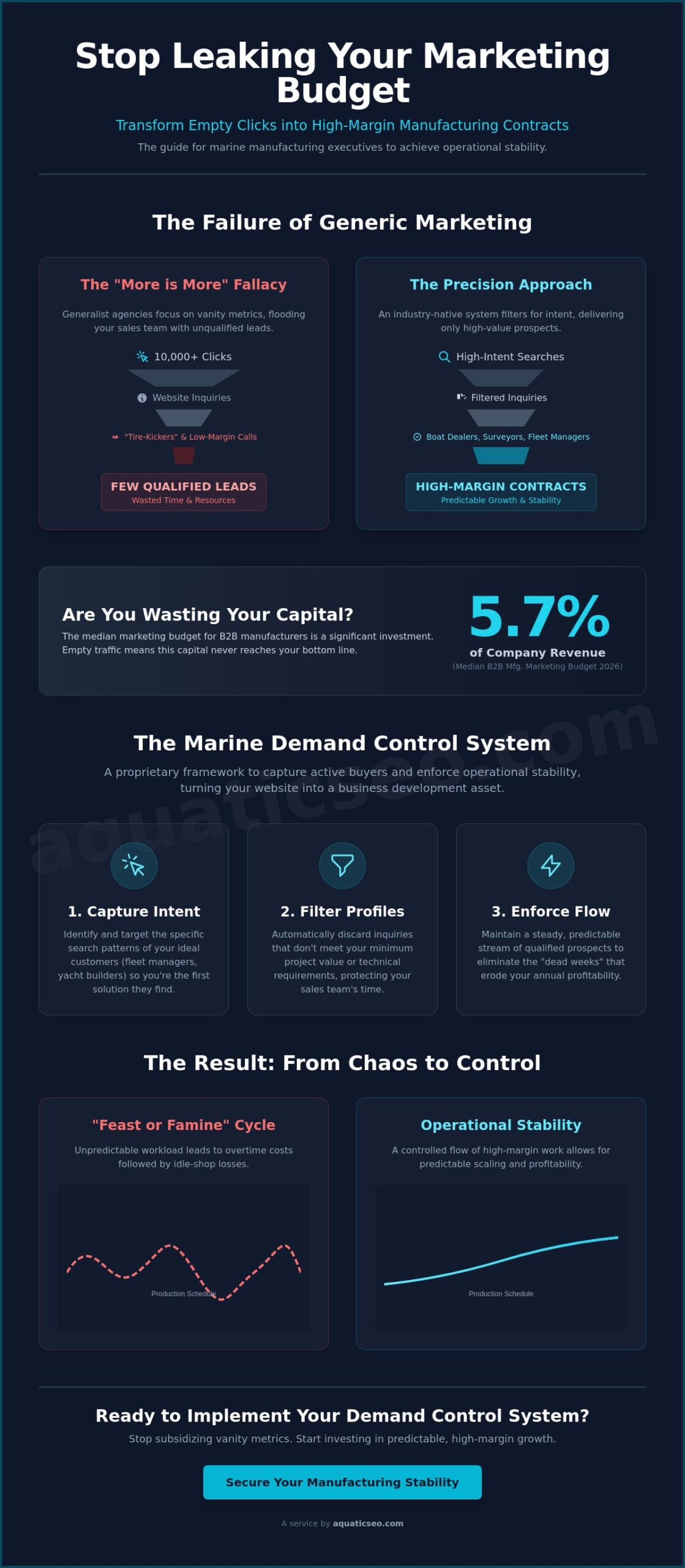
Marine manufacturing requires high-precision operations, yet most marketing strategies are built on guesswork. You likely experience a “Feast or Famine” cycle where your production schedule is either dangerously empty or overwhelmed by low-margin rush jobs. This inconsistency isn’t just frustrating; it’s expensive. In 2026, the median marketing budget for B2B manufacturing sits at 5.7% of company revenue. If you’re spending that capital on agencies that prioritize clicks over qualified inquiries, you’re subsidizing vanity instead of growth.
Traditional digital marketing often fails because it treats a high-ticket marine asset like a commodity. Clicks and impressions don’t pay for factory overhead or skilled labor. You need a strategy that understands the difference between a boat dealer seeking a long-term partnership and a retail customer looking for a one-off repair. Generic SEO firms focus on volume, but volume without intent is just noise that distracts your sales team.
Why Generalist Agencies Sink Marine Brands
Generalist agencies don’t know the trenches of this industry. They frequently fail to distinguish between a boat dealer and a service yard, leading to misaligned content that kills your credibility. When an agency uses the wrong terminology, they signal to high-value prospects that you aren’t a specialist. Effective digital marketing for marine service companies requires “industry-native” expertise that speaks the language of surveyors, fleet owners, and commercial operators.
The Problem with Low-Margin Inquiries
A spike in website traffic often masks a decline in lead quality. If your sales team spends hours answering questions from “tire-kickers” who can’t afford your services, your marketing is failing you. These low-margin inquiries drain your energy and prevent you from pursuing the high-margin manufacturing contracts that drive operational stability. Chasing unqualified leads has a hidden cost; it stalls your growth while your competitors capture the active buyers. You don’t need more leads; you need a system that filters out the waste before it reaches your desk.
Capturing High-Intent Demand with a Dedicated Control System
Most marine manufacturers treat marketing as an unavoidable expense rather than an operational lever. This passive approach is why you feel like a “client” of an agency rather than a partner in growth. A growth partner doesn’t just deliver reports; they enforce accountability through auditable tracking. Every dollar you deploy must be traceable to a specific, qualified inquiry that fits your current manufacturing capacity. If your marketing isn’t protecting your margins and production schedule, it’s failing its primary purpose.
Precision in your outreach ensures that your shop floor stays busy with high-value projects instead of small, distracting repairs. We focus on capturing the demand that already exists in the market. While federal manufacturing programs offer resources for structural industry growth, our system provides the immediate commercial fuel required to dominate your niche. Effective digital marketing for marine service companies must function as a precision tool, not a broad-spectrum advertisement.
Defining the Marine Demand Control System
The Marine Demand Control System is a proprietary operational framework designed to capture active buyers at the moment they require specific manufacturing solutions. This system targets high-intent buyers who are actively searching for your expertise rather than “spraying and praying” on social media platforms. By focusing on search intent, we ensure that your brand appears in front of fleet managers and yacht builders exactly when they are ready to sign a contract. This methodical approach transforms your website from a digital brochure into a dedicated business development asset.
The Four Pillars of Demand Visibility
Stability in marine manufacturing isn’t an accident. It’s the result of implementing a system that prioritizes demand visibility and control. Our framework relies on three core actions to stabilize your production line:
- Capturing Intent: We identify the specific search patterns of your ideal customers, ensuring you’re the first solution they see.
- Filtering Profiles: The system automatically discards inquiries that don’t match your technical requirements or minimum project values.
- Enforcing Flow: By maintaining a steady stream of qualified prospects, we eliminate the “dead weeks” that erode your annual profitability.
If you’re tired of inconsistent job flow and want to see how these pillars apply to your specific operations, you should schedule a fit call to discuss your growth goals.
Why Industry-Native Strategy Outperforms Traditional Advertising
Marine manufacturing isn’t a generic B2B sector that thrives on broad exposure. Success in this industry is built on authority and high-trust relationships with professional gatekeepers. Traditional advertising agencies often hide behind vague terms like “brand awareness” because they can’t track a direct line from their efforts to your factory floor. They prioritize the quantity of the crowd over the quality of the inquiry, which is why your inbox is full of noise instead of contracts. Effective digital marketing for marine service companies requires an industry-native strategy that reflects your actual technical capabilities.
You shouldn’t settle for a vendor that needs to be educated on the nuances of your business. Utilizing resources to enhance your global competitiveness starts with a strategy that understands the maritime supply chain. If your marketing content uses generic jargon instead of precise terminology, you’re actively damaging your reputation. Clicks are easy to buy, but trust is earned through demonstrated expertise. Industry-native positioning ensures that you aren’t just another name in a directory; you’re the specific solution a buyer is searching for.
Terminology as a Trust Signal
In the marine world, terminology is your first line of defense against unqualified prospects. If your website calls a boat dealer a “marina,” you immediately signal to professionals that you don’t understand their operations. A marine surveyor or a fleet operator won’t recommend a manufacturer that sounds like a hobbyist. Using terms like “service yard” correctly attracts partners who value precision. Niche-specific content acts as a filter, ensuring that only those who speak your language reach out for a quote.
Growth Partner vs. Marketing Vendor
The difference between a vendor and a growth partner is accountability. A vendor delivers a monthly PDF filled with clicks, impressions, and rankings that don’t correlate with your production schedule. A growth partner delivers a stable stream of qualified inquiries and understands how those inquiries impact your margins. You need a partner who views your business through an operational lens, not just a creative one. While a vendor focuses on “more traffic,” a growth partner focuses on “demand control” to ensure your shop stays busy with the right mix of high-margin work.
Implementing a Demand Filtering System for Better Profit Margins
Success in marine manufacturing isn’t defined by how many people know your name. It’s defined by how many of the right people are asking for a quote. Most digital marketing for marine service companies focuses on lead volume, which creates a massive operational bottleneck. If your sales team spends 30% of their week disqualifying retail tire-kickers, your marketing is actively eroding your profit margins. You need a system that acts as a high-precision gatekeeper.
A “Qualified Inquiry” is fundamentally different from a standard lead. A lead is a name and an email; a qualified inquiry is a prospect that has already cleared your technical and financial hurdles. By the time they speak to your sales team, they’ve confirmed they have the budget, the timeline, and the specific project scope that matches your factory’s strengths. This alignment ensures that your production schedule stays filled with high-margin work rather than low-value distractions.
Step 1: Identifying High-Value Search Intent
Filtering starts with the keywords you choose to target. If you bid on broad terms, you’ll attract hobbyists and researchers who have no intention of placing a commercial order. We target specific search patterns used by boat dealers and fleet managers looking for long-term manufacturing partners. This B2B focus separates you from the noise of the retail market and places your brand in front of decision-makers who control significant budgets.
Step 2: Building the Filtering Mechanism
Your website must do more than just present information. It must enforce your standards. We use dedicated landing pages that ask critical qualifying questions regarding technical specifications and minimum order quantities. This process automatically filters out prospects that don’t fit your ideal client profile. It ensures your sales team only invests time in “best fit” prospects who are ready to move forward with a high-value contract.
Step 3: Stabilizing the Job Mix
Demand control allows you to dictate your production schedule rather than being a victim of it. When you have a predictable stream of qualified inquiries, you can prioritize high-margin custom projects over low-margin bulk orders. This control leads to operational stability and prevents the “dead weeks” that kill annual profitability. If you’re ready to stop chasing leads and start controlling your demand, you should book a fit call today.
How to Scale Your Marine Manufacturing Operations with Aquatic SEO
Scaling a manufacturing facility requires more than just luck or a “good season.” It requires a predictable input of high-margin work that keeps your skilled labor productive and your overhead covered. Most agencies will take your money regardless of whether they can actually move the needle for your specific business. We operate differently. Aquatic SEO is a specialist growth partner that only accepts “best fit” clients. This exclusivity ensures that our resources are dedicated to businesses with the infrastructure to handle the precision demand we generate.
Effective digital marketing for marine service companies should be an extension of your operations, not a separate marketing silo. We don’t just send traffic to a homepage; we build a system that captures and qualifies intent. This methodical approach allows you to scale without the chaos of unqualified leads. In 2026, where B2B SEO ROI averages 748%, you cannot afford a strategy built on vague promises. You need a partner that treats your manufacturing capacity as a finite resource to be optimized.
A System Designed for Manufacturers
Our Marine Demand Control System provides specific, technical support for marine contractors and custom builders who need to secure large-scale commercial contracts. This isn’t about general visibility. It’s about ensuring your technical expertise is visible to the exact fleet managers and commercial operators searching for it. Our system integrates directly with your existing sales process to ensure that once a qualified inquiry is captured, it’s tracked through to the final contract. For a deeper look at this process, read our Digital Marketing for Marine Contractors guide.
Next Steps: Secure Your Job Flow
Unpredictable revenue is a choice you no longer have to make. You can continue to rely on word-of-mouth and generic advertising, or you can start enforcing demand. A fit call is the first step in determining if your manufacturing goals align with our system. We provide a no-BS analysis of your current market position and identify where you’re losing high-margin opportunities to less-qualified competitors. If we aren’t a good match, we’ll tell you immediately. If we are, we’ll show you exactly how to dominate your niche. Book your marine service analysis here.
Take Command of Your Production Schedule
Marine manufacturing success isn’t a byproduct of luck; it’s the result of a precise operational system. You’ve seen how vanity metrics like clicks and impressions fail to pay for factory overhead. By implementing the Marine Demand Control System™, you shift your focus from raw traffic to the qualified inquiries that drive high-margin growth. We specialize in helping marine businesses with revenues between $300K and $5M eliminate the feast or famine cycle once and for all.
Effective digital marketing for marine service companies requires a partner that understands your shop floor and your margins. We offer a no-nonsense guarantee on qualified inquiries because we only accept clients who are a perfect fit for our methodical approach. You don’t need more noise in your inbox. You need a predictable stream of work that stabilizes your operations and protects your time. It’s time to stop settling for unpredictable revenue and start enforcing the growth your business deserves.
Request a No-BS Marine Manufacturing Analysis today to see if your facility is ready for a dedicated growth partner. Your production line is too valuable to leave to chance.
Frequently Asked Questions
Is marketing for marine manufacturing companies different from standard SEO?
Marketing for marine manufacturing is fundamentally different because the technical requirements and stakes are much higher. Standard SEO often targets high-volume, low-intent terms that attract retail boaters or hobbyists. Effective digital marketing for marine service companies focuses on technical specifications and B2B intent to capture shipbuilders and fleet managers. This precision ensures you don’t waste budget on traffic that will never sign a high-value manufacturing contract.
Can I target boat dealers specifically with digital marketing?
You can target boat dealers specifically by capturing their search intent during the procurement or partnership phase. Dealers often search for specific manufacturing capabilities or regional partners when they need to expand their inventory. Our system uses these intent signals to place your facility in front of them exactly when they are looking for a new supplier. This functions as a targeted business development tool rather than a broad, ineffective advertising campaign.
How much should a marine manufacturer spend on marketing in 2026?
As of April 2026, the median marketing budget for manufacturing companies is 5.7% of company revenue. This data from Digital Applied reflects the necessity of maintaining visibility in an increasingly digital maritime sector. For a business in the $300K to $5M range, this investment must be strictly focused on auditable results and qualified inquiries. Spending without a tracking system in place is simply subsidizing an agency’s overhead.
What happens if my production schedule is already full?
A full production schedule is the ideal time to implement demand control. Instead of accepting every job that comes through the door, you use the system to filter for higher-margin projects. This allows you to replace low-profit work with more lucrative manufacturing contracts. You increase your bottom line and operational stability without needing to expand your physical facility or hire more labor immediately.
How long does it take to see results from a Demand Control System?
You will typically see measurable shifts in inquiry quality within the first 90 days of implementation. The Marine Demand Control System requires this initial period to gather data on specific search intent and refine your filtering mechanisms. By the 12-month mark, the system usually compounds. This creates a stable and predictable job flow that allows for long-term operational planning and better equipment utilization.
Is social media effective for B2B marine manufacturing?
Social media is rarely the primary driver for high-value B2B manufacturing contracts. While it can build some brand recognition, fleet owners and professional buyers don’t use social platforms to source technical partners. We prioritize search intent because it captures prospects at the moment they are actively seeking a solution. This is where the real return on investment lives for manufacturers who value their time.
What is the difference between a lead and a qualified inquiry?
A lead is a generic contact that often results in wasted sales time because they haven’t been vetted. A qualified inquiry is a prospect that has cleared your technical and financial hurdles through a filtering system. Our focus is strictly on the latter. We ensure your sales team only invests energy into prospects who have the authority, budget, and intent to close a manufacturing deal.
Can this system help me find international distributors?
This system is designed to capture demand wherever it exists, including international markets. By targeting specific global search terms and technical requirements, you can attract dealers and distributors from across the world. This allows your digital marketing for marine service companies to capture global demand. You can find partners who value your specific manufacturing expertise regardless of their geographic location.