
Your last marketing agency likely treated your service yard exactly like a local bakery or a suburban law firm. They focused on vague metrics like clicks and impressions while you were stuck explaining the technical difference between a yacht charter and a boat rental for the third time. This fundamental niche ignorance is exactly why generic marketing fails marine businesses. When an agency doesn’t understand the high-stakes seasonality or the technical precision of the maritime world, they burn your budget on low-margin leads that never convert. You don’t need more generic traffic; you need a system that filters for high-intent buyers who value professional expertise.
Specificity drives profit. A user searching for “marine electrical refit services” is ready to hire a professional and commit to a high-margin project. Someone searching for “cheap boat parts” is a DIY hobbyist, just as a resort operator wouldn’t look for “pool toys” when they need to learn more about Commercial Inflatable Water Park Sales and Custom Design for their venue. Broad keywords attract volume; specific keywords attract buyers. Generic agencies focus on the volume because it looks good on a report, but those numbers rarely translate to bankable revenue.
It’s frustrating to pay an outside firm only to end up doing their research for them. You’re likely tired of the hand-holding required just to keep your ads relevant and the seasonal dips that leave your bays empty. This article reveals why standard agency tactics bleed your budget and how a marine-specific strategy secures qualified inquiries. We’ll examine the hidden costs of generalist mistakes and show you how to implement a demand filtering system that prioritizes your most profitable jobs.
Key Takeaways
- Stop wasting budget on agencies that treat your service yard like a local retail shop. You will learn exactly why generic marketing fails marine businesses by attracting window shoppers instead of high-intent buyers.
- Master the technical distinctions between a boat rental and a yacht charter to ensure your SEO strategy attracts elite clients rather than budget seekers.
- Shift your focus from vanity metrics like website traffic to capturing qualified inquiries that actually fill your bays and stabilize your revenue.
- Implement a specialized Marine Demand Control System to gain oversight of your job mix and maintain a consistent flow of high-margin work.
The ‘One-Size-Fits-All’ Trap: Why Generic Marketing Fails Marine Businesses
Most marketing agencies operate on a volume-based model that prioritizes client count over industry depth. They apply the same cookie-cutter templates to your marine service yard that they use for a local retail shop or a florist. This fundamental lack of specialization is exactly why generic marketing fails marine businesses. You aren’t operating in a standard consumer market; you’re operating in a highly technical niche market where a single wrong word can disqualify you from a high-value contract.
The Failure of Generalist Agency Models
Generalist agencies often manage hundreds of clients across dozens of unrelated sectors. They simply don’t have the bandwidth to understand the specific needs of service yards and boatyards. You’ve likely spent hours on strategy calls explaining basic industry terms to a junior account manager who has never stepped foot on a dock. This education happens on your dime. When your marketing materials sound like they were written by an outsider, savvy yacht owners and captains spot the amateurism immediately and look elsewhere.
The Economic Impact of Poor Targeting
Generic messaging acts like a wide net with massive holes. It attracts window shoppers who are looking for the lowest price rather than the best technical outcome. These low-margin leads clog your sales pipeline and waste your team’s time with endless questions about services you don’t even provide. Standard agencies will show you reports filled with clicks and impressions to justify their fees. These metrics are a distraction from the only number that impacts your bottom line: the Qualified Inquiry.
A Qualified Inquiry is a prospect who understands your value, has the budget for your services, and is ready to book. When an agency fails to distinguish between a casual boater and a serious yacht owner, your ad spend vanishes into the void. This lack of precision is a major reason why generic marketing fails marine businesses and leaves owners stuck in a cycle of inconsistent, low-profit work. You need a system that filters out the noise and focuses exclusively on high-intent buyers who recognize your expertise.
Precision Matters: Why a Boat Rental is Not a Yacht Charter
Elite yacht owners and captains communicate with a highly specific vocabulary. They don’t search for “boat rentals” when they require a crewed, full-service Yacht Charter. If your marketing partner treats these terms as synonyms, they are signaling a lack of professionalism to your most valuable prospects. This failure to distinguish between vessel types and service levels is a fundamental reason why generic marketing fails marine businesses.
Precision is the difference between a ringing phone and a silent inbox. You know that a Service Yard or Boatyard focuses on technical maintenance, refits, and complex repairs. A marina provides dockage, slips, and fueling. When your website content blurs these lines, elite clients assume you don’t understand your own trade. Terminological errors destroy your authority before a prospect even reads your “About Us” page.
The Authority Gap in Marine Search
Search engines now prioritize technical accuracy and industry-native expertise. Using “dockage” when a prospect actually needs “mechanical refit” signals a lack of depth to both Google and the user. Many agencies fail Marine Contractors by using broad terminology that lacks the necessary technical weight. You need content that speaks the language of the engine room and the survey report; not just the sales brochure. If your content sounds like it was written by a generalist, search engines will rank you alongside generalists.
Terminological Precision and Conversion Rates
Specificity drives profit. A user searching for “marine electrical refit services” is ready to hire a professional and commit to a high-margin project. Someone searching for “cheap boat parts” is a DIY hobbyist who will likely never contribute to your bottom line. While a hobbyist’s search intent is ideal for a niche retailer like CU Aquatics, it is the wrong target for a service yard. Broad keywords attract volume; specific keywords attract buyers. Generic agencies focus on the volume because it looks good on a report, but those numbers rarely translate to bankable revenue.
This is where the “one-size-fits-all” approach collapses. High-end marine providers cannot afford to look like amateurs in a market where trust is the primary currency. If you want to see how targeted strategy outperforms generic noise, you can review our specialized marine services. Precision isn’t just about grammar; it’s about financial stability and capturing high-intent demand from buyers who know exactly what they need.
The Vanity Metric Mirage: Traffic vs. Qualified Inquiries
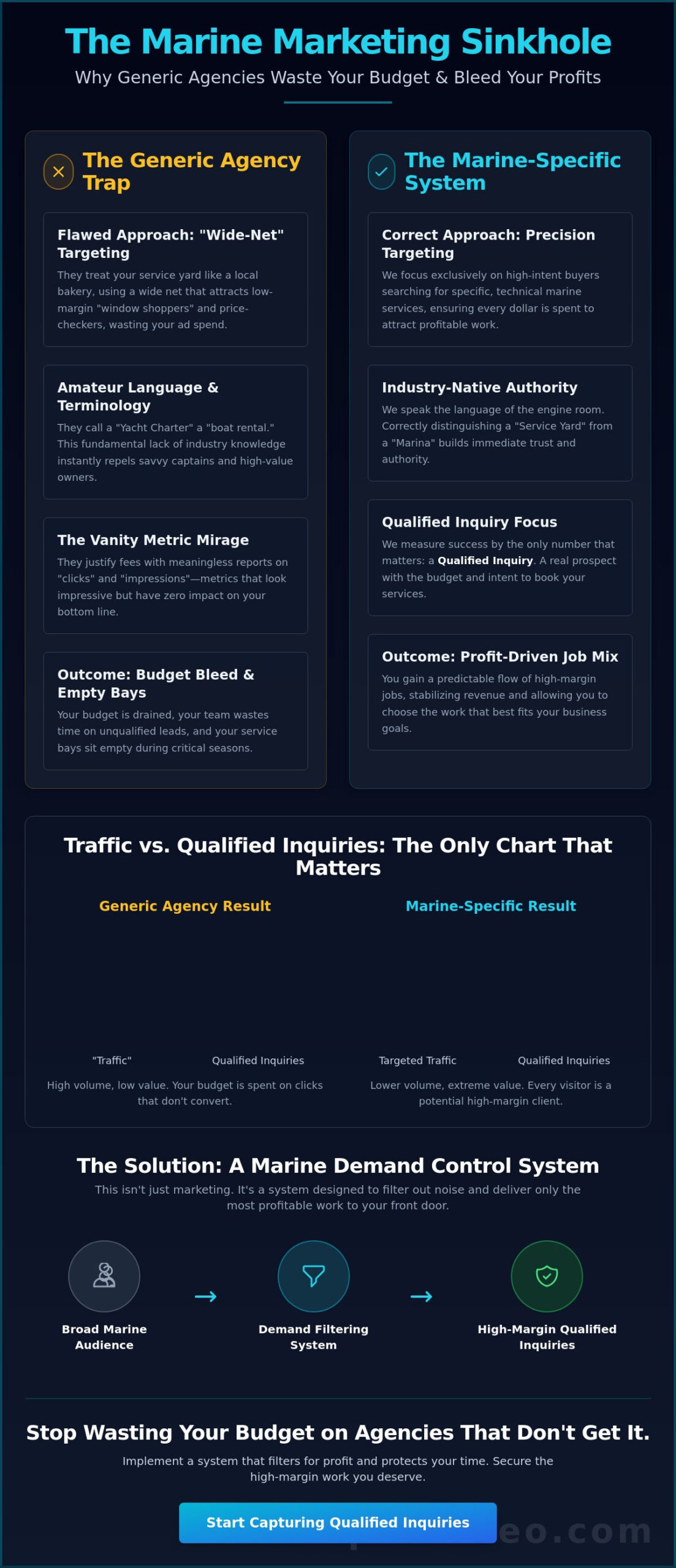
Many agencies will send you a monthly report glowing with upward-trending traffic graphs. They celebrate thousands of visitors while your service bays sit empty and your phone stays silent. This disconnect exists because most providers prioritize volume over intent. It’s a key reason why generic marketing fails marine businesses; it values the number of eyes on a page rather than the quality of the person behind them. You can’t pay your technicians with clicks or impressions.
High volume often leads to high noise. When an agency casts too wide a net, they fill your inbox with unqualified tire-kickers who lack the budget for your expertise. Your staff then spends valuable hours answering basic questions from people who will never book a job. A generalist agency sees this as success because their “lead” count is high. In reality, they’ve just created an administrative burden that drains your operational efficiency.
Why Traffic is a Deceptive Metric
If your agency focuses on broad keywords like “boating tips” or “best fishing spots,” they are attracting hobbyists, not buyers. A yacht owner requiring a structural refit isn’t looking for tips on how to tie a bowline. They’re searching for specific, high-stakes solutions. Vanity metrics look impressive in a slide deck, but they don’t pay for your slips or your insurance. This focus on raw visitor counts is exactly why generic marketing fails marine businesses that need high-intent search queries to thrive.
Filtering for Quality Over Quantity
You don’t need more leads; you need a system that captures a Qualified Inquiry. A general agency wants to fill your inbox at any cost, but a specialist operator wants to protect your time and your margins. We prioritize a Demand Filtering System that uses technical, industry-specific content as a gatekeeper for your sales team. This ensures that only prospects who understand your value and have the intent to buy actually reach out to your office.
Specialized content acts as a filter, answering technical questions upfront and weeding out those looking for “cheap” alternatives. By the time a prospect contacts you, they should already be convinced of your authority. If you want to scale your operations without the headache of managing unqualified noise, refer to our Marine Demand Control Guide. This framework provides the oversight needed to move beyond the vanity metric mirage and focus on tangible financial health.
Implementing a Marine Demand Control System for Growth
Understanding the theory is only half the battle. To stabilize your revenue, you must transition from passive lead generation to an active Marine Demand Control System. This methodology addresses the core reason why generic marketing fails marine businesses; it lacks the operational foresight to manage seasonal shifts and high-stakes job cycles. By treating your marketing as an extension of your logistics, you gain the ability to dial demand up or down based on your current bay occupancy and technician availability.
This is not about casting a wider net. It is about building a filtration system that only allows profitable, high-intent work through the door. Whether you are managing marine mechanics and electricians or a full-scale service yard, your growth depends on your ability to capture the right kind of attention at the right time. Industry-native marketing ensures that your brand appears exactly when a captain or owner is searching for a technical solution to a critical problem.
Capturing Active Buyer Intent
High-value customers are rarely browsing; they are searching with specific intent. They use technical terms like “NMEA 2000 integration” or “hull osmosis repair” rather than broad phrases. Our system uses technical SEO to position your expertise directly in front of these skeptical buyers. By speaking their language from the first click, you establish immediate authority. This strategy converts a searcher into a Qualified Inquiry because you’ve already answered their technical objections before they pick up the phone.
Controlling the Job Mix
Most marine contractors are trapped in a cycle of taking whatever work comes their way just to keep the lights on. A specialized Demand Control System allows you to prioritize high-margin refits and installations over low-margin, emergency repairs that disrupt your schedule. Consistency across your digital touchpoints reinforces this positioning. You cease being a general vendor and become a specialized partner who understands the financial health of your client’s vessel. To see how this system can stabilize your seasonal flow, book a fit call to discuss your operational goals.
Synthesis: Moving Beyond Generic Marketing
Industry-native expertise is not a luxury; it is the fundamental baseline for your business development. Generalist agencies cannot bridge the gap between their retail templates and your technical operations. This is the final word on why generic marketing fails marine businesses: it lacks the technical depth required to convert a skeptical professional buyer. If your marketing partner doesn’t understand the nuance of your specific sector, they are effectively learning the trade on your dime while your competitors capture the most profitable jobs.
You shouldn’t have to explain your own industry to the people responsible for growing it. A specialized strategy ensures that your authority is established before the first phone call even happens. By moving beyond broad tactics, you replace the noise of unqualified leads with a streamlined flow of high-intent inquiries. This shift allows you to regain oversight of your schedule and focus on the high-margin work that actually builds long-term organizational stability.
Expected Results of a Specialized Approach
Transitioning to a niche-specific strategy changes your business from a passive recipient of random traffic to an active operator of demand. You gain the ability to dial your job flow up or down based on your current bay capacity or crew availability. This specialized oversight provides a level of peace of mind that generic agencies simply cannot offer. You stop chasing every low-margin repair just to keep the lights on and start managing a predictable, high-value demand cycle. The long-term ROI of niche expertise far outweighs the short-term volume of generic ad spend.
Next Steps for Marine Business Owners
Audit your current marketing strategy for “generalist” red flags today. If your agency uses vague jargon, reports on meaningless clicks, or requires constant hand-holding to get technical terms right, they are a liability to your financial health. Stop settling for a partner that treats your shipyard like a suburban retail shop. Our Demand Filtering philosophy is designed to protect your time and maximize your margins by speaking directly to the buyers you actually want.
You deserve a marketing system that reflects the precision of your own trade. It is time to implement a framework that prioritizes qualified outcomes over vanity metrics. If you are ready to stabilize your revenue and take command of your market position, Book a No-BS Marine Marketing Analysis. We will identify exactly where your current strategy is bleeding budget and show you how to secure the high-intent inquiries your business requires.
Secure Your Operational Future
Stop settling for marketing partners that force you to teach them the difference between dockage and a technical refit. You’ve seen how terminological precision and a Qualified Inquiry Focus protect your margins and your time. By moving away from vanity metrics and adopting a strategy built on Industry-Native Expertise, you gain oversight of your revenue instead of being at the mercy of seasonal fluctuations. This transition is the only permanent solution to the problem of why generic marketing fails marine businesses that require technical depth.
You now have the framework to move beyond the “feast or famine” cycle that plagues so many service yards and contractors. Implementing a Marine Demand Control System allows you to dictate your job mix and focus on high-margin contracts that build long-term financial health. Your expertise deserves a strategy that matches its precision. Let’s stabilize your growth, filter out the noise, and secure the buyers you actually want.
Book a No-BS Marine Marketing Analysis
Frequently Asked Questions
Is generic marketing bad for boat dealers?
Generic marketing wastes your ad spend by attracting people who aren’t ready to buy or don’t have the budget for your inventory. Broad campaigns often target “cheap boats” or general “boating tips” instead of specific vessel classes like center consoles or sportfishers. This lack of precision forces your sales team to waste hours filtering through low-quality leads instead of closing deals with high-intent buyers.
What is the difference between a lead and a qualified inquiry?
A lead is simply contact information from anyone who clicked an ad, while a qualified inquiry is a prospect with the specific intent and budget for your services. Leads often include tire-kickers and window shoppers who have no intention of booking a structural refit or hiring a marine surveyor. We focus on capturing qualified inquiries because they represent bankable revenue rather than just a name in a database.
Why do most agencies fail to understand the marine industry?
Most agencies operate on a volume model that treats a service yard exactly like a suburban retail shop. They lack the “in the trenches” experience required to understand technical logistics or seasonal job flows. This fundamental niche ignorance is the primary reason why generic marketing fails marine businesses that require precision to maintain their reputation with elite yacht owners.
How does a Demand Filtering System help marine contractors?
A Demand Filtering System acts as a gatekeeper that weeds out low-margin projects before they reach your office. It uses technical content to answer basic questions and verify a prospect’s intent, ensuring your technicians only focus on high-value work. This oversight protects your schedule from administrative noise and stabilizes your revenue by prioritizing your most profitable service lines.
Can I use general SEO for my yacht charter business?
General SEO is ineffective for yacht charters because it often targets “boat rentals,” which attracts a completely different tax bracket. Elite clients searching for a crewed, premium experience use different terminology than casual weekend renters. If your SEO strategy doesn’t distinguish between these service models, you’ll end up paying for traffic that will never convert into a high-value booking.
How long does it take to see results from marine-specific marketing?
Capturing active buyer intent can produce qualified inquiries within the first few weeks, though building long-term authority takes several months of consistent effort. Because we target technical, low-competition search terms instead of broad industry keywords, we bypass the noise of generalist competitors. This focused approach allows you to see a shift in your job mix much faster than traditional, broad-based strategies.
Why is industry terminology so important for marine SEO?
Using the correct technical language establishes immediate authority with both search engines and skeptical boat owners. If your website uses “dockage” when a client actually needs “mechanical maintenance,” you signal a lack of professional depth. Precision in your content is a key factor in why generic marketing fails marine businesses; generalists simply don’t know the vocabulary of the engine room or the shipyard.
What should I look for in a marine digital marketing agency?
You should look for a specialist operator who prioritizes tangible business outcomes over vanity metrics like clicks or impressions. Ensure they understand the technical distinctions of your trade and have a methodical framework for capturing high-intent demand. A partner-based designation is always superior to a traditional vendor relationship because it implies a shared commitment to your organizational stability and financial health.