
Your high-ranking website might be the most expensive liability on your balance sheet. Most boat dealers and yacht charter operators assume that a surge in traffic equals a healthy business, but chasing raw volume often masks the hidden costs of marine SEO that quietly erode your profit margins. If your inbox is full of tire-kickers asking for boat rentals when you only provide crewed charters, you aren’t winning; you’re paying for the privilege of wasting your team’s time.
You probably already know that generic marketing agencies don’t understand the difference between a marine mechanic and a service yard. It’s frustrating to pay premium fees for a strategy that delivers low-intent leads and inconsistent job flow. This guide will show you how to identify the operational drains hidden in your current marketing reports and how to transition to a system that prioritizes high-value, qualified inquiries. We’ll examine why industry literacy is the only way to stop the vanity lead tax and finally stabilize your revenue patterns.
Key Takeaways
- Learn why raw traffic is a vanity metric that often masks a lack of real business growth.
- Identify how the hidden costs of marine SEO manifest as a “vanity lead tax” that drains your team’s billable hours.
- Understand the terminology penalty and how mislabeling a yacht charter as a boat rental repels your high-net-worth prospects.
- Discover the technical debt caused by broken inventory syncs and how they inflate your customer acquisition costs.
- Find out how a Marine Demand Control System uses demand filtering to eliminate operational waste and stabilize your job flow.
The Opportunity Cost of Generic Strategies: Analyzing the Hidden Costs of Marine SEO
Raw traffic is a vanity metric that often hides a lack of real business growth. Most agencies prioritize “visibility” because it is easy to report, but this creates a “PPC Trap” where you over-pay for clicks to compensate for a weak organic foundation. When your website lacks the authority to rank for high-intent terms, you are forced to subsidize your visibility through expensive ad auctions. You aren’t just paying a monthly retainer; you’re paying for the business you aren’t capturing because your site fails to command authority.
In the 2026 market, simply “getting found” is not enough. You must capture high-intent demand through a methodical system that understands the nuances of the water. Generic SEO fails because it lacks Demand Filtering, turning your website into a megaphone for noise rather than a precision tool for profit. This lack of oversight forces your team to waste hours filtering through garbage inquiries. You need a marketing system that functions as a gatekeeper for your business operations, ensuring every visitor has the potential to become a billable client.
The High Cost of Being “Invisible” to High-Intent Buyers
Ready-to-buy customers are efficient and skip past generic, low-authority marine sites that don’t speak their language. Losing a single high-margin Yacht Charter booking can cost your business tens of thousands in net profit. This is the price of being invisible to the right people. Generic agencies fail to target the specific search patterns of marine surveyors and electricians, leaving you invisible to the professional captains and owners who drive your margins. While your traffic numbers might go up, your share of the high-value market remains stagnant.
Why Your Current Traffic Might Be a Liability
High volume often attracts “information seekers” who have no intention of booking a professional service. These DIYers drain your staff’s time and clutter your CRM with data that will never convert into a contract at a Service Yard. Every minute your team spends explaining a process to someone who won’t pay for it is a minute stolen from a billable job. Ignoring these structural issues builds Technical debt that becomes increasingly expensive to resolve as your site grows more bloated. Generic SEO attracts low-margin volume while repelling premium clients.
The “Vanity Lead” Tax: How Unqualified Inquiries Drain Your Margins
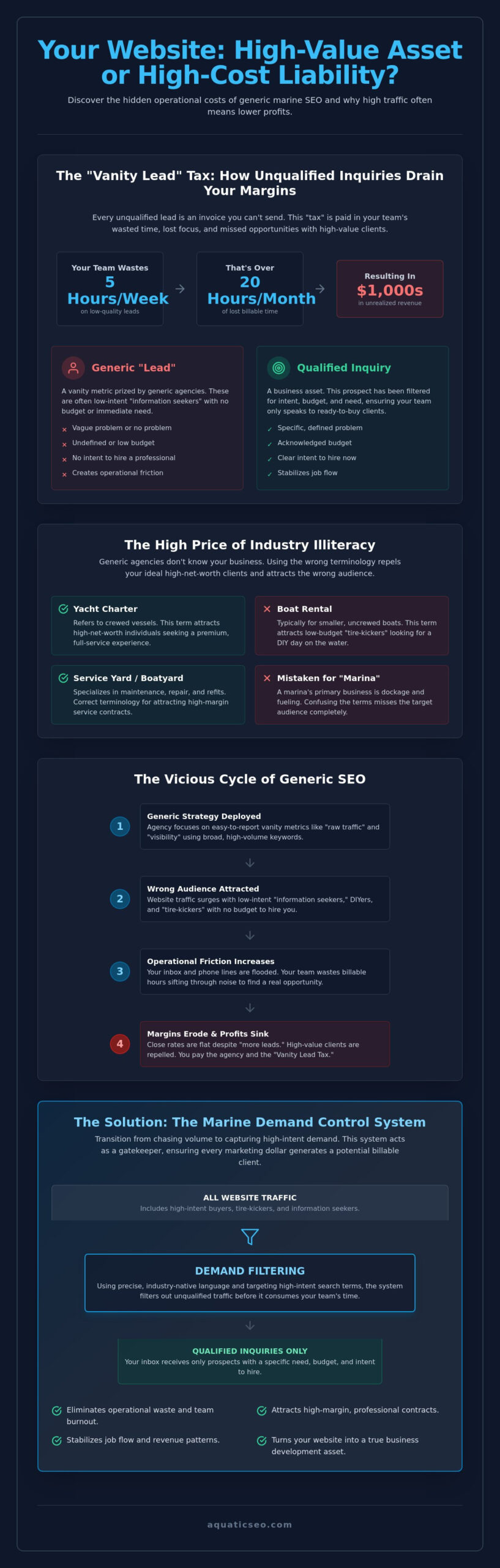
Every unqualified lead is an invoice you can’t send. Generic agencies brag about lead volume because it’s easy to manipulate, but they rarely mention the operational friction that follows. This is one of the most persistent hidden costs of marine SEO. When your inbox is flooded with low-intent noise, your business pays a tax in lost time and missed opportunities.
The math of the “tire-kicker” is simple and brutal. If your service manager spends five hours a week fielding calls for services you don’t provide, you’re losing thousands in billable potential every month. For a Marine Contractor or a busy service yard, “more leads” is often the worst thing that can happen if those leads aren’t vetted. You end up paying an agency to waste your own time.
Operational Friction Caused by Poor Lead Quality
Low-quality leads don’t just cost money; they destroy focus. When your team has to sift through dozens of “Boat Rental” queries just to find one high-margin Yacht Charter inquiry, their efficiency drops. You can identify this agency failure by looking at your close rates. If your traffic is up but your contract volume is flat, your current marketing provider is likely charging you to manage their mistakes.
The Difference Between a Lead and a Qualified Inquiry
Generic SEO prioritizes search volume over buyer intent. This is why Boat Dealers often receive inquiries from people who are months away from a purchase or lack the necessary budget. A Qualified Inquiry is a prospect with a specific problem, a defined budget, and the intent to hire a professional today. Search volume is a vanity metric; intent is a business asset.
Your sales team knows the difference. When they are constantly fed low-quality leads, they grow frustrated and stop following up with the necessary urgency. This morale cost leads to a “death spiral” where even the good inquiries are handled poorly because the team is exhausted by the noise. Our Marine Demand Control System addresses this by installing a filtration layer that removes the vanity lead tax from your operations. You can schedule a fit call to see how a filtration-first strategy protects your team’s billable hours.
The Price of Industry Illiteracy: Why Mislabeling Your Services Repels Buyers
Marine business owners operate in a world of precise definitions. When a generic agency handles your marketing, they often treat your high-ticket offerings like basic commodities. This creates a “Terminology Penalty” where your website loses credibility before a prospect even reads your first paragraph. It is a significant factor among the hidden costs of marine SEO that most owners don’t realize they’re paying until their conversion rates tank.
Precision isn’t just about sounding professional; it’s about signaling that you belong in the premium market. If your digital presence lacks the correct vocabulary, you’re essentially telling high-net-worth individuals that you don’t understand their needs. This industry illiteracy acts as a barrier to entry for the very clients you want to attract.
Yacht Charters vs. Boat Rentals: A Costly Distinction
A high-net-worth individual looking for a crewed Yacht Charter will never click on an ad or link labeled “Boat Rental.” Renters want the cheapest hourly rate for a pontoon; charter clients want a curated experience on a luxury vessel. Generic agencies often use these terms interchangeably to chase higher search volume. This mistake ensures you attract budget-conscious tourists while repelling the premium clients who actually drive your margins. In the 2026 search landscape, using incorrect terminology is a fast track to being categorized as a low-authority site, which keeps you invisible to serious buyers.
Marinas, Boatyards, and Service Yards: Positioning for Profit
The distinction between a dockage-focused marina and a maintenance-focused boatyard is vital for your operational health. Generic SEO strategies often lump these together under “boat services,” which is a recipe for wasted administrative time. A specialized marine mechanic needs to be found by owners facing specific technical failures, not people looking for a place to park for the weekend. Similarly, a Service Yard that gets optimized as a marina will be plagued by calls for transient slips and fuel prices instead of engine refits and hull repairs.
Industry-native terminology is the primary filter for high-value demand. When your content correctly identifies the nuances of marine construction operations or specific surveyor certifications, you build immediate authority. Skeptical owners recognize when a provider speaks their language. This precision reduces the cost of filtering out noise and ensures your visibility is converted into profit rather than just more work for your front desk.
Technical Debt and Integration Failures: The Hidden Tech Costs
Technical failure is a silent margin killer that generic agencies rarely discuss. When your website’s backend is a mess of bloated themes and broken plugins, you pay for it through higher customer acquisition costs and lost sales. These are the hidden costs of marine SEO that manifest as poor site performance and integration gaps. If your site takes five seconds to load on a mobile device, Google will penalize your rankings and charge you more for every click on your ads.
Site speed and clean code directly influence your Google Ad Quality Score. A generic agency might build a “pretty” site that fails the technical requirements of modern search engines. This technical sloppiness forces you to spend more on PPC to maintain the same visibility that a lean, optimized site would get for half the price. You end up subsidizing your agency’s lack of technical expertise with your own advertising budget.
Inventory Syncing and API Nightmares for Boat Dealers
Manual inventory entry is a massive operational drain. If your agency doesn’t understand how to integrate with YachtWorld or BoatTrader APIs, your team is likely wasting hours every week duplicating data. Even worse, losing a buyer because a sold vessel still appears as “available” on your site destroys trust instantly. Effective Digital Marketing for Boat Dealers requires a seamless connection between your local site and major marine portals. When these syncs fail, your website becomes a source of misinformation rather than a sales tool.
The “Refurbishment” Cost of Poor Initial SEO
Fixing a bad SEO foundation costs significantly more than building it correctly the first time. We often see marine businesses paying three times the original investment just to undo the damage caused by “cheap” site builds. Bloated themes and poorly configured redirects create a legacy of technical debt that hampers your growth for years. You can’t just “bolt on” SEO to a broken site; you have to refurbish the entire structure to meet 2026 standards. Before you sign another marketing contract, book a fit call to audit your current technical build and stop the drain on your margins.
The Marine Demand Control System: Eliminating Hidden Waste
You have seen how the hidden costs of marine SEO accumulate through poor terminology, technical debt, and unqualified leads. The solution isn’t to try harder with a generalist; it’s to install a methodical engine designed for the specific logistics of the water. We call this the Marine Demand Control System. It moves your business away from the “hope and pray” model of marketing toward a predictable, auditable framework.
This system functions as a filtration layer for your business. Instead of throwing a wide net and hoping you don’t catch too much bycatch, we target the specific species of client you actually want. This approach turns your website into a precision tool that captures high-intent buyers while actively repelling the tire-kickers. We prioritize functional efficiency over superficial metrics that don’t impact your bottom line.
How We Filter Demand to Protect Your Time
We reject vanity metrics like “impressions” or “engagement” because they don’t pay the bills at a Service Yard. Our mechanism for Demand Filtering ensures that only Qualified Inquiries reach your desk. We use industry-native language and intent-based targeting to qualify prospects before they ever click a call-to-action. This protects your team’s time and ensures your sales efforts are focused on high-margin opportunities.
Specialized agencies outperform generalist firms because we already know your inventory cycles and service constraints. You don’t have to explain the difference between a survey and an appraisal to us. We focus on “job flow control,” ensuring your pipeline remains full of the high-margin contracts that sustain your long-term financial health. Our approach is active and assertive, designed to dismantle the operational waste that generic SEO creates.
Taking Control of Your Job Mix in 2026
A stable demand system gives you the power to be selective. When you have a predictable stream of Marine Contractor Demand Control, you can stop taking low-margin filler jobs just to keep the lights on. This is the “Demand Compounding” effect: as your authority grows, your cost per acquisition drops, and your profit margins expand. You gain the ability to choose jobs that fit your crew’s expertise and your yard’s capacity.
Aquatic SEO operates as a no-nonsense partner for boatyards and dealerships that value outcomes over volume. We provide an auditable marketing engine that gives you the peace of mind to focus on operations rather than lead quality. By eliminating the noise, we help you stabilize inconsistent revenue patterns and build a business that thrives on precision. Stop paying for traffic and start controlling your demand.
Secure Your Margins with a Precise Marine Strategy
Managing a boat dealership or a service yard requires operational oversight that leaves no room for marketing waste. You have seen how generic agencies prioritize vanity traffic that clutters your CRM and burns your team’s billable hours. By ignoring the technical nuances of marine APIs and the psychological triggers of high-net-worth charter clients, these generalists create deep-seated hidden costs of marine SEO that quietly erode your bottom line.
Stabilizing your revenue patterns requires a partner who understands the difference between a marina and a boatyard. Our Marine Demand Control System focuses exclusively on capturing high-intent Qualified Inquiries, ensuring your visibility translates directly into auditable profit. It’s time to stop paying for noise and start investing in a system that filters for quality. You can take the first step toward a predictable job flow today.
Request a No-BS Marine Marketing Analysis to see how we can eliminate operational waste and protect your margins. Let’s build a marketing engine that works as hard as your crew.
Frequently Asked Questions
What is the most common hidden cost of working with a generic SEO agency?
The most significant drain is the operational waste created by processing unqualified inquiries. Generic agencies prioritize raw traffic volume to make their reports look successful, but this floods your inbox with “vanity leads” who have no intent to buy. Your team then spends billable hours vetting tire-kickers instead of closing high-margin contracts. This is one of the most persistent hidden costs of marine SEO that never appears on a standard marketing dashboard.
How does mislabeling a Yacht Charter as a Boat Rental impact my bottom line?
This terminology error repels high-net-worth clients while attracting budget-conscious tourists. A charter client seeking a crewed, luxury experience will immediately lose trust in a site that uses “rental” language. You end up paying for traffic that actively damages your brand authority and fills your pipeline with people looking for the lowest hourly rate. Precision in labeling is the difference between a premium booking and a wasted click.
Can SEO really help filter out tire-kickers and low-quality leads?
Yes, if the strategy prioritizes Demand Filtering over raw visibility. By targeting high-intent keywords and using industry-native qualifiers, your website acts as a gatekeeper. We focus on capturing Qualified Inquiries, which means the prospects reaching your desk already understand your value and are ready to hire a professional. This methodical approach ensures your marketing system removes the noise before it reaches your staff.
Why do Boat Dealers face unique technical SEO challenges compared to other retailers?
Dealerships rely on complex inventory syncs with major marine portals like YachtWorld and BoatTrader. Generic agencies often struggle with these specific API integrations, leading to manual data entry errors or sold vessels remaining “available” on your site. This technical debt creates friction for buyers and can lead to lost sales when high-intent prospects encounter outdated information. A specialized builder ensures your local inventory remains a reliable sales tool.
How much time should my team spend processing inquiries from our website?
Your staff should only spend time on prospects who have already been qualified by your digital presence. If your team spends more than a few hours a week answering basic questions or vetting unqualified leads, your marketing engine is failing. A functional system handles the heavy lifting of qualification, allowing your experts to focus on closing and billable work. Efficiency in lead processing is a direct reflection of your SEO’s quality.
What happens if my SEO agency doesn’t understand the difference between a Marina and a Service Yard?
You will be buried in phone calls for transient slips and fuel prices when you actually need engine refits and hull repairs. Marinas focus on dockage and fueling, while a Service Yard or boatyard focuses on technical maintenance. Lumping these together under “boat services” ensures your team wastes administrative resources on inquiries you cannot fulfill. Industry literacy is required to target the specific job mix that drives your profit.
Is the Marine Demand Control System different from standard SEO packages?
Standard SEO packages focus on “visibility” and “engagement,” which are vanity metrics that don’t guarantee profit. The Marine Demand Control System is a methodical framework designed for job flow control and revenue stabilization. It treats marketing as an auditable business operation rather than a creative project. We prioritize the capture of high-value contracts and the filtration of low-margin noise to protect your team’s time.
How do I know if my current marine marketing is actually wasting my money?
Audit your close rate and the quality of your inquiries rather than your traffic graph. If your website visits are climbing but your net profit remains flat, you are likely paying for generic volume that lacks buyer intent. You should also check your site for “Terminology Penalties” like using general labels for specialized services. If your agency doesn’t speak the language of the docks, they are repelling the premium clients you need.